

TL;DR:
- Philanthropy should be a core element of luxury travel, creating lasting legacy and measurable local impact.
- Planning requires early vetting, local leadership, and clear impact metrics to ensure meaningful projects.
Philanthropy belongs at the center of a bespoke luxury trip, not as an optional add-on, but as a deliberate vehicle for legacy, exclusive access, and measurable local impact. The most discerning travelers today expect their itineraries to generate something lasting. Three things to know before you plan:
- Philanthropic activities convert exclusivity into a personal legacy that outlasts any hotel suite.
- Expect measurable reporting, local leadership, and third-party verification from every partner.
- Planning requires concierge-grade vetting and several months of lead time for meaningful projects.
Programs like Abercrombie & Kent Philanthropy (AKP), verification platforms like Charity Navigator and GuideStar, and advisory firms like Grandglobetrotting are professionalizing this space rapidly. AKP raised a record US$3.3 million in 2025, supporting 80 projects across 27 countries. That figure sets the benchmark every serious traveler and advisor should reference.
Table of Contents
- Why philanthropy is reshaping the luxury travel value proposition
- What philanthropic experiences can you add to a bespoke itinerary?
- How do you vet philanthropic partners before committing?
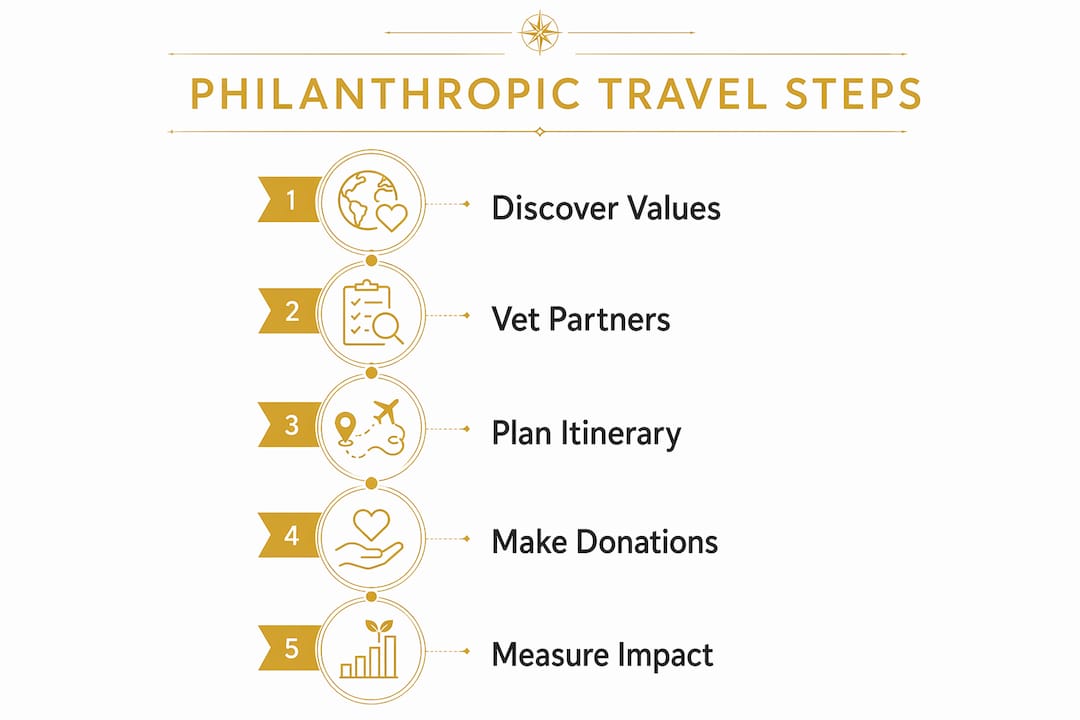
- Step-by-step: how to design a bespoke philanthropic luxury experience
- Cost models, giving mechanics, and U.S. tax considerations
- Measuring impact and reporting: what to demand from your partners
- How do you choose a luxury travel advisor to manage philanthropic experiences?
- What does the AKP 2025 case study show about mature philanthropy programs?
- Key Takeaways
- Why the “add-on” model fails discerning travelers
- Grandglobetrotting: concierge-level planning for philanthropic luxury travel
- Useful sources and further reading
Why philanthropy is reshaping the luxury travel value proposition
Guest expectations have shifted. Affluent travelers are no longer satisfied with passive luxury; they want experiences that feel intelligent and intentional. The traditional gala circuit still has its place, but the demand is now for participatory, embedded giving that produces visible outcomes.
The business case is equally clear. Academic research on hotel firm performance finds that corporate charitable giving has a measurable positive effect on sales growth and return on assets, though with diminishing returns past an optimal level. Operators that integrate philanthropy thoughtfully see stronger guest loyalty and a pricing premium that passive luxury properties struggle to match.
For a high-net-worth traveler, the value proposition shifts on three axes: access to closed communities and private reserves, authenticity that money alone cannot purchase, and a documented legacy that persists long after departure.
What philanthropic experiences can you add to a bespoke itinerary?
The shift from passive to participatory giving has produced a clear set of experience categories. Each suits a different traveler profile and level of involvement:
- Conservation and private reserves. Guests fund anti-poaching units or habitat restoration and may join a collaring expedition or meet resident ecologists. Best for legacy-building over multiple visits.
- Cultural preservation and heritage projects. Private after-hours access to museums or historical sites, paired with a donation to a specific restoration fund. Ideal for one-time, high-impact giving.
- Education and school programs. Visits to funded classrooms, water projects, or feeding programs. AKP’s 2025 work placed clean drinking water access in reach of over 6,400 students and provided daily meals for more than 7,200 children across Kenya, Namibia, Uganda, and Zambia.
- Social enterprise partnerships. Traveling with a luxury brand to its community development or sustainability project, aligning personal values with corporate commitments.
- Charity auction prize creation. Curating a rare travel package as a fundraising lot, generating donations far exceeding the package’s cost. Best for well-connected philanthropists who prefer a force-multiplying strategy.
- Disaster relief and emergency support visits. Structured visits to recovery projects, typically arranged through established operators with in-country staff.
Pro Tip: Conservation safaris and education projects suit legacy-building because they support multi-year funding models. Auction prize creation and cultural preservation donations work well for one-off, high-visibility giving. For HNWIs who value privacy, access-only experiences with a small group or private guide are the most discreet format.
How do you vet philanthropic partners before committing?
Tour operators frequently select charitable projects based on trust relationships and informal judgment rather than formal frameworks. That approach carries real reputational and effectiveness risk for a high-net-worth donor. Insist on local leadership, transparent financials, and measurable KPIs before you commit.
A practical due-diligence checklist:
- Organizational structure. Is the project locally led with a named in-country director?
- Audited financials. Request the most recent audited report. For U.S.-registered charities, confirm 501©(3) status via the IRS database, Charity Navigator, or GuideStar.
- Impact metrics. Distinguish outputs (meals served, trees planted) from outcomes (school attendance rates, income changes). Demand both.
- Multi-year commitment. Locally led, durable programs consistently outperform one-off gestures. Ask how the project is funded between guest visits.
- Cultural sensitivity safeguards. Who reviews program design for unintended harm or dependency risks?
- In-destination impact managers. Operators that hire dedicated impact managers on the ground signal a serious, professionally managed program.
Ask partners directly: How is my donation allocated? Who manages funds locally? Can you provide audited results from the past two years? Clear, prompt answers are the trust signal. Vague responses are the red flag.
Step-by-step: how to design a bespoke philanthropic luxury experience
A meaningful philanthropic itinerary typically requires several months of lead time. Express options exist but limit depth of engagement and partner quality. Here is the framework a concierge team should follow:
- Values and impact discovery. Define the traveler’s priority areas (conservation, education, cultural heritage) and preferred participation level (observer, small-group contributor, funded project sponsor).
- Partner selection and vetting. Apply the due-diligence checklist above. Confirm local governance, audited financials, and KPI frameworks.
- Program design. Agree on deliverables, group size, schedule, and the degree of hands-on participation. Build in flexibility for in-country conditions.
- Legal, tax, and insurance review. Confirm 501©(3) eligibility for any direct donations. Arrange appropriate travel insurance covering philanthropic site visits, and address privacy provisions for donor identity.
- Travel logistics. Coordinate permits, local liaison contacts, in-country staffing, ground transportation, and personalized itinerary planning that integrates philanthropic stops naturally into the broader trip.
- Post-trip reporting and legacy follow-up. Agree on reporting cadence and format before departure.
| Milestone | Typical lead time |
|---|---|
| Values discovery and partner shortlist | 3–4 months before travel |
| Partner vetting and program design | 2–3 months before travel |
| Legal, tax, and insurance review | 6 weeks before travel |
| Logistics finalization and briefings | 2–4 weeks before travel |
| Post-trip impact report (initial) | Within 30 days of return |
| Follow-up reporting | 6–12 months after travel |
Cost models, giving mechanics, and U.S. tax considerations

Costs typically bundle a program fee (covering logistics, in-country staff, and access), a direct charitable donation, and an operational surcharge. Only the direct donation to a qualified charity is tax-deductible in the United States.
Common structures:
- Discrete donation plus program fee. The donation goes directly to the 501©(3) partner; the program fee covers logistics and is not deductible.
- Percentage-of-trip giving. A fixed percentage of the total trip cost is directed to a partner charity. Confirm the charity’s IRS status to establish deductibility.
- Matched funds. The operator or a foundation matches guest donations up to a set amount, effectively doubling impact.
- Donor-advised fund (DAF) flows. HNWIs with an existing DAF at Fidelity Charitable, Schwab Charitable, or a similar sponsor can recommend grants to vetted 501©(3) partners, often with greater flexibility and tax efficiency.
Always obtain written receipts for any direct donation. Ask your advisor to coordinate documentation with your tax counsel.
This article provides general information only, not tax or legal advice. Confirm deductibility and current IRS rules with a qualified tax advisor for your specific situation.
Measuring impact and reporting: what to demand from your partners
Demand outcome-focused KPIs, not just activity counts, and agree on a time-bound reporting schedule before the trip begins. Outputs (number of meals served) matter, but outcomes (school attendance rates, income changes, hectares of habitat restored) are what justify continued investment.
Practical metrics to request:
- Beneficiaries served, disaggregated by age and gender where relevant
- School attendance or literacy rate changes (education projects)
- Hectares restored or species population trends (conservation)
- Maintenance budgets funded and multi-year sustainability plans
- Income or livelihood changes for community participants
Minimum reporting cadence: an initial summary within 30 days of return, a substantive update at 6–12 months, and annual reports for multi-year commitments. For major gifts, commission an independent evaluation from a third-party auditor. Transparent, measurable results are the standard HNWIs should expect, particularly as foreign aid levels fluctuate and travel-funded philanthropy fills growing gaps.
How do you choose a luxury travel advisor to manage philanthropic experiences?
Pick an advisor that combines deep supplier access, in-destination impact managers, and transparent reporting. The best firms embed philanthropy into itinerary design from the first consultation rather than treating it as a late addition. Grandglobetrotting approaches bespoke itinerary design this way, integrating values discovery and partner vetting into the planning process from day one.
Selection criteria:
- Proven project management experience across multiple philanthropic formats
- On-the-ground partners or named impact managers in target destinations
- Verified reporting practice with documented KPIs and post-trip follow-up
- Insurance and risk management coverage for philanthropic site visits
- Respect for donor privacy and discretion throughout
Ask potential advisors: Can you show me a past philanthropic itinerary and its impact report? Who are your in-country partners and how are they vetted? How do you handle donor privacy? An advisor who cannot answer those questions clearly is not ready to manage this category of experience.
What does the AKP 2025 case study show about mature philanthropy programs?
AKP 2025 benchmark: US$3.3 million raised, 80 projects across 27 countries, nearly 550,000 beneficiaries since inception.
Those figures from Abercrombie & Kent Philanthropy’s 2025 reporting illustrate what a professionalized philanthropic arm can achieve at scale. Specific 2025 highlights included approximately $800,000 of medical equipment delivered, school water projects reaching over 6,400 students, and daily meals provided for more than 7,200 children in Kenya, Namibia, Uganda, and Zambia. The program’s longevity and geographic reach are what make it a credible benchmark, not just its dollar total.
For a high-net-worth traveler, AKP’s model signals three things to look for in any operator or advisor: dedicated impact managers, multi-year project commitments, and audited reporting. Use these as minimum standards when evaluating alternatives.
Key Takeaways
Philanthropy integrated from the start of itinerary design, backed by local leadership and measurable KPIs, produces the most durable impact and the most meaningful travel experience for high-net-worth individuals.
| Point | Details |
|---|---|
| Integrate philanthropy early | Build giving into the itinerary from the values-discovery stage, not as a last-minute addition. |
| Insist on local leadership and KPIs | Require audited financials, named in-country directors, and outcome-focused metrics before committing. |
| Plan 3–6 months ahead | Meaningful philanthropic projects need this lead time; shorter windows limit partner quality and depth. |
| Consult tax counsel | Only direct donations to 501©(3)-qualified charities are deductible in the U.S.; document everything. |
| Grandglobetrotting as your advisor | Grandglobetrotting offers concierge-level coordination, partner vetting, and full itinerary integration for philanthropic luxury travel. |
Why the “add-on” model fails discerning travelers
Most operators treat philanthropy as a line item appended to an itinerary after everything else is booked. That approach produces shallow engagement: a brief site visit, a donation receipt, and no follow-up. The travelers who walk away most satisfied are those whose giving was designed into the trip’s architecture from the first conversation with their advisor.
The AKP model works precisely because it is not optional. When philanthropy is assumed rather than elected, participation scales and project quality rises. The same logic applies to any bespoke itinerary: the earlier the values conversation happens, the more precisely the experience can be tailored. Advisors who wait until the itinerary is nearly finalized to raise the philanthropic question risk less tailored client service.
Grandglobetrotting: concierge-level planning for philanthropic luxury travel
For travelers who want their giving to be as carefully planned as their accommodations, Grandglobetrotting offers a full concierge service that covers values discovery, partner vetting, logistics, privacy management, and post-trip impact reporting. Every philanthropic component is built into the itinerary from the first consultation, not attached afterward.
Donor discretion is a priority throughout the process, a principle supported by expert PR and communications partner Bridge PR who specialize in managing narratives around experiential giving for HNWIs. Grandglobetrotting coordinates documentation with your tax counsel and ensures that all partner organizations meet 501©(3) or equivalent verification standards. Whether you are planning a private conservation safari, a school program visit in East Africa, or a cultural preservation experience in Southeast Asia, the planning process begins with your values and ends with a report you can trust.
Start with a personalized planning consultation or explore the VIP travel planning guide to see how a bespoke philanthropic itinerary comes together.
Useful sources and further reading
- Abercrombie & Kent Philanthropy 2025 benchmark (Insider Travel Report) — Primary source for AKP’s 2025 fundraising figures; use for benchmarking mature philanthropic programs.
- AKP project highlights across 27 countries (Kane Bridge News) — Detailed program examples including water access and school feeding; best for impact measurement benchmarks.
- Journeys with a purpose: jet-set philanthropy (APX Luxury) — Industry analysis of how philanthropy shifts the luxury value proposition; recommended for understanding guest demand drivers.
- Philanthropy as a gamechanger in luxury travel (Karryon) — Covers in-destination impact managers and the opt-out giving model; useful for advisor selection criteria.
- Luxury philanthropy: 7 exclusive experiences (The Prestige Edit) — Curated experience archetypes with traveler preference analysis; best for identifying experience types that suit different donor profiles.
- Corporate giving and hotel firm performance (PMC / academic) — Peer-reviewed research on the business case for charitable giving in hospitality; authoritative for the operator-side value proposition.
- Corporate philanthropy and ethical subjectivity (Springer / Journal of Business Ethics) — Academic source on informal, trust-based partner selection risks; essential reading for due-diligence frameworks.
- Inside AKP philanthropic impact (Travel Weekly) — Reporting on transparency and measurement standards; recommended for understanding what HNWIs should demand from operators.
- Travel Elevates — Nonprofit arm of Signature Travel Network; connects travelers and advisors to vetted community projects worldwide; useful for identifying U.S.-based giving programs.
Recommended
At Grand Globetrotting, we don't just plan vacations; we craft extraordinary adventures that leave you with cherished memories. Let us bring your dream vacation to life, perfectly tailored to your style, and immerse yourself in a world of luxury, exploration, and unforgettable moments. Your journey begins with us.
Itinerary planning services require a separate charge outside of cost to book travel accommodations. Depending upon the complexity of the itinerary and the level of effort required to acquire unique experiences, cost may vary. Speak with our team to learn more.
Book your consultation