

Romance travel specialists plan, negotiate, and manage milestone trips end-to-end, from the first discovery conversation through booking, vendor contracts, and on-trip concierge support. The role of romance specialists in travel goes well beyond selecting a resort. These advisors handle group room blocks, legal paperwork for destination ceremonies, supplier negotiations, and real-time problem-solving so couples can stay emotionally present throughout the entire experience. Credentials from organizations like the Destination Wedding & Honeymoon Specialists Association (DWHSA) serve as strong trust signals for high-net-worth clients, and romance travel is recognized as one of the highest-margin niches in the advisory industry. Grandglobetrotting operates in exactly this space, offering concierge-first luxury planning for honeymoons, destination weddings, and the full range of milestone celebrations.
Quick value at a glance:
- Time saved: A specialist replaces dozens of hours of independent research with a curated shortlist built around your specific priorities.
- Stress reduction: Contract review, payment deadlines, and vendor coordination move off your plate entirely.
- Exclusive access: Preferred-supplier relationships unlock room upgrades, spa credits, and VIP amenities unavailable through direct booking.
- Contract protection: A specialist spots reduction dates, cancellation clauses, and penalty terms before you sign anything.
Hiring a specialist pays off most clearly for destination weddings, complex multi-destination honeymoons, group travel with 10 or more guests, and any trip where the emotional stakes are high enough that a logistical misstep would genuinely matter.
Table of Contents
- What romance travel specialists actually do every day
- Which occasions do romance specialists typically plan?
- How romance specialists add measurable value to your trip
- What the planning timeline looks like from inquiry to return
- How romance specialists charge for their services
- Which credentials and trust signals actually matter when vetting a specialist
- When does hiring a specialist make more sense than planning yourself?
- Questions to ask a romance travel specialist before you hire one
- Romance travel demand trends shaping 2025 and 2026
- A Grandglobetrotting case example: what specialist planning delivers
- Key Takeaways
- Why milestone trips deserve more than a search engine
- Grandglobetrotting brings concierge-level care to your milestone trip
- Useful sources and references
What romance travel specialists actually do every day
The core duties of a travel advisor include itinerary planning, transport and lodging coordination, and vendor management. Romance specialists expand that foundation significantly to cover the group and ceremonial logistics that standard advisors rarely handle.

A typical day might include conducting a discovery interview to understand a couple’s travel style, drafting a bespoke itinerary with three destination options, negotiating a group room block with a Caribbean resort, and reviewing a contract’s reduction-date schedule before a client signs. Beyond those planning tasks, specialists manage payment timelines, coordinate guest communications for destination weddings, and provide on-trip concierge support when a flight delay or room issue arises.
The tasks that genuinely require specialist experience are the ones most clients never anticipate:
- Discovery and vision interviews: Structured conversations that surface priorities, budget comfort, and non-negotiables before any research begins.
- Bespoke itinerary design: Curating destinations, resorts, and experiences that match the couple’s style rather than defaulting to popular options.
- Vendor negotiation: Securing group rates, complimentary upgrades, and added amenities through preferred-supplier relationships.
- Group room block management: Setting up, monitoring, and adjusting room blocks as guest RSVPs change.
- Contract review: Reading group contracts for reduction dates, attrition clauses, payment deadlines, and penalty terms.
- Payments and deadline tracking: Managing deposit schedules, final payment windows, and block expiration dates across multiple vendors.
- Guest communications: Answering travel questions from wedding guests, distributing booking links, and coordinating arrival logistics.
- On-trip troubleshooting: Handling flight disruptions, room discrepancies, or vendor no-shows in real time.
The planning phase itself becomes part of the celebration when a specialist removes logistical friction. Couples who are not fielding vendor emails or decoding contract language can focus on the anticipation of the trip rather than the administration of it.
Pro Tip: Ask your specialist to walk you through every reduction date in your group contract before you sign. These are the deadlines by which you must release unused rooms, and missing them can trigger financial penalties or shrink your room block at the worst possible moment.

Which occasions do romance specialists typically plan?
The range of occasions has expanded well beyond traditional honeymoons, and specialists today plan the full lifecycle of romantic and milestone travel. Each occasion has its own logistical profile and the most relevant specialist service shifts accordingly.
- Honeymoon: A couple wants a private overwater villa in the Maldives with a sunset dinner on arrival. The specialist curates three resort options, secures a complimentary room upgrade through a preferred-supplier relationship, and arranges all transfers. For deeper planning guidance, luxury honeymoon planning tips offer a practical starting point.
- Destination wedding: Forty guests traveling to a resort in Riviera Maya. The specialist manages the group room block, reviews the venue contract, coordinates guest booking links, and liaises with the on-site wedding coordinator.
- Elopement: Two people, one remote location, complete privacy. The specialist identifies venues that accommodate intimate ceremonies, handles legal documentation requirements, and arranges private transport.
- Vow renewal: A couple celebrating 25 years wants to recreate their honeymoon destination with upgraded accommodations. The specialist sources the original property, negotiates a suite upgrade, and adds a private dining experience.
- Anniversary trip: A milestone anniversary with a surprise element. The specialist coordinates in-room amenities, a private excursion, and a romantic hotel experience without the client managing a single vendor call.
- Babymoon: A couple in the second trimester wants a relaxing beach escape before the baby arrives. The specialist selects resorts with strong medical facilities nearby and avoids long-haul connections.
- Proposal trip: A partner wants to propose at a specific location with a photographer present. The specialist arranges the venue permit, photographer coordination, and a celebratory dinner reservation.
- Familymoon: A couple with children from previous relationships wants a trip that works as both a honeymoon and a family vacation. The specialist balances adult-only amenities with family-friendly activities at the same property.
Destination weddings frequently overlap with several of these categories at once. A single engagement might include guest travel management, a pre-wedding excursion day, the ceremony itself, and a post-wedding honeymoon extension, all coordinated by one specialist. For more on what that post-wedding experience looks like, post-wedding travel planning covers the options in detail.
How romance specialists add measurable value to your trip
Romance travel is one of the highest-margin niches in the travel advisory industry, and the value specialists deliver is concrete rather than abstract. Certified advisors report higher average commissions per booking, better conversion rates, and faster closing times compared to generalist counterparts.
The measurable benefits fall into several clear categories:
- Time savings: A specialist replaces research that would otherwise span dozens of hours across review sites, resort websites, and travel forums.
- Fewer logistical errors: Missed payment deadlines and misread contract clauses are among the most common and costly DIY mistakes. A specialist tracks every deadline.
- Better upgrades and perks: Preferred-supplier status gives specialists access to room categories, spa credits, and welcome amenities that are not available through direct booking or online travel agencies.
- Faster booking cycles: Clients who work with a specialist move from inquiry to confirmed itinerary more quickly because the research and negotiation phases are handled professionally.
- Higher confidence: Knowing that contracts have been reviewed and contingency plans exist reduces pre-trip anxiety significantly.
Three concrete examples illustrate the difference. A specialist who spots an attrition clause in a group contract can prevent a penalty that might otherwise cost thousands of dollars. A preferred-supplier relationship with a luxury resort chain can yield a complimentary suite upgrade on a $10,000 honeymoon booking. And a specialist who has personally visited a destination can steer a couple away from a resort that photographs beautifully but consistently underdelivers on service, a distinction no algorithm can make.
What the planning timeline looks like from inquiry to return
The timeline for romance travel planning varies by trip type, but the general arc moves through six phases. The table below shows typical durations and key actions at each stage.
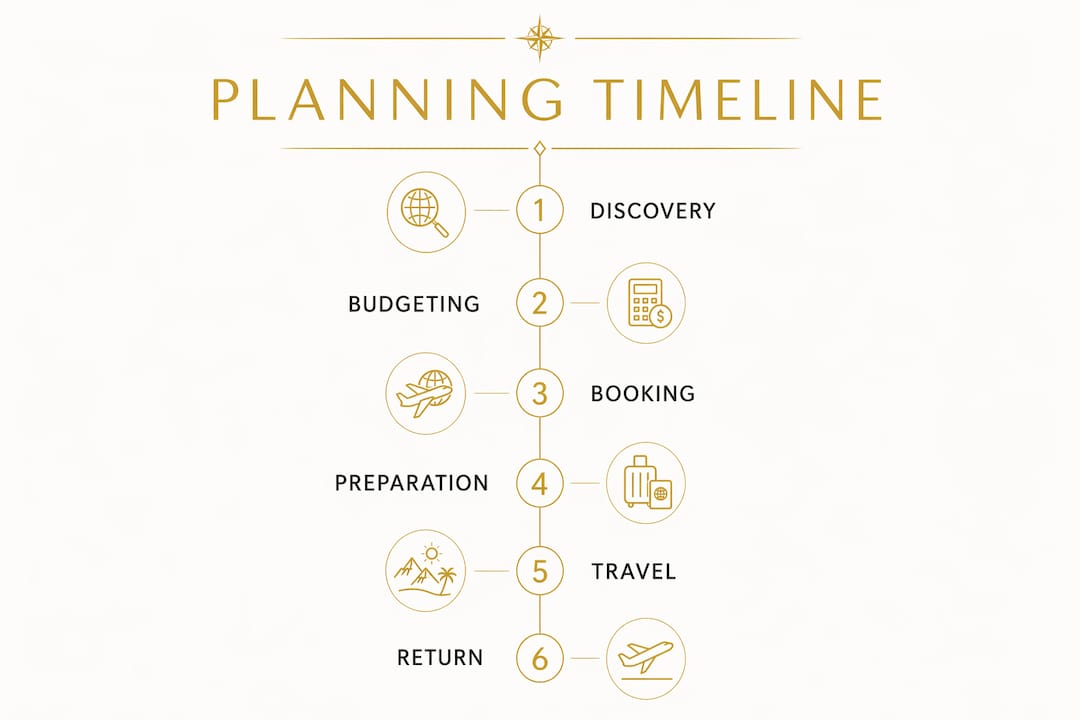
| Phase | Typical Timing | Key Actions |
|---|---|---|
| Discovery | Week 1 | Vision interview, budget alignment, destination shortlist |
| Proposal | Weeks 2–3 | Itinerary draft, resort options, preliminary pricing |
| Booking and deposits | Weeks 3–6 | Signed contracts, initial deposits, room block setup |
| Pre-trip preparation | 60 days before | Final payments, guest communications, document review |
| On-trip support | During travel | Real-time concierge, troubleshooting, vendor liaison |
| Post-trip follow-up | Within 2 weeks of return | Feedback collection, future trip planning, loyalty follow-up |
Booking windows matter as much as the timeline itself. Hotels and resorts at popular destinations often require group contracts 12–18 months in advance, particularly for peak season dates. Cruise cabins in preferred categories sell out 9–12 months ahead. Flights for international destinations are typically best locked in 6–9 months out to secure competitive fares. Venue availability for destination weddings at sought-after properties can disappear even earlier.
For a destination wedding, the inquiry should ideally begin 12–18 months before the ceremony date. A honeymoon with straightforward logistics can be planned in 6–12 months, though earlier always provides more options. A babymoon or anniversary trip with fewer moving parts can sometimes come together in 8–12 weeks, though last-minute bookings sacrifice choice and pricing leverage. The step-by-step honeymoon planning guide offers a detailed procedural walkthrough for couples who want to understand each phase more deeply.
How romance specialists charge for their services
Fee structures vary across the industry, and understanding the models helps couples evaluate whether a specialist’s pricing reflects the value they deliver.
The most common approaches:
- Flat planning fee: A fixed amount charged upfront for the full planning service, regardless of trip cost. This is common for destination weddings and complex multi-destination itineraries where the planning workload is substantial.
- Tiered service packages: Entry, standard, and premium tiers with different levels of service, vendor access, and on-trip support. Couples choose the tier that matches their needs and budget.
- Hourly consulting: Less common for full-service planning, but used for clients who want guidance on specific decisions (destination selection, contract review) without full management.
- Supplier commissions and markups: Many specialists earn commissions from hotels, resorts, and cruise lines. These are built into the supplier’s pricing and do not always appear as a separate line item on the client’s invoice.
- Hybrid models: A planning fee combined with supplier commissions. This is increasingly standard because it aligns the specialist’s incentive with the client’s outcome.
For a $10,000 trip, the math might look like this: a specialist charges a $500 planning fee and earns a 10–15% commission from the resort, which amounts to $1,000–$1,500 paid by the supplier. The client pays $10,500 total, receives a fully managed itinerary, contract review, and on-trip support, and gains access to upgrades and amenities that often exceed the planning fee in dollar value. On a destination wedding where the group room block totals $80,000, the commission structure can generate substantial advisor income while the couple pays no direct fee beyond the initial planning retainer.
Transparency matters here. A reputable specialist will explain their fee structure clearly before any work begins and will disclose whether they earn supplier commissions on your booking.
Which credentials and trust signals actually matter when vetting a specialist
Certification programs differ significantly in what they teach and what they signal. Understanding the distinction helps clients make smarter vetting decisions.
Vendor-neutral credentials focus on legal, logistical, and group-management skills rather than product knowledge for a specific brand:
- DWHSA (Destination Wedding & Honeymoon Specialists Association): The most recognized vendor-neutral credential in the U.S. romance travel space. Signals training in group contracts, destination wedding logistics, and client management.
- ASTA (American Society of Travel Advisors): Membership signals professional accountability and access to industry resources, though it is not romance-specific.
- CLIA luxury credentials: Relevant for specialists who include cruise options in their romance travel portfolio.
Supplier-specific certifications (hotel-brand specialist programs, resort preferred-partner designations) signal deep product knowledge for a particular property or brand. They are valuable for clients whose trip centers on one resort or cruise line, but they do not replace vendor-neutral training in contract law or group logistics.
A practical verification checklist for clients:
- Ask to see a sample itinerary from a comparable trip.
- Request references from past clients with similar trip types.
- Ask how many destination weddings or honeymoons the specialist has planned in the past 12 months.
- Confirm whether they have personally visited the destinations or resorts they are recommending.
- Review their fee and commission disclosure before signing anything.
- Ask about their contingency planning process for flight disruptions or vendor failures.
Published case studies and clear pricing documentation are among the strongest trust signals a specialist can offer. A specialist who hesitates to share either deserves scrutiny.
When does hiring a specialist make more sense than planning yourself?
The decision comes down to five factors: trip complexity, group size, emotional stakes, budget sensitivity, and desire for exclusive access.
A decision checklist:
- Group size over 10: Managing travel logistics for a large group requires professional coordination. DIY group management is one of the most common sources of destination wedding stress.
- Destination wedding or elopement abroad: Legal requirements, vendor contracts, and guest travel management all benefit from specialist experience.
- Budget over $10,000: At this level, the cost of a planning mistake (wrong resort, missed reduction date, no contingency plan) typically exceeds the specialist’s fee.
- Limited planning time: Couples with demanding careers who cannot dedicate 40–60 hours to research and vendor management get the clearest return on a specialist’s fee.
- Desire for exclusive perks: Preferred-supplier access to upgrades, credits, and amenities is not available through self-booking.
For a straightforward two-person honeymoon to a single all-inclusive resort, a confident traveler with time to research might manage adequately without a specialist. For anything involving multiple destinations, a group of guests, a ceremony, or a once-in-a-lifetime budget, the cost-benefit calculation shifts decisively toward professional help.
The luxury travel trends shaping 2026 offer useful context on how demand for specialist services is evolving, particularly for lifecycle celebrations beyond the traditional honeymoon.
Questions to ask a romance travel specialist before you hire one
The interview stage is where couples separate experienced specialists from generalists who have added romance travel to a broader menu of services.
Interview checklist:
- How many destination weddings or honeymoons have you planned in the past year?
- Have you personally visited the destinations or resorts you are recommending for our trip?
- Can you share a sample itinerary from a comparable trip?
- How do you handle group room blocks, and what happens if our guest count changes?
- What does your contract review process look like, and what terms do you flag most often?
- How are you compensated, and do you earn commissions from the suppliers you recommend?
- What is your contingency plan if a flight is cancelled or a vendor fails to deliver?
- Can you provide references from past clients with a similar trip type?
Red flags to watch for:
- Vague or evasive answers about fee structure and commission disclosure.
- Unwillingness to share sample contracts or past itineraries.
- No references available or references who cannot speak to specific outcomes.
- No clear process for tracking payment deadlines and reduction dates.
- A portfolio that shows no firsthand destination experience (no FAM trips, no personal visits).
- Pressure to book quickly without time for contract review.
Negotiation tip: Rather than asking for a lower planning fee, ask what added value the specialist can include at the current price. Experienced advisors often have flexibility on amenities, upgrades, or additional services that cost them little but add meaningful value for the client. Framing the conversation around value rather than price tends to produce better outcomes for both parties.
Romance travel demand trends shaping 2025 and 2026
The romance travel market has expanded well beyond honeymoons into a broader set of lifecycle celebrations, and that shift is creating both opportunity and complexity for couples planning milestone trips.
Key trends shaping the market:
- Lifecycle celebrations: Babymoons, familymoons, and anniversary group trips are now established categories, not niche requests. Advisors who serve clients across multiple life stages capture repeat business that generalists miss.
- Multi-day destination wedding weekends: Couples are increasingly planning two- and three-day wedding experiences rather than single-ceremony events, which multiplies the logistical complexity and the value a specialist provides.
- Anniversary group travel: Milestone anniversaries (10th, 25th, 50th) are generating group bookings that rival destination weddings in size and planning complexity.
- Emerging destinations: Couples are moving beyond saturated markets in Mexico and the Caribbean toward destinations in Europe, Southeast Asia, and Central America, where specialist knowledge of local vendors and legal requirements is even more critical.
The practical implication for couples planning in 2025–2026 is that supplier availability is tighter and booking windows are longer than they were five years ago. Popular resorts in peak destinations are filling group blocks earlier, and the specialists with preferred-supplier relationships are securing the best inventory first. Couples who want off-peak dates, unique venues, or emerging destinations have a genuine advantage if they engage a specialist early, because those options require local knowledge and vendor trust that no search engine can replicate.
A Grandglobetrotting case example: what specialist planning delivers
The clearest way to understand the value of a romance travel specialist is to see what the planning process looks like when it is done well.
Consider a couple planning a destination wedding in the Riviera Maya with 35 guests. Without specialist support, they face: selecting a resort from hundreds of options, negotiating a group contract they have never seen before, coordinating travel logistics for guests arriving from four different cities, tracking payment deadlines across multiple vendors, and managing the inevitable last-minute changes as the date approaches.
With Grandglobetrotting’s concierge-first approach, the process looks different. The specialist conducts a discovery session to understand the couple’s priorities, narrows the resort shortlist to three genuinely compatible options based on group size, budget, and aesthetic, and reviews the group contract before the couple signs. Guest booking links go out with clear instructions, questions are fielded by the specialist rather than the couple, and a pre-trip briefing confirms every logistical detail.
The measurable outcomes from this kind of engagement typically include:
- Planning hours saved: Couples who manage destination wedding logistics independently often spend 60 or more hours on research, vendor calls, and contract review. A specialist absorbs the majority of that workload.
- Upgrades and perks secured: Preferred-supplier relationships routinely yield complimentary suite upgrades, resort credits, or welcome amenities that add tangible dollar value to the trip.
- Fewer contract surprises: Specialist contract review catches reduction dates, attrition clauses, and penalty terms before they become problems.
- Smoother guest experience: Guests who receive clear, professionally managed booking instructions arrive with fewer questions and less friction.
| Outcome | Without Specialist | With Specialist |
|---|---|---|
| Planning hours (couple) | 60+ hours | Under 10 hours |
| Contract clause awareness | Limited | Full review before signing |
| Upgrade/perk access | Public rates only | Preferred-supplier benefits |
| Guest coordination | Managed by couple | Managed by specialist |
| On-trip support | Self-managed | Dedicated concierge |
Grandglobetrotting’s founder Sandon emphasizes that milestone trips deserve the same level of professional attention as any other high-stakes life event. The bespoke itinerary process, vendor relationships, and on-trip concierge support are built specifically to deliver that standard for every client.
Key Takeaways
Romance travel specialists deliver the most measurable value when they manage the full planning arc, from vendor contract review and group logistics to on-trip concierge support, for milestone trips where complexity and emotional stakes are both high.
| Point | Details |
|---|---|
| Start planning early | Destination weddings need 12–18 months; honeymoons need 6–12 months to secure the best inventory. |
| Credentials signal real capability | DWHSA and vendor-neutral certifications cover group contracts and legal logistics, not just product knowledge. |
| Fee structures vary | Flat fees, commissions, and hybrid models all exist; ask for full disclosure before signing anything. |
| Specialist value is concrete | Time savings, contract protection, and preferred-supplier upgrades typically exceed the planning fee in dollar value. |
| Grandglobetrotting’s approach | Grandglobetrotting offers concierge-first luxury planning for honeymoons, destination weddings, and lifecycle celebrations with bespoke itineraries and dedicated on-trip support. |
Why milestone trips deserve more than a search engine
The conventional wisdom in travel planning is that more research produces better results. Spend enough time on review sites, compare enough resort options, and you will eventually arrive at the right choice. That logic works reasonably well for a weekend city break. It breaks down entirely for a destination wedding with 40 guests, a multi-destination honeymoon, or any trip where the emotional weight of the occasion means that a logistical failure is not just inconvenient but genuinely painful.
What most couples underestimate is not the complexity of the planning itself but the cost of the knowledge gaps they do not know they have. A group contract’s reduction dates look like administrative fine print until you miss one and lose a third of your room block two weeks before the wedding. A resort that photographs beautifully can deliver a mediocre experience for a specific group size or travel style. A flight connection that looks fine on paper can strand guests in a hub city with no backup plan in place.
A romance travel specialist’s real value is not the hours they save you, though those matter. It is the mistakes they prevent that you would not have known to avoid. That is a different kind of value, and it is harder to quantify until you see what happens when it is absent. The expert trip support that a specialist provides is most visible precisely when something goes wrong and a solution appears before the couple even knows there was a problem.
Grandglobetrotting brings concierge-level care to your milestone trip
For couples who want their milestone trip planned with the same precision and personal attention they bring to the rest of their lives, Grandglobetrotting offers a concierge-first alternative to generic booking platforms and one-size-fits-all travel packages.
The service covers the full planning arc: bespoke itinerary development, luxury hotel selection and negotiation, private and commercial flight coordination, destination wedding and group logistics, and dedicated on-trip concierge support. Preferred-supplier relationships with leading hotels and resorts translate directly into upgrades, credits, and amenities that are not available through standard booking channels. Every itinerary is built around the couple’s specific priorities, not a template.
Whether you are planning a honeymoon, a destination wedding, a babymoon, or a landmark anniversary trip, the process begins with a single conversation. Visit the travel planning and bespoke itinerary page to request a discovery consultation and take the first step toward a trip that is planned with genuine expertise and personal care.
Useful sources and references
- What Does a Travel Agent Do? | WGU Career Guide — Defines the core duties of travel advisors and provides a baseline for understanding how romance specialists expand the standard role.
- Romance Travel Advisor Certification: Is It Worth It? (2026 Guide) | LOVU Business — Covers the value of romance-specific certifications, the distinction between vendor-neutral and supplier-specific credentials, and the margin profile of the romance travel niche.
- Experts Discuss the State of the Romance Market | TravelPulse — Industry practitioners discuss the expansion of romance travel into lifecycle celebrations and the growing complexity of multi-day destination events.
- Redefining Romance | TravelWeekly — Practitioner perspectives on how removing logistical friction makes planning part of the romantic experience itself.
- Does Dating When Traveling Ever Actually Work Out Long-Term? | DriftTravel — Reports Appinio survey data showing that over a quarter of respondents fell in love while traveling, supporting the persistent demand for romance-oriented travel.
Recommended
At Grand Globetrotting, we don't just plan vacations; we craft extraordinary adventures that leave you with cherished memories. Let us bring your dream vacation to life, perfectly tailored to your style, and immerse yourself in a world of luxury, exploration, and unforgettable moments. Your journey begins with us.
Itinerary planning services require a separate charge outside of cost to book travel accommodations. Depending upon the complexity of the itinerary and the level of effort required to acquire unique experiences, cost may vary. Speak with our team to learn more.
Book your consultation