

TL;DR:
- Privacy is essential in high-end queer travel planning, involving confidential bookings and secure communication controls. Grandglobetrotting integrates operational privacy measures, such as discreet sourcing and coded reservations, to meet strong client demand. Effective privacy enforcement requires comprehensive, documented procedures from booking through post-departure.
Privacy is an operational service layer in queer luxury travel planning, not a courtesy — it means confidential bookings, off-market property access, encrypted communications, and audit-enforced controls delivered by a concierge from the first inquiry through post-departure data deletion. Grandglobetrotting builds this layer into every engagement for LGBTQIA+ travelers who require absolute discretion, and the demand is well-founded: according to Business Insider’s reporting on a Capital One Travel study, 86% of luxury travelers rank privacy and seclusion as top considerations and 83% prioritize exclusivity of access when selecting accommodations.
- Discretion planning session: a pre-booking alignment on authorized contacts, disclosure rules, and breach-response procedures
- Off-market sourcing: access to villas, estates, and properties circulated only through vetted private networks
- Representative booking: reservations routed through a family office, trust, or corporate entity rather than under the client’s name
- Coded guest identifiers: property management systems carry a code, not a name
- Private-arrival logistics: FBO/tarmac access, dedicated transfers, and no public terminal exposure
- Vendor NDAs with operational enforcement: contracts with penalties, not just signatures
- Encrypted communications: end-to-end encrypted channels for all itinerary correspondence
- Data deletion on checkout: documented retention and deletion protocols that close the paper trail
Pro Tip: In your first call with any concierge, ask one direct question: “How will my name appear in the property’s reservation system?” The answer tells you immediately whether privacy is operational or merely promised.
Table of Contents
- Why privacy is a core service demand for high-net-worth queer travelers
- What concrete privacy services should a concierge deliver?
- How is privacy enforced end-to-end across vendors and systems?
- What do privacy-first arrangements typically cost and how far ahead should you plan?
- How do you vet a privacy-first concierge before you commit?
- What does privacy-first delivery look like in practice?
- Key Takeaways
- Privacy as the foundation of bespoke queer travel
- Grandglobetrotting brings privacy-first planning to queer luxury travel
Why privacy is a core service demand for high-net-worth queer travelers
Privacy is a primary service requirement for luxury clients because exposure undermines the entire value of a bespoke trip. For LGBTQIA+ travelers, that calculus is sharper: control over who knows your travel plans, your companions, and your itinerary is not a preference — it is a condition of the experience itself.
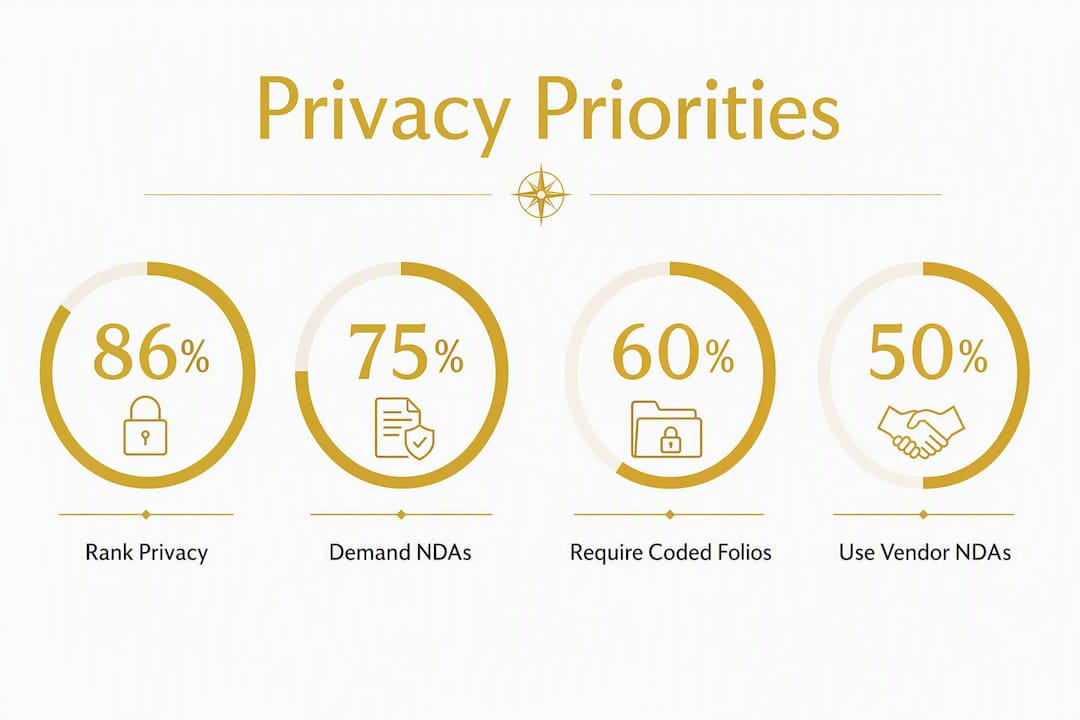
| Privacy Metric | Share of Luxury Travelers |
|---|---|
| Rank privacy and seclusion as top accommodation criteria | 86% |
| Prioritize exclusivity of access | 83% |
Those figures reflect a broader market shift: privacy has become a packaged offering at the top end of the market, with private-arrival packages and privacy-first itineraries now standard expectations rather than bespoke upgrades.
The digital risk vectors have multiplied. Reservation systems, property apps, guest-profile databases, and social-media check-ins all create exposure points that did not exist a decade ago. A single unencrypted folio entry or a staff member’s casual social post can surface a client’s travel plans publicly. For queer travelers who value control over their own disclosure, that exposure is not a minor inconvenience. It is a breach of the experience they paid for.
What concrete privacy services should a concierge deliver?
A concierge turns privacy demands into tasked services and documented operational controls. The checklist below is what a credible provider should be able to confirm in writing:
- Pre-booking discretion planning session with the client, their representative, and the advisor to align on authorized contacts and breach-response rules — a critical pre-booking phase in practitioner guides
- Representative booking via a family office, trust, or shell corporate entity so the client’s name never appears in a public or property-facing reservation
- Coded reservation identifiers in the property management system (PMS) and central reservation system (CRS)
- Vendor and staff NDAs tied to contractual penalties and limited-knowledge briefings
- Off-market sourcing through estate directors, family offices, and yacht/jet broker networks rather than public platforms
- Private-arrival logistics: FBO/tarmac access, private car transfers direct to the property, and no public terminal or lobby exposure
- On-property anonymity controls: separate staff entrances, a dedicated team briefed only on what they need to know
- Encrypted guest communications and device recommendations for the duration of travel
- Data minimization and deletion protocols with a documented timeline for post-departure record removal
- Incident response playbook: a written procedure for detecting, containing, and notifying only the authorized contacts named in the client protocol
Each item should appear in a written client protocol, not just a verbal agreement. Documentation is what makes enforcement possible.
Pro Tip: Ask your concierge to confirm that folio entries at the property use a code, not your name or your representative’s name. Many advisors overlook this final step, and it is where exposure most often occurs.
How is privacy enforced end-to-end across vendors and systems?
Enforceable privacy requires controls at every handoff: booking, operations, on-site, and post-departure. A signed NDA is a starting point, not a solution.
An NDA without operational enforcement is a piece of paper. Effective confidentiality requires limited-knowledge briefings, scope-restricted system access, audit-trail logging, and contractual penalties — all documented before the first booking is made.
Vendor controls are the first layer. Vendor contracts should include staff NDA requirements, scope-limited access to guest details, and explicit financial penalties for breaches. Vendors who refuse these terms are a disqualifying red flag.
Reservation and systems controls form the second layer. Booking via representative entities and using coded identifiers in PMS/CRS systems prevents a client’s name from appearing in any property-facing record. Access roles within those systems should be restricted, internal communications encrypted, and an audit trail maintained showing who accessed guest data and when. Digital security measures — encrypted communications, WPA3 property networks, and the ability to request data deletion under applicable privacy laws — are now standard expectations at the top of the market.

On-site operational checks complete the picture: pre-arrival staff briefings, check-in under coded folios, separate entrances, and a dedicated team. At checkout, guest records should be deleted or archived per the agreed retention policy.
Incident response follows a simple flow: detect the potential breach, contain it immediately, notify only the authorized contacts named in the client protocol, remediate the source, and conduct a post-incident audit. The authorized contact list should be agreed upon during the discretion planning session.
| Control Layer | Key Mechanism |
|---|---|
| Vendor contracts | NDAs + scope-limited access + financial penalties |
| Reservation systems | Coded identifiers + restricted roles + audit trails |
| On-site operations | Pre-arrival briefings + coded folios + dedicated staff |
| Post-departure | Data deletion per documented retention policy |
| Incident response | Detect → contain → notify authorized contacts → audit |
What do privacy-first arrangements typically cost and how far ahead should you plan?
Privacy adds operational costs and lead time. Plan earlier and budget for dedicated sourcing, buy-outs, or premium logistics.
| Arrangement Type | Recommended Lead Time |
|---|---|
| Full property buy-out or off-market villa | 8 weeks |
| Private jet + coordinated yacht/villa package | 4 weeks |
| Simple privacy add-ons to existing bookings | 2–6 weeks |
Private jet and villa/yacht pairings and full property buy-outs require specialized broker relationships and longer lead times because inventory is sourced through private networks, not public platforms. Cost shapes include markups for off-market sourcing, FBO and tarmac fees, NDA and contract administration, additional staffing or security, and the premium for a full buy-out versus an exclusive-wing negotiation.
Peak season, last-minute access, political or destination risk, and bespoke security requirements all extend both timeline and cost. A concierge who quotes a flat fee without accounting for these variables is not pricing the service accurately.
How do you vet a privacy-first concierge before you commit?
Vetting is evidence-based. Request documentation and operational proof, not promises. A credible provider will share materials without hesitation.
- Do you run a formal discretion planning session, and can you walk me through the agenda?
- Can you provide an anonymized sample client protocol showing authorized contacts, disclosure rules, and breach-response procedures?
- How do you handle bookings — representative entity, trust, or direct client name?
- Do you use coded identifiers in property management systems?
- Do vendors sign NDAs with contractual penalties, and can you show sample language?
- What are your audit and access-control procedures for reservation systems?
- Can you provide an anonymized reference and describe a recent incident response example?
- What data retention and deletion steps are implemented after checkout, and is this documented?
Red flags to watch:
- Inability to produce any written protocol or sample NDA
- Insisting that privacy is handled “verbally” or “through relationships”
- Requiring the client’s name in public-facing reservations
- Vendors who refuse NDAs or deletion requests
- No incident response plan
- Reluctance to provide any form of anonymized reference
Validate references by asking for a brief description of the operational controls used in a past engagement, not just a general endorsement. Reputable providers will also share sample NDA language and vendor confidentiality clauses on request.
What does privacy-first delivery look like in practice?
Privacy controls are operational and repeatable. These anonymized illustrations show how the mechanics work across different trip types.
Case A: Off-market villa with private jet arrival. The booking was routed through the client’s family office. The property received a coded folio with no personal identifiers. Arrival was via a private FBO with tarmac-to-car transfer, bypassing the public terminal entirely. All on-site staff signed NDAs before the pre-arrival briefing. Guest records were deleted within 48 hours of departure per the documented protocol.
Case B: Full hotel buy-out for a private event. Every on-site staff member signed an NDA before the event date. A single authorized contact list governed all communications. Guests used a separate entrance throughout the stay, and a dedicated team handled all service requests. No external staff rotations occurred during the booking window.
The most effective privacy protection is delivered via off-market relationships and vetted representative channels — family offices, estate directors, and yacht and jet brokers — that pre-qualify guests before property details are shared.
Case C: Short-notice privacy add-on. A discretion planning call was completed within 24 hours of booking. Coded identifiers replaced the client’s name in the PMS. A vetted private transfer provider handled the arrival, preventing any public exposure at the hotel entrance.
After hearing these examples from your advisor, request three things in writing: the documented client protocol, confirmation that all vendors have signed NDAs, and the arrival logistics plan with named transfer contacts.
Key Takeaways
Privacy in queer luxury travel planning is an operational deliverable — choose a concierge that documents, enforces, and audits it at every stage from booking to post-departure data deletion.
| Point | Details |
|---|---|
| Discretion planning is foundational | Insist on a formal pre-booking session that documents authorized contacts and breach-response rules. |
| NDAs require operational enforcement | Vendor NDAs must be paired with scope-limited access, audit trails, and contractual penalties to be effective. |
| Lead time and budget matter | Full buy-outs and off-market villas require several weeks of planning; budget for sourcing premiums and private-arrival logistics. |
| Vetting is evidence-based | Request anonymized protocols, sample NDA language, and a described incident response example before committing. |
| Grandglobetrotting delivers this service | Grandglobetrotting offers discretion planning, off-market sourcing, representative booking, and private-arrival logistics for LGBTQIA+ luxury travelers. |
Privacy as the foundation of bespoke queer travel
The conventional wisdom in luxury travel is that privacy is a feature — something you add to a trip like a butler or a private pool. That framing misses the point entirely, especially for LGBTQIA+ travelers at the high-net-worth level.
Privacy is not an amenity. It is the precondition that makes every other element of a bespoke trip possible. When a client cannot trust that their travel plans, companions, and itinerary are genuinely confidential, the experience is compromised before the first flight departs. The emotional value of a private villa or an off-market estate is inseparable from the certainty that no one outside the authorized contact list knows you are there.
What the industry often gets wrong is treating an NDA as the finish line. The real work is operational: coded folios, restricted system access, audit trails, vendor briefings, and a documented incident response plan. Those controls are what separate a concierge that takes privacy seriously from one that simply uses the word.
For queer travelers specifically, the stakes of a breach extend beyond inconvenience. Control over disclosure is personal. A concierge who understands that will build the protocol accordingly, not as a compliance exercise, but as a genuine service commitment.
Grandglobetrotting brings privacy-first planning to queer luxury travel
Grandglobetrotting offers something specific to high-net-worth LGBTQIA+ travelers: a concierge service where privacy is planned operationally from the first conversation, not added as an afterthought. The service covers discretion planning sessions, off-market property sourcing, representative booking through trusts or family offices, private-arrival logistics, vendor NDAs with contractual enforcement, encrypted communications, and post-departure data deletion.
To begin, schedule a bespoke itinerary planning consultation and have your representative’s details and an initial authorized contact list ready. Grandglobetrotting’s fee structure includes a planning consultation fee, service markups on sourced properties and logistics, and bespoke buy-out costs for full-property arrangements. For a fuller picture of how the LGBTQIA+ travel planning process works end-to-end, that guide covers the intake, itinerary development, and privacy briefing stages in detail. Reach out directly to discuss lead times and begin your discretion planning session.
Recommended
At Grand Globetrotting, we don't just plan vacations; we craft extraordinary adventures that leave you with cherished memories. Let us bring your dream vacation to life, perfectly tailored to your style, and immerse yourself in a world of luxury, exploration, and unforgettable moments. Your journey begins with us.
Itinerary planning services require a separate charge outside of cost to book travel accommodations. Depending upon the complexity of the itinerary and the level of effort required to acquire unique experiences, cost may vary. Speak with our team to learn more.
Book your consultation