

TL;DR:
- Transformative travel aims to produce durable inner change through intentional challenge and deep reflection. It fosters shifts in perspective, values, and behavior that last well beyond the trip itself.
Transformative travel is intentional travel designed to produce durable inner change: shifts in perspective, values, and behavior that outlast the trip itself, achieved through voluntary challenge, deep reflection, and deliberate post-trip integration. It is not a better vacation. It is a different person coming home.
- Lasting growth, not just rest: transformative trips rewire how you see yourself and the world, not just how rested you feel.
- Worldview shift: exposure to unfamiliar cultures, histories, and ways of living disrupts assumptions you did not know you held.
- Resilience: navigating voluntary difficulty in an unfamiliar environment builds psychological capacity that transfers to everyday life.
- Meaning and purpose: eudaimonic activities, those built around mastery, connection, and contribution, produce well-being gains that outlast the trip far longer than hedonic pleasure does.
The rest of this guide explains the mechanisms behind durable change, the formats most likely to produce it, and a practical three-phase framework for planning a trip that actually delivers.
Table of Contents
- What counts as transformative travel vs. ordinary tourism?
- How does transformative travel produce lasting change?
- What are the main benefits of transformative travel?
- Which travel formats tend to produce the most transformation?
- How do you design a trip that actually transforms you?
- How do you travel ethically and leave places better?
- What does the research say about transformative travel?
- Key Takeaways
- Why transformation is the wrong thing to chase
- How Grandglobetrotting helps you design a trip built for change
- Useful sources and further reading
What counts as transformative travel vs. ordinary tourism?
The Transformational Travel Council defines transformational tourism as travel undertaken and designed for durable inner change: shifts in perspective, values, and behavior that outlast the trip itself. That single phrase, “outlast the trip,” is the dividing line.
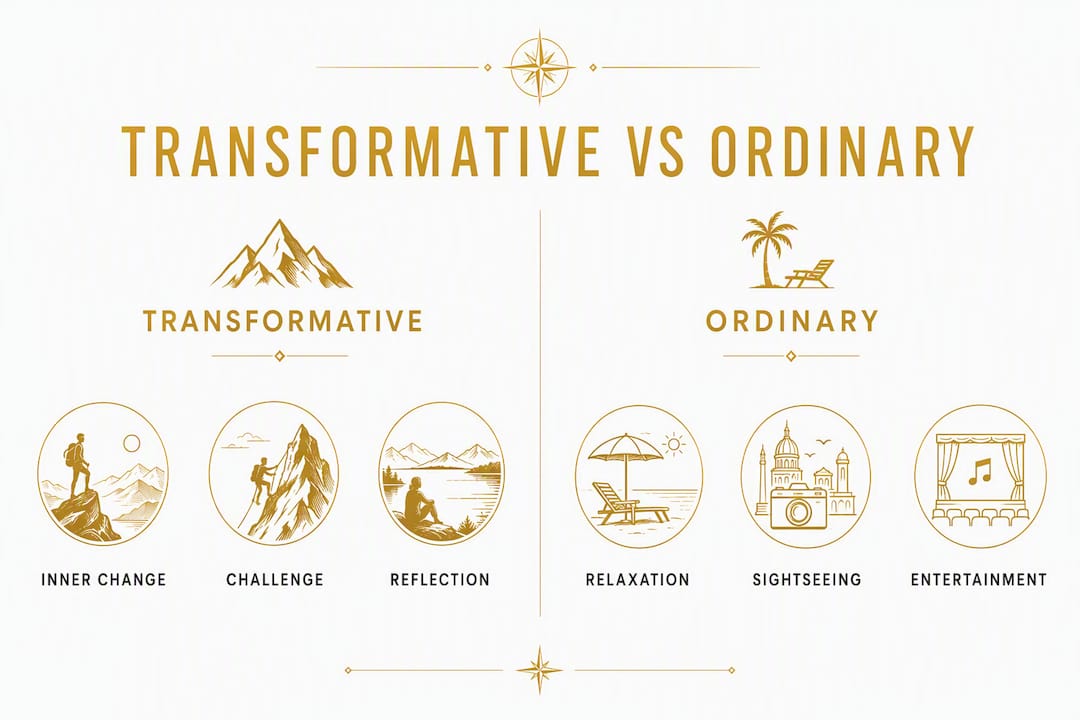
Most travel produces restorative effects. You return less stressed, better rested, and briefly more optimistic. Those gains are real, but they tend to fade within a few weeks. Transformative travel aims at something different: trait change rather than state change. A trait is a stable pattern in how you think, feel, or behave. Changing a trait takes more than a week at the beach.
Five criteria tend to identify trips with genuine transformative potential:
- Readiness: the traveler arrives with an open, reflective mindset and some willingness to be changed.
- Voluntary difficulty: the itinerary includes meaningful challenge the traveler chose, not hardship imposed by poor planning.
- Witnessing: at least one other person, a guide, a fellow traveler, a local host, sees and acknowledges the traveler’s growth.
- Capacity and restoration: the traveler is rested enough to engage fully; exhaustion closes the mind rather than opening it.
- Integration: there is a plan for processing and embedding insights after returning home.
These criteria map cleanly onto real trip formats. A silent meditation retreat in New Mexico checks readiness and reflection. A language-immersion homestay in Oaxaca checks novelty, voluntary difficulty, and witnessing. A multi-day backcountry trek in Patagonia checks challenge, nature, and capacity. None of these is inherently transformative; the design and the traveler’s intention make them so.
| Dimension | Restorative vacation | Transformative trip |
|---|---|---|
| Primary goal | Stress relief, pleasure | Durable inner change |
| Challenge level | Minimal, comfort-first | Voluntary difficulty by design |
| Reflection built in | Rarely | Structured journaling, rituals |
| Post-trip integration | None planned | 30–90 day integration plan |
| Typical benefit duration | Days to weeks | Months to years |
How does transformative travel produce lasting change?
Scholarly reviews confirm that transformative experiences arise from specific triggers: introspection, novelty, challenge, connection with nature, and cultural engagement. These are not random. They activate a chain of psychological processes that, when completed, produce durable change.
The core mechanisms work like this:
- Novelty and arousal: an unfamiliar environment raises alertness and loosens habitual thinking patterns.
- Disorienting dilemma: a moment, an encounter, a realization, that directly contradicts a core assumption about yourself or the world.
- Liminality: the “in-between” state of being away from your normal roles and routines, which creates psychological space for identity revision.
- Social witnessing: having another person acknowledge your growth makes it real and harder to dismiss when you return home.
- Reflective processing: journaling, conversation, or quiet contemplation that converts raw experience into articulated insight.
- Narrative integration: weaving the new insight into your life story so it becomes part of who you are, not just something that happened to you.
These mechanisms interact. Novelty plus challenge creates the disorienting dilemma. Liminality creates the space to sit with that dilemma rather than immediately resolving it. Reflective processing converts the discomfort into insight. Social witnessing anchors the insight. Narrative integration makes it stick.
“Triggers for transformative change include meeting diverse people, observing novel contexts such as confronting inequality or tragic history, spending time in nature, and participating in meaningful activities.” — Frontiers in Sustainable Tourism, 2024
A traveler on a cultural immersion program in rural Japan, for example, might arrive expecting a pleasant cultural experience. On day three, she is asked to participate in a community rice harvest alongside elderly farmers who have worked the same land for decades. The physical labor, the silence, the shared meal afterward, and the realization that her entire professional identity is invisible here, that she is simply a pair of hands and a guest, produces a disorienting dilemma. Her guide facilitates a reflection session that evening. She writes in her journal. A fellow traveler witnesses her articulating the insight. She returns home with a revised sense of what work means to her.
A Scientific Reports study found a significant positive correlation (β = 0.436, p < 0.001) between memorable tourist experiences and subjective well-being, with psychological resilience moderating the relationship. Travelers who arrived with higher resilience extracted more durable benefit from the same experiences. This matters for planning: building capacity before travel, through rest, preparation, and realistic expectations, is not a luxury. It is a prerequisite.

What are the main benefits of transformative travel?
The benefits of transformative travel divide into two categories: immediate state benefits that appear during or just after the trip, and durable trait benefits that persist for months or years. Most travel produces the first kind. Intentional, well-designed travel produces both.
- Perspective shift: exposure to radically different ways of living disrupts the assumption that your own way is the default. This is often the most immediate and visceral benefit.
- Meaning and purpose: travelers who engage in eudaimonic activities, those centered on mastery, contribution, and connection, report a clearer sense of what matters to them. Research distinguishes these eudaimonic gains from hedonic pleasure and finds they tend to last significantly longer.
- Skills and mastery: learning a language, a craft, a culinary tradition, or a navigation skill during travel builds genuine competence that transfers to everyday life.
- Social connection: meeting people outside your usual networks, especially across cultural or economic lines, builds empathy and broadens your sense of community.
- Resilience: navigating unfamiliar environments, managing uncertainty, and solving problems without your usual support structures strengthens adaptive capacity.
- Sustained well-being: eudaimonic activities such as skills, mastery, connection, and meaning deliver longer-lasting well-being than hedonic rest alone.
Statistic callout: A Scientific Reports study found a significant positive correlation (β = 0.436, p < 0.001) between memorable tourist experiences and subjective well-being, with psychological resilience as a key moderator.
The distinction between state and trait benefits is worth holding onto. Feeling inspired on the last day of a retreat is a state benefit. Still living differently six months later is a trait benefit. The design of the trip, and especially what happens after it, determines which you get.
Which travel formats tend to produce the most transformation?
Research confirms that the format of a trip shapes which mechanisms activate and how strongly. Five paths consistently appear in the literature and in practitioner experience.
- Pilgrimage and spiritual retreat: the combination of physical effort, communal ritual, and structured silence creates powerful liminality. The Camino de Santiago, a Vipassana silent retreat, or a guided vision quest in the American Southwest all use this structure. Travelers in life transitions, career changes, loss, or identity shifts, tend to benefit most.
- Cultural immersion and homestay: living with a local family, learning a language, and participating in daily routines rather than observing them from a tour bus activates novelty, social witnessing, and perspective shift simultaneously. Local storytelling deepens this exchange considerably, centering the host community’s narrative rather than the traveler’s gaze.
- Skills and learning travel: a cooking school in Lyon, a ceramics workshop in Kyoto, a sailing course in the British Virgin Islands. Mastery-based travel produces eudaimonic benefits through challenge and competence-building. The skill itself is often secondary to the confidence and focus it generates.
- Service and project-based travel: working alongside a local organization on a project with genuine community buy-in, not a short-term charity drop-in, activates the “shift from consumer to contributor” dynamic that deepens both personal transformation and local benefit. The key word is “alongside”: the traveler supports existing community capacity rather than substituting for it.
- Nature-based quests: multi-day trekking, wilderness solo experiences, or sea kayaking expeditions use physical challenge and natural grandeur to strip away distraction and force presence. Adventure travel of this kind also builds local economies when routed through local guides and outfitters.
Travelers mid-transition, those navigating a major life change, tend to extract the most from all five paths. The disorienting dilemma lands harder when the traveler is already questioning something fundamental.
How do you design a trip that actually transforms you?
The three-phase framework, before, during, and after, is the most reliable structure for maximizing the chances of durable change. A bespoke itinerary built around this arc looks very different from a standard luxury itinerary, even when the destinations overlap.
Before you travel
Clarify your intention. Not “I want to relax” or “I want adventure,” but something specific: “I want to understand why I keep avoiding risk in my career” or “I want to reconnect with what I value outside of work.” Write it down.
Readiness questions to answer before booking:
- Am I traveling toward something or away from something? (Both are valid, but knowing which shapes the design.)
- What level of voluntary difficulty am I genuinely willing to accept?
- Who will witness my growth, during the trip and after?
- What does my integration plan look like?
Practical logistics that support capacity: traveler wellness practices before departure, including adequate sleep, reduced alcohol, and realistic scheduling, matter more than most travelers expect. Arriving exhausted closes the mind.
Pro Tip: Psychological science recommends arriving rested or building rest into the first two days, then layering in voluntary difficulty. Transformation requires an open, alert mind; fatigue is its enemy.
During the trip
Daily journaling prompts:
- What surprised me today, and why did it surprise me?
- What assumption did I bring here that today challenged?
- What did I notice about myself in this unfamiliar context?
- What do I want to carry home, and what do I want to leave behind?
Structure voluntary difficulty deliberately. Choose one activity per day that sits just outside your comfort zone. Not dangerous, just uncomfortable enough to require full attention.
Build witnesses. Tell a guide, a fellow traveler, or a local host what you are working on. Articulating your intention aloud to another person is one of the most reliable ways to make it real.
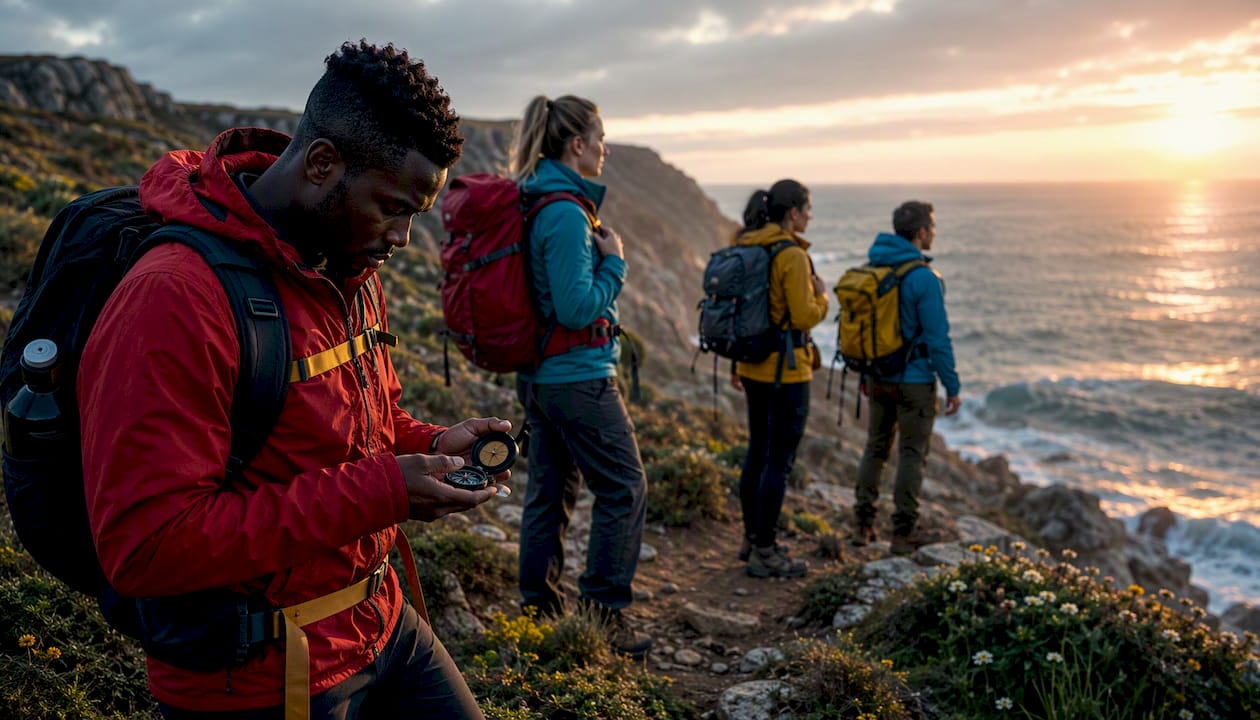
Balance restoration and challenge. Personal preferences and pacing shape how much challenge is productive versus depleting. A day of rest between intense experiences is not a concession; it is part of the design.
After you return
The integration gap is the most common failure point. Travelers return inspired, then slip back into old patterns within two weeks because they have no structure for embedding what they learned.
30–90 day integration checklist:
- Write a 500-word expressive piece within 48 hours of returning, describing the single most significant moment of the trip and what it means for your life going forward.
- Identify your “witness at home,” one person who knows your intention and will check in with you at 30 and 90 days.
- Schedule one new behavior within two weeks of return that reflects your stated intention. Put it in your calendar.
- Revisit your journaling prompts at the 30-day mark and note what has changed.
Pro Tip: Providers who offer post-trip follow-up, a check-in call at 30 days, a curated reading list, or a community of fellow travelers, significantly increase the likelihood of durable change. Ongoing travel support is not an upsell; it is part of the transformation architecture.
How do you travel ethically and leave places better?
The most transformative trips tend to be the most reciprocal ones. Travelers who arrive with the intention to contribute, not just consume, deepen both their own growth and the benefit to host communities.
Do-no-harm checklist:
- Hire local guides, drivers, and fixers rather than importing staff from outside the community.
- Ask before photographing people, especially in ceremonial or private contexts.
- Avoid voluntourism projects that displace local workers or require no local buy-in.
- Research cultural protocols before arrival: dress codes, gift-giving customs, appropriate behavior at sacred sites.
- Pay fair fees. Bargaining aggressively at local markets extracts value from the people least able to absorb it.
Reciprocity actions that deepen community benefit:
- Spend at small, locally owned enterprises rather than international chains.
- Ask your host or guide to recommend where to eat, shop, and tip, then follow through.
- Participate in co-created experiences where the community shapes the itinerary, not just performs for it.
- Share your story afterward in ways that center the community’s narrative, not just your personal transformation arc.
Ethical red flags to avoid:
- Short-term orphanage visits or “poverty tourism” with no community consent or benefit.
- Wildlife experiences that involve captive animals trained through stress.
- Projects framed as charity where the primary beneficiary is the traveler’s Instagram feed.
Reciprocity also improves the quality of transformation. Travelers who contribute to a community rather than observe it activate the “shift from consumer to contributor” dynamic, which is one of the most reliable triggers for durable identity change.
What does the research say about transformative travel?
The evidence base for transformative travel is growing, though it carries important caveats.
Statistic callout: A Scientific Reports study found a significant positive correlation (β = 0.436, p < 0.001) between memorable tourist experiences and subjective well-being, with psychological resilience moderating the relationship. Travelers with higher resilience extracted more durable benefit from the same experiences.
The Transformational Travel Council’s working definition anchors the field: travel designed for durable inner change, not a better vacation but a different person coming home. This framing draws on Jack Mezirow’s transformative learning theory, which identifies disorienting dilemmas, critical reflection, and rational discourse as the three steps through which adults revise core assumptions. Travel is one of the most reliable environments for triggering all three simultaneously.
A 2024 Frontiers in Sustainable Tourism review confirmed that transformative experiences arise from specific, designable triggers: introspection, novelty, challenge, nature connection, and cultural engagement. Research on hedonic versus eudaimonic well-being consistently finds that purposeful, growth-oriented activities produce longer-lasting gains than pleasure-based rest alone. A SAGE review integrating consumer and managerial perspectives found that providers can design touchpoints and reflection moments that catalyze transformation, improving outcomes for travelers and competitiveness for operators.
Limitations the research is honest about:
| Limitation | What it means for travelers |
|---|---|
| Fade-out effect | Hedonic benefits (mood, energy) typically fade within weeks without integration |
| Rarity of guaranteed transformation | Not every intentional trip produces durable change; readiness and design both matter |
| Integration gap | Most travelers return without a structured plan; this is the most common failure point |
| Resilience dependency | Travelers with lower baseline resilience may need more structured support to extract durable benefit |
Most travel produces temporary restorative effects; transformation is rarer and depends heavily on what happens in the 30–90 days after return. That is not a reason to avoid it. It is a reason to plan it properly.
Key Takeaways
Transformative travel produces durable inner change when trips are designed with clear intention, voluntary challenge, and a structured integration plan covering the 30–90 days after return.
| Point | Details |
|---|---|
| Definition matters | Transformative travel targets trait change, not just state restoration; the design and integration plan make the difference. |
| Three-phase framework | Before (intention and readiness), during (reflection and voluntary difficulty), and after (integration plan) are all required. |
| Resilience moderates outcomes | A Scientific Reports study found β = 0.436 (p < 0.001) linking memorable experiences to well-being, with resilience as a key moderator. |
| Reciprocity deepens transformation | Travelers who contribute to host communities rather than consume them activate the most reliable triggers for durable identity change. |
| Grandglobetrotting’s role | Grandglobetrotting designs bespoke itineraries built around the before/during/after framework, with vetted local partners and post-trip support. |
Why transformation is the wrong thing to chase
The most common mistake travelers make when pursuing personal growth through travel is treating transformation as a destination rather than a byproduct. They book the retreat, pack the journal, and arrive with a checklist of insights they expect to collect. That posture, acquisitive, goal-oriented, slightly transactional, is precisely what prevents the disorienting dilemma from landing.
The research is clear that transformation arises from genuine disruption of core assumptions. You cannot manufacture that disruption by wanting it hard enough. What you can do is design conditions that make it more likely: arrive rested, choose voluntary difficulty, build in reflection time, and find a witness. Then let the place do its work.
There is also a tendency in the personal-growth travel space to overweight the dramatic. The rice harvest moment, the summit at dawn, the conversation with a stranger that changes everything. These moments are real, but they are not the mechanism. They are the trigger. The mechanism is what you do with the discomfort afterward, in the journal, in the conversation with your witness, in the first two weeks back home when the old patterns reassert themselves and you have to choose, consciously, to act differently.
The travelers who report the most durable change are rarely the ones who had the most intense experiences. They are the ones who had a plan for what to do when they got home.
How Grandglobetrotting helps you design a trip built for change
Planning a transformative trip is not the same as booking a great vacation. The before/during/after framework this guide describes requires a level of intentional design that most standard booking platforms are not built to provide.
Grandglobetrotting’s bespoke travel planning service is built around exactly this kind of intentional design. The process begins with a consultation that clarifies your intention, readiness, and the type of voluntary difficulty that fits your goals. From there, a custom itinerary is developed that balances restorative comfort with purposeful challenge, selects vetted local partners who understand the value of witnessing and co-creation, and builds in structured reflection moments throughout the trip. Post-trip, Grandglobetrotting offers follow-up support to help you close the integration gap, the most common failure point in transformative travel. This is a paid advisory service, and the investment reflects the depth of design and ongoing support involved. If you are ready to plan a trip built for durable change, start with a consultation.
Useful sources and further reading
- What Is Transformational Tourism? Definition & Meaning — (Transformational Tourism) — The authoritative working definition of transformational tourism; essential starting point for understanding the field’s boundaries and goals.
- What Is Transformative Travel? (Transformational Travel Council) — The Transformational Travel Council’s own framing of intentional travel; useful for understanding the practitioner perspective and the “leave places better” principle.
- Transformative experiences in tourism: where, when, with whom, and how — (Frontiers in Sustainable Tourism, 2024) — Peer-reviewed review identifying the triggers and conditions for transformative experiences; the strongest academic source on mechanisms.
- The relationship between memorable tourist experiences and subjective well-being — (Scientific Reports) — Quantitative study (β = 0.436, p < 0.001) linking memorable experiences to well-being and identifying resilience as a moderator.
- How to maximise the mental health benefits of your vacation — (New Scientist) — Accessible summary of hedonic vs. eudaimonic well-being research; practical guidance on which activities produce lasting mental health benefits.
- Eudaimonic vs. hedonic well-being in tourism (SAGE Journals) — Academic review confirming that mastery, connection, and meaning-based activities deliver longer-lasting well-being than pleasure-based rest.
- Frontiers in Psychology: Meaningful tourism experiences and posttraumatic travel — Examines how reflective tourism experiences foster gratitude and multidimensional well-being after major life disruption; relevant for travelers in transition.
Recommended
At Grand Globetrotting, we don't just plan vacations; we craft extraordinary adventures that leave you with cherished memories. Let us bring your dream vacation to life, perfectly tailored to your style, and immerse yourself in a world of luxury, exploration, and unforgettable moments. Your journey begins with us.
Itinerary planning services require a separate charge outside of cost to book travel accommodations. Depending upon the complexity of the itinerary and the level of effort required to acquire unique experiences, cost may vary. Speak with our team to learn more.
Book your consultation