
Structured bleisure travel, meaning business trips extended with planned personal days, tends to improve job performance when managed correctly. A peer-reviewed field study of 400 respondents found that active, engaging leisure experiences were a stronger driver of improved job performance than passive rest alone. For managers, the single most important first step is formalizing a written policy that defines what qualifies as bleisure, splits expenses clearly, and sets a measurement cadence. Without that structure, the productivity gains are real but inconsistent, and the compliance risks grow quickly.
Key Takeaways
Structured bleisure travel, anchored by active leisure and a formal policy, consistently improves post-trip engagement and performance when employers provide clear boundaries, expense rules, and measurement.
| Point | Details |
|---|---|
| Active leisure drives gains | Engaging experiences outperform passive rest as a performance driver, per peer-reviewed research. |
| Policy awareness gap is critical | ~64% of companies have bleisure policies, but employee access awareness varies widely. |
| Equity and compliance risks are real | Unequal access and insurance gaps require explicit policy guardrails before any extension is approved. |
| Measure with a defined cadence | Use pre/post engagement scores, deliverable completion, and willingness-to-travel surveys at 30 and 90 days. |
| Grandglobetrotting structures the full trip | Bespoke itinerary design, vetted hotel selection, and concierge support deliver productive executive bleisure. |
First three actions to take this week:
- Draft a one-page bleisure policy defining scope, expense split rules, and the approval workflow, then share it with HR for compliance review.
- Send a brief pulse survey to employees who have traveled in the past quarter asking whether they were aware of any bleisure option and whether they would have used it.
- Schedule a 30-minute review with your travel management partner to confirm that your corporate travel insurance addresses the duty-of-care boundary between business and personal trip days.
Table of Contents
- How does bleisure travel affect productivity at work?
- What are the real benefits for employees and employers?
- When bleisure can hurt productivity and what to watch for
- How to design a corporate bleisure policy that protects productivity
- How to measure productivity and ROI from bleisure programs
- How Grandglobetrotting structures bleisure for executives
- Why structured bleisure is worth championing
- Grandglobetrotting’s corporate bleisure planning services
- Sources
How does bleisure travel affect productivity at work?
The research points to a specific mechanism: arousal, not relaxation, is what drives performance gains. The PAD (pleasure-arousal-dominance) framework study found that employees who engaged actively with their destination, through short excursions, cultural experiences, or physical activity, returned to work tasks with measurably better output than those who simply rested. Passive leisure, such as lying by the pool between meetings, produced weaker effects. This distinction matters for policy design: a bleisure program built around recovery alone will underdeliver.
Role-switching is the primary cognitive cost. When an employee shifts from a client dinner to a sunset hike and then back to a morning deliverable, the brain pays a tax each time. Forbes reporting on blended travel recommends structured daily rituals, such as a scheduled morning workout or a protected offline hour in the evening, to reduce that switching cost and preserve cognitive capacity for work obligations. Without those rituals, unstructured leisure can actually increase stress rather than reduce it.
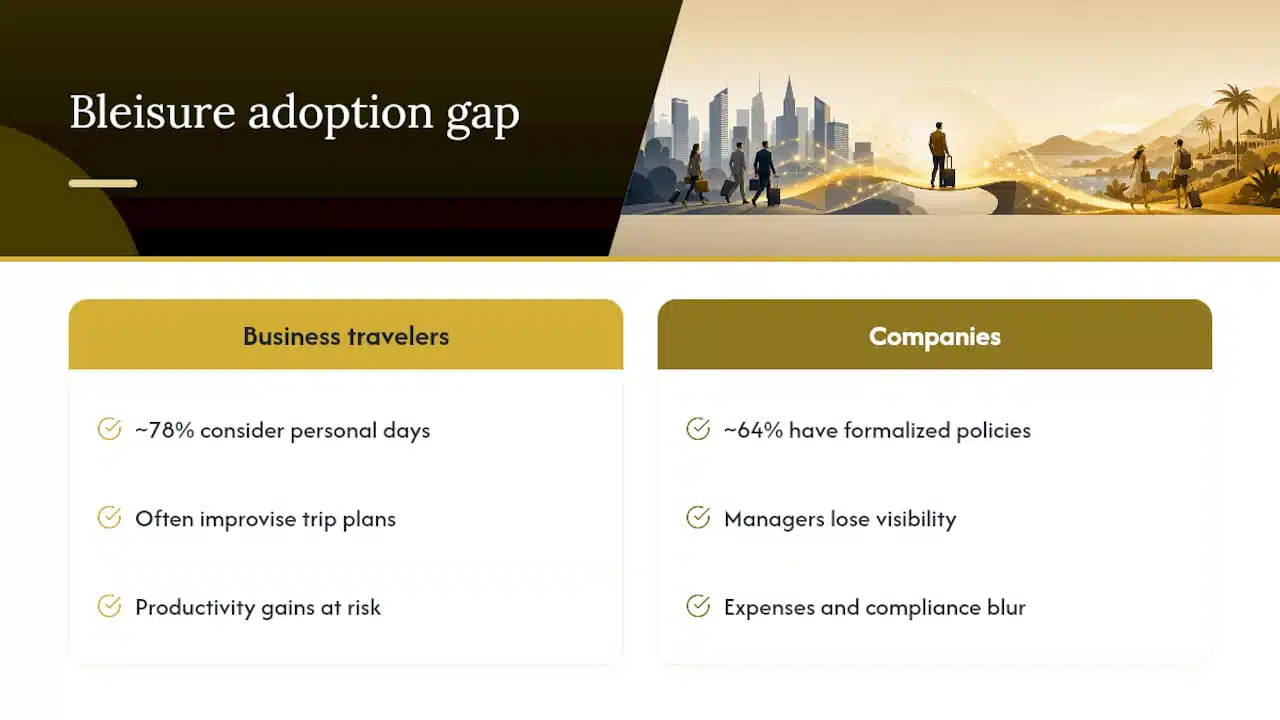
Adoption is rising faster than policy awareness. Industry benchmarking shows that ~78% of business travelers now consider adding personal days to work trips, while ~64% of companies have formalized bleisure policies. That awareness gap is where productivity gains get lost: employees improvise, expenses blur, and managers lose visibility into outcomes.
Property selection also shapes results. Hospitality industry analysis from HSMAI shows that hotels adapting to bleisure demand, specifically those offering fast connectivity, quiet workspaces, and wellness amenities, are better positioned to support travelers who need to perform at both ends of the trip. A property that cannot offer reliable Wi-Fi and a restorative spa in the same building forces the traveler to choose between productivity and recovery. Leisure travel trends confirm that travelers increasingly expect both in a single stay.
One honest limitation: most existing studies draw from specific regional or professional populations, and sample sizes remain modest. The evidence is directionally strong but not yet definitive across all industries and demographics.
What are the real benefits for employees and employers?
The bleisure travel benefits split neatly into two columns, and each maps to a KPI your HR team can track.
Employee benefits:
- Reduced burnout, measured through post-trip engagement scores and absenteeism rates in the 30 days following travel
- Higher job satisfaction, captured via pulse surveys comparing bleisure travelers to non-travelers on the same trip cycle
- Greater willingness to travel for work, which directly reduces the cost and friction of filling future trip assignments
- Improved work-life integration, particularly for employees who travel frequently and struggle to maintain personal routines
Employer benefits:
- Retention advantage: formalized bleisure policies correlate with improved retention and engagement, giving companies a concrete differentiator in competitive hiring markets
- Cost-per-trip efficiency: when an employee extends a trip by two personal days, the company’s airfare and base hotel costs are already sunk, so the incremental cost to the employer is near zero while the employee captures significant personal value
- Recruitment signal: a published bleisure policy signals a culture of trust and flexibility, which resonates with high-performing candidates who have options
Pro Tip: Track willingness-to-travel scores separately for employees who have used your bleisure policy versus those who have not. A consistent gap is a compelling data point for your next budget conversation.
Traveler wellness programs that incorporate bleisure principles also tend to reduce the health-related productivity losses that accumulate across frequent business travel cycles.
When bleisure can hurt productivity and what to watch for
Not every bleisure trip delivers a net gain. The risks cluster around three areas: cognitive load, equity, and operational compliance.
Cognitive and stress risks. Unstructured leisure, particularly when the employee has no clear boundary between work hours and personal time, tends to increase rather than decrease anxiety. A traveler who checks email during a museum visit and answers Slack messages from a restaurant table never fully recovers. Academic regional studies document this pattern: bleisure improves satisfaction when managerial support is present, but without it, the blending of roles can accelerate burnout rather than prevent it.
Equity and access concerns. Bleisure is not equally available to all employees. Those with caregiving responsibilities, visa constraints, or roles that require immediate return often cannot extend trips. If your policy implicitly favors employees who can stay longer, it may disadvantage groups that are already underrepresented in senior roles. A thesis-level literature review on bleisure impacts flags demographic variability as an underexplored gap: the benefits are not uniformly distributed, and policies that ignore this risk compounding existing inequities.
Operational and compliance risks. Expense misuse is the most common operational problem. Without a clear split between corporate-paid business days and employee-paid personal days, receipts blur and audits become difficult. Insurance and duty-of-care coverage typically apply only during the business portion of a trip; an employee injured during a personal extension may not be covered under standard corporate travel insurance. GBTA guidance specifically recommends that companies address duty-of-care boundaries in writing before approving extended trips.
Pro Tip: Before approving any bleisure extension, ask three questions: Does the employee’s role allow a clean handoff during personal days? Is the destination covered under your corporate travel insurance for the business portion only? And has the employee confirmed personal coverage for the extended stay?
How to design a corporate bleisure policy that protects productivity
A written policy is the single highest-leverage action a manager can take. Here is a practical blueprint.
Policy scope and booking rules
- Define what counts as bleisure: personal days added immediately before or after a confirmed business trip, at the same destination or within reasonable proximity.
- Require all bleisure extensions to be declared at the time of booking, not after the fact.
- Specify that the business-class or corporate-rate airfare applies only to the business-trip dates; any fare differential for altered return dates is the employee’s responsibility.
- Set a maximum personal extension: most companies use two to four days as a practical ceiling before duty-of-care and productivity risks increase meaningfully.
- Require employees to confirm personal travel insurance coverage for the leisure portion before departure.
Expense split rules
- Corporate pays: flights booked at the standard business-trip rate, hotel nights during business days, ground transportation to and from business venues.
- Employee pays: hotel nights during personal days, all meals and activities during the personal extension, any fare premium caused by the altered return date.
- Split receipts: when a hotel stay spans both business and personal nights, the employee submits the full folio and marks personal nights clearly. Finance reimburses only the business nights at the corporate rate.
Approval workflow
The direct manager approves the bleisure request, confirming that deliverables are covered during personal days and that the extension does not conflict with team obligations. HR or travel management reviews insurance and duty-of-care compliance. A simple email confirmation with the trip dates, business days, and personal days documented is sufficient for most organizations. Business travel best practices recommend documenting this approval in the same system used for expense reporting to create a clean audit trail.
Communication and post-trip documentation
Managers should set clear deliverable expectations before the trip, not during the personal extension. After the trip, a brief check-in within 48 hours of return captures any issues while the experience is fresh and establishes a feedback loop for policy refinement.
How to measure productivity and ROI from bleisure programs
Measurement is where most bleisure programs stall. Without a baseline and a defined cadence, the data is anecdotal.
Sample KPIs to track:
- Pre/post engagement scores (pulse survey, same cohort, 30 days before and after travel)
- Deliverable completion rate during the trip week versus a non-travel baseline week
- Voluntary turnover rate among frequent travelers, segmented by bleisure policy users versus non-users
- Time-to-fill for roles that require frequent travel, comparing periods before and after policy launch
- Employee-reported willingness-to-travel score, collected quarterly
Mini survey template (send within 48 hours of return):
- On a scale of 1 to 5, how energized do you feel compared to before the trip?
- Did the personal extension help you feel more positive about the upcoming work week?
- Were the expense and approval processes clear and easy to follow?
- Would you use the bleisure policy again on a future trip?
- Is there anything that would have made the experience more productive?
| KPI | Measurement method | Data source | Reporting cadence |
|---|---|---|---|
| Engagement score delta | Pulse survey (pre/post) | HR platform or survey tool | Per trip, aggregated quarterly |
| Deliverable completion | Manager review vs. baseline | Project management system | Per trip |
| Voluntary turnover (travelers) | Headcount tracking | HRIS | Quarterly |
| Willingness-to-travel score | Quarterly pulse | HR survey | Quarterly |
| Time-to-fill (travel roles) | Recruiting data | ATS | Semi-annual |
Industry adoption benchmarks suggest that the awareness gap between policy existence and employee knowledge is itself a measurable KPI: if fewer than half your eligible employees can describe how to request a bleisure extension, the policy is not functioning as designed.
How Grandglobetrotting structures bleisure for executives
The operational difference between a productive bleisure trip and a stressful one often comes down to how the itinerary is designed before departure. When Grandglobetrotting structures executive bleisure, the approach controls three axes: timing, environment, and communication.
A typical executive itinerary might look like this: two days of client meetings and conference sessions, followed by one structured leisure day featuring a curated morning activity (a private culinary tour or a guided coastal hike) and an afternoon of protected offline time, then a final travel day with a late checkout and airport transfer coordinated to avoid the post-trip scramble. Business deliverables are confirmed before the leisure window opens. The leisure day is scheduled, not improvised.
Property selection is not incidental. Grandglobetrotting selects hotels that can simultaneously deliver conference-ready connectivity and restorative wellness environments, because a property that excels at one but not the other forces the executive to compromise. Must-have business travel amenities for this profile include reliable high-speed Wi-Fi in guest rooms, a quiet workspace separate from the bedroom, and on-site wellness facilities that do not require advance booking. Private villa options offer an additional layer of separation between work and leisure environments that standard hotel rooms cannot replicate.
Pro Tip: When selecting a property for an executive bleisure trip, ask the hotel directly whether the wellness facilities require advance booking and what the peak-hour wait times are. A spa that is fully booked during the only free afternoon defeats the purpose.
The concierge layer handles duty-of-care integration: insurance documentation is confirmed before departure, the approval chain is documented, and a single point of contact is available throughout the trip. Employers who use this model report that the time saved on logistics planning, typically several hours per trip, is itself a measurable productivity return. Curated activity selection for the leisure window ensures the experience is active and engaging rather than passive, which aligns directly with the arousal mechanism the research identifies as the primary driver of post-trip performance gains.
Why structured bleisure is worth championing
The conventional wisdom treats bleisure as a perk, something nice to offer if the budget allows. That framing undersells it. The evidence from organizational behavior research and industry benchmarking points to a more precise claim: structured bleisure, with active leisure, clear boundaries, and managerial support, produces measurable improvements in engagement and performance. Ad-hoc bleisure, where the employee improvises personal time without a framework, tends to produce the opposite.
What gets overlooked in most corporate travel discussions is the quality of the leisure experience itself. A two-hour guided tour of a city’s culinary scene does more for cognitive recovery than an afternoon of aimless wandering, not because it is more relaxing, but because it is engaging without being demanding. That distinction, between restorative engagement and passive drift, is exactly what a skilled travel advisor brings to the design of an executive itinerary. The personalized luxury travel approach that Grandglobetrotting applies to executive trips is not about indulgence for its own sake. It is about selecting experiences that return the traveler to work in a better state than they left it.
Grandglobetrotting’s corporate bleisure planning services
Grandglobetrotting offers executives and corporate travel managers a full-service approach to bleisure planning that removes the logistical burden and delivers measurable outcomes. The services most relevant to corporate bleisure programs include:
- Bespoke itinerary design that maps business days and leisure windows with precision, so deliverables and recovery are both protected
- Hotel selection focused on properties that meet both productivity and wellness criteria, with luxury hotel amenities vetted for executive-grade connectivity and comfort
- Private flight coordination to reduce travel fatigue on longer routes, preserving cognitive capacity for the work ahead
- Concierge support throughout the trip, including duty-of-care documentation and expense-split guidance
- Access-only experiences for the leisure window, curated to be active and engaging rather than passive
To request a consultation or a bespoke executive itinerary, visit Grandglobetrotting’s travel planning service and connect with the advisory team directly.
Sources
These sources support the claims in this article and provide the depth a manager or HR leader needs to build an internal business case or operational policy.
- Work to Wanderlust: Delineating the Role of Emotional States in Bleisure Travel
- Blended Travel: 4 Ways The Trend Reduces Employee Stress, Study Shows | Forbes
- Sit back, relax and stay awhile: A quick guide to bleisure travelers | GBTA
- The rise of the bleisure traveler | HSMAI
For policy design, start with GBTA and the AlwaySIM HR Playbook. For building a leadership business case, lead with the peer-reviewed PAD study and the HSMAI industry analysis.
Recommended
At Grand Globetrotting, we don't just plan vacations; we craft extraordinary adventures that leave you with cherished memories. Let us bring your dream vacation to life, perfectly tailored to your style, and immerse yourself in a world of luxury, exploration, and unforgettable moments. Your journey begins with us.
Itinerary planning services require a separate charge outside of cost to book travel accommodations. Depending upon the complexity of the itinerary and the level of effort required to acquire unique experiences, cost may vary. Speak with our team to learn more.
Book your consultation