

Business travel should be a competitive advantage, not a source of lost hours and missed opportunities. Yet many executives arrive at critical meetings jet-lagged, under-prepared, and frustrated by logistics that should have been invisible. The difference between a draining trip and a high-performing one comes down to intentional planning. This guide walks you through every stage of building an executive travel itinerary that protects your time, elevates your comfort, and keeps security at the forefront. From assessing your core requirements to tracking measurable outcomes, these frameworks are designed for travelers who expect more from every journey.
Table of Contents
- Assessing your executive travel needs: Key considerations for 2026
- Select the right transport and accommodation: Private jet or first class?
- Integrate mission-critical security into your itinerary
- Optimize your travel schedule for productivity and personalization
- Final checklist and common pitfalls: Ensuring flawless execution
- Expert perspective: Why executive travel success is a boardroom issue in 2026
- Experience seamless executive travel with Grand Globetrotting
- Frequently asked questions
Key Takeaways
| Point | Details |
|---|---|
| Tailor itinerary to needs | Executive travel must align with both productivity goals and luxury expectations, starting with a thorough needs assessment. |
| Prioritize security | Integrated, proactive security measures are non-negotiable for 2026’s executive travelers. |
| Choose transport strategically | Decision frameworks help decide between private and commercial options for maximum efficiency. |
| Track travel success metrics | Use KPIs like time saved, traveler satisfaction, and direct business results to ensure itinerary quality. |
| Avoid common pitfalls | Checklists and mid-trip reviews help prevent the most frequent executive travel disruptions. |
Assessing your executive travel needs: Key considerations for 2026
Every successful executive trip starts with an honest assessment of what the journey actually demands. Generic travel planning ignores the factors that matter most at the senior level: time sensitivity, personal security, revenue impact, and the expectation of seamless luxury at every touchpoint.
According to SAP Concur’s research, executives lose 25% of travel time due to poor planning. That is a significant drain on productivity that a structured needs analysis can prevent before you even pack a bag. The same data shows that a 1% increase in T&E spend yields a 0.2% revenue growth, confirming that strategic travel investment pays off.
In 2026, the threat landscape has also shifted. Express kidnapping and digital espionage have become real concerns for high-profile travelers, and some boards now mandate corporate jets for executive travel specifically because of these elevated risks. This is no longer a fringe consideration.
Before booking anything, work through this checklist to clarify your requirements:
- Trip purpose: Is this revenue-critical, relationship-building, or operational?
- Time constraints: What is your tolerance for delays or rerouting?
- Security profile: Does your role or destination require heightened protection?
- Comfort and productivity needs: Do you need in-flight workspace, private transfers, or suite-level accommodations?
- Flexibility requirements: How likely is the schedule to change at short notice?
Pro Tip: Pair this checklist with a review of itinerary management for luxury travel to understand how professional management reduces friction at every stage.
Answering these questions upfront shapes every decision that follows, from transport selection to hotel choice to daily scheduling.
Select the right transport and accommodation: Private jet or first class?
Once your requirements are clear, selecting the right combination of transport and accommodation becomes far more straightforward. The private jet versus commercial debate is one of the most common questions in executive travel, and the answer depends on more than budget.
A practical decision framework scores each trip on delay tolerance, routing complexity, short-notice booking needs, and revenue criticality. Private aviation earns its premium on trips where any of these factors score high. For routine routes with flexible timing, a first-class commercial seat with lounge access may serve just as well.

| Factor | Private jet | First class commercial |
|---|---|---|
| Schedule flexibility | Very high | Low to moderate |
| Security and privacy | Excellent | Moderate |
| Productivity in transit | Excellent | Good |
| Cost efficiency | Lower on short routes | Higher on long-haul |
| Short-notice availability | High | Variable |
For accommodation, the standard for executive travelers in 2026 goes well beyond thread count. The best properties offer dedicated business floors, in-room secure Wi-Fi, 24-hour concierge, private check-in, and direct access to meeting facilities. Explore executive flight options and luxury hotels for executives to see curated selections that meet these standards.
Key features to prioritize in executive accommodations:
- Secure, high-speed connectivity for confidential calls and document access
- Dedicated concierge support for last-minute schedule changes
- Suite-level privacy with separate living and working areas
- Proximity to meeting venues to minimize transit time
Pro Tip: Consolidate your stays with one or two premium loyalty programs. Elite status unlocks upgrades, early check-in, and VIP experiences that add genuine value without additional spend.
Integrate mission-critical security into your itinerary
Choosing where and how you travel is only half the equation. Embedding safety at every stage of the itinerary is equally vital, especially given the threat environment executives now face.
“Intelligence-led pre-travel risk assessments, route vetting, venue sweeps, and discreet in-transit protocols account for 90% of security success on high-risk executive trips.”
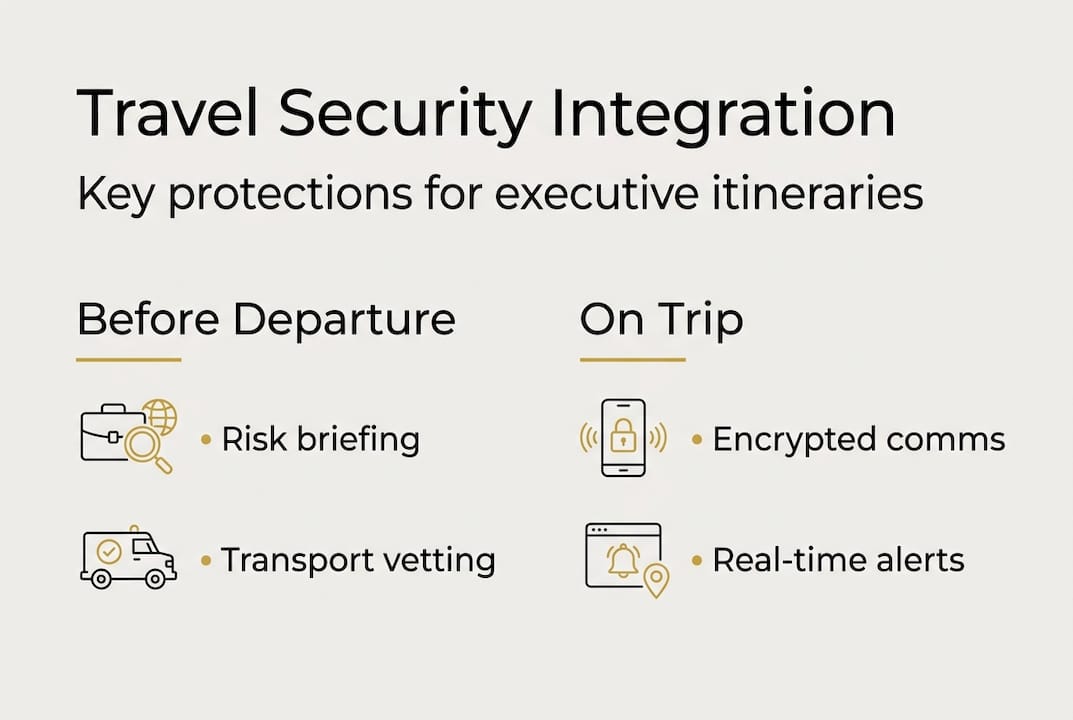
Security is not a luxury add-on. It is a mission-critical layer that belongs in every itinerary from day one. Here is a step-by-step approach to integrating it effectively:
- Conduct a pre-trip risk assessment. Review destination-specific threats, political climate, and crime patterns at least two weeks before departure.
- Vet all routes and venues. Confirm that ground transport routes, hotel locations, and meeting venues have been assessed for risk.
- Implement digital threat countermeasures. Use encrypted communication tools, avoid public Wi-Fi, and brief your team on device security protocols.
- Arrange discreet in-transit protection. Depending on your risk profile, this may mean a security driver, a close protection officer, or simply pre-arranged private transfers.
- Establish emergency contacts and protocols. Every traveler in your party should have a clear escalation path for any incident.
| Security feature | Why it matters |
|---|---|
| Pre-trip risk briefing | Identifies threats before departure |
| Encrypted communications | Protects sensitive business data |
| Vetted ground transport | Reduces exposure to express kidnapping |
| Venue security sweeps | Confirms meeting locations are safe |
| 24/7 emergency support | Ensures rapid response to incidents |
For travelers seeking exclusive access travel arrangements, security integration is already built into the planning process. A well-designed customized travel itinerary treats security as a structural element, not an afterthought.
Optimize your travel schedule for productivity and personalization
With logistics and security solidified, focus turns to the elements that enhance both outcomes and enjoyment. A high-performing executive schedule is not just packed with meetings. It is designed with intention, balancing peak-output hours with recovery time and curated local experiences.
The most effective itineraries share several characteristics:
- A unified calendar that integrates flights, transfers, meetings, meals, and personal time in one view
- Built-in buffer time between commitments to absorb delays without cascading disruptions
- Curated local experiences that provide genuine relaxation and cultural connection without requiring extensive planning
- Consistent morning routines that anchor productivity regardless of time zone
Tracking the right KPIs for executive travel makes it possible to measure and improve performance over time. The most useful metrics include time saved versus commercial travel, cost per productive hour, schedule reliability rate, traveler Net Promoter Score (NPS), and emissions per trip.
NPS, in particular, is an underused tool for business travel. It captures how the traveler actually experienced the trip, not just whether flights ran on time.
Pro Tip: Use a brief real-time feedback form at the midpoint of a multi-day trip. This allows your travel manager or concierge to make adjustments before the trip ends rather than collecting lessons learned after the fact.
Personalization does not have to conflict with business goals. A step-by-step luxury itinerary can include a private dining reservation or a curated cultural experience that takes 90 minutes but delivers outsized value in terms of energy and perspective. Explore personalized travel planning to see how these touchpoints are built into a structured framework.
Final checklist and common pitfalls: Ensuring flawless execution
Before departure, a final verification pass and awareness of the most frequent executive travel mistakes keeps everything on track. Even the most carefully designed itinerary can unravel without a disciplined pre-departure review.
Use this numbered checklist before every executive trip:
- Confirm all travel documents are current and accessible, including visas and health requirements.
- Verify that all bookings, including flights, hotels, and transfers, are confirmed and stored in one accessible location.
- Download offline versions of all itinerary documents and emergency contacts.
- Confirm that all security protocols are in place, including encrypted devices and vetted transport.
- Brief your executive assistant or travel manager on the full schedule and contingency plans.
- Set up real-time tracking or check-in protocols for high-risk destinations.
Common pitfalls that disrupt even well-planned trips:
- Over-scheduling the first day after a long-haul flight, leaving no recovery time
- Failing to account for local logistics such as traffic patterns, customs delays, or venue access restrictions
- Neglecting digital security on personal devices used for business communication
- Skipping contingency planning for flight cancellations or meeting rescheduling
- Ignoring time zone management, which compounds fatigue and reduces cognitive performance
As SAP Concur’s data confirms, poor planning costs executives 25% of their travel time. Prevention starts here, before you leave the office.
Pro Tip: Schedule a 15-minute mid-trip review call with your travel manager. Real-time adjustments to ground transport, dining reservations, or meeting logistics are far easier to make in the moment than to untangle after the fact. Learn how to personalize luxury travel so these reviews become a seamless part of your travel rhythm.
Expert perspective: Why executive travel success is a boardroom issue in 2026
Most organizations still treat executive travel as a procurement function. They focus on cost control, preferred vendor agreements, and policy compliance. What they consistently underestimate is the downstream impact of travel inefficiencies on leadership performance, deal outcomes, and talent retention.
When a senior executive loses a quarter of their travel time to poor logistics, the cost is not just the hours lost. It is the meeting that started late, the relationship that did not deepen, and the decision that got delayed. These are boardroom-level consequences dressed up as operational inconveniences.
In 2026, leading organizations are beginning to reframe executive travel as a risk management and talent strategy issue. Boards that mandate secure, tailored travel for their senior leaders are not being indulgent. They are protecting their most valuable assets and signaling that leadership wellbeing is a strategic priority.
If you are making the case internally for better travel resources, connect the investment directly to measurable outcomes: deal velocity, executive retention, and schedule reliability. The customized itinerary process is not a perk. It is a performance infrastructure decision that belongs in the same conversation as cybersecurity and leadership development.
Experience seamless executive travel with Grand Globetrotting
Everything covered in this guide, from security integration to productivity scheduling to personalized luxury, is exactly what Grand Globetrotting specializes in for executive travelers.
Grand Globetrotting designs bespoke itineraries that treat your time, safety, and comfort as non-negotiable priorities. Whether you need master the customized itinerary process support, access to curated luxury hotel options, or seamless executive class flight booking, our concierge team handles every detail. A well-executed executive trip is a competitive advantage. Let Grand Globetrotting help you build one.
Frequently asked questions
What’s the main advantage of private jet travel for executives in 2026?
Private jets offer unmatched security, privacy, and scheduling flexibility, making them the preferred choice for revenue-critical trips where delays or exposure carry significant business risk.
How do I safeguard against 2026’s top business travel risks?
Start with an intelligence-led pre-travel risk assessment, then layer in vetted transport, encrypted communications, and discreet in-transit protocols tailored to your destination and profile.
What’s the single largest time-waster for executive travelers?
Inadequate upfront planning is the primary culprit. Executives lose 25% of their travel time to poor scheduling and logistics gaps that a structured needs assessment can prevent.
How do you measure executive travel ROI?
The most actionable KPIs for travel include time saved versus commercial alternatives, cost per productive hour, schedule reliability rate, and traveler NPS, all of which connect directly to business performance.
Recommended
At Grand Globetrotting, we don't just plan vacations; we craft extraordinary adventures that leave you with cherished memories. Let us bring your dream vacation to life, perfectly tailored to your style, and immerse yourself in a world of luxury, exploration, and unforgettable moments. Your journey begins with us.
Itinerary planning services require a separate charge outside of cost to book travel accommodations. Depending upon the complexity of the itinerary and the level of effort required to acquire unique experiences, cost may vary. Speak with our team to learn more.
Book your consultation