
TL;DR:
- Pre-trip planning involves confirming dates, visas, and risk assessments to ensure smooth travel.
- Booking direct flights, reliable transfers, and strategic hotels enhances executive travel efficiency.
- Real-time expense tracking and post-trip reviews optimize future travel, control costs, and improve compliance.
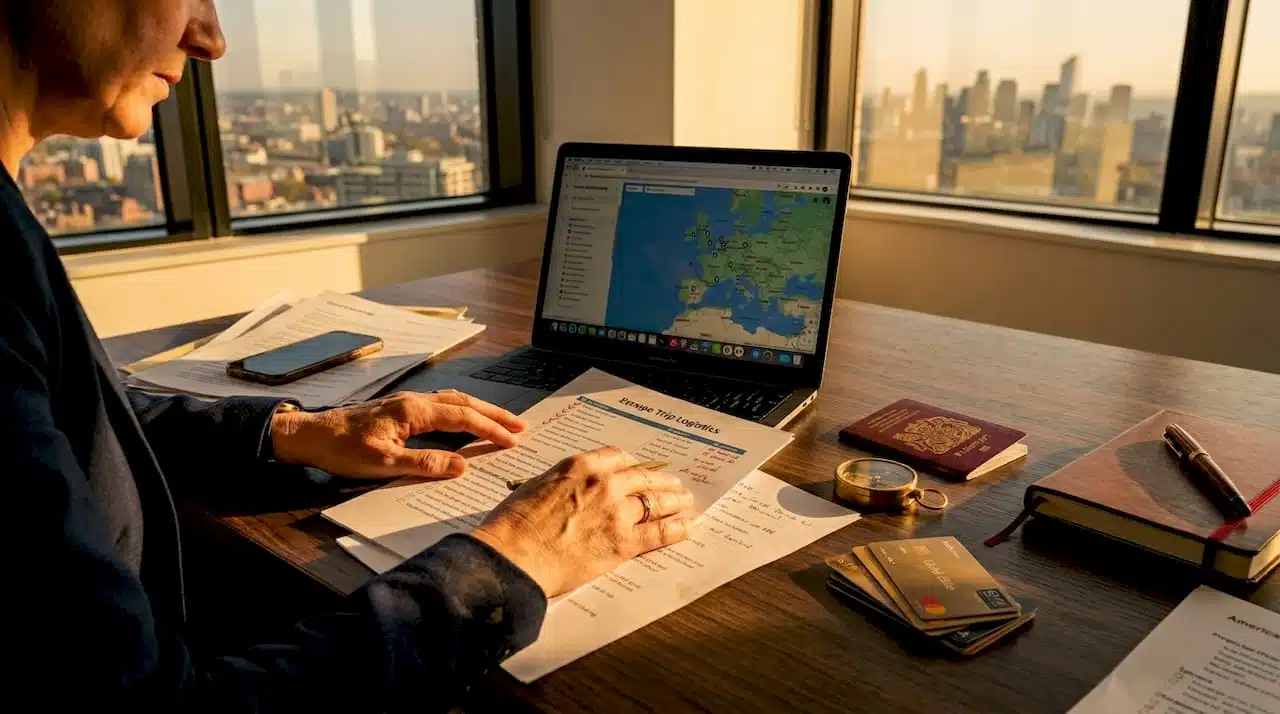
Even the most seasoned executive can lose a critical deal when a single overlooked detail unravels a carefully coordinated trip. A delayed visa, a missed time zone conversion, or a hotel without reliable meeting infrastructure can quickly erode both reputation and revenue. Pre-trip planning requires confirming travel dates with stakeholders, checking visa processing times, local holidays, and time zones, making preparation the true foundation of executive success. This guide walks through every stage of business travel, from initial coordination to post-trip review, ensuring your next journey is as seamless as it is impressive.
Table of Contents
- Core pre-trip essentials for business travelers
- Flights, transfers, and luxury lodging
- Building the perfect executive itinerary
- Packing tips and executive essentials
- Expense tracking, compliance, and post-trip review
- Why most executive travel checklists fall short and how elite travelers stay ahead
- Seamless luxury travel—your next step
- Frequently asked questions
Key Takeaways
| Point | Details |
|---|---|
| Synchronize schedules | Align dates, confirm documents, and factor in visa times and local holidays well in advance. |
| Prioritize premium logistics | Book direct flights, trusted transfers, and hotels with executive amenities for travel comfort and productivity. |
| Structure your itinerary | Include every appointment and buffer, and keep both digital and hard copies of your schedule and documents. |
| Pack strategically | Use the 5-4-3-2-1 rule, focusing on essentials, device chargers, and luxury touches for readiness and confidence. |
| Master expense management | Use digital tracking and quick submissions to stay compliant and leverage spending data for future upgrades. |
Core pre-trip essentials for business travelers
Before any flight is booked or hotel reserved, the groundwork must be solid. Skipping even one of these early steps often creates compounding problems that surface at the worst possible moment, usually mid-trip or right before a critical meeting.
Here is a structured approach to pre-trip preparation every executive should follow:
- Synchronize your travel dates with key participants. Confirm meeting windows with all relevant stakeholders and cross-check against local public holidays at your destination. A meeting scheduled on a national holiday in Tokyo or Frankfurt is a costly error that thorough planning prevents.
- Verify your passport and begin the visa process immediately. Your passport must remain valid for at least 6 months beyond your return date, and visa applications should be initiated weeks ahead due to lengthy processing times. Some countries require supporting documents that take time to gather.
- Assess geopolitical risks for your destination. Review current travel advisories and route options. Inform your employer and key emergency contacts of your itinerary. Some destinations require rerouting on short notice, so flexibility is essential.
- Research destination-specific requirements. This includes vaccination records, currency restrictions, customs regulations, and local dress codes for business settings.
You can explore detailed business trip planning steps to make sure your pre-departure routine is structured and complete.
Pro Tip: Digitize every critical document, including your passport, visa approvals, insurance certificates, and hotel confirmations. Store them in a secure cloud folder and also carry physical copies. If your phone dies or luggage goes missing, you are still covered.
Thinking about streamlining travel workflows from the very beginning reduces the cognitive load significantly, freeing you to focus on the business at hand rather than logistics.
Flights, transfers, and luxury lodging
With documents confirmed and risks assessed, you are ready to lock in the three pillars of a smooth executive journey: flights, ground transfers, and accommodations. Each one demands deliberate selection rather than default booking.
Flights:
When booking executive flights, prioritize non-stop routes wherever possible. Layovers introduce unnecessary risk, especially for tight schedules. Choose business or first class for long-haul routes, not as an indulgence but as a productivity decision. Arriving rested and composed is worth every dollar. Book flights early prioritizing direct routes, preferred departure times, and adequate baggage allowances. Also confirm flexible ticketing terms so last-minute changes do not result in significant penalties.
Ground transfers:
Arrange airport transfers in advance, always. Relying on ride-sharing apps in unfamiliar cities during peak hours introduces unnecessary risk. Private cars or vetted executive shuttles offer reliability, discretion, and a professional first impression when a client is watching.
Accommodations:
Selecting the right hotel goes well beyond star ratings. When reviewing luxury hotel options, look for properties with dedicated business centers, private meeting rooms, flexible check-in and check-out policies, and strong privacy protocols. Some executives also need proximity to specific business districts or venues. Use the following comparison to guide your selection process:
| Feature | Standard hotel | Executive business hotel |
|---|---|---|
| Meeting rooms | Shared, limited hours | Private, bookable, extended hours |
| Check-in flexibility | Fixed times | Flexible, priority access |
| Concierge services | Basic assistance | Full-service executive concierge |
| Connectivity | Standard Wi-Fi | High-speed, secure business Wi-Fi |
| Loyalty program benefits | Points accumulation | Suite upgrades, lounge access |
Key amenities to prioritize when selecting business hotels:
- Executive lounges with complimentary breakfast and evening drinks
- In-room workspace with proper desk setup and fast connectivity
- Laundry and pressing services available same-day or overnight
- Wellness facilities including a gym and spa for recovery between demanding days
- On-site dining with private dining options for client entertainment
Pro Tip: Compare elite airline and hotel loyalty program benefits carefully before booking. Pairing an airline alliance membership with a hotel program in the same ecosystem often yields suite upgrades, priority check-in, and complimentary lounge access that together elevate the entire trip experience at minimal additional cost.
Building the perfect executive itinerary
Once your travel logistics are confirmed, a robust itinerary is what transforms a series of bookings into a genuinely productive trip. A well-built itinerary anticipates problems before they happen and ensures every hour of your time is accounted for and purposeful.
Follow these steps when designing travel itineraries for executive business travel:
- Document every meeting, transfer, and deadline. Include start and end times, venue addresses, contact names, and backup phone numbers. If a meeting runs long, you need to know at a glance what gets affected next.
- Sync schedules across all relevant time zones. Use a tool like World Time Buddy or a smart calendar platform to display your home time zone alongside your destination time zone at all times. Missing a call because you forgot to account for daylight saving time changes is a preventable mistake.
- Build in buffer time. Block 15 to 30 minutes between major commitments. Traffic, delays in a previous meeting, or simply needing a moment to collect your thoughts before a high-stakes presentation all justify this cushion.
- Include backup contacts and contingency plans. If a key contact becomes unavailable, who do you call? If a venue is closed or inaccessible, what is the alternative? Having those answers documented in advance saves real time under pressure.
“One overlooked time zone can derail an entire multi-country trip. The executives who travel most effectively don’t just plan for what should happen. They plan for what might.”
Create a detailed itinerary that includes meetings, travel times, and deadlines, and always keep both digital and physical copies of all key documents. A printed one-page daily schedule kept in your jacket pocket has saved many professionals when a device ran out of battery at the wrong moment.
Here is a practical time structure for a single day on an executive business trip:
| Time block | Activity | Notes |
|---|---|---|
| 6:30 AM | Morning wellness routine | Gym, review emails |
| 8:00 AM | Breakfast (in-room or lounge) | Prepare for first meeting |
| 9:00 AM | Client meeting 1 | Confirm location the night before |
| 11:30 AM | Buffer / travel to next venue | Allow extra time in unfamiliar cities |
| 12:30 PM | Business lunch | Pre-book, confirm dietary preferences |
| 2:30 PM | Client meeting 2 | Backup contact documented |
| 5:00 PM | Admin and email catch-up | Hotel room or lounge |
| 7:00 PM | Client dinner or personal time | Reservation confirmed |
If the customized itinerary process sounds complex, working with an experienced travel advisor can reduce the planning burden significantly.
Packing tips and executive essentials
A flawless itinerary can still go sideways if you forget critical tech, miss a wardrobe requirement for a formal dinner, or land without the right power adapter. Packing systematically is a skill that elite travelers refine over time.

The 5-4-3-2-1 packing rule structures your wardrobe efficiently: 5 tops, 4 bottoms, 3 pairs of shoes, 2 layers, and 1 accessory. This method maximizes outfit combinations while keeping luggage manageable enough for overhead storage, eliminating the risk of checked baggage delays.
Essential items to pack for every executive trip:
- Technology: High-quality device chargers for all devices, a portable power bank with at least 20,000mAh capacity, universal adapters suitable for your destination, and a travel router if you need guaranteed secure connectivity
- Medications: A sufficient supply of any prescription medications, plus a travel-size pharmacy kit covering headache relief, antacids, and allergy medication
- Business tools: Printed business cards, a compact portfolio or notebook, branded pens, and any presentation materials required for key meetings
- Personal care: Travel-sized grooming essentials that comply with carry-on liquid regulations, keeping you polished and confident regardless of schedule disruptions
- Documents folder: Your digitized and printed copies of all essential documents, neatly organized for quick access
Key statistic: Lodging represents approximately 34% of total business travel costs, while meals account for roughly 20%. Packing smart snacks and registering for airline and hotel executive lounges can keep your meal expenses under control without sacrificing comfort or quality on demanding travel days.
Pro Tip: Build a pre-packed travel kit that lives in your luggage permanently. Include duplicates of your everyday essentials, including chargers, adapters, grooming items, and a spare dress shirt. When an unplanned trip arises, which it will, you are ready to depart within hours rather than scrambling to repack from scratch. Review your executive packing checklist to make sure nothing critical is left behind.
Expense tracking, compliance, and post-trip review
The final competitive edge for executive travelers is not what happens during the trip. It is how meticulously the financial and operational details are handled before and after landing home. This stage is often rushed or neglected, yet it has a direct impact on budget approval for future trips.
Follow this approach for managing expenses and post-trip responsibilities:
- Track expenses in real time throughout the trip. Use a digital expense management app that allows photo capture of receipts immediately after each transaction. Accumulated paper receipts invite errors and are easily lost. Real-time logging also keeps you aware of spending pace relative to your approved budget.
- Follow corporate policy precisely. Use your approved corporate card for all purchases, understand your per diem allowances, and know which expense categories require pre-approval. Commingling personal and business expenses creates compliance problems and delays reimbursement.
- Submit your expense report within 7 days of returning. Submit expenses within 7 days and take time to review vendors and update internal policies based on what worked and what did not. Timely submission maintains good standing with your finance team and keeps your travel privileges protected.
- Conduct a post-trip vendor review. Rate your hotels, transfer services, airlines, and restaurants while the experience is fresh. Your feedback directly informs better selections next time.
- Update your personal travel checklist. Note anything that surprised you, whether a new visa requirement, a better routing option, or a hotel that exceeded expectations. Use expense tracking apps to log real-time spending, avoid mixing personal and corporate funds, and analyze where your travel budget actually goes.
Key post-trip actions at a glance:
- Submit all receipts and reports promptly
- Review loyalty points earned and apply them to upcoming bookings
- Flag any compliance issues or policy gaps to the travel manager
- Archive the finalized itinerary for reference on similar future trips
- Update your preferred vendor list based on actual performance
Pro Tip: AI-driven expense management platforms like Expensify or Concur do more than log receipts. They identify spending patterns, flag out-of-policy purchases automatically, and generate forecasting reports that help you negotiate better rates and budget more accurately for future trips. Explore luxury itinerary management tools designed specifically for high-frequency executive travelers.
Why most executive travel checklists fall short and how elite travelers stay ahead
Here is an honest observation worth considering: most published business travel checklists are static documents built for average travelers on average trips. They cover the basics reasonably well but fail entirely to account for the dynamic, high-stakes nature of executive travel in today’s environment.
The most effective executive travelers we have observed do not simply follow a checklist. They treat it as a living document. Every trip generates new intelligence: a faster transfer route, a hotel that quietly upgraded their Wi-Fi infrastructure, a visa processing service that cut lead time in half. Capturing that intelligence and integrating it forward is what separates consistently smooth travelers from those who keep encountering the same avoidable friction.
Real-time data and AI-powered tools are now central to elite travel management. Route optimization, risk monitoring, and pricing pattern analysis are no longer exclusive to corporate travel management companies. Individual executives and their advisors can access these tools directly, making it possible to reroute around a geopolitical flare-up or identify a premium flight upgrade opportunity before it disappears.
The corporate travel outlook presents an interesting tension: while steady growth is projected for business travel overall, confidence among large enterprises is declining, with many companies growing more cautious. Smaller firms tend to show more optimism. This divergence suggests that premium upgrades may plateau for large corporate accounts, making smart spending and strategic loyalty management even more valuable for individual executives.
“Premium travel no longer means more money spent, but spending more wisely and adapting faster than everyone else.”
The luxury travel planning guide at Grand Globetrotting reflects this evolved philosophy. The goal is not to spend more. It is to extract more value, comfort, and productivity from every trip, regardless of the budget ceiling.
Seamless luxury travel—your next step
If you’re ready to experience business travel without compromise, the right guidance makes every difference. Grand Globetrotting specializes in elevating every stage of the executive travel journey, from pre-trip document coordination to post-trip vendor review, with a high-touch approach that removes the burden of planning from your plate.
Whether you are preparing for a single high-stakes conference or managing a year of international commitments, our team handles the complexity so you arrive calm, prepared, and in complete control. Explore our executive business trip planning resources, review our luxury itinerary creation process, or start with our personalized planning guide to see how a truly tailored approach transforms your next trip from stressful to exceptional.
Frequently asked questions
What is the first step in planning a business trip?
Confirm key dates with all stakeholders and verify that your travel documents, including your passport and any required visas, are in order before booking flights or accommodations. Pre-trip planning should always begin with stakeholder alignment and document readiness.
How early should I begin the visa application process?
Start your visa application several weeks before your intended departure, as processing times vary widely and some destinations require extensive supporting documentation. Your passport must remain valid for at least 6 months beyond your return date before any application is submitted.
What is the most common travel expense for executives?
Lodging is typically the single largest cost category, representing about 34% of total business travel expenses, followed by meals at approximately 20%.
How soon should expenses be submitted after a business trip?
Best practice is to submit all expense reports and receipts within 7 days of returning. Submitting within 7 days ensures timely reimbursement and keeps your records accurate for corporate compliance purposes.
Why do executive travelers need to monitor geopolitical risks?
Geopolitical developments can trigger route changes, force event relocations, or require a shift to virtual meetings, all of which affect business continuity and travel logistics. Geopolitical risks prompt route adjustments in roughly 50% of affected cases, with 22% requiring event relocation and 26% shifting to virtual formats entirely.
Recommended
At Grand Globetrotting, we don't just plan vacations; we craft extraordinary adventures that leave you with cherished memories. Let us bring your dream vacation to life, perfectly tailored to your style, and immerse yourself in a world of luxury, exploration, and unforgettable moments. Your journey begins with us.
Itinerary planning services require a separate charge outside of cost to book travel accommodations. Depending upon the complexity of the itinerary and the level of effort required to acquire unique experiences, cost may vary. Speak with our team to learn more.
Book your consultation