
TL;DR:
- A true boutique hotel features fewer than 100 rooms, unique design, and a service culture shaped by the property itself.
- Evaluating recent guest reviews, location, design, and personalized service indicators ensures authentic boutique experiences.
- Trust signals like neighborhood character and staff responsiveness over superficial aesthetics to select memorable, genuine boutique stays.
Not every hotel with reclaimed wood floors and a lobby art installation qualifies as a true boutique property. The term gets stretched far too often, and travelers who rely on marketing language alone end up disappointed. Understanding what is boutique hotel selection, and doing it well, is the difference between a forgettable stay and one that shapes how you travel forever. This guide cuts through the noise to show you exactly what defines an authentic boutique hotel, how to evaluate them before you book, and what practical criteria separate the genuinely special properties from the ones simply borrowing the label.
Table of Contents
- Key takeaways
- What boutique hotel selection really means
- How to evaluate quality using guest reviews
- Location and neighborhood as selection criteria
- Design, service, and personalization inside the experience
- My take on choosing boutique hotels well
- Plan your boutique stay with Grandglobetrotting
- FAQ
Key takeaways
| Point | Details |
|---|---|
| Definition matters | A true boutique hotel has fewer than 100 rooms, a unique design identity, and a service culture shaped by the property itself. |
| Reviews reveal the truth | Scan at least 20 to 30 recent guest reviews from the last 18 months to identify real patterns in service and maintenance. |
| Location shapes the experience | Proximity to transit and authentic neighborhood character are stronger quality signals than a “central” claim in the marketing copy. |
| Design tells a story | Exceptional boutique hotels use architecture and interiors to communicate local culture and history, not simply to look photogenic. |
| Service ratios signal quality | Guest-to-staff ratios near 2:1 or 3:1 indicate the kind of personalized care that makes boutique stays genuinely memorable. |
What boutique hotel selection really means
Before you can apply boutique hotel selection criteria with confidence, you need a clear definition to anchor your decisions. A boutique hotel is defined by three core attributes: a unique design identity, fewer than 100 rooms, and a service culture shaped by the property itself rather than a corporate brand standard. That last point separates boutique stays from everything else.
Chain hotels deliver consistency. Boutique hotels deliver character. The distinction matters because the two serve fundamentally different travel desires.
Here is what genuine boutique hotel features look like in practice:
- Scale and intimacy. Fewer rooms mean staff actually notice when you arrive. Guests are not processed through a lobby designed for volume.
- Distinctive design. Every design decision, from the furniture to the art on the walls, reflects a point of view. Nothing is generic. No two boutique hotels feel the same because design acts as a narrative tool communicating local history and values.
- High guest-to-staff ratios. The best boutique properties maintain ratios near 2:1 or 3:1, enabling staff to recognize guests by name, remember preferences, and anticipate needs without being asked.
- Locally sourced touches. Culinary programs at authentic boutique hotels draw on regional ingredients and recipes. Nearly 70% of boutique hotel guests travel primarily for leisure and place genuine value on memorable food experiences.
- Neighborhood integration. The best boutique hotels do not exist apart from their surroundings. They are part of a local ecosystem, directing guests to nearby markets, galleries, and restaurants that locals actually use.
Understanding these boutique hotel features up front prevents you from paying boutique prices for a property that simply swapped out the chain’s art prints for something trendier.
How to evaluate quality using guest reviews
Marketing images are curated to perfection. Guest reviews are not. When you want to understand what staying at a specific boutique hotel actually feels like, reviews are your most reliable tool, but only if you know what to look for.
The first rule is recency. Scan 20 to 30 reviews focused on the last 18 months. Ownership changes, new management, and renovation cycles can dramatically alter a property’s quality in either direction. A hotel with glowing feedback from three years ago may have slipped significantly, and vice versa.
The second rule is pattern recognition. Isolated complaints about a noisy room or a slow breakfast happen at every property. What you are watching for is repetition. If three reviewers in six months mention peeling wallpaper or indifferent front desk staff, those are signals, not anomalies.
Pro Tip: Look for guests who mention staff members by name. Phrases like “Marco at the front desk remembered our coffee order” or “the concierge Sofia arranged a last-minute dinner reservation” indicate a genuine culture of personalization, not scripted hospitality.
Here is what else to prioritize when reading reviews:
- Guest photos taken in rooms and common areas, which reflect actual conditions rather than professional staging
- Comments about noise levels, particularly from street traffic or neighboring rooms
- Mentions of maintenance quality, specifically whether the property feels well cared for or tired
- Feedback about how staff handled problems, since recovery from a mistake often reveals service culture better than a flawless stay
A boutique hotel with 4.7 stars and 800 reviews may be far more reliable than a chain property with an identical rating, precisely because boutique quality varies more widely. Those 800 reviews represent real signal. Use them.
Location and neighborhood as selection criteria
One of the most overlooked boutique hotel selection criteria is the relationship between a property and its surroundings. A boutique hotel does not exist in isolation. It should feel like a natural expression of the neighborhood it occupies.

Boutique hotels thrive in areas with character, such as historic districts, arts neighborhoods, and streets with active local culture. That context shapes the entire experience. When you step outside and find yourself on a block that is genuinely interesting, the hotel’s investment in local storytelling pays off immediately.
Convenience matters too, but the marketing phrase “centrally located” deserves scrutiny. A property that is genuinely central to the city’s transit network is different from one that is central to a commercial corridor with nothing of note nearby. Look for practical signals:
- Walking distance to transit. Properties within a 5 to 10 minute walk of a transit hub offer measurably better convenience than isolated properties that market themselves as accessible.
- A restaurant that locals use. When a boutique hotel’s dining room attracts neighborhood regulars, not just hotel guests, it is a strong quality signal. It means the culinary program is genuinely competitive.
- Walkability to authentic experiences. Check whether you can reach a local market, independent coffee shop, or cultural site on foot. That access often tells you more about the neighborhood than any neighborhood description in the hotel copy.
Think about your travel goals when weighing location. If cultural immersion matters most to you, a boutique hotel in an arts district will deliver more than a glossy property in a business hub, even if the latter has a better fitness center.
Design, service, and personalization inside the experience
This is where boutique hotels either justify their rates completely or fall short. The intangible qualities of design and service are exactly what you are paying for, and they are harder to assess from a listing than thread count or room size.
On design: spatial efficiency matters more than square footage. An intelligently designed room of 18 square meters can feel more luxurious and functional than a poorly planned 30 square meter space. Before dismissing a room as small, look at the floor plan and guest photos for how the layout actually uses the space.
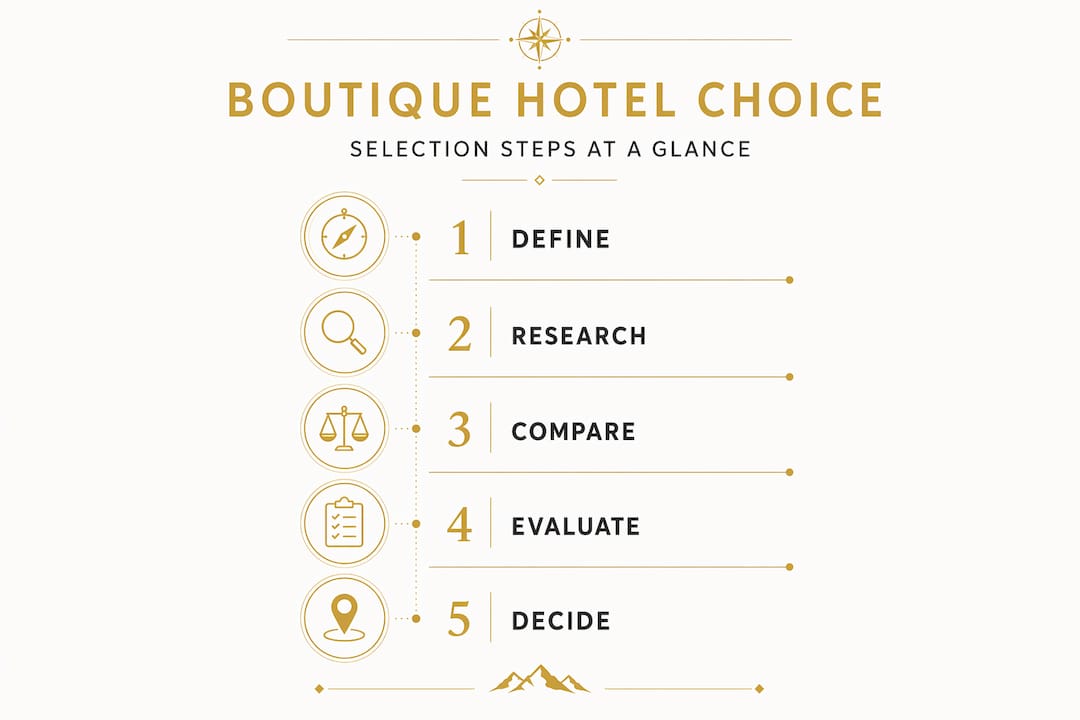
On service: the best boutique properties use guest profiling to personalize stays before arrival. That means questions at booking, notes in the reservation system, and staff who arrive at your door already knowing your preferences. That kind of care is structurally difficult for large chains to replicate.
Here is a quick comparison of what separates a genuinely exceptional boutique experience from one that only uses the label:
| Feature | Authentic boutique hotel | Chain or boutique-branded chain |
|---|---|---|
| Service culture | Staff recognize guests individually | Standardized greeting scripts |
| Design | Locally commissioned art, bespoke furnishings | Trend-driven but interchangeable decor |
| Menu | Regional ingredients, locally inspired dishes | Consistent brand menu across locations |
| Flexibility | Operational agility to act on guest requests | Requires corporate approval for exceptions |
| Technology | Enhances human connection | Often replaces it |
Pro Tip: Before booking, email the property directly with a specific, modest request, such as asking about the best local coffee shop nearby. How quickly they respond, and how genuinely they answer, tells you almost everything about the service culture you will encounter on arrival.
The way a boutique hotel handles that small moment of contact reveals whether staff are empowered to act or working from a script. That distinction defines the entire stay.
My take on choosing boutique hotels well
I have spent years helping travelers find boutique properties that genuinely deliver, and the honest truth is that the word “boutique” now requires skepticism. Large hotel groups have co-opted the label, applying it to properties that are independent in name only. The curated lobby, the local honey at breakfast, the reclaimed timber headboard — these are aesthetic choices, not guarantees of authentic hospitality.
What I have learned from first-hand experience evaluating dozens of boutique stays is that the real differentiator is how a property treats you when something goes wrong. Any hotel can perform warmth when everything runs smoothly. Boutique hotels with genuine service cultures improvise, adapt, and solve problems without sending you to a corporate hotline. That operational agility is not something chains can replicate, and it is the thing I look for above almost everything else.
I also believe travelers underestimate how much location shapes the boutique experience. A beautiful property in a characterless neighborhood will always disappoint, no matter how lovely the room. The neighborhood is part of the product. When I evaluate a boutique hotel for a client, I spend as much time researching the streets around it as I do the property itself.
My advice: trust the criteria in this guide, read reviews with discipline, contact the hotel before you book, and pay attention to how the property sits within its neighborhood. When all of those signals align, you are looking at a stay worth remembering.
— Sandon
Plan your boutique stay with Grandglobetrotting
Finding a boutique hotel that genuinely delivers on its promise takes more than reading the listing. At Grandglobetrotting, the team specializes in doing exactly that work for you. From curating properties with authentic service cultures to matching your travel style with the right neighborhood and setting, the personalized luxury travel planning process removes the guesswork entirely. Whether you are planning a honeymoon, a solo cultural trip, or a family escape, Grandglobetrotting’s hotel booking expertise connects you with boutique properties that are genuinely worth your time and investment. Explore the full range of bespoke itinerary and travel planning services to start building a trip that feels entirely your own.
FAQ
What is boutique hotel selection?
Boutique hotel selection is the process of identifying and evaluating independently styled properties, typically under 100 rooms, based on criteria like design authenticity, service quality, guest-to-staff ratios, and neighborhood character rather than brand name or star rating alone.
How is a boutique hotel defined?
A boutique hotel is defined by three core traits: fewer than 100 rooms, a unique design identity, and a service culture shaped by the individual property rather than a corporate brand standard.
What should I look for in boutique hotel reviews?
Focus on reviews from the last 18 months, look for repeated mentions of staff quality, noise, and maintenance, and prioritize guest photos over professional images to get an accurate picture of current conditions.
How do boutique hotels differ from chain hotels?
Boutique hotels are built around the individual guest experience and a distinct sense of place, while chain hotels prioritize brand consistency and predictability across locations. Boutique properties also have the operational flexibility to fulfill personalized requests that chain hotels typically cannot accommodate.
Does room size matter in boutique hotels?
Not as much as design and spatial efficiency. An intelligently designed smaller room can deliver greater comfort and functionality than a larger, poorly planned space, making layout and thoughtful design more important than raw square footage.
Recommended
At Grand Globetrotting, we don't just plan vacations; we craft extraordinary adventures that leave you with cherished memories. Let us bring your dream vacation to life, perfectly tailored to your style, and immerse yourself in a world of luxury, exploration, and unforgettable moments. Your journey begins with us.
Itinerary planning services require a separate charge outside of cost to book travel accommodations. Depending upon the complexity of the itinerary and the level of effort required to acquire unique experiences, cost may vary. Speak with our team to learn more.
Book your consultation