

TL;DR:
- Tailor family vacations are essential because generic packages often fail to meet diverse family needs and interests. Customization, guided by the 70/30 rule and thorough planning, reduces conflicts and creates meaningful shared experiences. Using expert advisors and early, flexible planning ensures trips are enjoyable, budget-efficient, and memorable for all generations.
There is a specific kind of disappointment that settles in when a family vacation falls flat. You planned, you booked, you traveled. Yet somehow, the teenager was bored, the toddler was overwhelmed, and Grandma could not keep pace with the itinerary. Understanding why tailor family vacations matters starts here: generic travel packages are built for average travelers, and your family is anything but average. Every family brings a unique mix of ages, energy levels, and interests to the table. The difference between a forgettable trip and a genuinely memorable one often comes down to how deliberately the experience was shaped around the people taking it.
Table of Contents
- Key Takeaways
- Why tailor family vacations instead of booking packages
- Practical factors to consider when customizing
- Tools and expert support for planning tailored trips
- How tailored trips strengthen family connection
- Practical steps to apply customization right now
- My honest take on why this matters more than most families realize
- Plan your tailored family vacation with Grandglobetrotting
- FAQ
Key Takeaways
| Point | Details |
|---|---|
| One size fits no one | Generic packages rarely satisfy diverse family needs; customization fills the gap. |
| The 70/30 rule works | Structure 70% group activities and 30% independent time to reduce conflict and burnout. |
| Budget transparency matters | Setting a clear budget upfront and tracking expenses reduces money-related tension during the trip. |
| Expert advisors save time | Over 71% of parents globally are willing to use travel advisors to secure tailored, stress-free planning. |
| Shared experiences build lasting bonds | Personalized trips create emotional narratives that families carry for decades, not just the duration of the vacation. |
Why tailor family vacations instead of booking packages
Preset vacation packages are designed to appeal to the widest possible group. That logic works for resorts. It rarely works for families with a seven-year-old, a sixteen-year-old, and two sets of grandparents traveling together.
The benefits of custom family trips go well beyond personal preference. Research shows that 42% of families prioritize great-value deals while still wanting meaningful, customized experiences. Customization is not the opposite of value. Done well, it delivers both. When you allocate budget toward activities your specific family will actually enjoy, you stop paying for amenities no one will use.
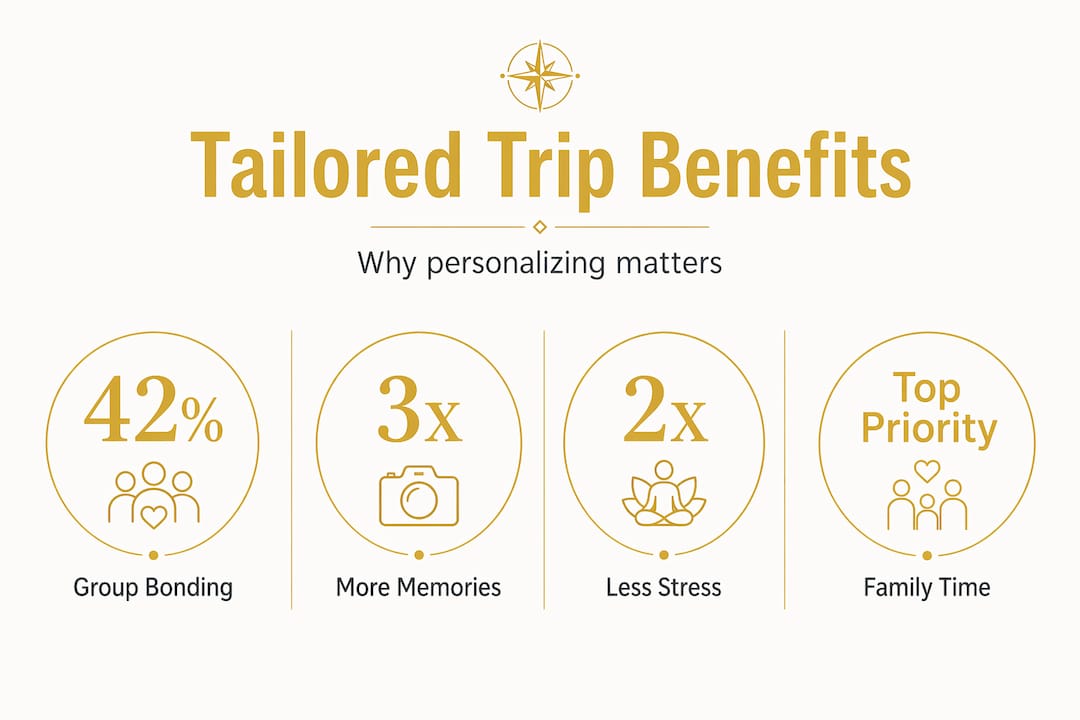
One of the most practical frameworks for personalized family vacation planning is the 70/30 rule: structure roughly 70% group activities and reserve 30% for subgroup or solo time. This reduces the pressure every family member feels to participate in everything, which is often the source of the most tension. When the teen can spend a morning at the skate park while the younger kids explore tide pools, everyone arrives at the group dinner in a better mood.
Here is what personalized family vacation planning consistently delivers:
- Reduced conflict. When everyone’s preferences are considered from the start, there are fewer moments of “I didn’t want to come here anyway.”
- Better memory creation. Shared experiences that connect to individual interests, like a cooking class a foodie parent actually wanted, stick in the memory longer.
- Budget flexibility. You decide where to spend more and where to spend less, based on what your family genuinely values.
- Emotional resilience. Luxury family travel strengthens the relational bonds and shared narratives that families draw on for decades.
Pro Tip: Before booking anything, ask each family member to name their single non-negotiable for the trip. Build the itinerary skeleton around those answers first.
Practical factors to consider when customizing
Knowing you want to customize is the easy part. Knowing where to start is where most families get stuck. A thoughtful approach to how to plan tailored family trips begins with a clear-eyed look at who is actually traveling.
-
Assess age groups and physical needs. A toddler needs nap schedules and stroller-accessible venues. A teenager needs some degree of independence and social stimulation. An elderly grandparent may need ground-floor accommodations and low-exertion activity options. Designing around these realities from the beginning prevents friction mid-trip.
-
Factor in mobility and health. Accessibility is not a footnote. If one family member uses a wheelchair or has dietary restrictions, those needs shape destination selection, hotel choice, and daily activity sequencing. Failing to plan for this often derails the whole group.
-
Map out group versus individual activity preferences. Not every activity needs to involve everyone. Splitting into subgroups for half a day can actually bring the full group back together with more energy and better stories.
-
Evaluate travel distance and logistics honestly. Long-haul flights with young children require buffer days. Tight connections with a large group are a recipe for stress. Building in travel recovery time is not a luxury. It is good planning.
-
Build in flexibility for the unexpected. Weather changes. A child gets sick. A parent wants to sleep in. Leaving one or two days lightly scheduled gives the trip room to breathe without collapsing entirely.
Pro Tip: Assign one family member as the “activity champion” for each day. That person researches and leads the plan for their day, giving everyone a sense of ownership and investment in the trip.
Setting realistic expectations before a multigenerational trip is one of the most underrated steps families skip. The goal is connection and flexibility, not perfect execution. Normalizing small inconveniences as part of the experience prevents them from becoming major grievances.

Tools and expert support for planning tailored trips
Even the most organized family planner benefits from the right tools and the right people. The advantages of bespoke family vacations are fully realized only when the planning process itself is organized.
Here is where families are finding the most support:
- Travel advisors. A skilled advisor brings insider knowledge on family-friendly accommodations and activity options that would take hours to research independently. With 71% of parents globally willing to use one, the demand for expert guidance reflects genuine value.
- Shared itinerary and budgeting apps. Collaborative planning tools reduce stress and increase satisfaction. When everyone can see the schedule, vote on activities, and track shared expenses in real time, the planning process stops being one person’s burden.
- Group polls and preference surveys. A simple shared survey before trip planning begins surfaces preferences you might not have assumed correctly. The teen who seems indifferent to everything might have a strong opinion about visiting a Formula 1 experience.
The table below highlights how different planning approaches compare:
| Planning method | Best for | Limitation |
|---|---|---|
| DIY research | Budget-conscious families with time | Time-intensive and prone to gaps |
| Collaborative apps | Families with older children | Requires everyone’s participation |
| Travel advisor | Luxury and multigenerational trips | Requires a clear brief and trust |
| Preset package | Simple, low-conflict trips | Limited personalization options |
How tailored trips strengthen family connection
There is a reason families talk about certain trips for the rest of their lives while others fade within months. The difference is almost never the destination. It is the quality of the shared experience.
Luxury family travel creates what researchers describe as emotional capital, which is the collection of shared relational narratives that outlive material possessions. A private villa in Bali where three generations cooked together, laughed at card games, and watched the same sunset is a story that gets retold. A stay at a generic resort where everyone scattered to separate activities is not.
“The best family vacations balance shared experiences with individual autonomy, allowing healthy personal space and flexibility.” — Multigenerational travel research
Compare the two approaches side by side:
| Standard family vacation | Tailored family vacation |
|---|---|
| Fixed itinerary for all ages | Age-specific activities within shared framework |
| One accommodation type | Options like private villas for full-group privacy |
| Preset dining and entertainment | Curated dining based on family preferences |
| Limited flexibility | Built-in buffer days and subgroup scheduling |
| Generic memory-making | Experiences aligned to individual and group values |
Family travel tailored experiences do not require extreme luxury to deliver connection. They require deliberate design. When you choose an activity because your twelve-year-old loves marine biology, or book a villa because your family needs the shared kitchen space, you are creating conditions where meaningful moments become far more likely.
Practical steps to apply customization right now
Understanding the why is only useful when paired with a clear starting point. Here is how to bring personalized family vacation planning to life without getting overwhelmed.
-
Start early and set your budget transparently. Budget transparency reduces money-related conflict among family members. Share a realistic number with everyone involved before destination discussions begin.
-
Apply the 70/30 activity rule. Sketch your itinerary with 70% of time in shared group activities and 30% reserved for subgroup or individual options. This one structural change resolves a remarkable amount of potential conflict before it starts.
-
Choose destinations with varied activity options. A destination like Costa Rica, Tuscany, or Japan offers enough breadth to satisfy a curious teenager, an adventure-seeking parent, and a grandparent who prefers cultural and culinary experiences. Versatile destinations reduce the need for multiple trips to satisfy everyone.
-
Assign planning roles. Let different family members own different parts of the trip: one person handles dining research, another manages transportation logistics, a third tracks the shared budget. Distributed ownership means distributed buy-in.
-
Include contingency plans and travel insurance. Unexpected events are not a question of if. They are a question of when. A well-placed travel insurance policy and a flexible cancellation policy protect both your budget and your peace of mind. Explore your luxury trip planning options early enough to make adjustments without penalty.
My honest take on why this matters more than most families realize
I have worked with enough families at Grandglobetrotting to know that the most common mistake is not poor destination choice or overspending. It is under-planning the human element of the trip.
Families often come to me with a destination in mind and no real framework for how the daily experience will actually work across three different age groups. They have researched hotels extensively and barely thought about what everyone will do between 8 a.m. and noon. That gap is where frustration lives.
What I have also seen is that families consistently underestimate how much flexibility matters. A trip that looks perfect on paper can unravel quickly if there is no room to pivot. The families who come back genuinely satisfied are not the ones who executed a flawless itinerary. They are the ones who built enough structure to feel organized and enough breathing room to follow the moment.
One more thing: tailoring a family vacation does not mean spending more. It means spending smarter. Shifting budget away from a resort spa no one will use and toward a private cooking experience the whole family will talk about for years is not an upgrade in cost. It is an upgrade in meaning. That distinction is worth more than any five-star rating.
— Sandon
Plan your tailored family vacation with Grandglobetrotting
Grandglobetrotting specializes in building personalized family vacation experiences from the ground up. Whether you are coordinating a multigenerational trip across time zones or planning an intimate getaway for a family of four, the team brings industry connections, curated family-friendly hotel selections, and expert itinerary design to every booking. The process starts with a consultation and ends with a trip built specifically around your family’s interests, budget, and pace. If you are ready to move beyond one-size-fits-all travel, work with a travel advisor who understands the difference between a good vacation and the right vacation for your family.
FAQ
Why should families customize their vacation plans?
Generic travel packages are designed for the average traveler, not for a group with diverse ages, interests, and physical needs. Customizing a family vacation reduces conflict, maximizes budget value, and creates more meaningful shared experiences for everyone involved.
What is the 70/30 rule for family trips?
The 70/30 rule suggests structuring 70% of your itinerary around shared group activities and reserving 30% for subgroup or individual options. This balance respects diverse interests while preserving the shared experiences that create lasting family memories.
How does a travel advisor help with personalized family vacation planning?
A travel advisor provides insider knowledge on family-friendly accommodations, tailored itineraries, and destination logistics that would take families hours to research independently. Research shows 71% of parents globally are willing to use one for the expertise and stress reduction they offer.
Is tailoring a family vacation more expensive than booking a standard package?
Not necessarily. Customization is about allocating your existing budget toward what your family values most. 42% of families prioritize great-value deals alongside personalization, and a well-planned tailored trip often eliminates spending on amenities the family never uses.
How far in advance should families start planning a customized trip?
For multigenerational or luxury family trips, starting six to twelve months ahead gives you access to the best accommodations, allows time to gather every family member’s preferences, and provides flexibility to adjust the plan without penalty fees.
Recommended
At Grand Globetrotting, we don't just plan vacations; we craft extraordinary adventures that leave you with cherished memories. Let us bring your dream vacation to life, perfectly tailored to your style, and immerse yourself in a world of luxury, exploration, and unforgettable moments. Your journey begins with us.
Itinerary planning services require a separate charge outside of cost to book travel accommodations. Depending upon the complexity of the itinerary and the level of effort required to acquire unique experiences, cost may vary. Speak with our team to learn more.
Book your consultation