

TL;DR:
- Destination expertise combines current, layered knowledge with local relationships and cultural insights to create personalized travel experiences. It involves active maintenance, verified connections, and real-time updates to ensure safety, authenticity, and tailored itineraries. Professional destination management companies exemplify true expertise through logistical mastery, insider access, and ongoing local engagement.
Most travelers assume they know a destination once they have scrolled through a few travel blogs or watched a YouTube tour. But what is destination expertise, really? It is far more than knowing which museum is worth visiting or what hotel sits closest to the beach. True destination expertise combines current, layered knowledge with local relationships, cultural understanding, and the ability to match all of that to a specific traveler’s needs. This article breaks down what destination expertise means, who holds it, how it is built, and why it makes a measurable difference in the quality of any trip you plan.
Table of Contents
- Key takeaways
- What is destination expertise, defined
- The role of destination management companies
- How destination expertise is built and maintained
- How to identify a reliable destination expert
- Applying destination expertise to your travel planning
- My take on why this matters more than people expect
- Plan your next trip with expert guidance
- FAQ
Key takeaways
| Point | Details |
|---|---|
| Expertise goes beyond basics | Destination knowledge includes cultural, safety, operational, and social details that online research rarely surfaces. |
| Professionals maintain it actively | True experts refresh their knowledge through certification, supplier training, and client feedback loops. |
| DMCs provide insider access | Destination management companies connect travelers to local services, hidden experiences, and on-ground support. |
| Reliability has clear markers | Look for certified specialists with tourism board partnerships and verified, up-to-date information. |
| Expertise improves every trip type | From luxury honeymoons to solo adventures, applied destination knowledge reduces risk and increases trip quality. |
What is destination expertise, defined
Destination expertise is the structured, current, and preference-driven knowledge that travel professionals use to plan trips that actually fit the traveler. It goes well beyond knowing the headline attractions. According to ELITE Travel, travelers value insider details and connections that no amount of standard online research can replicate. That is the core of what destination expertise means.
Think of it in layers. The surface layer is factual: geography, climate, major attractions, and visa requirements. The deeper layer is operational: which local vendors are reliable, where crowds peak by season, which neighborhoods are safe at night, and which dining reservations require months of advance notice. The deepest layer is personal: understanding how to adapt all of that knowledge to a solo traveler versus a family with young children versus a couple celebrating a milestone anniversary.
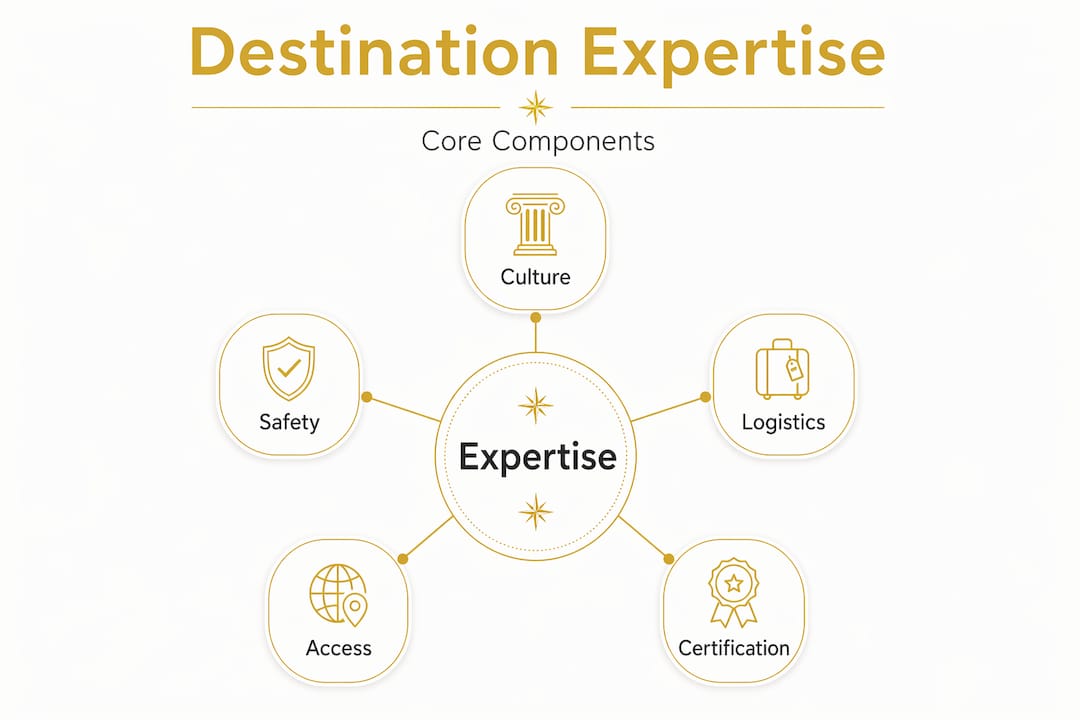
Destination management skills that define true expertise include:
- Research fluency: the ability to source accurate, up-to-date information from verified local contacts and official tourism authorities
- Cultural literacy: understanding customs, etiquette, and social norms that shape the experience on the ground
- Safety awareness: knowing current health, political, and environmental conditions, not just what was true six months ago
- Client tailoring: mapping destination knowledge directly to a specific traveler’s preferences, budget, and travel style
- Operational logistics: understanding transportation networks, entry requirements, seasonal access, and provider reliability
VETReady’s curriculum confirms that destination knowledge must cover cultural, social, safety, geographical, and operational features, and that it must be updated continuously to remain useful.
Pro Tip: When evaluating a travel advisor’s destination knowledge, ask them about conditions in the last 30 to 90 days, not just general facts. A genuine expert will reference recent changes, not just well-known highlights.
The role of destination management companies
No organization embodies destination expertise more completely than a destination management company, or DMC. These are locally based firms that act as the operational backbone of high-quality travel experiences in a specific region. Palisis describes DMCs as local connectors who transform generic bookings into tailored, memorable experiences by combining insider access with logistical mastery.
What a DMC actually does is far more involved than arranging tours. They maintain ongoing relationships with hotels, restaurants, transportation providers, local guides, and government tourism bodies. When a traveler wants something specific, a private cooking class in a Provençal farmhouse or a sunrise access to a UNESCO site before public opening, a DMC can make that happen because they have cultivated those relationships over years.
Footprint Travel highlights that DMCs also provide emergency support on the ground, which is something no travel app offers. If a flight is canceled, a hotel is overbooked, or a medical situation arises, a DMC has local contacts to resolve problems quickly. That layer of protection is part of what makes working with a destination expert genuinely different from self-booking.
“A great DMC does not just know a destination. They know it well enough to anticipate what goes wrong and to have already planned around it.”
The practical services a destination specialist or DMC delivers include custom itinerary design, private event planning, group logistics coordination, venue sourcing, and 24-hour traveler support. For luxury travelers especially, this depth of service transforms a trip from a sequence of bookings into a curated experience. You can see how that kind of expert trip support changes the texture of a luxury journey entirely.
How destination expertise is built and maintained

One of the most common misconceptions about destination expertise is that it is static. You visit a place, you know it. That is not how professional expertise works. Destinations change constantly. Restaurants close. Political climates shift. New infrastructure opens access to areas that were previously difficult. Natural events alter landscapes. Real expertise requires active maintenance.
ELITE Travel outlines a structured maintenance loop that serious travel advisors use to keep their knowledge current and credible:
- Supplier training programs: Attending sessions hosted by tourism boards, hotel groups, airlines, and cruise lines to receive firsthand updates on new offerings, renovations, and operational changes.
- Review mining: Systematically analyzing recent traveler reviews on platforms like TripAdvisor or Google to identify emerging patterns, recurring complaints, and newly praised experiences.
- Post-trip client debriefs: Gathering detailed feedback from clients after every trip to calibrate future recommendations and catch discrepancies between expectation and reality.
- Familiarization trips: Visiting destinations personally to verify conditions, test vendor quality, and discover new experiences worth recommending.
- Real-time monitoring: Using digital platforms and data tools to track weather events, political developments, health advisories, and seasonal changes as they happen.
Choose-Destination explains that modern experts use analytics and real-time monitoring platforms to underpin the reliability of their advice. This is not optional. It is the difference between advice that ages well and advice that leads travelers into frustration.
Pro Tip: Ask any travel advisor when they last personally visited a destination or completed a training update specific to it. The answer tells you everything about the freshness of their knowledge.
Certification matters here too. Choose-Destination notes that certification and ongoing development are what separate credible destination specialists from casual booking agents. Professional bodies like the Society of International Travel Agents and tourism board accreditation programs create standards that distinguish true expertise from informed enthusiasm.
How to identify a reliable destination expert
Not all destination expertise is equal. The travel industry includes a broad range of providers, from hobbyist bloggers who have visited a place once to full-time specialists who have spent years building deep knowledge in a specific region. Knowing who to trust requires understanding the markers of genuine expertise.
| Provider Type | Knowledge Depth | Accountability | Best For |
|---|---|---|---|
| Travel blogger or influencer | Surface level, often subjective | Low, no formal accountability | General inspiration |
| General travel agent | Moderate, broad but shallow | Moderate, booking-level support | Simple, standard itineraries |
| Destination specialist | Deep, region-specific, certified | High, professional standards | Complex or niche trip types |
| Destination management company | Expert, local, relationship-based | Very high, on-ground presence | Luxury, group, bespoke travel |
VETReady emphasizes that scope and sourcing of knowledge vary significantly by role and client need. A general travel agent may book a flight to Barcelona and recommend a hotel from a preferred list. A destination specialist with expertise in Spain will know which neighborhoods in Barcelona have the best independent food markets, which local guide companies offer authentic experiences rather than tourist-facing performances, and which time of year the city feels genuinely alive for the type of traveler you are. For that kind of immersive local experience, connecting with providers like Rban Tours illustrates how local expert-led access works in practice.
Choose-Destination identifies several markers of trustworthy experts: partnerships with tourism boards, use of standardized inspection protocols, formal certification, and clear emergency support protocols. If an advisor cannot articulate how they stay current or who their local contacts are, that is a signal to look further.
Applying destination expertise to your travel planning
Understanding what destination expertise means is useful. Knowing how to apply it to your own trips is where the real value appears. Whether you are working with a professional or building partial knowledge yourself, there are concrete ways to use destination expertise more effectively.
- Ask specific questions, not general ones. Instead of asking “What should I do in Kyoto?” ask “What is the best way to experience the Arashiyama bamboo grove without the crowds, and what time of year should I go?” The specificity of the question determines the quality of the answer.
- Request itinerary reasoning, not just an itinerary. A destination expert should be able to explain why each element of your trip is placed where it is. If the reasoning is vague, the expertise behind it probably is too.
- Match expertise to your travel type. Palisis confirms that local expert knowledge converts generic bookings into tailored, memorable experiences. For luxury travel, ask specifically about exclusive access and curated excursions. For adventure travel, ask about safety protocols and local guide credentials.
- Use experts for the places you know least. Your own familiarity with a destination is a useful filter. The greater the knowledge gap, the more valuable professional expertise becomes.
- Build partial expertise yourself. Read recent local publications, not just travel media. Follow tourism board social accounts for real-time updates. Talk to recent travelers with similar preferences. This does not replace professional expertise, but it makes your conversations with experts more productive.
The payoff of applying customized luxury excursions through expert planning is not just a better trip. It is the confidence that comes from knowing someone with deep, verified knowledge is behind every decision.
My take on why this matters more than people expect
I have seen travelers spend extraordinary amounts of money on trips that underdelivered, not because the destination was wrong for them, but because the planning lacked depth. A beautiful hotel in the wrong location. A private tour with a guide who recited facts rather than brought the place to life. A restaurant reservation at a place that peaked three years ago.
What I have learned is that destination expertise is not a luxury add-on. It is the difference between a trip that meets expectations and one that exceeds them in ways you could not have anticipated. When I work with clients planning honeymoons or milestone trips, the moments they remember most are rarely the famous sights. They are the private dinner arranged through a local contact, the neighborhood that no guidebook covers, the experience that felt made specifically for them.
The uncomfortable truth is that generic online research will always leave you with generic results. You find the same top-ten lists every other traveler finds. Expertise gives you something different: the knowledge gaps filled, the risks anticipated, and the surprises worth having.
Continuous learning and maintained local relationships are not optional elements of real expertise. They are its foundation. I find that the advisors and specialists who genuinely transform travel experiences are the ones who treat their knowledge as something that requires the same care as any professional skill, updated, tested, and refined with every client and every trip.
— Sandon
Plan your next trip with expert guidance
At Grandglobetrotting, destination expertise is built into every service offered. Whether you are planning a honeymoon, a solo adventure, or a multi-destination luxury itinerary, the team combines deep destination knowledge with exclusive industry connections to build a trip that fits you precisely. From curated hotel selections to fully bespoke travel itineraries, every recommendation is grounded in current, verified knowledge, not generic suggestions pulled from a database. If you are ready to plan a trip where every detail reflects genuine expertise, explore Grandglobetrotting’s personalized luxury travel guide and take the first step toward an experience that is genuinely your own.
FAQ
What does destination expertise mean in travel?
Destination expertise means having deep, current, and preference-driven knowledge of a location that goes beyond common facts. It includes cultural understanding, safety awareness, local connections, and the ability to tailor that knowledge to specific traveler needs.
How is destination expertise different from basic travel research?
Basic research surfaces information available to anyone. Destination expertise provides verified, insider-level knowledge including local vendor relationships, seasonal nuances, and real-time conditions that standard research cannot replicate.
What qualifies someone as a destination expert?
A destination expert typically holds professional certification, maintains active relationships with local tourism authorities and suppliers, completes ongoing training, and uses structured feedback loops to keep their knowledge current and accurate.
Why should I use a destination expert instead of booking myself?
Destination experts reduce planning errors, unlock exclusive access, and tailor every element of a trip to your specific preferences. Palisis notes that expert local knowledge converts standard bookings into memorable, personalized experiences.
What is the role of a destination management company?
A destination management company provides on-the-ground logistical support, exclusive local access, vendor relationships, and emergency assistance in a specific region. They act as the local expert layer that elevates the quality and safety of high-end travel.
Recommended
At Grand Globetrotting, we don't just plan vacations; we craft extraordinary adventures that leave you with cherished memories. Let us bring your dream vacation to life, perfectly tailored to your style, and immerse yourself in a world of luxury, exploration, and unforgettable moments. Your journey begins with us.
Itinerary planning services require a separate charge outside of cost to book travel accommodations. Depending upon the complexity of the itinerary and the level of effort required to acquire unique experiences, cost may vary. Speak with our team to learn more.
Book your consultation