

TL;DR:
- Access-only experiences in luxury travel grant permission-based, restricted entry to private or off-limits spaces, often with limited capacity.
- These encounters provide deeper, authentic connections through after-hours visits, expert guides, and curated access that standard tours cannot offer.
Most luxury travelers assume access-only experiences are simply a ticket category, a way to enter a venue without a seat. That assumption misses something far more meaningful. What is access-only experiences really about? At its core, it is a model of travel that grants you permission-based entry to spaces, events, and encounters that are genuinely off-limits to everyone else. This article breaks down what these experiences are, why they matter to discerning travelers, and how you can build them into your next high-end trip.
Table of Contents
- Key takeaways
- What is access-only experiences in luxury travel
- Benefits of access-only experiences for luxury travelers
- How access-only compares to other luxury formats
- How to plan access-only experiences for your itinerary
- My perspective on access-only and what most travelers miss
- Plan your access-only luxury travel with Grandglobetrotting
- FAQ
Key takeaways
| Point | Details |
|---|---|
| Access-only means restricted entry | These experiences grant permission-based access to areas, events, or moments unavailable to general visitors. |
| Exclusivity comes from capacity control | Limited guest numbers, not just premium pricing, are what make access-only moments feel genuinely special. |
| Benefits go beyond entry | Priority timing, expert guides, and hosted visits create immersive encounters that standard tours cannot replicate. |
| Early booking is non-negotiable | Many access-only events enforce strict capacity limits and will turn away guests once sold out. |
| Expert planning unlocks more | Working with a knowledgeable travel planner opens doors to access-only opportunities that most travelers never discover. |
What is access-only experiences in luxury travel
The clearest way to understand access-only experiences is through contrast. A standard tour gives you what everyone else gets: the same path, the same timing, the same view from the same rope barrier. An access-only experience operates differently. It grants entry that is conditional, restricted, and often tied to a specific permission structure that separates participants from the general public.
Exclusive access means entry restricted to ticketed guests or specific programs, granting experiences unavailable to general visitors. In practice, this can look very different depending on the context. Consider the NFR Access ONLY ticket as a straightforward example. Priced at $75, it grants entry to multiple experience zones, including the Cowboy Corral and ProRodeo Zone, but offers no reserved seating. You are purchasing a defined range of access, not comprehensive event admission. That distinction is what defines the access-only model.
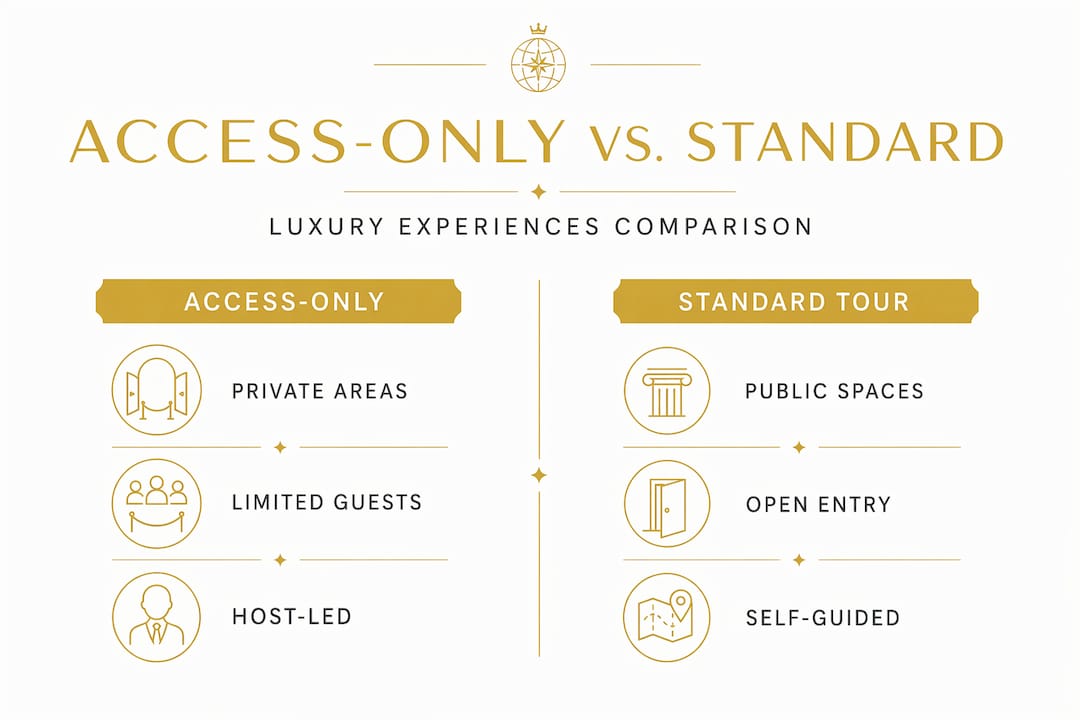
In luxury travel, the same principle scales up dramatically. Think of an after-hours visit to the Louvre when the galleries are empty, or a private tour of a Moroccan riad’s private quarters accompanied by the family who has owned it for generations. These are not upgrades on top of a standard experience. They are entirely separate offerings built around controlled, curated entry.
Here is what typically characterizes a genuine access-only experience in high-end travel:
- Permission-based entry: Access is conditional, granted through tickets, membership, or a vetted booking process
- Restricted availability: Guest numbers are tightly capped to preserve the quality of the encounter
- Off-limits areas: Participants reach spaces that are closed or invisible to regular visitors
- Timed or after-hours access: Entry windows are specific, often outside standard operating hours to minimize overlap with crowds
- Hosted or guided formats: An expert or insider accompanies the group to provide context and depth
Pro Tip: When evaluating whether something is a true access-only experience, ask the operator one question: “Can a member of the public book this same experience tomorrow?” If the answer is yes, it is likely a premium tour, not a genuine access-only offering.
Benefits of access-only experiences for luxury travelers
The appeal of access-only experiences goes well beyond novelty. For luxury travelers who have seen the world’s most celebrated destinations, the real currency is no longer the place itself. It is the quality of the encounter.
In luxury travel, exclusive access typically includes priority entry, after-hours visits, small-group guided tours, and hosted experiences not normally open to the public. Each of these elements delivers a specific and measurable benefit:
- Fewer people, more presence. When you visit the Vatican Museums with a group of eight at 7 a.m., before any other guests arrive, the art actually speaks to you. The same galleries at noon feel overwhelming.
- Expert depth you cannot find in a group tour. Access-only experiences regularly feature specialized guides, including curators, archaeologists, sommeliers, or local historians, who share knowledge that no audio guide or general tour covers.
- Authentic moments over choreographed ones. Hosted experiences in private homes, family estates, or working farms create genuine human connection. That kind of storytelling is increasingly rare in travel.
- Calmer, more considered pacing. Without crowds dictating your movement, you linger where something interests you and move on when you are ready.
- The irreplaceable sense of privilege. Knowing that what you are experiencing exists outside the reach of the general public changes how it feels to be there.
“Luxury travel operators frame unlocking access as removing friction to create calmer, immersive experiences rather than just adding perks.” — The National News, 2026
The organized advantages of exclusive access are also visible in nature-based travel, where a guided private ascent of Table Mountain in Cape Town offers a fundamentally different encounter than joining a crowded cable car queue. The wildlife you spot, the silence you experience, and the perspective you gain are simply not available in a mass-tourism format.
How access-only compares to other luxury formats

Many travelers use the terms private tour, VIP package, and access-only experience interchangeably. They are not the same. Understanding the differences helps you make smarter decisions when building a luxury itinerary.
| Format | Capacity | Timing | What you access | Exclusivity driver |
|---|---|---|---|---|
| Standard tour | 20 to 50 guests | Regular operating hours | Public areas only | None |
| Private tour | 1 to 8 guests | Regular or slightly extended hours | Public areas, sometimes more | Pricing and customization |
| VIP package | Varies | Priority entry within public hours | Fast-tracked public access | Ticketing tier |
| Access-only experience | Strictly capped, often 2 to 12 | After-hours, pre-opening, or restricted windows | Closed or private areas | Capacity management and permission |
The defining variable is capacity management. Disney After Hours sells out regularly despite rising prices because the value lies entirely in the reduced crowd, not the entertainment itself. That same logic governs premium access-only travel experiences. When a winery opens its barrel cellar to eight guests on a Tuesday evening and the winemaker pours directly from the cask, the scarcity is the experience.
True access-only experiences combine priority or after-hours access, expert guides, and hosted visits to areas not normally open, distinguishing them clearly from private tours. A private tour of Rome can still take you down the same streets as everyone else, just with your own driver. An access-only experience takes you through the door behind the altar of a closed church while a professor of ecclesiastical history explains what you are seeing.
VistaJet’s exclusive dinner experiences at private residences and behind-the-scenes access represent the premium end of this spectrum, where the brand’s value is entirely built on unlocking what money alone cannot buy. That shift from purchasing services to unlocking access is what separates the top tier of luxury travel from everything below it. You can explore elite travel distinctions in more depth to see how this plays out across destinations and formats.
How to plan access-only experiences for your itinerary
Planning access-only experiences requires a different approach than booking standard luxury accommodations or restaurants. The scarcity is real. Limited-capacity events enforce strict caps and may refuse entry to late arrivals, even with payment confirmed. That reality shapes how you need to approach the planning process.
Here is how to build access-only experiences effectively into a luxury travel agenda:
- Define your interests before searching for options. Access-only offerings span cultural heritage, wildlife, gastronomy, architecture, and private estates. Knowing whether you want to stand inside a pharaoh’s tomb before the crowds arrive or dine in a vineyard’s private cave narrows the search considerably.
- Work with operators who have genuine insider relationships. Not every travel company can deliver true access-only experiences. Travel industry insiders who have cultivated direct connections with museums, landowners, and local institutions can unlock opportunities that are simply not listed anywhere publicly.
- Book as early as possible. Many of the best access-only experiences are released months in advance and fill within days. Treating these as afterthoughts when you arrive at a destination usually means missing them entirely.
- Ask specifically about what makes the access restricted. A credible operator should be able to explain clearly why this experience is not available to the general public, whether it is a capacity agreement, a private arrangement, or a special permit.
- Consider access-only memberships as a long-term strategy. Some luxury travel clubs and museum foundations offer access-only memberships that provide recurring priority entry, after-hours invitations, and hosted events throughout the year.
Pro Tip: When reviewing a luxury itinerary, check how many of the experiences listed are genuinely capacity-controlled and permission-based. If most can be booked by anyone online, you may want to ask your travel planner about upgrading to true exclusive excursion options instead.
Standout examples of access-only experiences worth seeking out include private sunrise access to Angkor Wat before public gates open, after-hours visits to Florence’s Uffizi Gallery arranged through select operators, hosted tastings in the private cellars of Burgundy’s grand cru estates, and small-group dawn safaris in conservancies that limit daily visitor numbers to single digits. The small group luxury tour model is particularly well-suited to delivering this caliber of experience.
My perspective on access-only and what most travelers miss
I’ve spent years helping discerning travelers build itineraries that genuinely surprise them. What I’ve learned is that most people come to me focused on the wrong thing. They want to know which hotel has the best suite, which restaurant has the longest waiting list, which island is the most remote. Those are fine questions. But the travelers who come back to me with the most vivid stories are the ones who had access.
What I’ve found is that access-only experiences do something that no amount of thread count or Michelin stars can replicate. They make you feel like the world opened up specifically for you. Standing in an archaeological site before sunrise, with a scholar explaining what you are looking at while everyone else is still asleep, changes the way you relate to a place. It is not about exclusivity as a status signal. It is about depth.
The uncomfortable truth I’ve learned about luxury travel planning is that capacity management is the most underrated element in the entire industry. The reason certain experiences feel genuinely rare is not because they are expensive. It is because the number of people who can have them at any given moment is tightly controlled. When I see a client’s itinerary filled with things anyone could book the day before departure, I know they are going to have a perfectly pleasant trip. But they won’t come home transformed.
My recommendation is always to anchor the itinerary around two or three genuine access-only moments, then build the comfortable, beautiful, well-serviced travel around those core experiences. The suite and the private jet are supporting characters. The access is the story.
— Sandon
Plan your access-only luxury travel with Grandglobetrotting
Grandglobetrotting specializes in building luxury travel itineraries that go beyond what any standard booking platform can offer. Through direct industry relationships and a personalized concierge approach, the team sources genuine access-only experiences, from after-hours museum visits to hosted private estate dinners, and weaves them into a cohesive, effortless trip. Whether you are planning a honeymoon, a solo adventure, or a milestone celebration, the process starts with understanding exactly what kind of access matters most to you. Explore the full range of bespoke itinerary planning services and luxury hotel selections that pair beautifully with access-only experiences at every destination.
FAQ
What does access-only mean in travel?
Access-only means entry that is restricted to a defined group through ticketing, membership, or a vetted permission process. It grants experiences that are unavailable to general visitors, such as after-hours site visits or hosted tours of private areas.
How are access-only events different from private tours?
Private tours customize your experience within publicly accessible areas, while access-only events take you into spaces that are genuinely closed or restricted to the general public, often with strict capacity limits.
Why do access-only experiences sell out so quickly?
Capacity limits are enforced strictly, and once an event reaches its guest maximum, no further entry is permitted. This scarcity is what makes the experience valuable, which drives early demand.
What are some examples of access-only experiences in luxury travel?
Examples include pre-dawn access to Angkor Wat, after-hours visits to major European museums, private tastings in grand cru wine cellars, and hosted tours of closed archaeological sites with specialist guides.
How do I book genuine access-only travel experiences?
Working with a luxury travel planner who holds direct relationships with operators and venues is the most reliable method, since many of the best access-only experiences are never listed publicly.
Recommended
At Grand Globetrotting, we don't just plan vacations; we craft extraordinary adventures that leave you with cherished memories. Let us bring your dream vacation to life, perfectly tailored to your style, and immerse yourself in a world of luxury, exploration, and unforgettable moments. Your journey begins with us.
Itinerary planning services require a separate charge outside of cost to book travel accommodations. Depending upon the complexity of the itinerary and the level of effort required to acquire unique experiences, cost may vary. Speak with our team to learn more.
Book your consultation