

TL;DR:
- Efficient group travel planning depends on appointing a single coordinator, utilizing digital tools, and starting early. Structured timelines, clear roles, and limited daily schedules help prevent planning delays and traveler fatigue. Proper financial transparency and early deposits ensure commitments, leading to smoother, more enjoyable trips.
Efficient group travel coordination is defined as the practice of centralizing logistics, communication, and decision-making so that every traveler moves through the planning process with minimal friction and maximum clarity. Knowing how to streamline group travel separates trips that actually happen from ones that dissolve into endless group chats and unanswered polls. Tools like Splitwise, TripIt, and Doodle now make it possible to manage budgets, itineraries, and scheduling across dozens of travelers from a single interface. The payoff is real: centralized travel coordination can reduce total trip costs by 10–18% and cut planning time by up to 90%. That kind of efficiency is not accidental. It comes from structure.
How to streamline group travel with clear roles and decisions
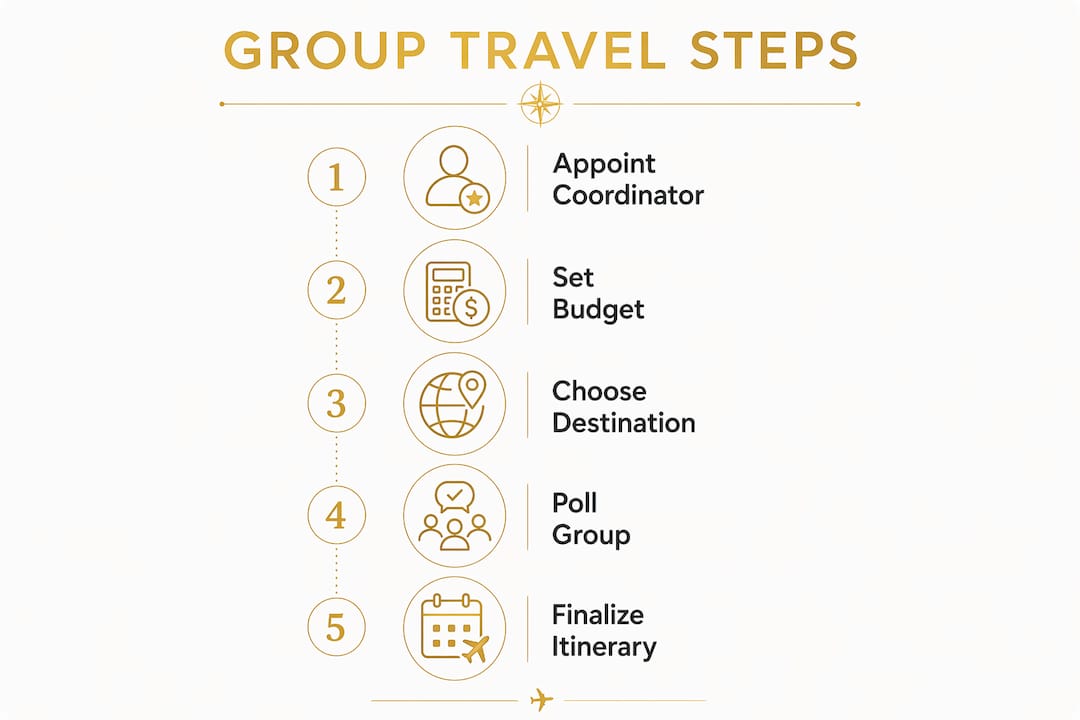
The single most effective structural change in organizing group trips is appointing one coordinator, not a committee. When everyone has an equal vote on every decision, the group stalls. When one person owns the process and presents curated options, the group moves forward.

Successful coordinators act as facilitators, not bosses. They research destinations, filter the realistic options down to two or three, and then present those to the group for a vote. This approach respects group input while preventing the paralysis that comes from open-ended questions like “Where does everyone want to go?”
For larger groups of ten or more, assign sub-group leaders or deputies. One person handles accommodation research, another manages dining reservations, and a third tracks transportation. This distribution prevents the primary coordinator from burning out before the trip even begins.
Key structural practices that accelerate group decision-making:
- Appoint one primary coordinator with final say on logistics
- Limit poll options to two or three choices to prevent scattered responses
- Set firm deadlines for every vote or confirmation request
- Assign sub-group deputies for accommodation, transport, and dining
- Avoid open-ended questions in group chats; use structured polls instead
Structured polls with deadlines speed decisions and prevent planning paralysis. Open-ended questions produce scattered answers and no resolution. The fix is simple: give people a limited set of options and a 48 to 72 hour window to respond.
Pro Tip: Use Google Forms or Doodle to create polls with a visible deadline. State the deadline in the poll itself, not just in a separate message that gets buried in the chat.
Which tools best support group travel planning?
The right digital tools eliminate the back-and-forth that consumes most of a coordinator’s time. The industry term for this category is “travel management platforms,” and they range from free consumer apps to enterprise-grade systems. For most leisure and mid-size groups, a combination of three tool types covers the full planning cycle.
| Tool Category | Best Options | Primary Function |
|---|---|---|
| Itinerary management | TripIt, Vacation Planner | Centralize flights, hotels, and activities |
| Expense tracking | Splitwise, Tricount | Split costs and track reimbursements |
| Scheduling and polls | Doodle, Google Forms | Coordinate dates and preferences |
| Communication | WhatsApp, Slack | Real-time logistics and updates |
Automation in travel booking cuts booking time from 15 to 20 hours down to under 5 hours per trip on average. That time savings alone justifies adopting even a basic platform. The broader benefit is that automated tools reduce human error in booking confirmations, payment tracking, and itinerary distribution.
For groups with a corporate or semi-formal structure, platforms that enforce travel policies at the point of booking are particularly valuable. Policy integration at booking increases compliance from 40% to 91%, which means fewer out-of-policy expenses and fewer disputes after the trip. This matters even for leisure groups where a shared budget has been agreed upon in advance.
Additional tools worth considering for efficient group travel planning:
- Expensify for receipt capture and reimbursement automation
- Google Docs for shared, view-only itinerary documents
- Slack channels to separate planning discussions from real-time logistics
- Trello or Notion for task assignment and deadline tracking across the coordinator team
How to set realistic timelines and budgets for group trips
Timing is the variable most groups underestimate. International group trips require at least 3 to 4 months of lead time. Domestic trips need a minimum of 6 to 8 weeks. These windows exist because group bookings involve coordinating multiple schedules, securing block accommodations, and confirming transportation for a larger party than any individual traveler manages alone.
A practical timeline for organizing group trips looks like this:
- Month 1 (international) or Week 1 (domestic): Confirm attendee list and collect commitment deposits
- Month 2 or Week 2: Lock in destination, dates, and accommodation type
- Month 3 or Week 3 to 4: Book flights, hotels, and major activities
- Month 4 or Week 5 to 6: Distribute the draft itinerary and collect final payments
- One week before departure: Share the final, view-only itinerary document with all travelers
The commitment deposit step is non-negotiable for groups larger than six. The top cause of group trip failures is the “maybe” attendee who cancels at the last minute, disrupting budgets and accommodation counts. Non-refundable deposits in the range of $100 to $200 per person filter out uncommitted participants before any money is spent on bookings.
Budget conversations must happen before destination selection, not after. When the group agrees on a per-person budget first, destination options naturally narrow to what is realistic. This prevents the awkward situation where one traveler books a luxury suite while another is calculating whether they can afford the trip at all.
Pro Tip: Use a single shared payment method or a group fund in an app like Splitwise to collect contributions upfront. Splitting charges across multiple cards multiplies reconciliation complexity and delays refunds significantly.
For flights specifically, group bookings are rarely cheaper than individual bookings. The smarter approach is for each traveler to book independently and coordinate arrival windows. Coordinated arrivals within a 3-hour window make ground transportation far more cost-effective and logistically manageable.
What itinerary and communication strategies keep group trips on track?
The most common mistake in group itinerary planning is over-scheduling. When every hour is accounted for, travelers feel managed rather than free, and resentment builds quickly. The 70/30 rule solves this directly: plan approximately 70% of each day as structured group activities and leave 30% unstructured for individual exploration, rest, or spontaneous decisions.
This balance prevents traveler fatigue and keeps the group dynamic positive throughout the trip. A day in Rome, for example, might include a morning Vatican tour and a group lunch reservation, with the afternoon left open for each traveler to explore independently before a group dinner.
Communication structure matters as much as the itinerary itself. The most effective setup uses two separate channels:
- A planning channel (Google Docs, Notion, or email thread) for pre-trip logistics, document sharing, and itinerary updates
- A real-time channel (WhatsApp or Slack group) for day-of logistics, meeting point confirmations, and quick updates during the trip
Mixing planning and real-time communication in one channel causes important information to get buried. When a hotel confirmation is three hundred messages above the current conversation, no one can find it when they need it.
| Communication Tool | Best Use Case | Format |
|---|---|---|
| Google Docs | Shared itinerary, packing lists | View-only document |
| Real-time updates during the trip | Group chat | |
| Doodle | Pre-trip scheduling and polls | Structured poll |
| Booking confirmations, formal updates | Threaded archive |
Distribute the final itinerary document 5 to 7 days before departure. This timing gives travelers enough lead time to review it, ask questions, and prepare without the document being forgotten by the time the trip starts. Make it view-only to prevent accidental edits, and include emergency contacts, hotel addresses, and transportation details in a clearly labeled section at the top.
For customized travel itineraries that account for the full complexity of a large group, working with a professional planner can reduce the coordinator’s workload substantially. The coordinator’s role then shifts from building the itinerary to communicating it.
Key takeaways
Efficient group travel planning requires a single coordinator, the right digital tools, and a structured timeline that begins months before departure.
| Point | Details |
|---|---|
| Appoint one coordinator | A single decision-maker with curated options prevents planning paralysis and delays. |
| Use digital tool combinations | Pair TripIt or Vacation Planner with Splitwise and Doodle to cover itinerary, expenses, and scheduling. |
| Start planning early | Allow 3 to 4 months for international trips and 6 to 8 weeks for domestic travel. |
| Collect commitment deposits | Non-refundable fees of $100 to $200 filter uncommitted travelers before bookings are made. |
| Apply the 70/30 itinerary rule | Plan 70% of each day as group activities and leave 30% free to prevent fatigue and resentment. |
What I’ve learned from coordinating group travel at scale
After years of planning group trips across dozens of destinations, the pattern I see most often is coordinators who take on too much and travelers who contribute too little. The coordinator becomes the single point of failure, and when they burn out or make one unpopular decision, the whole group dynamic fractures.
The coordinators who do this well treat themselves as process managers, not travel agents. They set up the systems, present the options, and enforce the deadlines. They do not personally research every restaurant or negotiate every room rate. That is what tools and professional services are for.
The financial transparency piece is where most leisure groups fail. People are uncomfortable talking about money, so budgets get assumed rather than confirmed. Then someone books a private villa while someone else is quietly calculating whether they can cover their share. Having the budget conversation in the first group meeting, before any destination is chosen, removes that tension entirely.
One more thing I have found to be consistently true: the groups that have the best trips are not the ones with the most elaborate itineraries. They are the ones with the clearest expectations and the most unstructured time. The 70/30 balance is not just a planning technique. It is a philosophy about respecting individual autonomy within a shared experience. Build that into your planning from day one, and the trip tends to take care of itself.
— Sandon
Let Grandglobetrotting handle the complexity for you
Planning a group trip involves more moving parts than most travelers anticipate until they are already deep in the process. Grandglobetrotting specializes in exactly this kind of complexity, offering bespoke itinerary planning that accounts for group size, individual preferences, budget parameters, and destination logistics from the first consultation.

Whether your group is traveling for a milestone celebration, a corporate retreat, or a multi-family vacation, Grandglobetrotting’s concierge team manages the coordination so you do not have to. From luxury hotel block bookings to curated activity schedules, every detail is handled with the precision and personal attention that group travel demands. Reach out to start building your group itinerary today.
FAQ
What is the ideal group size for coordinated travel?
Groups of 6 to 20 travelers benefit most from structured coordination with a single coordinator and digital tools. Above 20 travelers, sub-group deputies and a formal travel management platform become necessary to maintain efficiency.
How far in advance should a group trip be planned?
International group trips require at least 3 to 4 months of lead time, while domestic trips need a minimum of 6 to 8 weeks. Starting earlier reduces costs and increases accommodation availability.
What is the best way to manage group travel expenses?
Use a centralized expense tracker like Splitwise or Tricount and collect contributions upfront into a shared fund. Splitting costs across multiple individual cards significantly increases reconciliation time and delays reimbursements.
Should a group book flights together or separately?
Group flight bookings are rarely cheaper than individual bookings. Each traveler should book independently and coordinate arrival times within a 3-hour window to simplify ground transportation logistics.
How do you prevent last-minute cancellations from disrupting a group trip?
Collect a non-refundable deposit of $100 to $200 per person early in the planning process. This commitment fee filters out uncertain participants before any accommodation or activity bookings are confirmed.
Recommended
At Grand Globetrotting, we don't just plan vacations; we craft extraordinary adventures that leave you with cherished memories. Let us bring your dream vacation to life, perfectly tailored to your style, and immerse yourself in a world of luxury, exploration, and unforgettable moments. Your journey begins with us.
Itinerary planning services require a separate charge outside of cost to book travel accommodations. Depending upon the complexity of the itinerary and the level of effort required to acquire unique experiences, cost may vary. Speak with our team to learn more.
Book your consultation