

TL;DR:
- Private aviation enables executives to reclaim 15 to 20 hours weekly by bypassing commercial delays and transfers. It offers faster airport access, flexible scheduling, and secure, confidential environments essential for high-stakes business activities. Strategic integration of private flights based on actual usage maximizes ROI and enhances corporate productivity.
Private aviation is defined as the use of non-commercial aircraft chartered or owned exclusively for a specific trip, and its role of private flights in business trips is to reclaim executive time, protect sensitive information, and deliver flexibility that commercial airlines structurally cannot provide. For senior executives managing multi-city schedules, investor meetings, and time-critical negotiations, private aviation functions as operational infrastructure rather than a travel upgrade. The difference between closing a deal in Frankfurt and missing it entirely can come down to a two-hour commercial delay. Understanding how private flights work, what they cost, and when they deliver genuine ROI is the foundation of smarter executive travel planning.
How do private flights save time and increase productivity?
Private aviation’s most measurable advantage is time recovery. Senior executives reclaim 15 to 20 hours weekly by bypassing commercial queues, check-in windows, and connection layovers. That figure represents nearly half a standard workweek returned to revenue-generating activity every single week.

The airport access advantage compounds this further. Private jets reach approximately 5,000 U.S. airports, compared to roughly 500 served by commercial carriers. That expanded reach means executives can land at a regional airport 15 minutes from a client’s headquarters rather than a major hub requiring a 90-minute ground transfer. The time saved on the ground often rivals the time saved in the air.
Flexible scheduling is the third mechanism. Commercial travel forces executives to build itineraries around airline timetables. Private aviation reverses that relationship. A CEO can depart at 6:00 a.m., attend two meetings in different cities, and return home the same evening. Multi-city itineraries compress from four or five days to three when private aviation replaces commercial routing, which directly improves business agility.
In-flight productivity adds another layer. Private cabins allow teams to conduct confidential briefings, review sensitive financial documents, and hold strategy sessions without the risk of being overheard. That capability is simply unavailable on commercial aircraft, regardless of cabin class.
Key time and productivity advantages include:
- No commercial check-in window: Arrive 15 minutes before departure instead of two hours.
- Expanded airport access: Land closer to final destinations, cutting ground transfer time.
- Same-day multi-city travel: Complete itineraries in fewer calendar days.
- Uninterrupted in-flight work: Conduct meetings and review confidential materials without exposure.
Pro Tip: Choose secondary airports within 30 miles of your destination over major hubs whenever possible. Smaller regional airports deliver faster connections and less congestion, and that ground time difference often exceeds the in-air time savings.
What are the economic benefits and ROI of private flights?
The economic case for private aviation rests on opportunity cost, not ticket price. A four-person executive team flying Paris to Geneva on a private jet saves 8 hours of travel time, translating to approximately €2,400 in productivity gains per trip when executive time is valued at €300 per hour. That calculation does not include the value of deals accelerated or relationships strengthened by arriving prepared and on time.
Group travel economics shift the per-person cost significantly. A charter flight shared across four executives costs far less per seat than four separate business-class tickets, once you factor in lounge access, checked baggage, and the hotel night often required when commercial connections fail. The hidden costs of commercial travel, including missed meetings, delayed decisions, and fatigue-driven errors, rarely appear in travel budgets but consistently affect business outcomes.
Private flights should be evaluated by opportunity cost, not by comparing the charter fee to a commercial fare. The correct comparison is the charter fee against the value of the contract, relationship, or decision that the trip enables.
| Cost component | Commercial travel | Private aviation |
|---|---|---|
| Per-seat cost (4 executives) | Lower nominal fare | Higher charter fee, lower per-person cost when shared |
| Hidden time costs | 2-hour check-in, layovers, transfers | 15-minute arrival, direct routing |
| Overnight hotel risk | High on multi-city trips | Minimal with same-day return capability |
| In-flight productivity | Limited, privacy absent | Full working environment, confidential meetings |
| Missed meeting risk | Moderate to high with connections | Low with flexible scheduling |
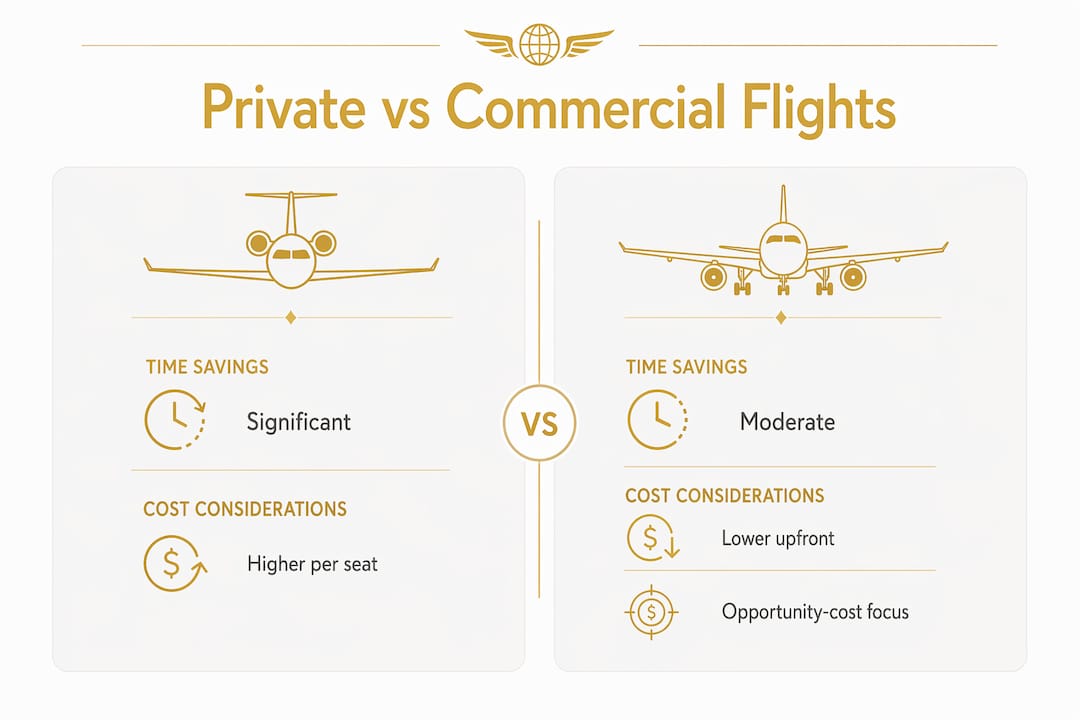
Access models matter for budget planning. Full ownership suits companies flying more than 400 hours annually. Fractional ownership programs, offered by operators like NetJets and Flexjet, suit companies flying 50 to 200 hours per year. On-demand charter through brokers suits companies with irregular or infrequent needs. Matching the model to actual usage patterns is where most companies either capture or destroy value.
Pro Tip: Before approving a private flight, calculate the executive hourly rate multiplied by hours saved, then add the cost of any delayed decision or missed meeting. That number almost always exceeds the charter fee for senior leadership travel.
What operational pitfalls should businesses know about private flights?
Private aviation delivers its promised efficiency only when managed with precision. Mismatched aircraft size and last-minute bookings can inflate costs by up to 40%, turning a smart investment into an expensive one. Booking a heavy jet for a two-person domestic trip, or calling a broker 12 hours before departure, are the two most common ways companies overspend.
Hidden operational delays also reduce nominal efficiency. De-icing procedures, aircraft repositioning from a distant base, and slot restrictions at certain airports all add time that does not appear in the quoted flight duration. Practitioners consistently note that true efficiency gains come from secondary airports closer to final destinations, not from the aircraft itself.
The most effective companies treat private aviation as a variable strategic asset. Businesses that align private aviation spending with revenue-driving activities rather than treating it as fixed overhead see better cost control and measurable ROI. That means approving private flights for high-stakes client meetings and time-sensitive multi-city trips, not routine travel that commercial airlines handle adequately.
Operational best practices for private flight management:
- Match aircraft to trip size: A light jet for one to three passengers, a midsize jet for four to six, and a heavy jet only when the passenger count or range demands it.
- Book with advance notice: Aim for 48 to 72 hours minimum to access competitive pricing and preferred aircraft.
- Use vetted brokers or AI-driven platforms: Services like PrivateFly and Avinode aggregate operator pricing and reduce sourcing risk.
- Account for repositioning fees: Always ask where the aircraft is based before accepting a quote.
- Track utilization data: Review flight logs quarterly to identify patterns and negotiate better rates with preferred operators.
Pro Tip: Build a simple decision matrix for your travel team: if the trip involves three or more executives, a same-day return, or a contract valued above a defined threshold, private aviation is automatically evaluated. That framework removes subjective approval delays and captures efficiency gains consistently.
How do private flights protect confidentiality and security?
Confidentiality is one of the most undervalued advantages of private aviation in corporate travel. Private cabins enable uninterrupted work and privacy that commercial business class cannot replicate, regardless of how premium the seat. On a commercial flight, a conversation about an acquisition target, a board decision, or a client negotiation can be overheard by anyone within three rows.
The security advantages extend beyond the cabin. Private terminals, known as fixed-base operators (FBOs), bypass the public check-in and security queues where sensitive documents and executive identities are exposed. Vetted ground crews and operators add another layer of discretion that commercial airports cannot provide at scale.
Specific use cases where private aviation security is non-negotiable:
- Mergers and acquisitions travel: Legal and financial teams traveling together to due diligence meetings require complete information security.
- Investor and board meetings: Executives discussing unreleased financial data need environments free from accidental disclosure.
- High-profile leadership transitions: Travel surrounding sensitive personnel decisions benefits from the anonymity private terminals provide.
- Healthcare and legal professionals: Regulated industries with strict confidentiality requirements find private aviation aligns naturally with compliance obligations.
Tailored ground services from reputable operators also include background-checked crews, secure baggage handling, and discreet arrival and departure procedures. For executives whose movements carry market-sensitive implications, that level of operational control is a genuine business requirement.
How can executives integrate private flights into their travel strategy?
Strategic integration of private aviation starts with an honest assessment of travel patterns. Companies flying fewer than 25 hours annually are best served by on-demand charter. Those flying 50 to 200 hours benefit from fractional ownership programs. Full ownership makes financial sense only above 400 annual flight hours, when the fixed costs of crew, maintenance, and hangar are distributed across sufficient utilization.
A structured approach to integration includes the following steps:
- Audit current travel data: Review the past 12 months of executive travel for trip frequency, destinations, group sizes, and commercial delays experienced.
- Identify high-value trip types: Flag multi-city itineraries, same-day returns, and trips involving four or more executives as primary candidates for private aviation.
- Select the right access model: Match ownership, fractional, or charter to actual usage volume and budget parameters.
- Engage a corporate travel manager or broker: Professionals with operator relationships negotiate better rates and manage logistics that internal teams rarely have bandwidth to handle.
- Set measurable outcomes: Define what success looks like, whether that is hours saved per quarter, deals closed faster, or executive satisfaction scores, and review results against spend.
Mid-sized businesses and healthcare networks increasingly use private aviation for urgent multi-state trips, expanding well beyond large multinationals. That shift reflects a broader recognition that the productivity and agility benefits scale to any organization where executive time has measurable commercial value. For companies building a corporate travel management framework, private aviation belongs in the toolkit alongside commercial premium cabins and ground transportation policies.
Key takeaways
Private aviation delivers its strongest ROI when treated as a strategic productivity tool aligned with specific, high-value business activities rather than a general travel upgrade.
| Point | Details |
|---|---|
| Time recovery is the core benefit | Executives reclaim 15 to 20 hours weekly by bypassing commercial queues and delays. |
| Airport access multiplies efficiency | Access to 5,000 airports versus 500 commercial ones cuts ground transfer time significantly. |
| ROI requires the right cost model | Match ownership, fractional, or charter access to actual annual flight hours to control spend. |
| Confidentiality has real business value | Private cabins and FBO terminals protect sensitive negotiations that commercial travel cannot secure. |
| Operational discipline prevents waste | Correct aircraft sizing and advance booking prevent cost inflation of up to 40%. |
Why I think most executives are still underusing private aviation
Most of the executives I work with come to private aviation after a commercial travel failure, a missed deal, a delayed board meeting, or a confidential conversation that should never have happened in a crowded terminal. That reactive approach costs more than a proactive strategy would have.
Smart CEOs treat private aviation as strategic infrastructure, similar to enterprise software or a senior hire. The question is never whether the flight is expensive. The question is whether the outcome it enables is worth more than the cost. In my experience, the answer is yes far more often than most travel budgets reflect.
The overlooked benefit I see most consistently is multi-stop flexibility. A single private flight day can replace three commercial travel days, and that compression does not just save time. It changes what is possible in a quarter. Executives who build private aviation into their planning from the start, rather than booking it as a last resort, consistently report better deal velocity and lower overall travel fatigue.
My recommendation is to start with data. Pull your last year of travel records, identify the five trips that cost the most in delayed decisions or executive hours lost, and price what a private charter would have cost for each. The comparison is almost always more favorable than expected.
— Sandon
Plan your executive travel with Grandglobetrotting
Grandglobetrotting specializes in building personalized, high-end travel experiences for executives who need more than a booking platform. From sourcing the right private aircraft for your itinerary to coordinating ground logistics, hotel accommodations, and dining, the team brings concierge-level expertise to every detail of your corporate travel.
Whether you are planning a single high-stakes trip or building a full-year executive travel program, Grandglobetrotting’s executive trip planning guide walks you through every decision with clarity and precision. For a fully tailored approach that integrates private flights, luxury hotels, and bespoke itineraries, explore the personalized luxury travel guide and start planning with confidence.
FAQ
What is the main role of private flights in business trips?
The primary role is to recover executive time and protect schedule flexibility. Private aviation eliminates commercial check-in windows, layovers, and ground transfers, allowing executives to complete multi-city itineraries in fewer days.
Are private flights cost-effective for business travel?
Private flights are cost-effective when evaluated against opportunity cost rather than ticket price. A four-person executive team traveling Paris to Geneva saves approximately €2,400 in productivity value per trip, which frequently offsets or exceeds the charter cost.
How do private jets improve confidentiality on business trips?
Private cabins and fixed-base operator terminals eliminate the public exposure of commercial airports and aircraft. Teams can conduct sensitive negotiations, review confidential documents, and discuss unreleased financial data without risk of interception.
What is the best access model for companies new to private aviation?
On-demand charter through a vetted broker is the lowest-risk entry point for companies flying fewer than 25 hours annually. Fractional ownership programs from operators like NetJets or Flexjet suit companies with more predictable, higher-volume travel needs.
How far in advance should a private flight be booked?
Booking 48 to 72 hours in advance secures competitive pricing and preferred aircraft availability. Last-minute bookings can inflate costs by up to 40% due to limited operator availability and repositioning fees.
Recommended
At Grand Globetrotting, we don't just plan vacations; we craft extraordinary adventures that leave you with cherished memories. Let us bring your dream vacation to life, perfectly tailored to your style, and immerse yourself in a world of luxury, exploration, and unforgettable moments. Your journey begins with us.
Itinerary planning services require a separate charge outside of cost to book travel accommodations. Depending upon the complexity of the itinerary and the level of effort required to acquire unique experiences, cost may vary. Speak with our team to learn more.
Book your consultation