

TL;DR:
- Travel risk management involves identifying, assessing, and mitigating travel dangers to ensure traveler safety and compliance. It requires a dynamic, intelligence-led approach with layered operational protocols, including real-time tracking, cybersecurity, and crisis response, to fulfill duty of care obligations. Regular policy reviews and cross-functional teamwork are essential for effective, legally compliant travel risk programs.
Travel risk management (TRM) is defined as the structured process of identifying, assessing, and mitigating risks that travelers face before, during, and after their journeys. Whether you are a solo traveler heading abroad or a corporation sending employees to high-risk destinations, TRM provides the framework to protect people and meet legal obligations. The international standard governing this practice is ISO 31030:2021, which shifts TRM from static policy documents to dynamic, intelligence-led programs. Duty of care sits at the legal and ethical core of every TRM program, making it a non-negotiable responsibility for employers and travel organizers alike.
What is travel risk management and why does it matter?
Travel risk management is the discipline of proactively protecting travelers from health emergencies, security threats, environmental hazards, and logistical disruptions. It covers every phase of a trip, from pre-departure planning through real-time monitoring to post-incident review. For businesses, TRM is also a compliance requirement. For individuals, it is the difference between a disrupted trip and a dangerous one.

The scope of TRM has expanded significantly in recent years. Geopolitical instability, cybersecurity threats on travel devices, and post-pandemic health protocols have added new layers of complexity. Organizations that treat TRM as a checkbox exercise rather than a living program expose themselves to serious legal and reputational consequences. The goal of travel risk strategies is to reduce disruptions, protect employee wellbeing, and support confident decision-making across global journeys.
What are the core components of a TRM program?
An effective TRM architecture requires five operational layers aligned with ISO 31030. Each layer addresses a distinct vulnerability in the travel lifecycle.
| Operational Layer | Description | Example |
|---|---|---|
| Pre-Trip Risk Assessment | Evaluate destination-specific threats before departure | Country risk ratings, health advisories |
| Real-Time Traveler Tracking | GPS check-ins, flight status, two-way communication | SMS alerts, push notifications |
| Cybersecurity Measures | Protect traveler devices and remote access | VPN requirements, encrypted communications |
| Medical and Evacuation Support | Health coverage and emergency evacuation planning | Medical insurance, local clinic directories |
| Crisis Response Protocol | Rapid incident management with defined response timelines | 24/7 support desk, 30-minute response baseline |
The 30-minute response baseline is the industry benchmark for high-severity incidents. It is achieved through synchronized location data drawn from booking records, GPS check-ins, and live flight status updates. That three-point data architecture means a travel security team can pinpoint a traveler’s location quickly when a crisis unfolds.
Pro Tip: Never rely solely on app-based push notifications for traveler alerts. SMS delivers over 97% success across 184 countries, making it the most dependable channel when data connectivity fails or networks are throttled during a crisis.
How does TRM support duty of care and legal compliance?
Duty of care is a non-delegable legal and ethical obligation requiring employers to protect the health, safety, and security of their traveling employees. “Non-delegable” means an organization cannot outsource this responsibility entirely to a travel management company or insurance provider. The obligation stays with the employer.
Failing to implement structured TRM programs exposes organizations to legal liability, regulatory penalties, and reputational damage. Courts in multiple jurisdictions have applied duty of care principles to corporate travel scenarios, holding employers accountable when employees were harmed in foreseeable situations that a TRM program could have mitigated. The regulatory environment is tightening, not loosening.
Key legal and compliance risks organizations face without a formal TRM program include:
- Litigation exposure from employees or their families following preventable travel incidents
- Regulatory penalties in jurisdictions with formal occupational health and safety travel requirements
- Reputational damage when incidents become public and reveal an absence of traveler protection protocols
- Insurance coverage gaps when claims arise from trips not covered by a documented risk assessment process
TRM enables organizations to fulfill duty of care through active monitoring and documented response, not just written policies. A policy that sits in a handbook without real-time tracking or incident response capability does not satisfy the legal standard. Employers need to show they acted, not just planned.
What are the best practices for managing travel risks?
The shift from static travel policies to dynamic, intelligence-led risk management is the defining feature of modern TRM. Destination conditions change rapidly. A policy written in January may be dangerously outdated by March if a geopolitical situation escalates or a health outbreak emerges.
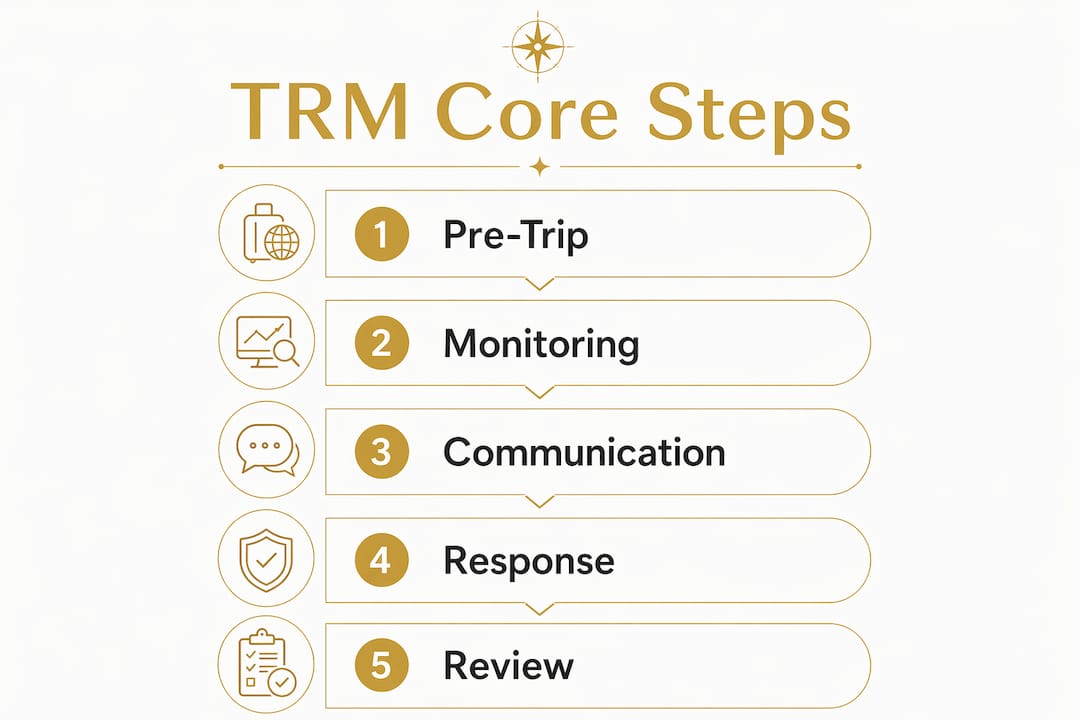
Effective TRM programs follow a structured sequence of steps:
- Conduct a pre-trip risk assessment. Score the destination against health, security, environmental, and logistical risk categories using current intelligence sources.
- Deliver destination-specific safety briefings. Provide travelers with actionable information about local laws, medical facilities, emergency contacts, and high-risk areas.
- Establish real-time communication protocols. Confirm traveler contact preferences and set up SMS-based check-in schedules before departure.
- Integrate cross-functional governance. Bring HR, Legal, Security, and Procurement into the TRM program to avoid siloed decision-making.
- Assign 24/7 incident ownership. Designate a human point of contact for emergencies rather than relying on automated systems alone.
- Review and update policies annually. Audit travel policies against current geopolitical and regulatory conditions every year without exception.
Cross-functional governance is one of the most overlooked elements of TRM. When HR manages traveler data, Security manages threat intelligence, and Legal manages compliance, but none of these teams communicate regularly, critical gaps emerge. A traveler can fall through the cracks of a fragmented system.
Human case ownership during incidents is equally critical. Automated alerts can notify a traveler of a threat, but a complex health emergency or civil unrest situation requires nuanced, expert guidance that no algorithm can provide. The most effective programs combine technology with a dedicated 24/7 support team.
Pro Tip: Failing to audit and update travel policies annually is one of the most common TRM failures. Geopolitical conditions, visa regulations, and health requirements shift constantly. An outdated policy is not a safety net. It is a liability.
Individual vs. business travel risk management: what is the difference?
TRM looks different depending on whether you are a solo traveler or a multinational corporation. The risks overlap, but the resources, responsibilities, and governance structures diverge significantly.
| Feature | Individual Traveler | Corporate Traveler / Business |
|---|---|---|
| Risk Assessment | Personal research, travel advisories | Formal pre-trip assessment aligned with ISO 31030 |
| Tracking | Self-managed check-ins with contacts | GPS-integrated tracking via travel management platforms |
| Communication | Personal phone, email | SMS protocols, 24/7 support desk |
| Insurance | Personal travel insurance | Corporate medical, evacuation, and liability coverage |
| Policy Framework | Personal judgment | Documented TRM policy with legal compliance requirements |
| Governance | Individual responsibility | Cross-functional teams: HR, Legal, Security, Procurement |
| Incident Response | Self-reliant or consulate assistance | Dedicated case manager with rapid response capability |
A solo traveler heading to a low-risk destination like Copenhagen needs personal travel insurance, awareness of local emergency numbers, and a basic executive travel checklist. An employee deployed to a high-risk environment requires a full TRM program with real-time tracking, pre-trip security briefings, and a 24/7 response team on standby.
The gap between these two scenarios illustrates why businesses cannot apply a one-size-fits-all approach to travel safety management. Risk level, destination profile, and traveler vulnerability all shape the appropriate response.
What are the most common travel risks in 2026?
Common travel risks fall into five broad categories, each requiring distinct mitigation strategies. Understanding these categories is the foundation of any practical travel risk assessment guide.
- Health emergencies: Illness, injury, or medical evacuation needs. Mitigation: Comprehensive travel medical insurance, pre-trip health screenings, and a directory of vetted local medical facilities.
- Security threats: Terrorism, crime, civil unrest, or kidnapping. Mitigation: Destination threat intelligence, avoidance of high-risk zones, and security briefings before arrival.
- Environmental hazards: Natural disasters including earthquakes, floods, and hurricanes. Mitigation: Real-time weather and disaster monitoring, flexible itinerary planning, and evacuation routes.
- Logistical disruptions: Flight cancellations, strikes, border closures, or infrastructure failures. Mitigation: Flexible booking policies, backup routing options, and traveler communication protocols.
- Cybersecurity threats: Data breaches, unsecured public Wi-Fi, and device theft. Mitigation: VPN requirements, encrypted devices, and traveler training on digital hygiene in transit.
Cybersecurity is the fastest-growing risk category in travel. Travelers connecting to hotel or airport Wi-Fi networks expose corporate data to interception. A single compromised device can create a data breach affecting an entire organization. TRM programs that do not address digital security are incomplete by 2026 standards.
Accommodation choices also affect risk exposure. Properties with strong security protocols, verified guest management, and reliable emergency procedures reduce several of these risk categories simultaneously. Reviewing accommodation security standards before booking is a practical step that many travelers overlook.
Key takeaways
Effective travel risk management requires pre-trip assessment, real-time monitoring, cross-functional governance, and 24/7 human incident support to protect travelers and satisfy legal duty of care obligations.
| Point | Details |
|---|---|
| TRM is legally required for employers | Duty of care is non-delegable; failing structured TRM programs creates litigation and regulatory exposure. |
| Five operational layers define TRM | Pre-trip assessment, tracking, cybersecurity, medical support, and crisis response form the complete framework. |
| SMS outperforms apps in crises | SMS achieves over 97% delivery success globally, making it the most reliable emergency communication channel. |
| Cross-functional governance prevents gaps | HR, Legal, Security, and Procurement must collaborate to avoid siloed TRM failures. |
| Annual policy reviews are non-negotiable | Geopolitical and regulatory conditions shift constantly; outdated policies create real liability. |
Why i think most organizations are getting TRM backwards
Most travel risk programs I encounter are built around documentation rather than response capability. Organizations invest heavily in policy writing and risk rating systems, then assume the work is done. The real test of a TRM program is what happens at 2 a.m. when a traveler is in a hospital in a country where they do not speak the language.
The insight I keep returning to is this: proactive risk assessment is not bureaucracy. It is preparation. Sending someone into an unfamiliar environment without current intelligence is not a cost-saving measure. It is a gamble with someone’s safety and your organization’s legal standing.
I have also seen the damage that siloed governance causes. When the security team does not know what the HR team has booked, and the legal team is not informed until after an incident, the response is always slower and more expensive than it needed to be. The organizations that handle travel incidents well are the ones that built their TRM programs around communication and coordination, not just compliance checklists.
Technology matters, but it is not the whole answer. Real-time tracking tools and SMS alert systems are powerful. They become genuinely effective only when a trained human being is on the other end, ready to make decisions and take ownership of an incident. Automation handles volume. Humans handle complexity.
The ultimate goal of travel risk management is not to restrict travel. It is to make confident, informed travel possible. When your program is working, travelers feel supported rather than surveilled, and organizations can send their people anywhere in the world knowing they have done everything reasonable to protect them.
— Sandon
Travel with confidence: how Grandglobetrotting supports risk-aware travelers
Risk-aware travel does not mean cautious travel. It means informed, well-prepared travel that lets you focus on the experience rather than the unexpected.

Grandglobetrotting designs bespoke travel itineraries with safety and comfort woven into every detail. From selecting luxury hotels with verified security standards to building flexible itineraries that account for destination-specific conditions, every plan reflects a deep understanding of what discerning travelers need. Whether you are planning a high-stakes executive trip or a private luxury escape, Grandglobetrotting’s concierge approach means your safety considerations are handled alongside your preferences, not as an afterthought. Reach out to start planning a journey that is as secure as it is extraordinary.
FAQ
What is the ISO 31030 standard for travel risk management?
ISO 31030:2021 is the international standard that frames professional TRM practices, emphasizing dynamic, intelligence-led risk management over static policies. It covers risk identification, impact assessment, and proactive mitigation strategies including destination-specific safety briefings.
What does duty of care mean in corporate travel?
Duty of care is the legal and ethical obligation employers hold to protect the health and safety of traveling employees. It is non-delegable, meaning organizations cannot transfer this responsibility entirely to a third party.
How do businesses track travelers in real time?
Mature TRM programs use a three-point data architecture combining booking records, GPS check-ins, and live flight status updates. This approach supports location awareness within the 30-minute response window required for high-severity incidents.
What is the most reliable communication channel during a travel emergency?
SMS is the most reliable channel, delivering messages with over 97% success across 184 countries. App-based notifications can fail when travelers lack data connectivity or when networks are throttled during a crisis.
How often should travel risk policies be updated?
Travel risk policies should be audited and updated at least annually. Geopolitical conditions, health requirements, and regulatory standards shift frequently, and outdated policies create genuine legal and safety exposure for organizations.
Recommended
At Grand Globetrotting, we don't just plan vacations; we craft extraordinary adventures that leave you with cherished memories. Let us bring your dream vacation to life, perfectly tailored to your style, and immerse yourself in a world of luxury, exploration, and unforgettable moments. Your journey begins with us.
Itinerary planning services require a separate charge outside of cost to book travel accommodations. Depending upon the complexity of the itinerary and the level of effort required to acquire unique experiences, cost may vary. Speak with our team to learn more.
Book your consultation