

TL;DR:
- A structured, policy-based approach is essential for successful meeting travel setup, ensuring clarity and consistency.
- Booking flights early, confirming accommodations near the venue, and pre-arranging ground transport streamline logistics and reduce surprises.
- Effective communication, detailed itineraries, and contingency planning help resolve common challenges and enhance attendee experience.
A step by step meeting travel setup is the process of organizing every travel logistics element for business meetings, from flight booking to ground transport, so attendees arrive prepared and on time. Corporate travel planners and executives who follow a structured approach, using tools like Vacation Planner for AI itinerary generation and services like Safe Harbors Corporate Travel Management, consistently deliver better attendee experiences with fewer last-minute surprises. This guide walks you through each phase of the process, covering policies, booking sequences, itinerary management, and troubleshooting, so your next business trip runs with the precision your meetings demand.
What are the prerequisite tools and policies for meeting travel setup?
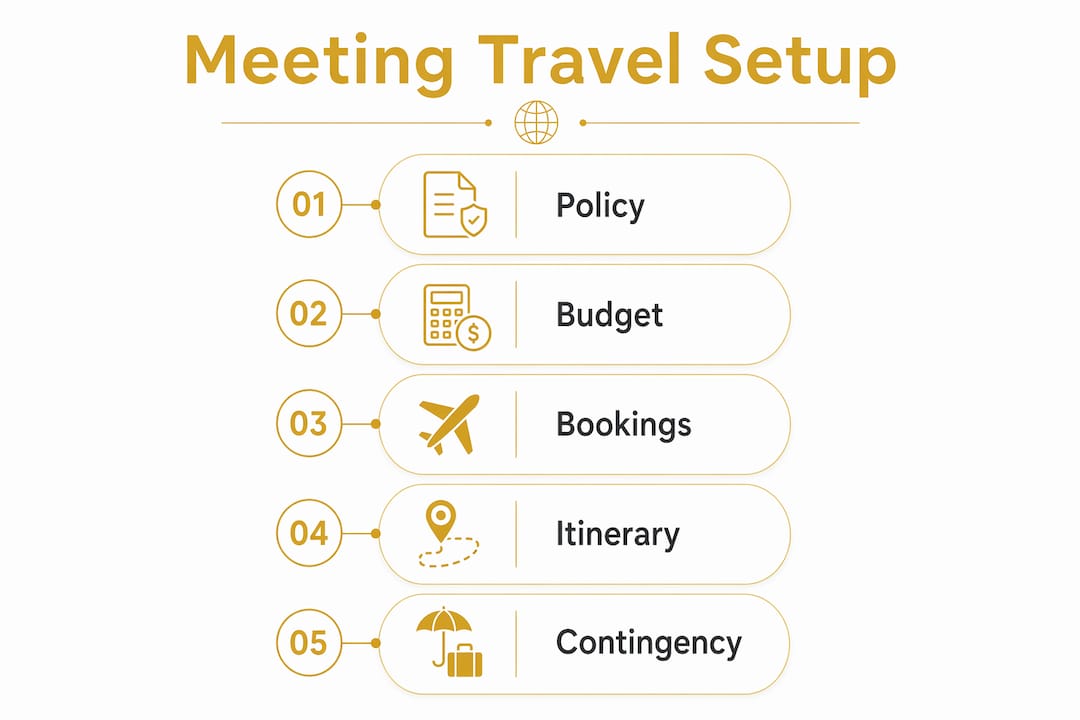
The foundation of any successful step by step meeting travel setup is a written travel and meeting policy. Without one, every booking decision becomes a negotiation. Your policy should define approved booking channels, spending limits by travel tier, and the approval chain for exceptions. Stakeholders need to know their roles before any logistics begin.
Beyond policy, three tools form the operational backbone of meeting travel logistics:
| Tool | Function |
|---|---|
| Centralized Traveler Manifest | Tracks all attendee flight, hotel, and transport details in one shared document |
| AI Itinerary Generator (e.g., Vacation Planner) | Builds and customizes schedules, addresses, and activity blocks at scale |
| Budget Tracker | Monitors spend against approved limits with contingency reserves |
A centralized traveler manifest is the most effective tool for keeping all stakeholders aligned. It eliminates version control problems by giving every planner, vendor, and attendee access to the same accurate, real-time travel information.
Budget frameworks deserve equal attention. Standard budgets include a 10–15% contingency for costs like visas, insurance, and logistics. Experienced planners often push that reserve to 20% to cover common, unavoidable overruns. That buffer is not padding. It is your protection against the unexpected venue change or last-minute rebooking fee.
Stakeholder alignment is the final prerequisite. Assign one lead planner for flights, one for accommodations, and one for ground transport. Overlap creates confusion. Clear ownership creates accountability.
Pro Tip: Before you open a single booking portal, circulate a one-page responsibility matrix listing each logistics owner, their contact, and their decision authority. It takes 30 minutes to create and saves hours of back-and-forth during execution.
How do you book flights, hotels, and transport step by step?
Booking flights first secures arrival windows and gives you the framework for every downstream decision. Hotels and ground transport can only be coordinated once you know when and where attendees land. For groups of 10 or more travelers, airlines often offer group fare blocks, though these typically carry stricter change fee policies.
Follow this sequence for every corporate meeting booking:
- Confirm the meeting dates and venue address. No booking should begin without a locked venue. Even a one-block difference in hotel placement affects ground transport costs and travel time.
- Book flights 6–12 weeks in advance. Domestic meetings warrant 6–8 weeks of lead time. International meetings require 9–12 weeks, and for large groups, major planning should start 9–12 months ahead.
- Select hotels within walking distance or a short drive from the venue. Proximity reduces transport complexity and gives attendees recovery time between sessions. Securing a group accommodation block also simplifies billing and check-in coordination. For high-stakes executive meetings, reviewing corporate hotel rate strategies can yield meaningful savings.
- Coordinate ground transport by arrival cluster. Group attendees arriving within 60-minute windows and arrange shared transfers. This reduces vehicle count and cost while keeping logistics manageable.
- Confirm all bookings in writing and log them in the traveler manifest. Every confirmation number, contact name, and cancellation policy belongs in one place.
Pro Tip: Schedule a 12–24 hour arrival buffer before the first meeting session. Travel fatigue is real, and stacking a keynote on top of a red-eye flight produces distracted, underperforming attendees. Build in recovery time as a non-negotiable.
For groups traveling internationally, factor in time zone adjustment, visa processing timelines, and local transit variability. These are not edge cases. They are standard variables in any well-built group travel arrangement.

How do you create and distribute a meeting travel itinerary?
A meeting travel itinerary is more than a schedule. It is the single document that prevents confusion, missed connections, and unanswered questions on the ground. Every high-value itinerary should include the following components:
- Full venue addresses with GPS coordinates or map links
- Flight details including terminal, gate, and baggage allowance
- Hotel name, address, check-in time, and confirmation number
- Ground transport schedule with driver contacts and vehicle descriptions
- Meeting agenda blocks with session titles and room assignments
- Emergency contacts for the lead planner and on-site coordinator
- Dress code requirements per session or event segment
Distribute the itinerary 5–7 days before departure to maximize attendee retention and engagement. Sending it too early means it gets buried. Sending it the day before means attendees have no time to prepare questions or flag conflicts.
AI tools like Vacation Planner make itinerary creation faster and more precise. 90% of planners now use AI tools like ChatGPT and Microsoft Copilot for destination research and itinerary creation. These tools enable real-time translation and customized schedules that improve the attendee experience at scale.
Centralized itinerary management also prevents version conflicts. When one document lives in a shared platform, every update reaches every attendee simultaneously. For guidance on building executive travel itineraries that balance productivity with comfort, the structure matters as much as the content.
Pro Tip: Lock the itinerary version 48 hours before departure and communicate any post-lock changes through a single channel, such as a dedicated group chat or email thread. Multiple update channels create conflicting information and unnecessary stress.
What are the most common challenges in meeting travel setup?
Even the most thorough travel meeting planning guide cannot prevent every disruption. The difference between a good planner and a great one is how quickly and calmly they resolve problems when they arise.
The most frequent challenges fall into four categories:
- Last-minute schedule or venue changes. Your 20% budget reserve exists precisely for this scenario. Rebook without panic when the funds are already allocated.
- Communication failures. A single WhatsApp group or Slack channel for all attendees eliminates the “I didn’t get the update” problem. Designate one person to push all changes through that channel.
- Flight delays and cancellations. Build the 12–24 hour arrival buffer into your timeline so a delayed flight does not cascade into a missed opening session.
- Meeting room technical failures. The final step before any meeting begins is a perspective walk-through using a mobile connection to verify audiovisual equipment, power accessibility, and seating configuration.
| Challenge | Practical Solution |
|---|---|
| Venue change at short notice | Activate budget reserve; contact hotel group coordinator immediately |
| Attendee misses flight | Maintain backup booking options in the traveler manifest |
| AV failure in meeting room | Complete a mobile walk-through 24 hours before the session |
| Version conflicts in itinerary | Use one centralized platform; lock document 48 hours before departure |
| Ground transport delays | Cluster arrivals and maintain a 60-minute buffer between pickup and first session |
Successful MICE event planning involves three distinct layers: strategic, operational, and project planning. Most failures happen when planners skip the strategic layer and jump straight to bookings. Define the meeting’s purpose, attendee profile, and success metrics before you open a booking portal.
Pro Tip: Create a one-page contingency card for each major logistics category: flights, hotels, and transport. List the backup vendor, their contact, and the trigger condition for activating them. Distribute it to every logistics owner before departure.
Key takeaways
A structured, policy-first approach to meeting travel setup is the single most reliable way to deliver consistent, high-quality experiences for business attendees.
| Point | Details |
|---|---|
| Policy before bookings | Establish a written travel policy and assign logistics owners before any booking begins. |
| Book flights first | Securing flights sets the arrival window that drives every hotel and transport decision. |
| Budget with a reserve | Build a 10–20% contingency into every meeting travel budget to cover unavoidable overruns. |
| Distribute itineraries early | Send the final itinerary 5–7 days before departure for maximum attendee engagement. |
| Walk through the room | Complete a mobile walk-through of the meeting room before the session to catch AV and seating issues. |
What i’ve learned after planning dozens of corporate trips
Most corporate travel guides treat meeting travel logistics as a checklist exercise. My experience tells a different story. The planners who consistently deliver exceptional results treat this process as a project management discipline, not an administrative task.
The insight that changed how I approach every business trip setup is this: the quality of your preparation is most visible when something goes wrong. A delayed flight, a double-booked conference room, a missing AV cable. These moments reveal whether you planned for reality or for the ideal scenario. I now build every plan assuming at least one thing will go sideways.
Budget discipline is the other area where I see planners consistently underestimate their exposure. When budgets tighten, the instinct is to cut across the board. The smarter move is a value-first approach that protects the core meeting experience and trims the periphery. Attendees remember the quality of the sessions and the comfort of their accommodations. They rarely remember whether the welcome reception had a premium bar.
AI tools have genuinely changed what is possible for solo planners managing large groups. Using Vacation Planner or Microsoft Copilot to generate and customize itineraries at scale is not a shortcut. It is a force multiplier that frees your attention for the decisions that require human judgment. I use AI for the structure and apply my own expertise to the details that matter most to the specific group.
The final lesson is about centralized information. Every version conflict, every “I didn’t get that update,” every attendee who shows up at the wrong terminal traces back to fragmented communication. One manifest, one itinerary platform, one update channel. That discipline alone eliminates the majority of on-the-ground problems I used to spend hours resolving.
— Sandon
How Grandglobetrotting handles your business trip from start to finish
Planning travel for meetings at the executive level requires more than a booking engine. It requires a concierge who understands the stakes.
Grandglobetrotting offers step-by-step business trip planning built for corporate professionals who need precision, discretion, and a polished experience from departure to return. From securing private flights and group hotel blocks to building detailed digital itineraries and managing ground logistics, the Grandglobetrotting team handles every layer of your meeting travel setup. You focus on the meeting. The logistics are covered. Explore how personalized luxury travel planning can transform your next corporate event into a genuinely exceptional experience.
FAQ
What is the first step in meeting travel setup?
The first step is establishing a written travel policy and assigning logistics owners before any bookings begin. Without clear roles and spending guidelines, every decision becomes a negotiation.
How far in advance should you book corporate meeting travel?
Domestic meetings require 6–8 weeks of lead time, while international meetings need 9–12 weeks. For large groups, major planning should begin 9–12 months before the event date.
What should a meeting travel itinerary include?
A complete itinerary includes venue addresses, flight details, hotel confirmations, ground transport schedules, meeting agenda blocks, emergency contacts, and dress code requirements per session.
How do you handle last-minute changes in meeting travel?
Activate your pre-built budget reserve, communicate all changes through a single designated channel, and reference your contingency card for backup vendor contacts and trigger conditions.
Why is an arrival buffer important for business meetings?
A 12–24 hour arrival buffer prevents travel fatigue from affecting meeting performance. Scheduling sessions immediately after long-haul flights consistently produces distracted, underperforming attendees.
Recommended
At Grand Globetrotting, we don't just plan vacations; we craft extraordinary adventures that leave you with cherished memories. Let us bring your dream vacation to life, perfectly tailored to your style, and immerse yourself in a world of luxury, exploration, and unforgettable moments. Your journey begins with us.
Itinerary planning services require a separate charge outside of cost to book travel accommodations. Depending upon the complexity of the itinerary and the level of effort required to acquire unique experiences, cost may vary. Speak with our team to learn more.
Book your consultation