

TL;DR:
- A corporate trip preparation workflow is a structured process that ensures compliance and cost control through clear stages like briefing, approval, booking, and reconciliation. Automating approval routing and booking within optimal windows reduces costs, prevents budget overruns, and improves compliance. Using integrated tools for planning, approval, and expense management creates an efficient, proactive travel program.
A corporate trip preparation workflow is a structured, repeatable process that integrates trip briefing, policy approval, booking coordination, and travel logistics to produce compliant and cost-controlled business travel. Without this kind of formal system, travel planners face fare drift, approval bottlenecks, and budget overruns that compound across every trip. The industry term for this discipline is corporate travel management, and the workflow is its operational backbone. Tools like Online Booking Tools (OBTs), multi-tier approval platforms, and expense automation software are the building blocks of any mature program. Getting the workflow right from the start is the difference between a trip that runs smoothly and one that costs twice the budget.
What are the core stages of a corporate trip preparation workflow?
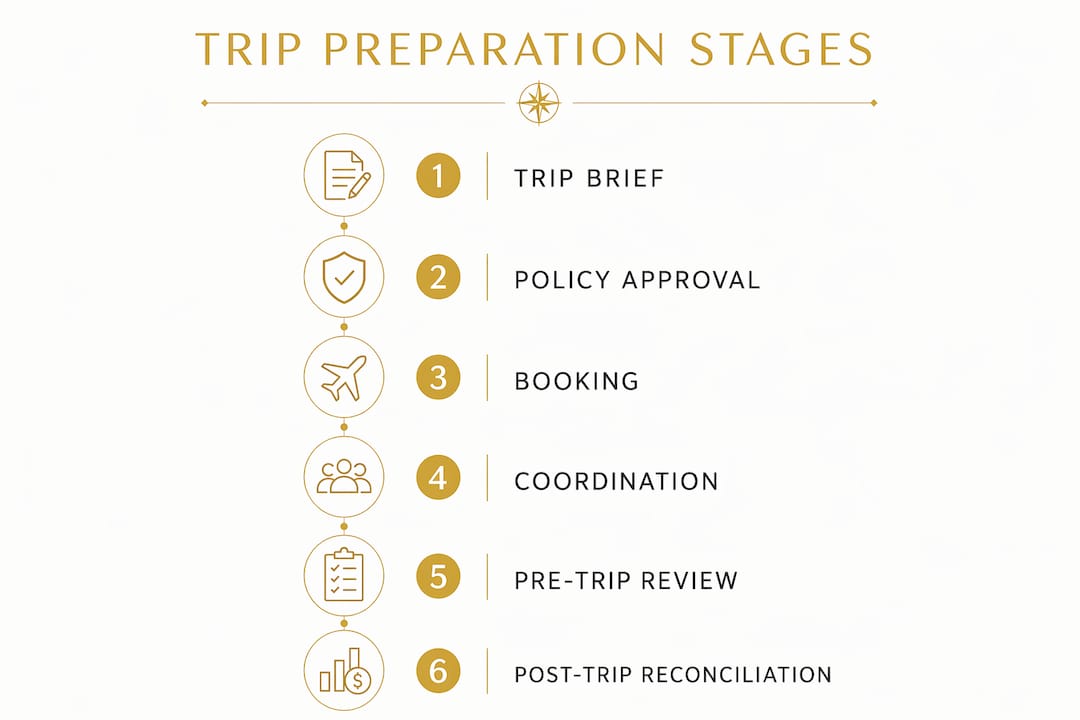
A well-designed corporate trip preparation workflow follows six sequential stages. Each stage has a clear owner, a defined output, and a handoff point to the next phase.
| Stage | Key Activities | Responsible Role |
|---|---|---|
| Trip brief | Define purpose, dates, attendees, constraints | Requester or executive assistant |
| Policy check and approval | Route for multi-level sign-off, verify compliance | Travel manager or approver |
| Booking | Reserve flights, hotels, and ground transport | Travel planner or OBT |
| Workday planning | Schedule meetings, venues, and workspace | Requester and travel planner |
| Change management | Handle cancellations, rebooking, and alerts | Travel manager |
| Post-trip reconciliation | Expense reporting, spend analysis, feedback | Finance and travel manager |
The trip brief is the mandatory first step, capturing purpose, meeting schedules, and traveler constraints. Skipping it causes rework and budget exceptions downstream. Every other stage depends on the clarity established here.
Policy check and approval is where most programs lose time. Manual routing through email chains delays decisions and allows fares to rise while approvers deliberate. Automating this stage with routing rules and OBT integration is the single highest-impact change a travel program can make.
Post-trip reconciliation closes the loop. It turns raw spend data into reporting that informs future budget decisions and flags policy violations for correction.
Pro Tip: Build a one-page trip brief template that every requester completes before any booking begins. This single document eliminates the most common source of rework in corporate travel programs.
How to implement a multi-tier pre-trip approval workflow
A multi-tier pre-trip approval workflow routes each travel request through defined approvers based on cost thresholds, destination risk, and traveler seniority. The goal is to catch policy violations before money is spent, not after.
- Map your routing rules. Define who approves what. A domestic trip under $1,500 might need only a direct manager. An international trip over $5,000 requires finance sign-off and a risk review.
- Set auto-approval thresholds. Low-risk, low-cost trips that meet all policy criteria can be approved automatically. This removes friction for routine travel without sacrificing oversight.
- Integrate approval logic with your OBT. Advanced programs lock fare quotes at request time so the price does not change while approvers deliberate.
- Capture every decision. Log approver names, timestamps, and any policy exceptions. This creates an audit trail for finance and duty-of-care compliance.
- Review and refine thresholds quarterly. Routing rules that made sense in january may be outdated by july as fare levels and company priorities shift.
Automating travel approvals with policy pre-checks and OBT integration cuts approval cycle time from 38 hours to under 4 hours and raises policy compliance by 34% compared to manual processes. That time saving translates directly into lower fares, since tickets booked sooner cost less. A structured multi-tier approval workflow can reduce out-of-policy spending by 12–18% annually, according to GBTA Business Travel Index data.
Pro Tip: Never route approvals through email. Use a dedicated approval platform or your OBT’s built-in workflow module so every decision is logged, timestamped, and searchable.

What are best practices for booking and coordinating travel?
Booking is where planning meets execution. The timing of your bookings directly determines the price you pay and the options available to you.
Planning windows vary by trip complexity: 1–2 weeks for simple domestic trips, 2–3 weeks for complex domestic or multi-city itineraries, and 3–4 weeks for short international trips. Booking within these windows ensures optimal pricing and avoids fare drift caused by approval delays.
Flight and accommodation selection
Choose flights that align with the traveler’s first meeting, not just the cheapest departure time. A red-eye that saves $200 but leaves the traveler exhausted for a morning board presentation is a false economy. For accommodation, prioritize properties within walking distance of the primary meeting venue. This eliminates ground transport costs for the core workday and reduces the risk of late arrivals.
- Book preferred hotel chains that offer corporate rate agreements to capture negotiated pricing.
- Confirm that the property has dedicated workspace, reliable Wi-Fi, and meeting room access.
- Verify cancellation policies before confirming, especially for trips booked 3–4 weeks out.
- Use your OBT to apply preferred vendor filters automatically so planners never see out-of-policy options.
Ground transportation planning
Ground transportation causes the most significant budget leakage and itinerary failures when left uncoordinated. Treat it as a core booking task, not an afterthought left to the traveler. Pre-book airport transfers, inter-city rail, and any client-facing transportation at the same time as flights and hotels.
Consolidating all booking confirmations into a single traveler pack creates one source of truth. This pack should include flight details, hotel confirmation numbers, ground transport schedules, and emergency contacts. It makes post-trip reconciliation faster and gives the traveler everything needed without hunting through multiple inboxes.
Pro Tip: Send the complete traveler pack 48 hours before departure. Include a one-paragraph summary of the itinerary at the top so the traveler can review it in under 60 seconds.
How to manage the corporate travel budget effectively
Budget control in corporate travel requires category-level planning, not just a single trip total. Breaking the budget into defined categories gives finance teams visibility and gives planners a clear ceiling for each decision.
| Budget Category | Typical Share of Trip Cost | Common Pitfall |
|---|---|---|
| Flights | 40–50% | Fare drift from late approvals |
| Accommodation | 25–30% | Booking outside preferred vendors |
| Ground transport | 10–15% | Left unbooked until day of travel |
| Meals and entertainment | 8–12% | No per diem policy enforced |
| Event fees and registration | 5–10% | Forgotten in initial budget draft |
| Miscellaneous | 5–8% | Underestimated or omitted entirely |
Allocate an additional 10–15% contingency of the total projected trip cost to cover unforeseen expenses. This buffer prevents emergency approvals mid-trip and keeps the overall program within annual targets.
Spend alerts are the real-time enforcement layer of your budget. Configure your OBT or expense platform to notify the travel manager when a booking approaches or exceeds a category ceiling. This catches problems before they become overruns.
- Tag every expense at the trip-leg or project level during booking, not after the trip.
- Expense tagging per trip leg enables automatic pre-population of expense reports, reducing reconciliation time by up to 80%.
- Avoid last-minute bookings. They are the primary driver of fare drift and accommodation premiums.
- Review actuals against budget within 72 hours of trip completion to catch discrepancies while details are fresh.
What operational tools support an efficient travel workflow?
The right technology stack turns a manual, error-prone process into a repeatable system. Each tool in the stack handles a specific stage of the workflow.
- Trip brief templates. A standardized document in Google Docs, Notion, or Microsoft Word captures all requester inputs before any booking begins. This reduces back-and-forth and speeds up the approval stage.
- Online Booking Tools (OBTs). Platforms like Concur, Egencia, or TravelPerk enforce policy at the point of booking. They display only compliant options, apply negotiated rates, and lock fares at request time.
- Approval workflow platforms. Dedicated tools or OBT-native modules route requests, capture decisions, and maintain audit logs without relying on email chains.
- Itinerary management tools. Apps like TripIt Pro or TravelPerk’s itinerary feature compile all booking details into a single document that updates in real time.
- Expense automation platforms. Tools like Expensify, Brex, or SAP Concur Expense connect to booking records and pre-populate reports using trip-leg tags set during booking.
Selecting tools that integrate with each other is the deciding factor in workflow efficiency. A travel planner using an OBT that does not connect to the expense platform will spend hours manually transferring data. Integration eliminates that gap entirely. For corporate travel management programs at scale, the technology stack is as important as the policy framework it enforces.
Pro Tip: Before purchasing any new tool, map your current workflow on paper and identify the three biggest time sinks. Buy only the tool that directly eliminates those three problems.
Key takeaways
A corporate trip preparation workflow succeeds when it combines a clear trip brief, automated approvals, timed bookings, coordinated ground transport, and tagged expense data into one repeatable system.
| Point | Details |
|---|---|
| Start with the trip brief | Capture purpose, dates, and constraints before any booking begins to prevent rework. |
| Automate approvals | Automated routing cuts cycle time from 38 hours to under 4 hours and raises compliance by 34%. |
| Book within planning windows | Use 1–4 week windows based on trip complexity to secure optimal pricing and avoid fare drift. |
| Treat ground transport as core | Pre-book transfers at the same time as flights and hotels to prevent budget leakage. |
| Tag expenses during booking | Trip-leg tagging reduces reconciliation time by up to 80% and improves reporting accuracy. |
Why most corporate travel programs are still reactive
The most common mistake I see in corporate travel programs is treating planning as a response to a request rather than a system that runs ahead of one. Travel planning is often viewed as reactive. Mature programs operate as a proactive system that enforces policy and protects travelers before problems arise.
I have worked with travel planners who spend 60% of their time correcting problems that a proper trip brief would have prevented entirely. The brief is not paperwork. It is the foundation of every decision that follows. When I review a program that is consistently over budget, the root cause is almost always a missing or incomplete brief combined with an approval process that runs on email.
The shift from reactive booking to proactive workflow automation is not a technology problem. It is a process design problem. The tools exist. The gap is in codifying the routing rules, the thresholds, and the handoff points so that the system runs without heroics from the planner. For business travel best practices that hold up under pressure, the workflow must be documented, tested, and owned by a named role.
The next frontier is integrating AI-driven spend analytics directly into the approval layer. Programs that do this will catch policy drift in real time rather than discovering it in a quarterly review. That is where the most significant gains in cost control will come from over the next two to three years.
— Sandon
How Grandglobetrotting can support your corporate travel planning
Corporate travel planning at the executive level demands more than a booking tool. It requires a concierge approach that handles every detail from preferred hotel selection to private ground transport coordination.
Grandglobetrotting specializes in bespoke corporate travel planning that takes the operational burden off your team. From sourcing luxury hotel accommodations with negotiated corporate rates to building complete traveler packs, the team manages the full workflow so your executives arrive prepared and your planners stay focused on higher-value work. Contact Grandglobetrotting to discuss a personalized corporate travel program built around your company’s policy requirements and traveler standards.
FAQ
What is a corporate trip preparation workflow?
A corporate trip preparation workflow is a structured, repeatable process covering trip briefing, policy approval, booking, logistics coordination, and post-trip reconciliation. It replaces ad-hoc planning with a defined system that controls costs and enforces compliance.
How far in advance should corporate travel be booked?
Planning windows depend on trip complexity: 1–2 weeks for simple domestic trips, 2–3 weeks for complex domestic itineraries, and 3–4 weeks for international travel. Booking within these windows secures better pricing and reduces fare drift.
How much contingency budget should a corporate trip include?
Best practice is to allocate 10–15% of the total projected trip cost as a contingency buffer. This covers unforeseen expenses without requiring emergency approvals mid-trip.
What is the biggest cause of budget overruns in corporate travel?
Fare drift from delayed approvals and uncoordinated ground transportation are the two leading causes of budget overruns. Automating the approval process and pre-booking all ground transport at the same time as flights eliminates both risks.
How does expense tagging improve post-trip reconciliation?
Tagging expenses at the trip-leg level during booking allows expense platforms to pre-populate reports automatically. This approach reduces reconciliation time by up to 80% and significantly reduces manual errors.
Recommended
At Grand Globetrotting, we don't just plan vacations; we craft extraordinary adventures that leave you with cherished memories. Let us bring your dream vacation to life, perfectly tailored to your style, and immerse yourself in a world of luxury, exploration, and unforgettable moments. Your journey begins with us.
Itinerary planning services require a separate charge outside of cost to book travel accommodations. Depending upon the complexity of the itinerary and the level of effort required to acquire unique experiences, cost may vary. Speak with our team to learn more.
Book your consultation