

TL;DR:
- Family-friendly corporate travel allows employees to bring family members on work trips, improving retention and work-life balance. Clear policies, expense separation, and suitable accommodations help organizations manage costs and duty of care effectively. Hotels are increasingly offering family-oriented amenities, making such travel practical and appealing for employees.
Family-friendly corporate travel is defined as any employer-sanctioned program that allows employees to bring family members on business trips, blending professional obligations with personal time. The benefits of family-friendly corporate travel extend well beyond employee comfort. They directly affect retention, engagement, and your organization’s ability to attract top talent. 74% of U.S. employees are willing to bring family on business trips, and 89% want to add leisure time to corporate travel to improve work-life balance. For HR managers and corporate professionals, that data signals a clear opportunity to turn travel policy into a competitive advantage.
What are the main benefits of family-friendly corporate travel?
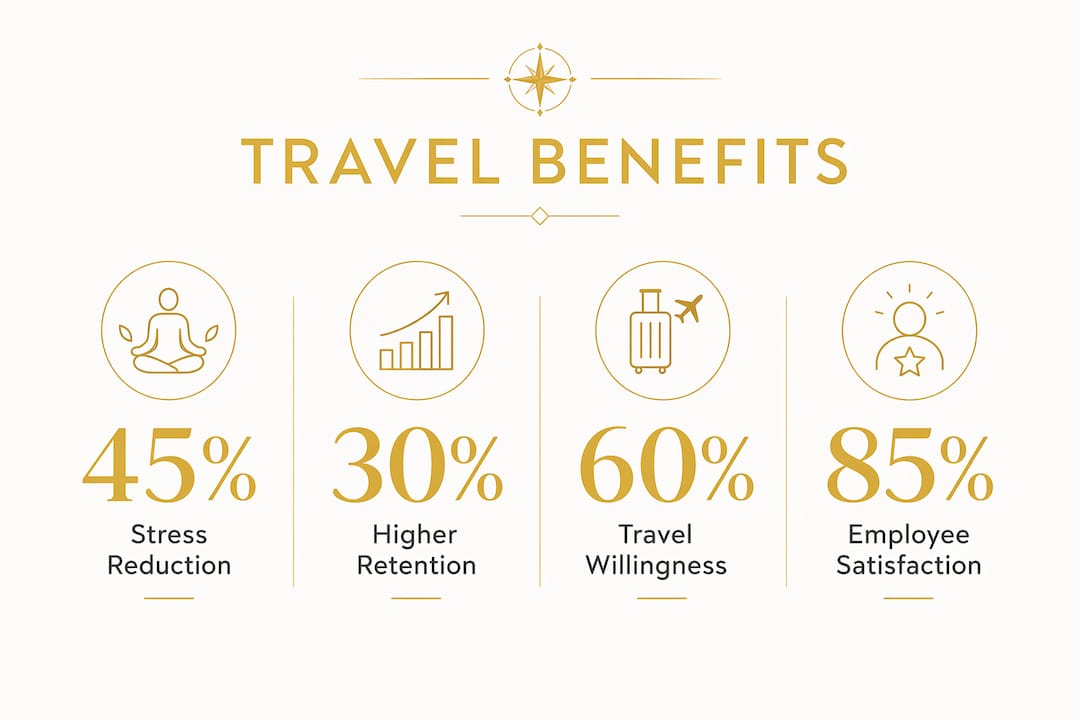
The core benefit is reduced employee stress. Employees combining work and family travel report better work-life integration, higher job satisfaction, and stronger motivation. When a traveling employee knows their family is nearby rather than waiting at home, the psychological weight of extended trips drops considerably.

The retention impact is equally direct. Formalizing family-inclusive travel policies is a high-ROI retention strategy that costs employers very little when structured well. Companies that offer family travel perks signal that they value the whole employee, not just their output on the road. That signal builds loyalty in ways that salary adjustments alone cannot replicate.
Family-friendly business trips also increase an employee’s willingness to accept travel assignments. Professionals who might otherwise decline a week-long trip to Singapore or Frankfurt become far more receptive when a spouse or child can join for part of the stay. This expands your talent pool for travel-heavy roles without requiring additional headcount.
The advantages of family corporate travel also show up in employer branding. Organizations with flexible travel policies gain a competitive edge in recruiting, particularly among professionals under 35 who routinely extend business trips for leisure. That demographic increasingly treats family-inclusive travel as a baseline expectation, not a perk.
Key employee benefits at a glance:
- Reduced travel fatigue from extended or frequent business trips
- Stronger work-life integration by eliminating the guilt of prolonged family separation
- Higher engagement on-site when personal stress is lower
- Greater willingness to accept international or long-haul assignments
- Improved perception of the employer as a people-first organization
How do family-friendly travel policies address expense and duty of care challenges?
Policy structure is where most corporate programs succeed or fail. Without clear rules, family-inclusive travel creates audit risks and legal exposure. The good news is that each challenge has a documented solution.
-
Separate business and personal expenses. Expense separation is the top operational hurdle in family-inclusive travel. Automated platforms that split hotel folios between business and personal charges reduce audit risk and simplify compliance. Employees who lack access to such tools must use a separate personal credit card for all non-business charges and maintain meticulous receipt records.
-
Secure separate insurance for family members. Corporate duty of care policies cover only the employee. Family members require private travel insurance that includes medical coverage and emergency evacuation. HR should communicate this requirement clearly before any trip is approved.
-
Require pre-approval for personal time. HR should require employees to log personal days as paid time off (PTO) before departure. This protects the organization legally and ensures duty of care obligations remain clearly scoped to business hours and locations.
-
Document companion eligibility in writing. Define who qualifies as a companion, whether that includes spouses, domestic partners, or children, and state this explicitly in the travel policy. Ambiguity creates inconsistent enforcement and potential discrimination claims.
-
Communicate cost responsibility clearly. 70% of employees cite accessible pricing as the key factor in deciding to bring family on business trips. Employees need to know upfront which costs the company covers and which they absorb personally.
Pro Tip: Ask your travel management platform whether it supports split-folio billing at the hotel level. Properties that work with corporate accounts through systems like Concur or Navan can often separate room charges automatically, removing the manual burden from the employee entirely.
What practical strategies can HR managers use to design family-inclusive travel programs?
Effective programs start with a written policy, not a verbal understanding. HR should define companion eligibility, require pre-approval of personal time, and log personal days as PTO. These three steps alone resolve the majority of compliance and fairness concerns before they arise.
Destination and accommodation selection matter more than most HR teams realize. Choosing hotels that offer both business-grade workspaces and family amenities, such as kids clubs, connecting rooms, and on-site dining, removes friction for the traveling employee. Grandglobetrotting’s corporate travel best practices guide covers how to evaluate properties for dual business and family use.
Technology platforms are the operational backbone of any family-inclusive program. Consider these priorities when selecting tools:
- Itinerary management software that allows employees to add personal legs to a business trip without disrupting the corporate booking record
- Expense tracking tools with split-folio or dual-card functionality to separate business and personal charges automatically
- Policy communication portals where employees can access the family travel policy, eligibility rules, and insurance requirements in one place
- Pre-approval workflows that route personal time requests to managers before travel is confirmed
Manager training is the final piece most programs skip. Managers need to understand the policy well enough to answer employee questions, approve personal time consistently, and recognize when a trip structure creates duty of care gaps. A 30-minute training session and a one-page policy summary are enough to close that gap for most teams.
A work-first approach is the foundation of successful family-friendly travel. Setting clear boundaries, keeping family time to evenings and weekends, and protecting business commitments prevents the arrangement from creating resentment among colleagues who travel without family.
How is the hospitality industry evolving to support business travel for families?
The hospitality sector has recognized the family-first bleisure segment as one of its fastest-growing client groups. Hotels are adapting their product design to serve guests who need a business-ready workspace in the morning and a kids club in the afternoon. This dual-purpose design makes work trips with family far more practical than they were even five years ago.
The comparison below shows how hotel offerings have shifted to meet this demand:
| Feature | Traditional Business Hotel | Family-Inclusive Business Hotel |
|---|---|---|
| Workspace | Desk in room, business center | Coworking lounge, private meeting pods |
| Family amenities | None or minimal | Kids club, cribs, connecting rooms |
| Dining | Single restaurant, room service | Multiple outlets with children’s menus |
| Leisure facilities | Gym, pool | Family pool, supervised activities |
| Room configuration | Standard king or double | Family suites, adjoining rooms |
Properties that offer luxury hotel amenities alongside family services represent the clearest win for corporate travelers. The employee gets a productive work environment during business hours and a genuinely comfortable family experience in the evenings. That combination directly supports the stress-reduction benefits that make family-inclusive travel worth the policy investment.
55% of business travelers have taken at least two bleisure trips blending business and leisure. Hotels that fail to accommodate this pattern risk losing corporate accounts to properties that do. For HR managers selecting preferred hotel partners, family-readiness is now a legitimate evaluation criterion alongside room rate and location.
Sandon’s take: what most corporate travel programs still get wrong
Most corporate travel programs treat family-inclusive travel as a liability to manage rather than a benefit to design. That framing produces policies full of restrictions and almost no guidance on how to make the arrangement actually work. The result is that employees either avoid bringing family altogether or do it informally, which creates exactly the compliance gaps the policy was meant to prevent.
The programs I have seen work best share one characteristic: they treat the employee as a professional who can manage their own time. A clear policy that defines eligibility, separates costs, and requires PTO for personal days gives employees the framework they need. It does not require a 20-page manual or a dedicated travel coordinator.
The other mistake I see consistently is ignoring the hotel selection step. Booking an employee into a standard business hotel and then expecting them to manage a family alongside their work schedule sets everyone up for frustration. Choosing properties with genuine family infrastructure, not just a pool, changes the entire experience. Grandglobetrotting’s incentive travel planning guide covers how to evaluate hospitality partners for exactly this kind of dual-purpose trip.
Family-friendly travel will become a standard line item in corporate travel policy within the next few years. The organizations that build thoughtful programs now will have a measurable retention advantage over those that wait for the trend to fully mature.
— Sandon
How Grandglobetrotting supports family-inclusive corporate travel
Corporate professionals and HR managers who want to move from policy to practice need a planning partner who understands both sides of the equation.

Grandglobetrotting specializes in personalized luxury travel planning that integrates business requirements with family needs from the first itinerary draft. The team identifies properties with business-grade facilities and genuine family amenities, structures itineraries that protect work commitments while creating space for family time, and connects clients with accommodations suited for executive travel with family. For organizations ready to formalize a family-inclusive travel program, Grandglobetrotting’s step-by-step business trip planning service provides the concierge support to make each trip work on both a professional and personal level.
Key takeaways
Family-friendly corporate travel programs deliver measurable retention and engagement benefits when built on clear written policies, expense separation tools, and thoughtfully selected accommodations.
| Point | Details |
|---|---|
| Retention and satisfaction | Family-inclusive travel policies reduce stress and build loyalty at low cost to the employer. |
| Expense separation is critical | Use platforms with split-folio billing to keep business and personal charges cleanly divided. |
| Insurance gap requires action | Corporate duty of care covers only the employee; family members need separate private insurance. |
| Work-first structure protects everyone | Set clear boundaries keeping family time to evenings and weekends to preserve business commitments. |
| Hotel selection drives outcomes | Choose properties with both coworking facilities and family amenities to make the arrangement practical. |
FAQ
What is family-friendly corporate travel?
Family-friendly corporate travel is a formal or informal employer policy that allows employees to bring family members on business trips, combining work obligations with personal time. It is also called family-inclusive travel or bleisure travel when leisure extensions are involved.
Does the company pay for family members on business trips?
The company covers only the employee’s business-related costs. Family members’ travel, accommodation upgrades, meals, and insurance are the employee’s personal responsibility, with expenses separated clearly in the travel policy.
How does family travel affect employee retention?
Employees who combine work and family travel report higher job satisfaction and stronger engagement. Formalizing this benefit costs employers very little and functions as a high-ROI retention tool, particularly for frequent travelers.
What insurance do family members need on a business trip?
Family members are not covered by corporate travel insurance or duty of care programs. They require private travel insurance that includes medical coverage and emergency evacuation, which the employee arranges and funds independently.
How should HR managers start a family-inclusive travel program?
HR managers should begin by drafting a written policy that defines companion eligibility, requires pre-approval for personal days logged as PTO, and specifies which costs the company covers. Selecting a travel platform with expense-splitting functionality is the recommended second step.
Recommended
At Grand Globetrotting, we don't just plan vacations; we craft extraordinary adventures that leave you with cherished memories. Let us bring your dream vacation to life, perfectly tailored to your style, and immerse yourself in a world of luxury, exploration, and unforgettable moments. Your journey begins with us.
Itinerary planning services require a separate charge outside of cost to book travel accommodations. Depending upon the complexity of the itinerary and the level of effort required to acquire unique experiences, cost may vary. Speak with our team to learn more.
Book your consultation