
TL;DR:
- Executive retreat planning involves designing and executing small, strategic offsites for senior leaders to enhance decision-making and leadership cohesion. Proper planning requires a 4 to 12 month lead time, focused agendas, and thorough post-retreat follow-up to ensure lasting organizational impact. Attention to logistics, venue selection, skilled facilitation, and embedding commitments into organizational tools are essential for success.
Executive retreat planning is the end-to-end process of designing and running an offsite specifically for senior leadership, focused on strategic alignment, decision-making, and leadership development. Unlike a general company offsite, an executive retreat brings together a small group of senior leaders to work through the decisions and challenges that shape an organization’s future. Done well, it produces documented commitments, stronger leadership cohesion, and measurable progress on the company’s most pressing priorities. This guide covers what executive retreat planning involves, how to organize a retreat from start to finish, and how to ensure the outcomes last long after everyone returns home.
What is executive retreat planning and how does it differ from a corporate offsite?
Executive retreat planning is distinct from broader corporate offsite planning in one critical way: intent. A general corporate offsite might include hundreds of employees, team-building games, and motivational speakers. An executive retreat is engineered for strategic outcomes, not just positive experiences. The participant group is typically small, often 5–10 senior leaders, and the agenda is built around sustained strategic discussion rather than social programming.
The differences show up clearly when you compare the two formats side by side:
- Participants: Executive retreats include C-suite and senior VP-level leaders only. Corporate offsites often span entire departments or company-wide groups.
- Agenda focus: Executive retreats prioritize decision-making, leadership development, and strategic alignment. General offsites lean toward team bonding and culture-building.
- Outcomes: Executive retreats close with documented decisions, named owners, and 90-day commitments. General offsites close with positive sentiment and shared memories.
- Facilitation: Executive retreats require skilled facilitators who can manage high-stakes dialogue. General offsites often use internal HR leads or event coordinators.
- Venue requirements: Executive retreats demand private, distraction-free environments. General offsites work in conference centers or hotel ballrooms.
The benefits of executive retreats come precisely from this focus. When senior leaders step away from daily operations and spend concentrated time on strategy, they make better decisions and return with clearer priorities. That clarity filters down through the entire organization.
What is the proven step-by-step process for planning a corporate retreat?
The planning horizon for executive retreats is typically 4–6 months, extending to 9–12 months for international groups or premium venues. Starting too late is the single most common logistical mistake. Premium venues often require 6–9 months advance booking, which means strategic decisions about objectives and participant lists must happen before venue conversations even begin.
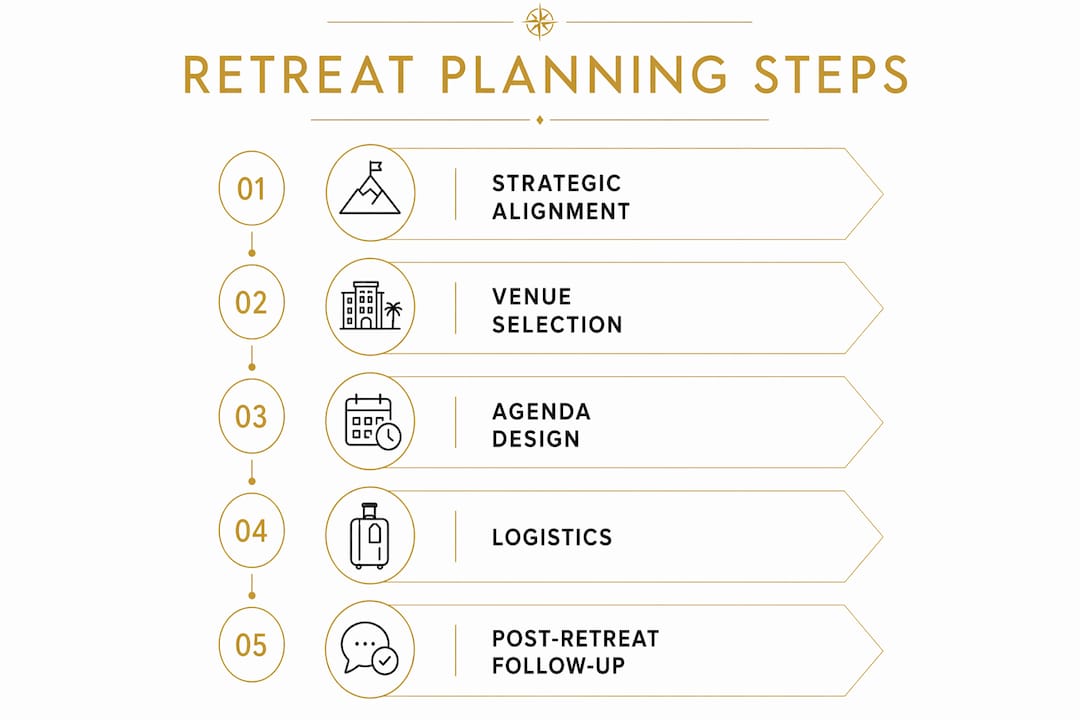
The planning process breaks into five clear stages:
- Strategic alignment (4–6 months out): Define the retreat’s objectives, confirm the participant list, and secure executive sponsor buy-in. No venue or agenda work should begin until objectives are locked.
- Venue and logistics procurement (3–4 months out): Select and book the venue, arrange travel and accommodations, and confirm budget parameters. For international retreats, factor in visa requirements and time zone considerations.
- Agenda design (6–8 weeks out): Build the session structure, assign facilitators, and confirm pre-work materials for participants. Agenda design should reflect the objectives set in stage one.
- Production setup (2–4 weeks out): Confirm AV and connectivity needs, finalize dietary and accessibility requirements, brief on-site staff, and prepare contingency plans.
- Post-retreat integration: Schedule 30/60/90-day check-ins before the retreat begins. Embed action items into existing project management or OKR tools so accountability starts on day one.
| Stage | Timeline | Key Deliverable |
|---|---|---|
| Strategic alignment | 4–6 months out | Confirmed objectives and participant list |
| Venue and logistics | 3–4 months out | Signed venue contract and travel plan |
| Agenda design | 6–8 weeks out | Final agenda with facilitator assignments |
| Production setup | 2–4 weeks out | AV brief, dietary list, contingency plan |
| Post-retreat integration | Before retreat date | 30/60/90-day review schedule in calendar |
Pro Tip: Lock your objectives before you book anything. Vague objectives at the start are the leading cause of retreats that feel productive in the room but produce no lasting change.
How to design an executive retreat agenda that drives real decisions
The most effective executive retreat agendas allocate 60–70% of time to structured decision debate, with named owners and defined 90-day outcomes for each decision. The remaining 30–40% goes to organic relational time, reflection, and context-setting. This ratio is not arbitrary. It reflects the reality that senior leaders need both structured debate and informal connection to build the trust required for honest dialogue.
A well-designed agenda follows a clear arc across the retreat days:
- Day one: CEO or sponsor framing of the retreat’s purpose, market or organizational context-setting, and relationship-deepening activities. The goal is mental transition from daily operations to strategic thinking.
- Mid-retreat days: Decision workshops with pre-assigned owners, small-group application sessions, and facilitated debate on the highest-priority issues. Avoid slide-heavy presentations. Use facilitation formats that build psychological safety and encourage honest dialogue.
- Final session: Convert insights into commitments. Each decision gets a documented owner, a 90-day measurable result, and a defined first action. This close is what separates a productive retreat from an expensive alignment meeting.
The biggest agenda mistake is designing a retreat that looks like a board meeting. Back-to-back presentations with minimal discussion time produce passive participants and no real decisions. Balance plenary sessions with small-group breakouts, and protect unstructured time for informal conversation. Those hallway conversations often surface the issues that formal sessions miss.
Pro Tip: Assign a dedicated note-taker to every decision workshop. The decision log should be distributed to all participants within 24 hours of the retreat ending, while context and commitment are still fresh.

What are the critical logistics and inclusivity considerations?
Logistics failures at executive retreats are disproportionately damaging. A connectivity outage during a key presentation or a dietary oversight for a senior leader signals poor preparation and erodes confidence in the entire planning process. The HR checklist for corporate retreats covers these requirements systematically, and executive retreats demand even tighter execution.
Key logistics and inclusivity requirements include:
- Travel coordination: Arrange private or business-class travel for all participants. Stagger arrivals to avoid bottlenecks and assign a point of contact for each executive’s travel queries. Reviewing executive travel amenities in advance helps set the right standard.
- Dietary and accessibility needs: Collect requirements at registration, not the week before. Confirm with the venue at least two weeks out and again 48 hours before arrival.
- AV and connectivity: Test all equipment on-site before participants arrive. Have a backup plan for every technology-dependent session, including offline versions of presentations.
- On-site role assignments: Designate a logistics lead, a technology lead, and an executive liaison for the duration of the retreat. Clear ownership prevents issues from falling through the gaps.
- Contingency planning: Prepare for weather disruptions, speaker cancellations, and medical situations. A written contingency plan shared with all on-site staff is non-negotiable.
Inclusivity extends beyond dietary needs. Consider cultural observances, mobility requirements, and time zone fatigue for international travelers. A retreat that makes one senior leader feel overlooked undermines the psychological safety the entire agenda depends on.
Why is post-retreat integration the most overlooked step?
The retreat is not the deliverable. The decisions, behavior changes, and organizational commitments that follow are the actual outcomes. Post-retreat follow-through must be built into the production plan before the retreat begins, not added as an afterthought once everyone is back at their desks.
Effective post-retreat integration follows four steps:
- Distribute the decision log within 24 hours. Every documented decision, owner, and 90-day result goes to all participants immediately after the retreat ends.
- Embed action items into existing tools. Load commitments into the organization’s OKR platform, project management software, or equivalent system. Commitments that live only in a retreat summary document rarely get executed.
- Schedule 30/60/90-day check-ins before the retreat date. These reviews should appear on calendars before participants leave the venue. Scheduling them retroactively signals low priority.
- Assign a single integration owner. One person is responsible for tracking progress across all commitments and escalating stalled items to the executive sponsor.
“Alignment without action is failure.” Retreats that produce warm consensus but no documented accountability mechanism deliver the same result as no retreat at all.
The most common post-retreat pitfalls are vague objectives that produce unmeasurable commitments, lack of a named owner for each action, and lost momentum after the first 30 days. Embedding retreat outcomes into OKRs and scheduling recurring reviews solves all three.
Key Takeaways
Effective executive retreat planning requires clear objectives, a decision-focused agenda, and a post-retreat integration plan built before the retreat begins.
| Point | Details |
|---|---|
| Define objectives first | Lock retreat goals before booking venues or designing the agenda. |
| Plan 4–6 months out | Premium venues require advance booking; international retreats need up to 12 months. |
| Design a decision-focused agenda | Allocate 60–70% of agenda time to structured debate with named owners and 90-day outcomes. |
| Build in post-retreat accountability | Embed action items into OKRs and schedule 30/60/90-day reviews before the retreat ends. |
| Address logistics and inclusivity early | Collect dietary, accessibility, and AV requirements weeks in advance, not days. |
What I’ve learned from planning executive retreats at the highest level
After years of working with senior leaders on high-stakes travel experiences, the pattern I see most often is this: organizations invest heavily in the venue and the agenda, then underinvest in the follow-through. The retreat becomes a beautiful, well-run event that produces a summary document no one reads three weeks later.
The retreats that actually move organizations forward share one quality: the planning team treated post-retreat integration as seriously as the event itself. That means building the decision log template before the retreat, not after. It means scheduling the 30-day check-in before participants leave the venue. It means assigning a real owner to each commitment, not a committee.
The venue matters more than most planners admit, though not for the reasons you might expect. The right environment, whether a private villa, a mountain lodge, or a premium boutique property, signals to participants that this time is different from the daily grind. That signal is what enables the mental transition from operational thinking to strategic thinking. You cannot manufacture that shift in a hotel conference room that looks identical to the office.
Facilitation is the other underestimated variable. Senior leaders are not always the best facilitators of their own strategic conversations. An experienced external facilitator creates the psychological safety that allows honest disagreement. That honest disagreement is where the best decisions come from. Invest in a skilled facilitator before you invest in upgraded catering.
— Sandon
How Grandglobetrotting supports executive retreat planning
Planning a leadership offsite at the level senior executives expect requires more than a venue booking and a printed agenda. Grandglobetrotting specializes in bespoke executive travel planning, from sourcing private villas and premium resort properties to coordinating private flights, ground transportation, and on-site logistics for leadership groups.

Every detail, from dietary requirements and AV setup to curated excursions that support informal bonding, is managed through a personalized concierge approach. Grandglobetrotting’s bespoke travel planning service is built for executives who need a flawless experience without spending their own time on logistics. Contact Grandglobetrotting to discuss your next leadership offsite and receive a tailored venue and itinerary recommendation.
FAQ
What is executive retreat planning?
Executive retreat planning is the end-to-end process of designing and running an offsite for senior leaders, focused on strategic alignment, decision-making, and leadership development. It differs from general corporate offsites by prioritizing documented decisions and measurable outcomes over team-building activities.
How far in advance should you start planning a corporate retreat?
The standard planning horizon is 4–6 months, with international or premium venue retreats requiring 9–12 months of lead time. Premium venues often require 6–9 months advance booking, so objectives and participant lists must be confirmed early.
What should an executive retreat agenda include?
An effective agenda allocates 60–70% of time to structured decision debate with named owners and 90-day outcomes, and 30–40% to relational and reflective sessions. The final session should convert insights into documented commitments before participants leave.
How do you ensure executive retreat outcomes last?
Distribute the decision log within 24 hours, embed action items into OKR or project management tools, and schedule 30/60/90-day review check-ins before the retreat ends. Assigning a single integration owner to track progress prevents momentum loss.
What makes a good venue for an executive retreat?
The best venues offer private meeting spaces, reliable high-speed connectivity, accessibility for all participants, and an environment that signals a clear break from daily office routines. Boutique and resort properties with dedicated event staff and customizable catering consistently outperform standard conference hotels for senior leadership groups.
Recommended
At Grand Globetrotting, we don't just plan vacations; we craft extraordinary adventures that leave you with cherished memories. Let us bring your dream vacation to life, perfectly tailored to your style, and immerse yourself in a world of luxury, exploration, and unforgettable moments. Your journey begins with us.
Itinerary planning services require a separate charge outside of cost to book travel accommodations. Depending upon the complexity of the itinerary and the level of effort required to acquire unique experiences, cost may vary. Speak with our team to learn more.
Book your consultation