

TL;DR:
- Exclusive partnerships in luxury travel provide clients with unique benefits like upgrades, amenities, and private experiences not available through regular channels.
- The value of these perks depends on precise contract terms, including scope, duration, and performance commitments, which influence the actual offerings.
Exclusive partnership perks are defined as unique benefits granted through formal agreements that restrict access to a product, service, or experience to a single partner within a set territory or category. In luxury travel, these arrangements sit at the heart of what separates a truly elevated experience from a standard booking. Explaining exclusive partnership perks matters because the terms, scope, and incentives built into these agreements directly shape what travelers receive, how brands position themselves, and how much value each party captures. Grandglobetrotting works within this world daily, and understanding how these deals function gives discerning travelers a real advantage when planning high-end trips.
What are the key benefits of exclusive partnerships for luxury travelers and brands?
Exclusive partnerships deliver advantages that standard, open-market arrangements simply cannot replicate. Exclusivity is a hallmark for luxury, niche, and highly technical products because it incentivizes specialized support and genuine brand investment from partners. That investment shows up in tangible ways: dedicated staff training, reserved inventory, co-branded marketing, and priority access to experiences that are not available through general booking channels.
The psychological dimension is equally powerful. Scarcity perception drives loyalty and brand value by making products or experiences unavailable elsewhere. Travelers who access an exclusive villa, a private dining event, or a chartered excursion through a partnership feel the weight of that rarity. It reinforces their decision to book through a premium channel and builds long-term loyalty to both the travel brand and the property.
For the brands and properties involved, the motivation is just as clear. Exclusive partnerships motivate partners to invest more heavily in marketing, staff training, and brand-building because their territory is protected. A luxury resort that grants exclusive representation to a single travel advisory firm knows that firm will prioritize its properties, train its team on the resort’s offerings, and position it prominently to high-value clients.
Typical perks found in exclusive luxury travel partnerships include:
- Priority room allocation and suite upgrades not available through standard booking platforms
- Complimentary amenity packages such as spa credits, private transfers, and welcome gifts
- Access to sold-out experiences including private chef dinners, after-hours museum tours, and yacht charters
- Dedicated concierge lines that bypass standard guest services for faster, more personalized responses
- Early access to new properties or seasonal openings before they are marketed to the general public
- Preferred pricing and rate holds during peak seasons when general availability is restricted
Pro Tip: When evaluating a luxury travel advisor, ask directly which properties they hold exclusive or preferred partner status with. That list tells you more about their real access than any marketing language.
How do exclusivity terms shape the value of partnership perks?
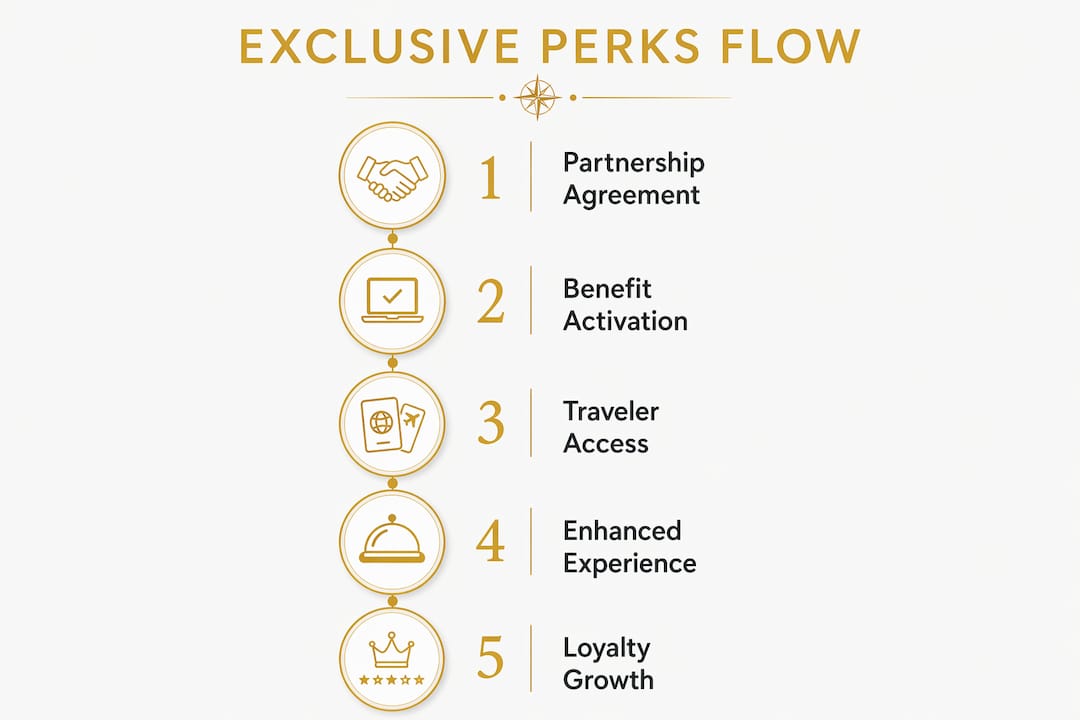
The contractual terms inside an exclusive agreement control how much value the partnership actually delivers. Duration is the first variable. Standard exclusivity windows often start at 90 days but are commonly negotiated down to 45–60 days without fee reductions, which prevents either party from blocking other revenue opportunities for too long. In luxury travel, this matters because a 90-day exclusive on peak-season inventory is a far more significant commitment than a 45-day window in the shoulder season.

Scope is the second critical variable. Exclusivity scope can be geographically narrow, product-specific, or time-bound, and each variation directly affects partnership value and flexibility. A travel advisory firm might hold exclusive access to a specific villa category at a resort without holding exclusivity over the resort’s entire inventory. That precision protects the property’s ability to work with multiple partners while still delivering a meaningful, differentiated perk to the exclusive partner’s clients.
Performance requirements are the third element, and they are often the most overlooked. Exclusivity without minimum performance commitments is a major risk. Contracts should include performance floors and automatic downgrade clauses that convert an exclusive arrangement to a non-exclusive one if booking targets are not met. This prevents a situation where a partner holds exclusive rights to a destination or property category but fails to generate the volume that justifies that exclusivity.
The table below summarizes the key terms and their practical impact:
| Exclusivity term | What it controls | Impact on partnership value |
|---|---|---|
| Duration | Length of the exclusive period | Longer windows increase partner commitment but raise opportunity cost |
| Geographic scope | Regions or markets covered | Narrow scope preserves flexibility; broad scope raises antitrust risk |
| Product/category scope | Which services or inventory are exclusive | Precision here protects both parties from overreach |
| Performance floor | Minimum booking or revenue targets | Prevents underperformance from blocking the market |
| Downgrade clause | Automatic shift to non-exclusive if targets are missed | Protects the brand from unproductive exclusivity |
Pro Tip: Always request a downgrade clause when negotiating exclusivity. It protects you from being locked into an arrangement that stops performing without requiring costly legal action to exit.
What operational risks come with exclusive partnership agreements?
Exclusive partnerships carry real risks alongside their advantages, and understanding those risks is part of understanding partnership advantages in luxury travel. The most significant risk is partner dependency. When a brand grants exclusivity to a single travel advisor or distributor, it concentrates its market access in one relationship. If that partner underperforms, changes strategy, or exits the market, the brand loses coverage in that territory entirely.
Maintaining multiple partners in the same region reduces operational risk and prevents dependency on a single exclusive partner. The best practice is to keep at least two partners active to balance leverage and prevent operational failure. In luxury travel, this often means structuring tiered preferred-partner programs rather than granting hard exclusivity, which preserves competition and service quality.
Hybrid distribution strategies address this challenge directly. Combining exclusive retail with direct-to-consumer channels helps brands balance intimacy and reach while reducing exclusivity risk. A luxury resort might grant a travel advisory firm exclusive access to its villa inventory while maintaining a direct booking channel for its standard rooms. That structure protects the brand’s revenue base without diluting the exclusive partner’s value.
Best practices for managing exclusive partnership risk include:
- Define scope precisely to avoid granting broader exclusivity than the relationship warrants
- Build in performance reviews at 30, 60, and 90-day intervals to catch underperformance early
- Retain direct-to-consumer channels for at least a portion of inventory to reduce dependency
- Document all obligations including co-branded marketing commitments, training requirements, and reporting standards
- Review antitrust exposure when exclusivity covers a broad geographic region or a dominant market share
Understanding digital reservation systems is also relevant here, as hospitality brands increasingly manage exclusive agreements through digital platforms that track performance in real time.
How can luxury travelers leverage exclusive deal perks to enhance their experiences?
Luxury travelers who understand how exclusive agreements work can actively use that knowledge to access better experiences. The first step is choosing a travel advisor who holds genuine preferred or exclusive partner status with the properties and destinations you want. That status translates directly into room upgrades, amenity packages, and access to sold-out experiences that are not available through standard booking channels.
Timing matters significantly when working with exclusive partnerships. Exclusivity periods often align with a property’s marketing calendar, meaning the best perks are available when the property is actively promoting a new season, a new suite category, or a new experience program. Asking your advisor to align your booking with these windows gives you access to the freshest inventory and the most generous amenity packages.
Here is a practical sequence for accessing exclusive partnership perks as a luxury traveler:
- Identify your priority destinations and property types before engaging an advisor, so you can ask specifically about their partner status in those categories.
- Request a written summary of partner benefits that apply to your booking, including room category, amenity credits, and any experiential access.
- Book during the property’s preferred window when exclusive allocations are at their highest and partner perks are most generous.
- Confirm all perks in writing before finalizing payment, as verbal commitments from front-desk staff do not always reflect what the exclusive partner agreement guarantees.
- Use your concierge line to request experiences that are not listed publicly, since exclusive partners often hold access to private events, after-hours tours, and off-menu dining experiences.
- Provide feedback to your advisor after each trip, as performance data from clients directly supports the advisor’s ability to maintain and upgrade their partner status.
Grandglobetrotting’s approach to exclusive hotel selection follows this exact logic, pairing clients with properties where genuine partner access translates into measurable on-the-ground benefits. For travelers planning private excursions, the same principle applies: exclusive excursion planning through a partner-connected advisor opens doors that standard booking platforms cannot.
Key Takeaways
Exclusive partnership perks deliver the most value when their terms are precise, performance-driven, and aligned with the traveler’s specific priorities.
| Point | Details |
|---|---|
| Exclusivity drives real access | Partner status unlocks upgrades, amenities, and experiences unavailable through standard channels. |
| Terms define the value | Duration, scope, and performance floors determine how much a partnership actually delivers. |
| Risk requires management | Dependency on a single partner is the primary operational risk; hybrid models reduce exposure. |
| Timing amplifies perks | Booking during a property’s active marketing window maximizes exclusive allocations and amenity packages. |
| Advisor status matters | Choose a travel advisor with documented preferred or exclusive partner agreements, not just marketing claims. |
Why exclusivity in luxury travel is more nuanced than it looks
Exclusivity in luxury travel gets treated as a simple status symbol far too often. Travelers hear “exclusive partner” and assume it means better service across the board. The reality is more specific, and that specificity is where the real value lives.
What I have found, working with luxury properties and high-net-worth travelers, is that the most valuable exclusive arrangements are the narrow ones. A travel advisor who holds exclusive access to a single villa category at a specific resort delivers more reliable, tangible perks than one who claims broad preferred status across hundreds of properties. Broad claims are hard to verify and even harder to deliver on consistently.
The misconception I see most often is that exclusivity guarantees priority. It does not. Exclusivity guarantees access to a defined set of benefits within a defined scope. If the scope is vague or the performance requirements are absent, the arrangement is essentially a marketing label. Travelers who push their advisors for specifics, including which properties, which room categories, and which amenities are actually covered, get far better outcomes than those who accept general assurances.
The trend toward hybrid models is worth watching. Properties that combine exclusive partner allocations with direct booking channels are finding a better balance between brand control and market reach. For travelers, this means the advisor relationship matters more than ever, because the exclusive allocation is a smaller, more curated slice of the total inventory. Getting into that slice requires an advisor with real standing, not just a preferred-partner badge.
— Sandon
How Grandglobetrotting connects clients to exclusive travel perks
Grandglobetrotting builds its planning process around genuine partner relationships, not general booking access. Every itinerary starts with a consultation that maps your priorities to the specific properties and experiences where Grandglobetrotting holds preferred or exclusive partner status.
That means clients receive confirmed amenity packages, priority allocations, and access to private experiences before their trip is finalized. The personalized luxury travel planning guide walks through how those partnerships translate into a complete, bespoke itinerary. For travelers ready to move from understanding exclusive deal perks to actually experiencing them, a direct consultation with Grandglobetrotting is the most direct path to a trip that delivers on every level.
FAQ
What are exclusive partnership perks in luxury travel?
Exclusive partnership perks are unique benefits granted through formal agreements between a travel advisor or brand and a property, giving clients access to upgrades, amenities, and experiences not available through standard booking channels.
How long do exclusivity periods typically last?
Standard exclusivity windows often start at 90 days but are commonly negotiated to 45–60 days. The specific duration depends on the scope of the agreement and the performance commitments involved.
What risks come with exclusive travel partnerships?
The primary risk is partner dependency. Concentrating market access in a single partner creates vulnerability if that partner underperforms. Best practice is to maintain multiple partner relationships and include performance-based downgrade clauses.
How do I know if my travel advisor has real exclusive access?
Ask for a written summary of their partner agreements, including which properties, which room or experience categories, and which specific amenities are covered. Documented partner status is more reliable than general preferred-partner claims.
Can exclusive partnership perks be negotiated?
Yes. Scope, duration, and amenity packages are all negotiable. Travelers working through an advisor with strong partner standing can often request specific perks, such as suite upgrades or private event access, that are not listed in standard booking terms.
Recommended
At Grand Globetrotting, we don't just plan vacations; we craft extraordinary adventures that leave you with cherished memories. Let us bring your dream vacation to life, perfectly tailored to your style, and immerse yourself in a world of luxury, exploration, and unforgettable moments. Your journey begins with us.
Itinerary planning services require a separate charge outside of cost to book travel accommodations. Depending upon the complexity of the itinerary and the level of effort required to acquire unique experiences, cost may vary. Speak with our team to learn more.
Book your consultation