
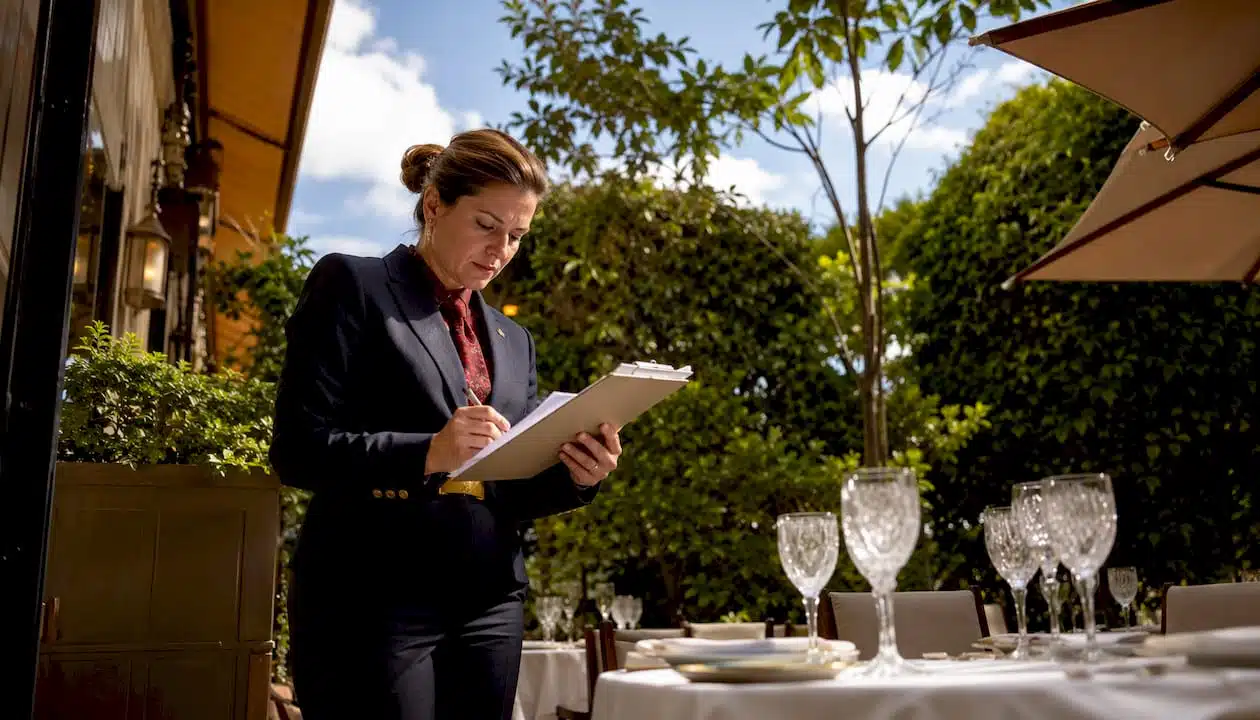
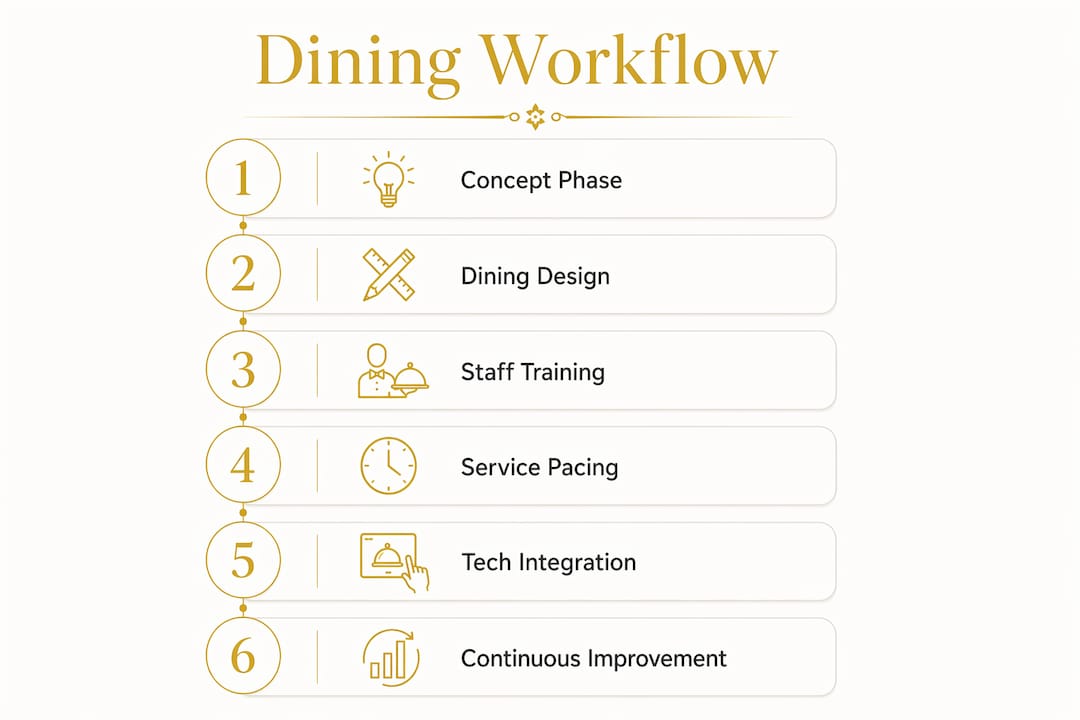
A high-end dining arrangements workflow is the systematic orchestration of culinary service, spatial planning, and staff coordination that transforms a meal into a flawless luxury experience. The most effective fine dining operations treat this workflow not as a checklist but as a living system, one where every role, every room, and every course timing decision reinforces the same standard of excellence. For restaurant owners and managers aiming for operational excellence in 2026, mastering this system is the clearest path to consistent guest satisfaction and stronger revenue performance.
The core components of a well-built workflow include:
- Concept and market positioning that shapes every downstream operational decision
- Physical layout design optimized for both guest comfort and staff circulation
- Front-of-house and back-of-house workflow mapping with precise timing sequences
- Service choreography covering course pacing, gestures, and transitions
- Technology integration for real-time communication and demand forecasting
- Continuous evaluation using performance metrics and guest feedback
- Staff training programs tailored to specialized luxury service roles
- Kitchen-to-floor coordination protocols for timing precision
- VIP and personalized service management built into standard operating procedures
- Dietary and allergen protocols embedded at the order-entry stage
- Crisis and contingency planning for real-time service disruptions
Each component depends on the others. A beautifully designed dining room loses its impact when the kitchen-to-floor timing is inconsistent. A talented sommelier cannot perform without a POS system that surfaces the right guest history at the right moment. The sections below address each element in depth.
1. How fine dining market positioning shapes your entire workflow
Fine dining occupies a distinct market segment defined by culinary artistry, exclusivity, and a level of personal attention that casual and mid-market restaurants simply do not attempt. Understanding where your concept sits within that segment is the first operational decision, because it determines staffing ratios, menu complexity, service style, and the physical investment required to deliver consistently.
Guest expectations at the luxury tier go well beyond food quality. Diners expect to feel recognized, unhurried, and attended to without ever having to ask. That expectation shapes staffing: a fine dining room typically requires a higher server-to-table ratio than a casual concept, plus specialized roles like a maître d’, chef de rang, and sommelier. Positioning your brand as a tasting-menu destination versus an à la carte luxury restaurant also changes the workflow substantially, since tasting menus demand tighter kitchen-to-floor timing and more deliberate course pacing.
Brand identity and operational workflow must align. A restaurant that markets itself around Japanese omakase precision but runs a disorganized kitchen handoff will lose credibility quickly. The luxury dining experience your guests expect begins the moment they make a reservation, and every operational decision from that point forward either reinforces or undermines that promise.
2. How should you design your dining room for optimal flow?
The physical layout of a fine dining room is an operational document as much as an aesthetic one. Table placement, service paths, and side-station positioning all determine whether your staff can deliver courses quietly and efficiently or whether they spend the evening navigating around each other.
Efficient service paths mapped as closed loops between the kitchen, tables, and side-stations prevent cross-traffic, reduce delays, and protect guest privacy. The loop model means servers always travel in the same direction, eliminating the collisions and hesitations that disrupt the calm atmosphere luxury guests expect.
- Place side-stations within a few steps of the tables they serve, but outside direct guest sightlines.
- Stock each station with napkins, water, bread, a crumb set, and spare flatware so servers never need to return to the kitchen for basics.
- Allow a narrow lane behind each chair, at least wide enough for a server to step in without brushing a seated guest.
- Keep bread plates above forks, water glasses above knives, and wine to the right of water, so reach never exceeds a forearm from the table edge.
- Use low centerpieces, under 12 inches, to preserve sightlines across the table and support conversation.
Warm, layered lighting is both an aesthetic and an operational choice. Avoid blue tones, which dull the color of food on the plate. A dimmed ceiling level combined with table lamps and candles lets staff read service cues discreetly without harsh overhead light flattening the room.
Pro Tip: Before every service, have a manager or senior server set one “master” table. Every other table in the room should match it exactly, including flatware placement measured one inch from the table edge with a ruler. This single habit eliminates the visual inconsistency that discerning guests notice immediately.
3. Building precise front-of-house and back-of-house workflows
The gap between a good restaurant and a great one often lives in the handoff between kitchen and floor. High-end private dining planning begins weeks in advance, with guest dietary restrictions confirmed two to four weeks out and specialty ingredients sourced three to seven days before service depending on perishability. That lead time is not a luxury; it is a structural requirement for maintaining quality.
Mapping the workflow means documenting every step from mise en place through plating and delivery, then assigning clear ownership to each step.
- Kitchen sequence: mise en place completion, prep sign-off, cooking, plating, expo check, runner dispatch
- Front-of-house sequence: greeting and seating, menu presentation, order entry by seat number, course timing communication, delivery, clearing, reset
- Communication protocol: POS-to-KDS integration so the kitchen receives seat-specific orders the moment a server enters them, with no verbal relay required
- Specialized roles: the maître d’ owns the dining room pace; the chef de rang manages the table relationship; the sommelier operates on a parallel track tied to course timing
| Role | Primary responsibility | Key timing trigger |
|---|---|---|
| Maître d’ | Room pace and guest relations | Monitors table progress, signals course advancement |
| Chef de rang | Table service and guest communication | Receives course-ready signal from expo |
| Sommelier | Wine service and pairing guidance | Pours ahead of each course, not during |
| Expo | Quality check and runner dispatch | Clears kitchen ticket only after visual approval |
| Runner | Plate delivery to correct seat | Moves on expo signal, not on server request |
A well-built POS system is the connective tissue of this workflow. Modern fine dining POS platforms support seat-level ordering, meaning every item is assigned to a specific seat number at entry. Runners know exactly where each plate goes without asking, and the kitchen sees structured modifications rather than freeform notes.
4. Service choreography: what separates good from exceptional
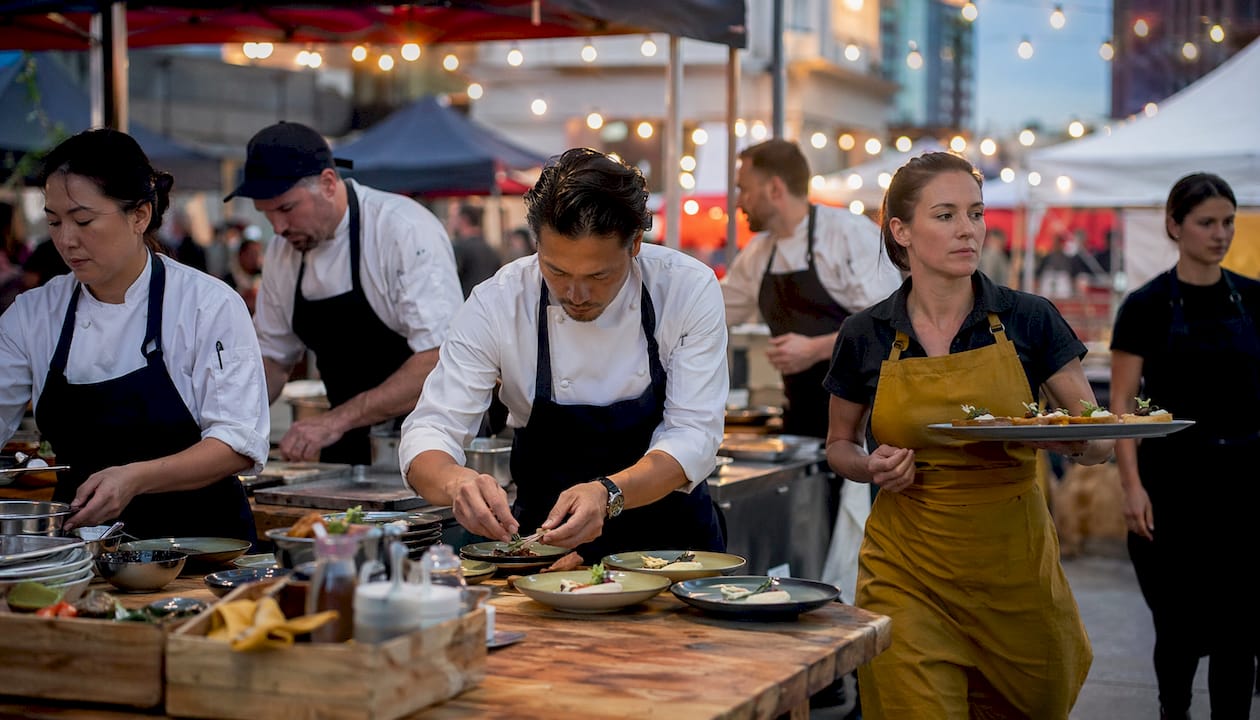
Service choreography in fine dining is the discipline of making complex, multi-person coordination look effortless to the guest. The standard gestures, serving from the left and clearing from the right, exist for a reason: they create a predictable physical pattern that keeps staff from crossing paths and gives guests a consistent, unobtrusive experience.
Seat-based ordering prevents the most common luxury service failure, which is a runner arriving at a table and asking “who had the salmon?” That question, however politely asked, signals a breakdown in the system and pulls guests out of the experience. When every item is assigned to a seat number from the moment of entry, the entire delivery chain operates with confidence.
- Pace multi-course meals with 12–20 minutes between plated courses, adjusting for the complexity of each course and the energy of the table.
- Use quiet, synchronized clearing: all plates at a table leave at the same moment, with multiple staff members moving in a single coordinated sweep.
- Align lighting and music adjustments with course transitions. A subtle dimming as the main course arrives and a slight brightening for dessert creates a rhythm guests feel without consciously noticing.
- Service pacing and ambiance cues such as dimming lights at transitions are as important to the guest experience as menu quality.
Pro Tip: Brief your entire floor team on the evening’s pacing before service begins. Share the expected timing for each course, note any VIP tables, and assign a single lead server to set the pace for the room. When one person owns the rhythm, the whole team moves in sync.
5. Which technology tools actually improve fine dining operations?
Technology in fine dining earns its place only when it makes service less visible, not more complicated. The right tools handle forecasting, inventory, and guest history in the background so your team can focus entirely on the guest.
- Kitchen Display Systems (KDS): color-coded, time-sensitive ticket routing keeps the kitchen aligned with the dining room. Alerts for allergens and course staging reduce errors on multi-course and prix-fixe menus.
- Seat-aware POS platforms: systems built natively for fine dining surface guest history, dietary flags, and past ordering patterns the moment a table opens, without requiring staff to search for the information.
- Real-time inventory tracking: the kitchen sets start counts for each special before service. The system tracks every cover and alerts the floor before a dish runs out, eliminating mid-service disappointments.
- AI demand forecasting: AI-driven event scheduling can increase private dining occupancy by 28–35% by configuring space and timing events based on historical demand patterns.
- Guest preference databases: a CRM that logs wine preferences, dietary notes, seating preferences, and visit history lets your team anticipate needs before a guest articulates them. That anticipation is the defining quality of luxury service.
- Digital seating charts: updated in real time, these tools let the maître d’ manage table turns, VIP placements, and room configuration without paper diagrams or memory alone.
For a broader look at how food and lodging workflow efficiency translates across hospitality operations in 2026, the principles of demand forecasting and real-time communication apply well beyond the restaurant floor.
6. How do you keep improving your workflow over time?
The best fine dining operations treat their workflow as a living document, not a fixed manual. Guest expectations shift, staff capabilities evolve, and new tools become available. A structured evaluation cycle is what separates restaurants that maintain excellence from those that plateau.
- Track revenue per available seat-hour (RevPASH): this metric captures how effectively you are converting your physical capacity into revenue across every service period, not just peak nights.
- Monitor guest satisfaction scores specifically for private dining and special event experiences, where expectations are highest and feedback is most detailed.
- Conduct post-service debriefs: a brief five-minute conversation with the floor team after each service surfaces timing issues, guest concerns, and equipment gaps before they become patterns.
- Update staff training regularly: role specialization in fine dining requires ongoing refinement. A sommelier who completed their certification two years ago still benefits from quarterly tastings and pairing workshops.
- Incorporate real-time sentiment analysis: leading operations now use tools that parse guest feedback as it arrives, allowing service adjustments mid-event rather than waiting for a post-dinner survey.
- Test new service models gradually: introduce changes during lower-volume services first, measure the impact, and empower your team to flag problems before rolling out changes room-wide.
Professional luxury event coordination follows a five-phase sequence: consultation, design, logistics, execution, and post-event feedback. Applying that same structure to internal workflow reviews gives your team a clear cycle for improvement rather than ad hoc adjustments.
7. Staff training and specialization for luxury service roles
Luxury service is a craft, and it requires training programs that treat it as one. Generic hospitality training covers the mechanics of service. Fine dining training goes further, building the judgment, discretion, and physical precision that guests at this level expect.
The foundation is role specialization. A chef de rang in a fine dining room carries different responsibilities than a general server, and training should reflect that distinction. The maître d’ needs fluency in room management, conflict resolution, and VIP protocol. The sommelier requires deep product knowledge plus the ability to read a table’s mood and pace wine service accordingly. Runners need physical precision: plates set the same way every time, announced with a single clear sentence, placed from the left in one smooth motion.
Table setting standards in luxury dining are non-negotiable. Flatware placed with ruler-measured consistency, a master table set before every service, and white-glove handling of glassware are the visible markers of a trained team. Guests may not consciously notice perfect execution, but they absolutely notice when it slips.
Cross-training between front-of-house and back-of-house roles builds empathy and communication. A server who has spent time in the kitchen understands why timing requests matter. A line cook who has observed the dining room understands the impact of a delayed plate. That shared understanding reduces friction at the handoff point where most service failures originate.
8. Coordination protocols between kitchen and service staff
Timing precision between kitchen and floor is the operational heartbeat of fine dining. A course that arrives thirty seconds after the previous plate is cleared feels rushed. One that arrives three minutes late feels neglected. The window for “perfect” is narrow, and hitting it consistently requires explicit protocols, not informal communication.
The expo station is the critical control point. Every plate passes through expo before it reaches the dining room, and the expo’s job is to verify presentation, confirm seat assignments, and dispatch runners only when the full table’s order is ready. Partial delivery at a fine dining table, where one guest receives their plate before others, is a service failure regardless of how it is explained.
VIP guests and personalized service require an additional layer of coordination. When a returning guest has a noted preference for a specific wine region or a documented allergy, that information must travel from the reservation system through the POS to the kitchen before service begins. Incorporating personalized guest data into workflow planning distinguishes high-end private dining by anticipating preferences before the guest articulates them. The bespoke dining experience that guests remember and return for is built on exactly this kind of proactive coordination.
Allergen protocols belong in the order-entry system, not in verbal communication alone. When allergen flags surface inline as a server enters an item, the kitchen sees the restriction attached to the specific seat and course, not as a separate note that can be missed during a busy service. That structural approach reduces risk far more reliably than reminders and verbal handoffs.
9. Crisis management and contingency planning during service
Even the most carefully designed workflow encounters disruptions. A key staff member calls in sick two hours before service. A supplier delivers the wrong protein. A guest arrives with a severe allergy not disclosed during booking. The difference between a restaurant that handles these moments gracefully and one that visibly struggles is the quality of its contingency planning.
Build contingency into the menu itself. Having one or two alternative dishes that use prepped ingredients gives the kitchen a fast response to last-minute dietary restrictions without requiring a full re-prep. A plated standby for timing delays, a light additional course that can be inserted if the kitchen needs recovery time, keeps the guest experience smooth even when the back-of-house is managing a problem.
Staff contingency plans should be documented and rehearsed, not improvised. Who covers the sommelier’s tables if they are unavailable? Which server takes over a section if someone leaves mid-service? Answering these questions in advance, and running brief scenario drills during slower services, builds the team’s confidence and reduces the visible impact of any disruption. For corporate dining events, where a service failure in front of a client group carries reputational stakes beyond the restaurant itself, this preparation is especially valuable.
Planning a luxury dining experience beyond the restaurant?
Grandglobetrotting brings the same standard of precision and personalization to luxury travel planning that the finest restaurants apply to their service workflows. Whether you are coordinating a private dining experience as part of a corporate trip, a honeymoon, or a bespoke international itinerary, the Grandglobetrotting team handles every detail with the same care a great maître d’ brings to the dining room. Explore the personalized luxury travel guide to see how a fully coordinated luxury experience comes together from first inquiry to final course.
Key Takeaways
A high-end dining arrangements workflow succeeds when concept positioning, physical layout, staff choreography, and technology operate as a single coordinated system rather than separate functions.
| Point | Details |
|---|---|
| Positioning drives operations | Your market position determines staffing ratios, menu complexity, and the service style your workflow must support. |
| Layout is an operational tool | Loop-mapped service paths and well-placed side-stations reduce collisions and protect the guest experience. |
| Seat-based ordering prevents failures | Assigning every item to a specific seat number at entry eliminates the most common luxury service error. |
| AI occupancy gains are measurable | AI-driven scheduling has increased private dining occupancy by 28–35% through demand-based space configuration. |
| Contingency planning protects the experience | Pre-built menu alternatives and documented staff coverage plans allow graceful recovery from real-time disruptions. |
Recommended
At Grand Globetrotting, we don't just plan vacations; we craft extraordinary adventures that leave you with cherished memories. Let us bring your dream vacation to life, perfectly tailored to your style, and immerse yourself in a world of luxury, exploration, and unforgettable moments. Your journey begins with us.
Itinerary planning services require a separate charge outside of cost to book travel accommodations. Depending upon the complexity of the itinerary and the level of effort required to acquire unique experiences, cost may vary. Speak with our team to learn more.
Book your consultation