

TL;DR:
- Effective incentive travel programs require clear objectives, strategic planning, and experience design focused on participant recovery. Proper budgeting, meaningful experiences, and comprehensive communication ensure impactful results and lasting motivation. Partnering with experts like Grandglobetrotting simplifies logistics, enhances quality, and maximizes return on investment.
Incentive travel sounds straightforward on paper: reward top performers with an unforgettable trip and watch engagement soar. In practice, knowing how to plan incentive travel effectively is what separates programs that genuinely move people from ones that generate polite thank-you emails and little else. The gap almost always comes down to planning depth, not budget size. This guide walks you through every critical phase, from setting clear objectives and building a realistic budget to designing brain-smart experiences and measuring real ROI, so your next program delivers results that matter.
Table of Contents
- Key Takeaways
- How to plan incentive travel that starts with strategy
- Building a realistic incentive travel budget
- Designing experiences participants actually want
- Managing communications, risk, and compliance
- Measuring success and maximizing ROI
- My honest take on why most incentive trips miss the mark
- Let Grandglobetrotting handle the heavy lifting
- FAQ
Key Takeaways
| Point | Details |
|---|---|
| Start with clear objectives | Define which behaviors you are rewarding before selecting a destination or booking anything. |
| Budget by category | Break costs into line items per participant to avoid missing expenses like visa fees or travel insurance. |
| Design for restoration | Protect sleep, offer participant choice, and create one shared awe experience rather than overpacking itineraries. |
| Manage compliance early | Incentive trips are taxable to recipients, so loop in tax counsel before finalizing program structure. |
| Measure after the trip | Use pre- and post-trip surveys to assess impact on motivation and inform future program decisions. |
How to plan incentive travel that starts with strategy
Most incentive travel programs underperform for one reason: the planner starts with a destination instead of a purpose. Before you open a single hotel catalog or request an airfare quote, you need a clear answer to one question. What specific behavior are you rewarding, and what outcome do you want to reinforce?
Program goals aligned to specific, measurable KPIs produce far better engagement than vague “top performer” criteria. If your goal is to reward a 20% sales increase, say so explicitly in your qualification criteria, your communications, and your program design. Participants who understand exactly how they earned the trip feel the recognition more deeply.
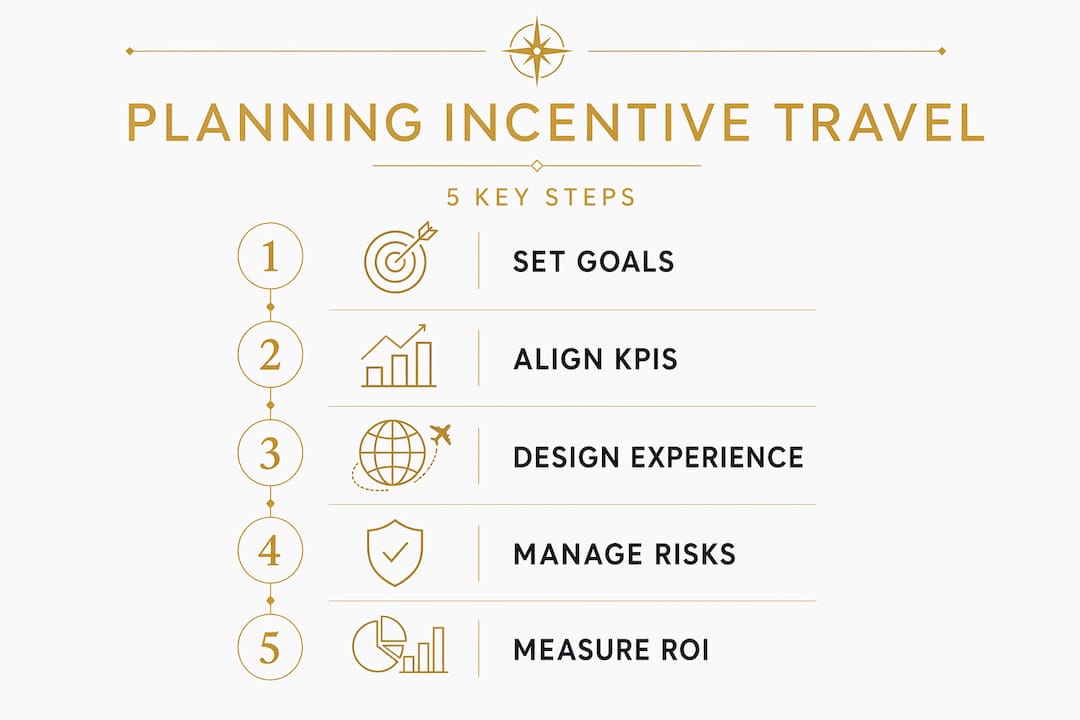
Once you have defined your objectives, profile your participants. A survey distributed four to six months out gives you data on destination preferences, activity types, dietary needs, and travel experience levels. This information directly shapes every decision you make afterward, from choosing between an adventure destination and a beach resort to deciding how many structured versus free-time hours to build into the schedule.
On timeline, plan at least six to nine months ahead for international programs and three to four months for domestic ones. Rushing this window leads to compromised hotel choices, inflated airfare, and limited negotiating power with vendors.
- Define qualifying criteria with measurable thresholds
- Survey participants on destination preferences and activity interests
- Set a budget range before shortlisting destinations
- Establish your planning team and assign vendor management roles
- Lock in your travel dates at least six months ahead for international trips
Pro Tip: Scheduling your travel dates within a three-week window of flexibility can unlock significantly better flight options and pricing, which directly improves both your budget and participant experience.
Building a realistic incentive travel budget
Budgeting is where most incentive travel programs either gain or lose their credibility with leadership. The approach that works is building your budget by category, calculating a per-person cost, and then multiplying by headcount. This method surfaces overlooked expenses that a lump-sum estimate will miss every time.
Here is a practical framework for how to organize incentive travel costs by category:
| Budget category | Typical % of total budget | Notes |
|---|---|---|
| Airfare | 10–18% | Negotiate group rates early; prioritize direct flights |
| Hotel and venue | 35–45% | Includes meeting space if needed |
| Food and beverage | 15–20% | Account for welcome dinners and farewell events |
| Activities and excursions | 10–15% | Build in tiered options for participant choice |
| Gifting and amenities | 3–6% | Personalized gifts carry more impact than generic ones |
| Contingency | 10% | Non-negotiable; cover currency shifts, emergencies, and delays |
Airfare budgeted at 10 to 18% of the total program cost is a reliable benchmark, but this shifts significantly based on destination. The contingency buffer is not optional. Visa fees, travel insurance, local taxes, and fluctuating exchange rates are consistently the line items that blindside planners who skip it.

On the logistics side, destinations with direct flights and straightforward visa access reduce both planning complexity and participant fatigue. A top performer who arrives exhausted from a four-connection journey is not going to feel rewarded, regardless of how beautiful the hotel is.
Negotiate group airfare blocks early, even before finalizing participant rosters. Many airlines offer group holding contracts that allow name changes up to a certain point. This protects your pricing while giving you flexibility as your qualifier list is confirmed.
Pro Tip: Build your budget from your strategic goals, not last year’s numbers. Reusing prior-year figures without auditing categories leads to compounding gaps that erode program quality over time.
Designing experiences participants actually want
The most common mistake in incentive travel program ideas is treating the itinerary like a highlight reel. Every hour scheduled, every activity mandatory, every meal a group affair. This approach exhausts participants rather than energizing them, particularly your highest performers who already operate at peak intensity throughout the year.
Brain-smart incentive design flips this model. The goal shifts from maximizing activity volume to maximizing participant recovery, meaning the trip becomes a genuine mental and physical reset alongside a recognition experience.
Here is what that looks like in practice:
- Protect sleep. Avoid mandatory early breakfasts and back-to-back evening events. High performers are often the most sleep-deprived people in your organization.
- Offer choice. Build tiered activity tracks, one high-energy option, one cultural or culinary option, and one genuinely relaxing option, so participants can follow their own energy levels.
- Create one shared awe moment. A fixed-anchor shared experience creates collective memory and group bonding without requiring every hour to be a group activity. This could be a private sunset dinner at an iconic location or a behind-the-scenes cultural access that money alone cannot buy.
- Build in unscheduled time. At least two to three hours per day with zero agenda allows participants to explore, rest, or connect authentically.
- Use local culture intentionally. Themed events tied to the destination, private market tours, local chef collaborations, or authentic performances create far more lasting memories than generic resort programming.
“The best incentive trips I have seen did not exhaust people into submission. They restored them. When participants return feeling genuinely refreshed and recognized, the motivational effect lasts months, not days.”
Personalized itineraries are increasingly the standard expectation in 2026 programs. This does not mean creating entirely individual programs, but it does mean giving participants meaningful input and accommodating preferences wherever possible. Resources like Grandglobetrotting’s guide on executive travel itineraries offer practical frameworks for structuring schedules that balance professional recognition with genuine personal enjoyment.
Managing communications, risk, and compliance
Getting the experience design right is only half the work. The logistical and legal side of incentive travel carries real risk for planners who treat it as an afterthought.
Start with participant communications well before departure. A well-designed communication arc builds anticipation and increases perceived program value:
- Send a teaser announcement the moment qualifiers are confirmed, focusing on exclusivity and reward.
- Follow with a personalized invitation that outlines the experience and includes a participant survey.
- Distribute detailed pre-trip information packets 30 days before departure, covering logistics, packing recommendations, and itinerary highlights.
- Deliver a day-by-day schedule with emergency contacts and on-site hospitality desk details one week prior.
On-site, assign a dedicated hospitality desk or travel manager whose sole role is handling participant needs. This person manages late arrivals, medical needs, activity changes, and any logistical friction so participants never feel like they are managing their own trip.
Risk management protocols should include group travel insurance covering trip interruption, medical emergencies, and evacuation. Document all emergency contacts and share them with both your on-site team and a point of contact at home base.
On the compliance side, incentive trips are taxable to recipients based on fair market value. The IRS does not provide a precise formula for calculating this, which creates genuine ambiguity. For deductibility on the company side, expenses must qualify as ordinary and necessary business expenses, which means documentation of business purpose is critical. Consult a tax professional before the program launches, not after.
Measuring success and maximizing ROI
An incentive travel program without a measurement plan is an expensive assumption. Before the trip departs, define the specific KPIs you will use to assess program success. These should connect directly to the business objectives you established at the start.
After the trip, collect data across several dimensions:
- Participant satisfaction scores from post-trip surveys distributed within 48 hours of return
- Motivation and engagement shifts measured by comparing pre-trip and post-trip survey responses on work engagement and team connection
- Business metric performance tracked over the 90-day post-trip window for sales, retention, or productivity outcomes
- Qualitative feedback gathered through open-ended questions about which specific experiences created the most impact
- Turnover intention changes if retention is a stated program goal, since incentive travel reliably affects this metric when designed well
Compile these findings into an internal report and present them to leadership within 30 days of the trip. Quantify both the financial ROI and the cultural impact. A program that retained three high-performers who would otherwise have left has a calculable dollar value that often exceeds the total program cost. This kind of internal communication is what builds the budget support for next year’s program.
My honest take on why most incentive trips miss the mark
I have spent years watching companies pour significant budgets into incentive travel programs that generate genuine excitement during booking and quiet disappointment on return. The pattern is consistent. The trip was too full, too structured, and too focused on showing participants a good time rather than actually giving them one.
The shift to brain-smart design is not a trend. It is a recognition that your top performers are often the most depleted people in the room. Mandatory sunrise yoga sessions and back-to-back excursions might look impressive on a program brochure, but they are not restoration. They are recreation dressed up as reward.
What I have found actually works is this: one extraordinary shared moment, genuine free time, and a sense of individual choice throughout the schedule. I have seen a private dinner at a clifftop vineyard create more lasting team connection than three days of group activities. I have watched participants return from a trip with two unscheduled afternoons talking about it for months, and return from jam-packed programs struggling to name a single standout moment.
Even modest budgets can deliver this. The caliber of an experience is not always proportional to its cost. It is proportional to how well it was designed for the specific people attending. That starts with knowing your participants, protecting their energy, and having the confidence to leave white space on the itinerary.
— Sandon
Let Grandglobetrotting handle the heavy lifting
Planning a high-quality incentive trip is demanding work, and the details that make the difference, like securing the right hotel block, sourcing exclusive local excursions, or building itineraries that actually fit your group, require connections and experience that take years to develop.
Grandglobetrotting specializes in exactly this kind of bespoke travel planning, offering corporate event planners direct access to premium hotels, curated excursion options, and personalized itinerary design that reflects both your brand and your participants’ preferences. From premium hotel selection to on-the-ground logistics support, the team handles complexity so you can focus on the program strategy. Whether you are planning your first incentive trip or refining a program that has not delivered the results you wanted, Grandglobetrotting brings the vendor relationships and luxury expertise your program deserves. Explore the full range of planning services at grandglobetrotting.com.
FAQ
How far in advance should incentive travel be planned?
International programs need six to nine months of lead time, while domestic programs typically require three to four months. Starting earlier secures better hotel rates, airfare, and vendor availability.
Is incentive travel taxable to employees?
Yes. The IRS treats incentive trips as taxable compensation based on fair market value, and companies should consult a tax professional to handle reporting and documentation correctly.
What percentage of the budget should airfare take?
Airfare typically represents 10 to 18% of the total incentive travel budget, with an additional 10% contingency buffer recommended across the full program.
What is a brain-smart incentive travel design?
It is an approach grounded in neurological principles that prioritizes restoration, individual agency, and a single shared awe experience over high-volume activity scheduling, producing stronger motivation and longer-lasting impact.
How do you measure incentive travel ROI?
Collect pre- and post-trip surveys on engagement and motivation, track business KPIs over the 90 days following the trip, and calculate retention value if applicable. Present these findings to leadership within 30 days of return.
Recommended
At Grand Globetrotting, we don't just plan vacations; we craft extraordinary adventures that leave you with cherished memories. Let us bring your dream vacation to life, perfectly tailored to your style, and immerse yourself in a world of luxury, exploration, and unforgettable moments. Your journey begins with us.
Itinerary planning services require a separate charge outside of cost to book travel accommodations. Depending upon the complexity of the itinerary and the level of effort required to acquire unique experiences, cost may vary. Speak with our team to learn more.
Book your consultation