

TL;DR:
- Advanced travel technology now serves as the core infrastructure enabling frictionless, personalized luxury journeys at scale. It enhances the traveler experience by streamlining processes like biometric recognition and digital identity sharing, while expert human judgment remains essential for bespoke planning. Trust, privacy, and seamless interoperability are critical to maximizing the benefits of innovative travel tech in high-end travel experiences.
Advanced travel technology is no longer a convenience layer on top of luxury travel. It is becoming the infrastructure that makes genuinely frictionless, deeply personalized experiences possible at scale. Yet a persistent misconception remains: that technology is slowly replacing the human expertise behind bespoke journeys. The role of advanced travel technology, as we see it, is precisely the opposite. For high-net-worth travelers planning honeymoons, executive trips, or one-of-a-kind excursions, the right technology removes every operational obstacle so that expert human judgment can do what algorithms simply cannot.
Table of Contents
- How contactless travel tech smooths the luxury journey
- Biometric innovations revolutionizing airport experience
- The promise and pitfalls of AI in luxury travel personalization
- Integrating interoperable systems for seamless, cross-border journeys
- Balancing innovation with privacy and trust in luxury travel tech
- Why human expertise remains irreplaceable despite advanced travel tech
- Enhance your bespoke luxury travel with expert planning support
- Frequently asked questions
Key Takeaways
| Point | Details |
|---|---|
| Contactless biometric travel | Advanced travel technology enables seamless, secure journeys by reusing digital identity credentials across touchpoints. |
| Speed and efficiency | Biometric smart gates reduce airport wait times dramatically for eligible luxury travelers with pre-registered data. |
| AI supports but doesn’t replace | Artificial intelligence streamlines planning but human curation remains essential for bespoke luxury experiences. |
| Interoperability is essential | Standards like IATA’s Directory prevent fragmented travel tech, ensuring smooth multi-provider journeys. |
| Privacy and trust | Responsible data governance builds confidence in technology-enabled personalized luxury travel. |
How contactless travel tech smooths the luxury journey
The friction points in elite travel are not always where you expect them. Long waits at immigration, repeated document checks, and disjointed digital experiences across airports are the details that quietly diminish a first-class journey. Contactless travel technology, applied thoughtfully, technology elevates bespoke luxury travel experiences by removing exactly these pain points before they arise.
The practical mechanism is straightforward. IATA’s Contactless Travel Directory enables a single API for airlines and airports to access up-to-date biometric service availability and passenger eligibility, simplifying integrations across the entire journey. Rather than each airport or airline building its own verification stack, service providers share eligibility data through one standardized connection. That means a traveler’s digital identity credentials can be recognized and reused across every touchpoint, from check-in to lounge access to boarding.
Here is what this looks like in practice for luxury travelers:
- Single credential reuse: A verified digital identity established once at departure can carry through connecting airports and hotel check-ins, reducing repetitive document presentations.
- Real-time eligibility updates: If a traveler’s status changes, such as an upgrade or a visa amendment, the update flows centrally rather than requiring manual corrections at each checkpoint.
- Reduced failure points: Fragmented systems create the gaps where VIP journeys go wrong. A centralized eligibility architecture closes those gaps before departure.
The ability to streamline bespoke itinerary workflow depends heavily on these back-end integrations being invisible to the traveler. When technology works at its best, you notice the ease, not the machinery behind it.
Pro Tip: When planning a complex multi-destination itinerary, confirm in advance whether your origin and destination airports are listed on IATA’s Contactless Travel Directory. Enrollment at airports not yet integrated may still be required, and knowing this early prevents surprises at the gate.
Biometric innovations revolutionizing airport experience
Contactless data sharing is only one part of the equation. The physical experience of moving through an airport is where biometric technology delivers the most visible results. And the numbers are genuinely striking.
Dubai’s 122 biometric smart gates reduce passport control clearance to about five seconds for pre-registered travelers using facial and iris recognition. For a traveler connecting through Dubai en route to a Maldives resort or an East African safari, that is the difference between a relaxed transfer and a stressful sprint. The technology uses dual-factor biometrics, combining both face and iris data, which significantly raises accuracy and reduces false rejections compared to single-factor systems.
The table below shows how biometric airport technology compares to traditional passport control in practical terms:
| Factor | Traditional passport control | Biometric smart gates |
|---|---|---|
| Average clearance time | 3 to 5 minutes per traveler | Approximately 5 seconds |
| Document requirement | Physical passport required | Pre-registered digital identity |
| Traveler experience | Queue-dependent, variable | Consistent and predictable |
| Security accuracy | Officer-assessed | Dual biometric verification |
| Scalability for VIPs | Limited dedicated lanes | Scalable across all registered users |
What the table does not capture is the eligibility design question. The speed benefit exists only for travelers who have pre-registered. Enrollment coverage, meaning how many eligible travelers have actually completed registration, determines whether a biometric deployment performs as advertised or becomes an underutilized amenity.
For expert travel guidance on luxury journeys, understanding which airports require advance enrollment and which offer on-arrival biometric setup is a practical planning detail that separates smooth arrivals from preventable delays.
Pro Tip: Pre-register your biometric credentials before any trip through a biometric-enabled hub. Even if your primary destination does not use smart gates, a connection through Dubai, Singapore, or Amsterdam Schiphol can benefit significantly from prior enrollment.
The promise and pitfalls of AI in luxury travel personalization
AI is reshaping how travel itineraries are researched, assembled, and refined. For high-net-worth travelers, that is partly good news and partly a risk worth understanding. The impact of travel technology is most visible in AI’s ability to process thousands of destination data points, hotel reviews, and flight combinations faster than any human researcher. But speed is not the same as taste.

Fast Company notes that AI can streamline planning but risks producing “herd mentality” itineraries unless paired with human-led personalized expertise. In plain terms: if every traveler’s AI uses the same training data, the “top 10 restaurants in Kyoto” list looks identical for everyone. That is not bespoke. That is a well-formatted generic tour.
The benefits of smart travel tools in AI planning are real when applied correctly:
- Research acceleration: AI can rapidly surface obscure properties, verify seasonal availability, and flag destination-specific considerations that would take hours to compile manually.
- Preference matching: With sufficient personal data, AI tools can narrow thousands of options to a shortlist aligned with a client’s specific tastes and past travel history.
- Dynamic repricing alerts: AI monitors fare and room rate fluctuations in real time, enabling advisors to secure the best available terms quickly.
But consider what AI cannot do. It cannot know that a particular client found their last “highly rated” restaurant in Tuscany too formal for a honeymoon dinner. It cannot gauge the emotional resonance of a specific suite view versus its neighbor two floors down. It cannot call a property’s general manager to arrange a private early access to a museum before the crowds arrive.
“The competitive differentiator in luxury travel personalization is not which AI a planner uses. It is the quality of human judgment layered on top of it.” — Grand Globetrotting
Luxury personalization redefined happens at the intersection of AI-driven efficiency and expert human discernment. Understanding personal preferences in bespoke luxury itineraries requires a conversation, not just a dataset.
Integrating interoperable systems for seamless, cross-border journeys
A bespoke luxury itinerary often spans multiple airlines, three or four countries, and half a dozen hotels. The worst travel experiences for high-net-worth clients happen not because of bad hotels, but because of fragmented systems that cannot talk to each other. Interoperability is the technical term, but the traveler experience it describes is simply this: everything works together, consistently.
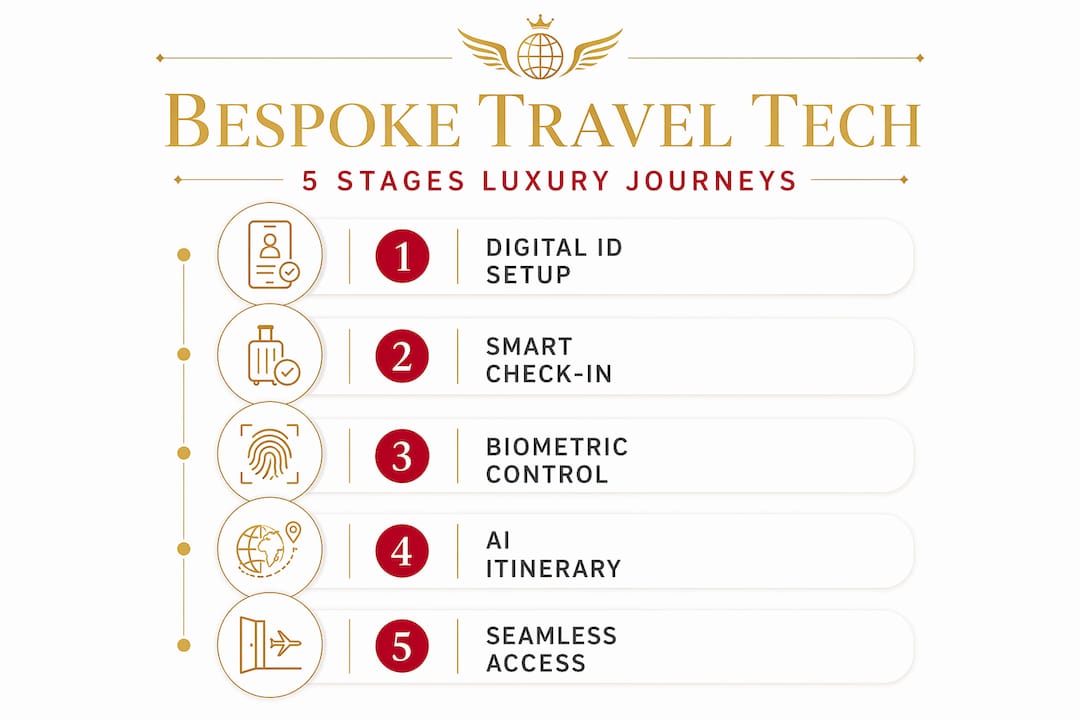
IATA’s 2026 proof-of-concept tests demonstrated that interoperable digital identity and biometric verification enable seamless multi-carrier and cross-border contactless journeys. The standards involved, including IATA’s One ID framework and Digital Travel Credentials, allow a single verified digital identity to function across different airlines and border agencies without re-verification at each stop.
Here is why that matters for a complex itinerary:
- Multi-carrier trips: A journey that begins on one airline, connects through a different carrier, and concludes on a regional operator requires each leg to recognize the traveler’s identity. Without interoperability, each carrier demands a separate check.
- Border agency integration: Cross-border journeys involve customs and immigration authorities in addition to airline systems. Interoperable credentials mean a traveler’s identity flows through without manual document re-presentation.
- Hotel and transfer touchpoints: The future of contactless travel extends beyond airports to hotel check-in, ground transport, and lounge access, all using the same verified credential.
- Error reduction during connections: Tight connections are a known stress point. When identity data transfers automatically, gate agents spend less time verifying documents and more time managing the boarding process.
Planning for itinerary management in luxury travel 2026 increasingly means selecting airlines and transit hubs that participate in these interoperability standards. Personalized travel planning for luxury journeys now includes a technology compatibility check as part of the routing decision.
Balancing innovation with privacy and trust in luxury travel tech
Advanced technologies in tourism bring a specific responsibility that luxury operators cannot afford to overlook. When a traveler shares biometric data, facial recognition enrollment, travel history, and dining preferences with a platform or advisor, they are extending significant trust. How that data is handled defines whether the relationship deepens or fractures.
A systematic review of smart tourism technologies highlights concerns around confidentiality, ethics, and employee well-being in smart tourism technology adoption, all of which are directly relevant to building client trust in luxury personalization. For high-net-worth clients, the stakes are elevated. Their travel patterns, spending habits, and personal preferences are sensitive in ways that go beyond ordinary consumer data.
Key principles for responsible data governance in luxury travel technology:
- Explicit consent at every layer: Clients should know exactly what data is collected, how it is stored, and who can access it. This should be explained clearly before enrollment, not buried in terms.
- Data minimization: Collect only what is needed to deliver the personalized service. A honeymoon itinerary does not require years of financial travel history.
- Transparent vendor agreements: Advisors and platforms should be able to confirm which third-party technology providers handle client data and under what security standards.
- Right to data deletion: Clients should have a clear path to remove their biometric and personal data from any system after their journey concludes.
Pro Tip: Before enrolling in any biometric or digital identity program, ask your travel advisor to confirm which data storage protocols the program uses and in which jurisdiction your data is held. For travelers from the US and EU, regulatory protections differ significantly across providers.
The expert travel guidance for luxury journeys that earns long-term client trust always includes an honest conversation about which technologies are used and why they are safe to adopt.
Why human expertise remains irreplaceable despite advanced travel tech
There is a conversation happening in luxury travel circles that overstates what technology can do and, more importantly, misunderstands what it is for. The role of digital travel solutions is not to replace the advisor who knows that a particular client prefers a suite with northern light exposure, or remembers that a certain couple’s first trip together was to Morocco and an anniversary return would carry genuine meaning. Technology does not hold that knowledge. People do.
The future of travel technology, as we see it from working with discerning clients across every travel category, is not autonomous AI itinerary generation. It is friction removal at scale so that human creativity and judgment can be applied where they matter most. Biometric gates save five seconds per traveler at passport control. That five seconds, multiplied across a complex two-week itinerary, adds up to a journey that feels effortlessly smooth rather than operationally taxing. But the choice of which two weeks, which properties, which private dining experiences, and which moments of surprise belong entirely to human expertise.
Fast Company’s analysis reinforces that the competitive differentiator is personalization paired with high-touch human judgment, not algorithm-only planning. The advisors who will define luxury travel over the next decade are those who use technology to eliminate every operational inefficiency and then invest that recovered time into deeper client relationships and more imaginative journey design. Overreliance on AI, without that human layer, produces experiences that feel polished but generic. And generic is the one thing luxury travel cannot be.
Enhance your bespoke luxury travel with expert planning support
Understanding the role of advanced travel technology is the first step. Applying it to an actual journey requires an advisor who knows which systems work together, which airports support biometric entry, and how to translate your personal preferences into an itinerary that no algorithm would ever produce on its own.
At Grand Globetrotting, we bring together the best technology available and the expert judgment of seasoned travel advisors to design journeys that are genuinely yours. Whether you are planning a personalized luxury travel experience, organizing an executive business trip where every detail reflects your professional image, or crafting a luxury honeymoon that you will remember for the rest of your lives, we are here to make it extraordinary. Technology gets you there smoothly. We make sure the journey is unforgettable.
Frequently asked questions
What is contactless travel technology and how does it benefit luxury travelers?
Contactless travel technology allows passengers to move through airports and borders using verified digital credentials and biometrics instead of physical documents, reducing wait times and creating a more secure experience. The Contactless Travel Directory makes these services discoverable and interoperable, allowing contactless travel to scale efficiently across providers.
How do biometric smart gates improve airport experiences for high-net-worth individuals?
Biometric smart gates use facial and iris recognition to verify traveler identity in seconds rather than minutes, enabling VIP travelers to move through passport control without queues. Dubai’s biometric smart gates cut passport control clearance to approximately five seconds for pre-registered travelers.
Can AI fully replace human travel planners in creating luxury itineraries?
No, AI is a powerful research and efficiency tool, but it cannot replace the judgment, relationship history, and creative thinking that define truly bespoke luxury travel. Without human curation, AI risks “herd mentality” itineraries that feel polished but impersonal.
Why is interoperability important in advanced travel technology for luxury trips?
Interoperability ensures a traveler’s verified digital identity works across different airlines, border agencies, and airports without re-verification at every step, preventing the fragmented experiences that disrupt complex multi-destination journeys. IATA’s PoCs confirmed that interoperable digital identities enable seamless cross-border and multi-provider contactless travel.
What privacy concerns should luxury travelers consider with advanced travel technology?
Luxury travelers should confirm that any biometric or personalization platform they enroll in has transparent data governance, clear deletion rights, and strong third-party security agreements. A systematic review of smart tourism technologies highlights that confidentiality and ethical governance are essential to building genuine trust in luxury personalization systems.
Recommended
At Grand Globetrotting, we don't just plan vacations; we craft extraordinary adventures that leave you with cherished memories. Let us bring your dream vacation to life, perfectly tailored to your style, and immerse yourself in a world of luxury, exploration, and unforgettable moments. Your journey begins with us.
Itinerary planning services require a separate charge outside of cost to book travel accommodations. Depending upon the complexity of the itinerary and the level of effort required to acquire unique experiences, cost may vary. Speak with our team to learn more.
Book your consultation