

TL;DR:
- Exclusive vendor partnerships in luxury travel provide unique access to premium properties and experiences, creating a competitive advantage. Properly structured contracts with clear scope, performance standards, and enforcement reduce risks like over-dependence and legal disputes. These alliances result in cost savings, enhanced service quality, and elevated client loyalty by ensuring priority access and consistent delivery.
Why exclusive vendor partnerships define luxury travel strategy
Exclusive vendor partnerships are contractual alliances that grant a single vendor sole rights to supply defined products or services within a specified territory, category, or time frame. In luxury travel, they function as the backbone of differentiated service delivery, giving operators consistent access to premium properties, private aviation providers, and curated experiences that competitors simply cannot replicate on demand.
The strategic importance of these alliances goes well beyond cost control. Nearly 67% of leaders in a Best Practices, LLC benchmarking study cited cost efficiency and faster turnaround as their primary objectives for exclusive vendor arrangements. In luxury travel, those gains translate directly into faster itinerary fulfillment, tighter quality control, and the kind of consistency that high-net-worth clients expect at every touchpoint.
A well-structured exclusive agreement typically covers:
- Scope of exclusivity: which product categories, territories, or client segments fall under the arrangement
- Duration: a fixed term with defined renewal options
- Performance metrics: service-level agreements (SLAs), delivery timelines, and defect thresholds
- Termination triggers: conditions under which either party may exit, including underperformance or insolvency
- Benchmarking rights: periodic price comparisons against market alternatives to prevent cost drift
When these elements are in place, exclusive supplier agreements stop being a procurement convenience and become a genuine competitive asset.
Benefits of exclusive vendor partnerships in luxury travel
Cost savings are the most cited advantage, but they are not the most interesting one. Exclusive supplier agreements deliver average cost savings between 12% and 18% compared to competitive bidding for each purchase, according to a McKinsey 2023 analysis. For a luxury travel operator managing dozens of high-value supplier contracts annually, those percentages represent real budget that can be redirected into client experience.
The less obvious gains are often more powerful:
- Vendor commitment: an exclusive partner invests more deeply in your brand because they own the territory, which means better staff training, priority inventory allocation, and faster problem resolution
- Demand intelligence: sharing accurate, long-term forecasts with vendors triggers higher prioritization and access to premium service tiers that non-exclusive buyers never see
- Brand positioning: sole access to a sought-after property or experience category becomes a direct marketing differentiator
- Client loyalty: when guests know that certain experiences are available only through your platform, repeat booking rates climb
Pro Tip: Share multi-year demand forecasts with your top vendors at the start of each contract cycle. Vendors who can plan capacity around your volume will consistently prioritize your clients over walk-in or spot-market buyers.
Best practices for establishing and managing exclusive vendor partnerships
Vendor selection is where most luxury travel operators either build a durable advantage or create a future liability. The right exclusive partner combines deep specialization in a specific category (private aviation, ultra-luxury villa rentals, expedition cruising) with geographic coverage that matches your client base and a demonstrated willingness to commit resources exclusively to your brand.

Once selected, the contractual framework must do real work. Professional legal guidance consistently points to four non-negotiable elements: clearly defined territory, measurable performance standards, enforceable audit rights, and specific termination triggers tied to underperformance rather than convenience alone. Vague language in any of these areas creates disputes and erodes the partnership’s value over time.
Governance matters just as much as the contract. Effective vendor governance includes appointing a dedicated vendor contact on both sides, scheduling regular performance reviews, and maintaining a win-win mindset rather than extracting concessions at every renewal. Vendors who feel valued consistently outperform those who feel squeezed.
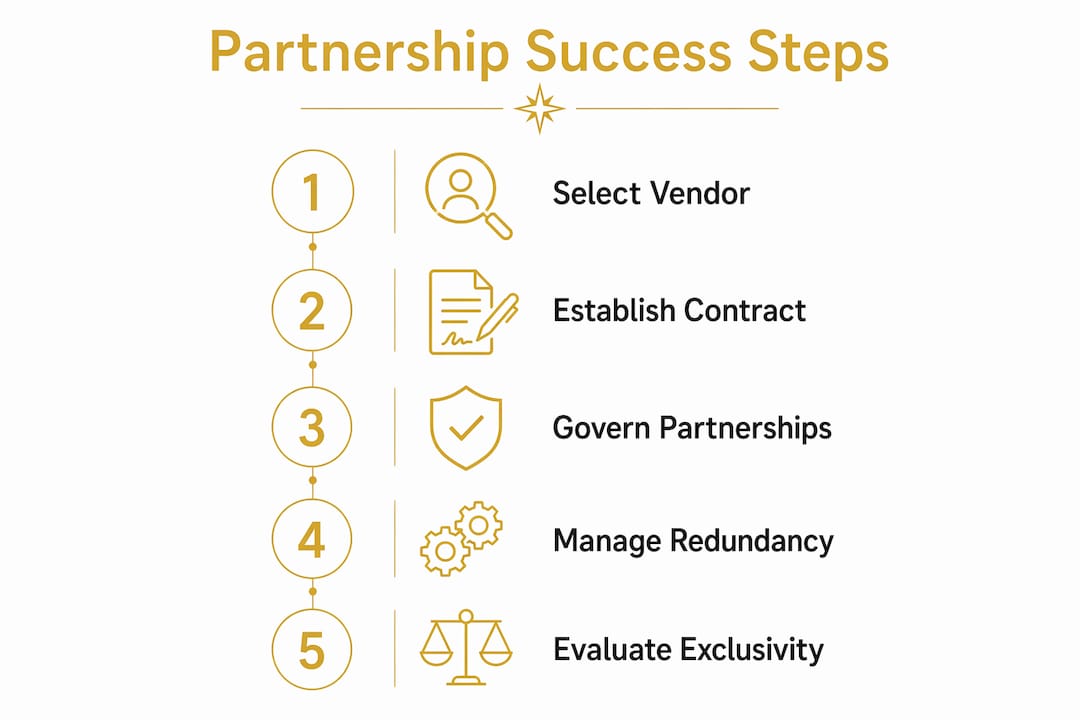
Operational redundancy deserves explicit attention. Channelnomics analysis recommends maintaining at least two vendors in any critical category, even when one holds preferred or near-exclusive status, to preserve pricing leverage and prevent a single point of failure.
Pro Tip: Apply exclusivity selectively. Reserve full exclusive agreements for premium, high-touch regions where differentiation is worth the dependency risk, and use diversified supplier pools in higher-volume or less brand-sensitive categories.
Common pitfalls in exclusive vendor partnerships and how to avoid them
Over-dependence is the most dangerous outcome of a poorly managed exclusive alliance. Concentrating all business with one vendor creates a single point of failure: if that vendor underperforms or shifts priorities, you cannot quickly activate an alternative without disrupting client commitments. The leverage equation also inverts over time, with the vendor gaining increasing power to extract concessions at renewal.
Almost half of vendor collaborations plateau when strategic management gives way to transactional routine. Relationships that start as growth alliances drift into basic order-fulfillment arrangements, and the premium service levels that justified exclusivity quietly erode.
Key pitfalls and their countermeasures:
- Single point of failure: maintain at least one qualified backup vendor in every critical category, even if they handle only a small share of volume
- Vendor complacency: tie exclusivity renewal directly to measurable KPI performance, not to relationship tenure
- Gray market leakage: enforce territorial restrictions actively through audit rights and marketplace monitoring; exclusivity does not prevent diversion without continuous enforcement
- Pricing drift: include annual benchmarking rights with a defined variance trigger (the market standard is 10%) that allows renegotiation or exit
- Stagnation: schedule quarterly business reviews focused on innovation and joint problem-solving, not just performance scorecards
For luxury travel operators, the hospitality context adds one more risk: exclusive agreements with venues or service providers can limit a client’s preferred vendor access, creating friction at the point of delivery. Building carve-out language into contracts preserves flexibility when client preferences conflict with exclusivity terms.
Legal essentials of exclusive vendor agreements
An exclusive supplier clause designates one vendor as the sole or primary source for defined goods or services during the contract term. The buyer agrees not to purchase from competing suppliers; in return, the vendor typically offers pricing concessions, capacity guarantees, or preferential access. Getting the clause structure right determines whether the agreement protects or constrains you.
Critical legal elements every exclusive vendor agreement should include:
- Scope definition: specify product categories, geographies, and client segments covered; ambiguity here is the most common source of disputes
- Percentage commitments: market-standard agreements typically require 80–90% of defined category purchases from the exclusive vendor, preserving a competitive buffer
- Benchmarking rights: annual price benchmarks against three comparable suppliers are the market standard, with a 10% variance trigger for renegotiation
- Performance-based KPIs: tie exclusivity to measurable thresholds such as on-time delivery above 95%, defect rate below 1%, and fill rate above 98%
- Termination triggers: include specific exit rights for insolvency, change of control, consecutive performance failures, and force majeure supply disruptions
- Carve-outs: reserve the right to source from alternatives during emergency orders, capacity shortfalls, or for product lines explicitly excluded from the exclusivity scope
- Antitrust compliance: under U.S. law, exclusive dealing arrangements are evaluated under Section 3 of the Clayton Act and Section 1 of the Sherman Act; agreements that foreclose a substantial share of the relevant market face legal scrutiny
Exclusive vendor agreements are legally enforceable contracts, provided they meet standard contractual requirements and do not violate antitrust law. Jurisdictional variations matter: legal standards for exclusivity differ by state, so tailor every agreement to the applicable jurisdiction.
How Grandglobetrotting uses exclusive vendor partnerships to deliver bespoke travel
Grandglobetrotting’s approach to exclusive vendor connections is built around one principle: every partnership must directly improve what a client experiences, not just what appears on a cost sheet. Vendor selection begins with a rigorous assessment of specialization, geographic depth, and the vendor’s demonstrated ability to perform under the specific demands of high-net-worth travel.
Exclusive access to select luxury hotels and private villa operators means that Grandglobetrotting clients receive priority allocation, room category upgrades, and personalized pre-arrival arrangements that are not available through standard booking channels. The same logic applies to private aviation partners, where exclusivity translates into confirmed availability during peak periods when open-market capacity disappears. For clients planning exclusive excursions, vendor relationships unlock access to experiences that are genuinely closed to the general public.
Internally, Grandglobetrotting enforces vendor performance through defined SLAs, regular quality audits, and a dedicated relationship management structure that keeps communication direct and accountability clear. Vendors who consistently meet performance benchmarks earn deeper integration into itinerary design; those who fall short face structured improvement periods before exclusivity is reconsidered.
Clients gain measurable benefits from this model:
- Reduced planning time, because vetted vendors deliver predictably without requiring repeated due diligence
- Personalized experiences, because exclusive partners invest in understanding individual client preferences over time
- Premium access, including allocations, private events, and service tiers that are not publicly listed
Case studies: exclusive vendor partnerships in luxury travel
Ultra-luxury cruise lines and private shore excursion operators. Several ultra-luxury cruise lines have formalized exclusive agreements with local expedition operators in remote destinations such as Antarctica and the Galápagos. These arrangements guarantee that the cruise line’s guests receive the only permitted small-group landings on certain sites on specific days, a logistical outcome that no amount of open-market booking can replicate. The premium event bartending sector has followed a parallel path, with high-end hospitality venues securing exclusive service providers to maintain consistent brand standards across every guest interaction.
Private villa operators and wedding travel. Exclusive supplier agreements between luxury travel advisors and private villa estates have reshaped the destination wedding market. When a travel advisor holds an exclusive or preferred relationship with a villa property, clients gain access to preferred dates, dedicated staff, and customized catering arrangements that open-market guests cannot request. Private villa stays illustrate how exclusivity at the property level translates directly into a superior, fully controlled guest experience.
Hotel groups and concierge travel platforms. Leading luxury hotel groups have established preferred partner programs that grant select travel advisors exclusive access to suite inventory, dining reservations at fully booked restaurants, and spa appointments during sold-out periods. Grandglobetrotting’s exclusive hotel access for high-net-worth travelers reflects this model, where the depth of the vendor relationship determines the quality of what can be delivered to the client.
These examples share a common thread: the exclusive arrangement was structured with clear performance expectations, defined scope, and active enforcement, which is precisely what separates a productive alliance from a contract that simply limits options.
How Grandglobetrotting can elevate your next luxury journey
Grandglobetrotting’s network of exclusive vendor connections exists to give you access to experiences that are not available through standard channels. Whether you are planning a bespoke honeymoon, a high-stakes corporate retreat, or a multi-destination family adventure, the depth of these partnerships determines what is actually possible. Explore the personalized luxury travel guide to see how Grandglobetrotting translates exclusive vendor relationships into itineraries that exceed expectations at every stage.
Key Takeaways
Exclusive vendor partnerships deliver their greatest value in luxury travel when they are structured with clear performance standards, active enforcement, and deliberate redundancy to prevent over-dependence.
| Point | Details |
|---|---|
| Cost savings are real but not the whole story | Exclusive agreements deliver 12–18% average cost savings, but vendor commitment and priority access often matter more in luxury travel. |
| Performance-based exclusivity protects both parties | Tie exclusivity renewal to measurable KPIs such as on-time delivery above 95% and defect rates below 1%. |
| Redundancy prevents single points of failure | Maintain at least one qualified backup vendor in every critical category, even under near-exclusive arrangements. |
| Legal structure determines enforceability | Market-standard agreements require 80–90% purchase commitments, annual benchmarking rights, and specific termination triggers. |
| Demand intelligence unlocks premium tiers | Sharing long-term forecasts with exclusive vendors triggers priority capacity allocation and service levels unavailable to spot buyers. |
Recommended
At Grand Globetrotting, we don't just plan vacations; we craft extraordinary adventures that leave you with cherished memories. Let us bring your dream vacation to life, perfectly tailored to your style, and immerse yourself in a world of luxury, exploration, and unforgettable moments. Your journey begins with us.
Itinerary planning services require a separate charge outside of cost to book travel accommodations. Depending upon the complexity of the itinerary and the level of effort required to acquire unique experiences, cost may vary. Speak with our team to learn more.
Book your consultation