

TL;DR:
- An upscale solo travel planning workflow involves destination vetting, safety checks, and AI-assisted itinerary design to create personalized, luxurious experiences. It emphasizes pre-booking key aspects while leaving sufficient spontaneity through the 60/40 rule to ensure comfort and flexibility. Operational discipline, including safety preparations and curated local experiences, transforms travel from logistical tasks into curated, high-end adventures.
An upscale solo travel planning workflow is a structured, multi-stage process that combines luxury preferences, safety protocols, and personalized organization to produce bespoke, high-end solo itineraries. Think of it as the professional equivalent of what a luxury travel concierge does internally, now available to any discerning solo traveler willing to apply the right sequence of steps and tools. The industry term for this approach is bespoke itinerary design, and it goes well beyond booking a flight and a five-star hotel. Platforms like MonkeyTravel and RainbowWanderer have made AI-assisted versions of this workflow accessible, while services like Grandglobetrotting bring the human expertise layer that technology alone cannot replicate. When executed correctly, this workflow cuts planning time, reduces logistical friction, and produces a trip that feels curated rather than assembled.
What are the essential steps in a luxury solo travel planning workflow?
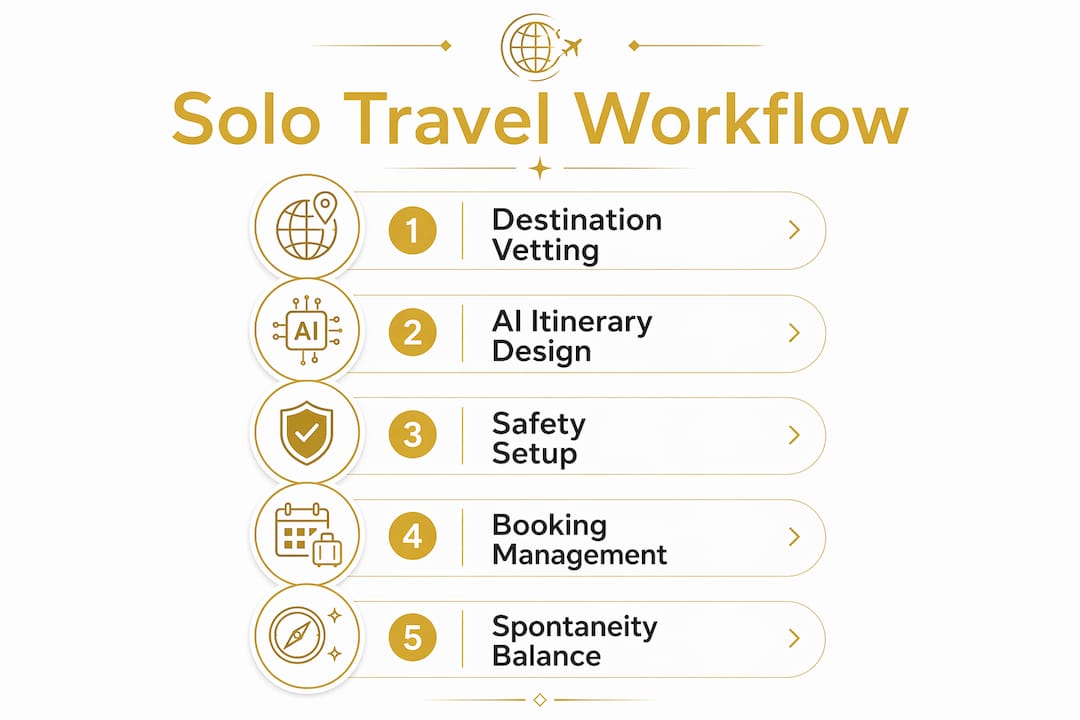
The ideal solo luxury workflow starts with destination selection and safety checks, then moves through logistics booking, accommodation vetting, and selective pre-booking of experiences. Each stage has a specific purpose, and skipping one creates gaps that surface at the worst possible moments during travel.
-
Shortlist destinations and verify budget alignment. Narrow your list to two or three destinations based on your interests, travel season, and realistic cost expectations. Cross-reference luxury hotel rates, flight costs, and dining benchmarks before committing.
-
Review travel advisories and safety data. Check the U.S. State Department’s travel advisory portal and local crime indexes for your shortlisted destinations. This step is non-negotiable for solo travelers, regardless of how well-known the destination is.
-
Book flights and accommodations with minimal suppliers. Consolidating bookings through fewer vendors reduces the number of points of contact if something goes wrong. A single luxury travel advisor or a tightly managed set of direct bookings keeps accountability clear.
-
Vet accommodations using maps and street view. Pull up the hotel on Google Maps and walk the surrounding streets virtually. Proximity to transit, restaurant density, and neighborhood character all affect the solo experience in ways that star ratings do not capture.
-
Pre-book key excursions and top-tier restaurants selectively. Reserve the two or three experiences that are genuinely difficult to access without advance booking. Leave the rest open. Over-scheduling is the single most common mistake in luxury solo planning.
-
Prepare travel insurance and emergency contacts. Travel insurance is not optional at the luxury tier. Medical evacuation coverage, trip interruption protection, and 24-hour assistance lines are the specific features worth paying for.
Pro Tip: Apply the 60/40 rule: plan 60% of your days with confirmed bookings and leave 40% unscheduled. This ratio preserves spontaneity without sacrificing the structured luxury experience you planned for.
How can AI tools enhance solo itinerary design and workflow efficiency?

AI-based itinerary workflows accelerate personalized solo travel design by incorporating user-defined constraints and enabling iterative refinement with real-time schedule adjustments. The key is understanding how to use these tools correctly, because a generic prompt produces a generic itinerary.
The process works in four distinct phases:
- Define your travel persona. Input your destination, travel dates, daily budget, preferred pace (relaxed, moderate, or packed), and a clear list of interests and dislikes. The more specific the constraints, the more targeted the output.
- Generate a draft with real venues and accurate costs. Tools like MonkeyTravel produce route-optimized itineraries with venue-specific recommendations and budget tiers designed specifically for solo travelers, eliminating the blank-page problem entirely.
- Refine iteratively without restarting. The real advantage of AI planning is targeted adjustment. Change a single day’s pacing, swap a restaurant, or shift a museum visit without regenerating the whole plan. Iterative refinement is what separates a polished itinerary from a generic one.
- Verify manually before confirming bookings. AI tools pull from training data that may not reflect current hours, pricing, or availability. Always cross-check key reservations directly with the venue or your travel advisor.
| AI Planning Phase | Purpose | Common Pitfall |
|---|---|---|
| Persona definition | Sets constraints for personalized output | Vague prompts produce generic results |
| Draft generation | Creates venue-specific, routed itinerary | Accepting first draft without review |
| Iterative refinement | Adjusts pacing and venues precisely | Regenerating whole plan unnecessarily |
| Manual verification | Confirms accuracy of hours and costs | Skipping this step before booking |
Pro Tip: When prompting an AI planner, include one specific “anti-preference” such as “no crowded tourist markets” or “avoid chain restaurants.” Negative constraints sharpen the output more effectively than positive ones alone.
What operational and safety preparations define a luxury solo travel workflow?
Operational discipline including itinerary sharing, document verification, and offline navigation is directly linked to smoother, less stressful luxury solo travel experiences. The confidence that comes from thorough preparation is itself part of the luxury.
The core operational checklist covers:
- Passport validity and visa research. Many countries require six months of passport validity beyond your travel dates. Verify this and confirm visa requirements at least eight weeks before departure.
- Itinerary sharing with a trusted contact. Send your full itinerary, hotel addresses, and local emergency numbers to someone at home. Update them if plans change significantly.
- Offline maps and translation apps. Download Google Maps offline regions and an app like Google Translate with offline language packs before you board. Connectivity abroad is never guaranteed, even at luxury properties.
- Bank notifications and multiple payment methods. Notify your bank of travel dates and destinations. Carry a primary card, a backup card from a different network, and a modest amount of local currency for the first 24 hours.
- Safety tools for accommodation. A portable door lock adds a layer of security in any hotel room. Ask the property directly about solo traveler safety protocols when checking in.
“The mental benefit of operational preparedness is underrated. When you know your documents are in order, your contacts are informed, and your offline tools are ready, you arrive with confidence rather than anxiety. That confidence shapes every interaction and decision for the rest of the trip.”
How to balance pre-booking and spontaneity for luxury solo travel
The 60/40 planning rule recommends booking 60% of your solo travel days with confirmed reservations and leaving 40% open, with pre-booking windows of two to four weeks ahead for key experiences. This ratio is not arbitrary. It reflects the actual decision fatigue threshold most solo travelers hit when every hour is scheduled.
Pre-booking priorities should focus on experiences with limited access or long lead times. Private museum tours, Michelin-starred restaurants, and airport transfers fall into this category. These are the moments that define the luxury perception of a trip, and they require advance planning to secure.
| Experience Type | Pre-book? | Recommended Window |
|---|---|---|
| Private airport transfer | Yes | At booking confirmation |
| Top-tier restaurant reservation | Yes | 2 to 4 weeks ahead |
| Guided private museum tour | Yes | 2 to 4 weeks ahead |
| Casual café or bistro | No | Day of, walk-in |
| Wellness or spa session | Optional | 3 to 7 days ahead |
| Street market or neighborhood walk | No | Fully spontaneous |
Unplanned days serve a specific function in a luxury solo itinerary. They create space for wellness, unexpected social connections, and the kind of slow, unhurried exploration that distinguishes a luxury trip from a packed tour. Scheduling downtime is not laziness. It is a deliberate pacing strategy that preserves the quality of every planned experience around it.
Pro Tip: Pre-arrange your arrival day transfer and your first dinner reservation before you leave home. A smooth first evening sets the emotional tone for the entire trip and removes decision-making pressure when you are jet-lagged and disoriented.
What expert tips define a high-end solo travel planning workflow?
Advanced solo travel planning at the luxury tier involves a set of operational habits that most guides overlook. These are the details that separate a well-planned trip from a genuinely exceptional one.
- Maintain a dual artifact system. Expert solo planners keep two parallel documents: a detailed itinerary and a compact safety sheet shared with a trusted contact. The safety sheet includes hotel names, addresses, and any planned changes, allowing remote tracking without sharing every personal detail of the trip.
- Pre-arrange arrival logistics as a luxury priority. Leading luxury itineraries treat first-day transfers as a critical determinant of trip quality. A private transfer from the airport to your hotel costs relatively little compared to the total trip budget and eliminates the single most stressful moment of any solo arrival.
- Leverage curated, local guided experiences. Virtuoso’s 2026 Luxe Report, drawing on over 2,400 advisors across 58 countries, confirms that guided, personal access experiences are the defining feature of upscale solo travel demand. Destinations like Italy and France lead this trend. This means booking a private guided excursion with genuine local access is not an add-on. It is the product.
- Check for single supplement fees proactively. Upscale solo travelers save meaningfully by identifying tours and cruises that waive or reduce single supplement charges. This requires comparing suppliers directly rather than accepting the first quoted price.
- Schedule deliberate downtime. Pacing strategies that build buffer zones into each day preserve the luxury feel and prevent the exhaustion that turns a premium trip into an ordeal. One unscheduled afternoon per three days of travel is a practical benchmark.
Key takeaways
A well-executed upscale solo travel planning workflow requires destination vetting, AI-assisted itinerary design, operational safety preparation, and deliberate pacing to produce a genuinely luxurious solo experience.
| Point | Details |
|---|---|
| Start with safety and destination vetting | Review travel advisories and consolidate suppliers before any booking is confirmed. |
| Use AI tools with specific constraints | Define pace, budget, and anti-preferences to generate a personalized, route-optimized draft. |
| Apply the 60/40 planning rule | Pre-book 60% of your days and leave 40% open to preserve spontaneity and avoid decision fatigue. |
| Maintain a dual artifact system | Keep a detailed itinerary and a separate safety sheet shared with a trusted contact at home. |
| Prioritize arrival logistics and guided access | A private transfer and at least one curated local experience define the luxury perception of any solo trip. |
Why I think most solo travelers over-plan and under-prepare
Most solo travelers I work with arrive with a packed itinerary and an underprepared safety setup. They have booked every restaurant and museum but have not shared their itinerary with anyone at home, have not downloaded offline maps, and have not checked whether their passport is valid for the full duration of the trip plus six months. The planning energy goes to the exciting parts and skips the operational ones.
The other pattern I see consistently is treating AI tools as a shortcut rather than a starting point. MonkeyTravel and RainbowWanderer are genuinely useful, but the travelers who get the most from them are the ones who spend time refining the output rather than accepting the first draft. The personalized luxury travel that actually feels bespoke comes from layering human judgment on top of AI efficiency, not from replacing one with the other.
My honest recommendation: spend 20% of your planning time on the operational checklist and 80% on the experience design. Most people do the opposite. The travelers who get this ratio right are the ones who arrive calm, confident, and ready to enjoy what they planned. That calm is the real luxury.
— Sandon
Plan your next upscale solo adventure with Grandglobetrotting
Grandglobetrotting specializes in exactly this kind of high-touch, bespoke planning for solo travelers who want the luxury experience without the research burden. From personalized itinerary design to exclusive hotel selection and curated excursion curation, the team handles every stage of the workflow described in this guide.
Whether you are planning a solo cultural immersion in Italy, a private wellness retreat in Southeast Asia, or a multi-city European adventure, Grandglobetrotting’s advisor network brings the supplier connections and destination expertise that turn a good trip into an exceptional one. Explore the top luxury excursion ideas curated specifically for discerning solo travelers in 2026 and start building your itinerary with confidence.
FAQ
What is an upscale solo travel planning workflow?
An upscale solo travel planning workflow is a structured process covering destination selection, safety preparation, AI-assisted itinerary design, and selective pre-booking to produce a personalized, high-end solo travel experience. It combines bespoke itinerary design principles with operational discipline to reduce friction and maximize luxury.
How far in advance should I book luxury solo travel experiences?
Pre-book airport transfers at the time of your main booking and reserve top-tier restaurants and private tours two to four weeks ahead. Casual dining and neighborhood exploration work best left unscheduled to preserve spontaneity.
Are AI itinerary tools reliable for luxury solo travel planning?
AI tools like MonkeyTravel generate venue-specific, route-optimized itineraries quickly, but manual verification of hours, pricing, and availability is required before confirming any booking. Use them as a starting point, not a final product.
What is the 60/40 rule in solo travel planning?
The 60/40 rule means planning 60% of your travel days with confirmed reservations and leaving 40% open for spontaneous exploration. This balance prevents decision fatigue while preserving the flexibility that makes solo travel rewarding.
How do I avoid single supplement fees on luxury solo trips?
Proactively compare suppliers that waive or reduce single supplement charges on tours and cruises rather than accepting the first quoted price. A knowledgeable travel advisor with direct supplier relationships can identify these options efficiently.
Recommended
At Grand Globetrotting, we don't just plan vacations; we craft extraordinary adventures that leave you with cherished memories. Let us bring your dream vacation to life, perfectly tailored to your style, and immerse yourself in a world of luxury, exploration, and unforgettable moments. Your journey begins with us.
Itinerary planning services require a separate charge outside of cost to book travel accommodations. Depending upon the complexity of the itinerary and the level of effort required to acquire unique experiences, cost may vary. Speak with our team to learn more.
Book your consultation