

TL;DR:
- A truly queer-affirming resort base its inclusion on policies, staff training, and consistent programming.
- Verification of these elements through official directories and direct questions ensures authentic safety and respect.
A queer-affirming resort is a property that has deliberately built inclusion into its operations, policies, staff training, and physical design so that LGBTQ+ guests can be fully themselves from check-in to checkout. This goes well beyond a rainbow flag in the lobby. The three signals that matter most: a published nondiscrimination and anti-harassment policy, documented staff training on inclusive language and pronoun use, and sustained on-site programming for LGBTQ+ guests rather than one-off Pride Month marketing.
Quick signals to look for:
- A written nondiscrimination policy available on the property’s website
- Staff trained in pronoun use, inclusive language, and incident response
- Active LGBTQ+ programming year-round, not just during Pride season
- IGLTA membership or a named partnership with a queer community organization
- Consistent positive reviews from LGBTQ+ travelers in community forums
Table of Contents
- What makes a resort truly queer-affirming?
- How ‘queer-affirming’ differs from ‘LGBTQ±friendly’ and gay-only spaces
- Common types of queer-affirming resorts and which travelers they suit best
- How to verify a resort is actually queer-affirming before you book
- What your stay should feel and look like at a queer-affirming resort
- Practical considerations specifically for trans and nonbinary travelers
- Typical costs, pricing models, and booking tips for queer-affirming resorts
- Where to find queer-affirming resorts and trusted recommendation sources
- How a vetted luxury travel advisor evaluates queer-affirming resorts
- Key Takeaways
- Why the ‘affirming’ label deserves more scrutiny than it gets
- Grandglobetrotting’s approach to booking queer-affirming resorts
- Trusted organizations and sources to consult
What makes a resort truly queer-affirming?
The difference between a resort that says it welcomes everyone and one that actually does comes down to operational decisions, not marketing copy. Queer-affirming hospitality is built into how a property runs, not added as a seasonal campaign.
Policies and documentation
A genuinely affirming property publishes its nondiscrimination and anti-harassment policies where guests can read them before booking. These policies name sexual orientation, gender identity, and gender expression explicitly. They also cover staff conduct, guest-to-guest interactions, and the process for reporting an incident. A policy that lives only in an employee handbook and never reaches the guest-facing website is a gap worth noting.
Gender-neutral room registration is another concrete marker. Affirming resorts allow guests to register under their preferred name regardless of what appears on a government-issued ID, and they handle the ID-to-name discrepancy discreetly. Medical privacy procedures, particularly relevant for trans guests traveling with prescriptions or medical devices, should also be addressed in writing.
Staff training and everyday language
Training that covers pronouns, diverse family structures, and respectful language for trans and nonbinary guests is a baseline, not a bonus. The best properties go further: staff are trained on incident response protocols, know who the on-property community liaison is, and understand how to handle a guest complaint involving identity-based disrespect. When a front-desk agent asks for your preferred name and pronoun at check-in without prompting, that is a trained behavior, not a coincidence.
Pro Tip: Ask the reservations team directly: “What pronoun and name practices does your staff follow?” A confident, specific answer signals real training. Vague reassurances like “we welcome everyone” do not.
Programming, spaces, and design
Sustained programming is what separates an affirming resort from one that simply tolerates LGBTQ+ guests. Think regular queer-centered social events, affinity spaces available throughout the year, and activity schedules that reflect diverse family structures and relationship types. VACAYA’s model, which includes dedicated spaces like the Transcend Lounge for trans and nonbinary guests, illustrates how purpose-built programming creates on-site freedom that offsets pressures guests may face elsewhere.
Design decisions matter too. Gender-inclusive restrooms, clear signage that avoids binary assumptions, and room assignment workflows that do not default to heteronormative configurations all signal that inclusion was considered at the architectural level, not retrofitted after the fact.
Trust signals to look for on a property website: IGLTA membership badge, named LGBTQ+ community partnerships, a linked nondiscrimination policy, staff training disclosures, and guest testimonials from queer travelers in verifiable community forums.
How ‘queer-affirming’ differs from ‘LGBTQ±friendly’ and gay-only spaces
These three labels describe meaningfully different experiences. Misreading them leads to booking a property that looks right on paper but falls short in practice.
| Label | What it typically means | Who tends to be centered | Key limitation |
|---|---|---|---|
| LGBTQ±friendly | Staff are generally tolerant; no active hostility | Cis gay and lesbian guests | No documented policy; inclusion is passive, not designed |
| Queer-affirming | Inclusion is built into policies, training, and programming | Broad LGBTQ+ spectrum including trans, nonbinary, BIPOC, and disabled guests | Requires verification; the label can be self-applied without standards |
| Gay-only / queer-exclusive | Property or event is reserved for LGBTQ+ guests | Primarily cis gay men in many legacy properties | May not serve trans, nonbinary, or family travelers equally |
The practical gap shows up most clearly for trans and nonbinary travelers. A resort that calls itself LGBTQ±friendly may have no protocol for a guest whose name differs from their ID, no gender-neutral facilities, and no staff training beyond basic sensitivity. A queer-affirming property has addressed all three. The distinction also matters for BIPOC travelers and guests with disabilities, since affirming resorts that take intersectionality seriously design programming and spaces for the full spectrum of queer identities, not just the most visible demographics.
Consider a scenario: a trans woman books a stay at a property advertising itself as “gay-friendly.” At check-in, a staff member uses her deadname from the ID, assigns her a room based on the gender marker on her passport, and there is no process for correcting either. At a queer-affirming property with documented protocols, the same guest would have pre-confirmed her preferred name and room assignment before arrival, and the front desk would have that information ready.
Common types of queer-affirming resorts and which travelers they suit best
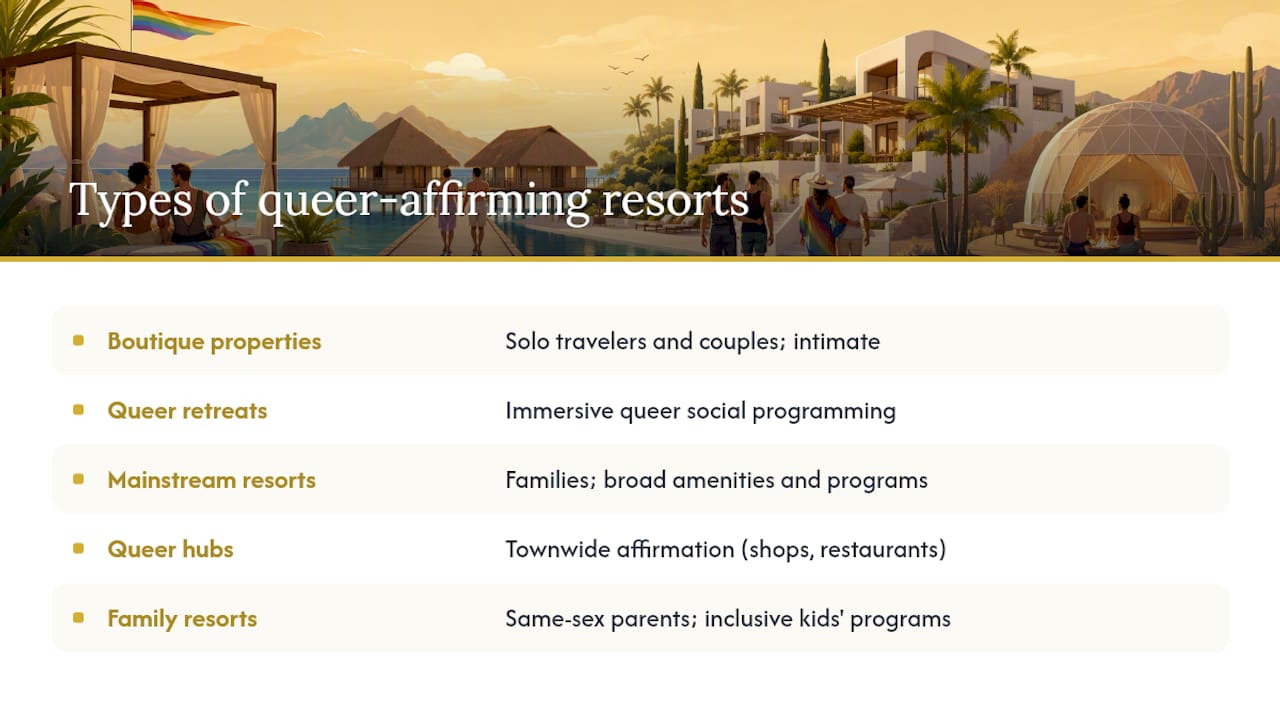
Queer-affirming accommodations come in several distinct formats, and the right fit depends on what kind of experience you are looking for.
Boutique queer-owned properties tend to offer the most consistent affirmation because inclusion is the owner’s lived priority, not a corporate initiative. The Charles Napa Valley is a domestic example of a boutique property that states inclusivity is built into its operating model and staff training from the ground up. These properties often have smaller room counts, which means more personalized service and a tighter community feel. They suit solo travelers, couples, and guests who want a quieter, more intimate stay.
Queer-focused retreat models operate on a group or charter basis, often taking over a resort property for a set period. Pricing and programming are curated specifically for LGBTQ+ guests. VACAYA’s approach shows the range this model can cover, from resort weeks to luxury expeditions, with programming designed for trans, nonbinary, BIPOC, and body-diverse travelers. These work especially well for travelers who want a fully immersive queer social environment.
Mainstream resorts with embedded affirming programs are larger properties that have invested in documented policies, staff training, and year-round LGBTQ+ programming without limiting their guest base. These suit families, travelers who prefer a broader range of amenities, and guests who want affirming hospitality without a queer-exclusive environment.
Rural and remote properties with codified inclusion are less common but increasingly notable. Fogo Island Inn demonstrates that a remote, design-forward property can offer high-level affirmation when inclusion is treated as a hospitality ethos rather than a niche marketing add-on. These properties appeal to travelers seeking privacy, natural settings, and a high-touch experience away from urban queer hubs.
Destination-embedded properties in established queer hubs benefit from a community-level affirmation that individual resorts cannot replicate alone. Provincetown, Massachusetts, is the clearest U.S. example: decades of LGBTQ+ presence have shaped the town’s businesses, cultural programming, and social fabric in ways that extend well beyond any single property’s policies. Staying within a queer hub means the affirmation extends to restaurants, shops, and public spaces, not just your hotel room.
Family-oriented affirming resorts explicitly design programming and facilities for same-sex parents, queer families, and children of LGBTQ+ parents. Activity schedules reflect diverse family structures, staff are trained to avoid heteronormative assumptions in family-facing interactions, and children’s programming is inclusive by design.
How to verify a resort is actually queer-affirming before you book
Marketing language is easy to produce. Verification takes a few deliberate steps, and it is worth doing before you commit to a deposit.
- Check for IGLTA membership or a named community partnership — IGLTA’s directory lists members who have committed to active inclusion standards. A property that lists IGLTA membership has made a public, verifiable commitment.
What your stay should feel and look like at a queer-affirming resort
From the moment you arrive, the signals of genuine affirmation are visible and consistent. Staff at the front desk use your preferred name and pronoun without being prompted, because that information was collected and shared across departments before your arrival. Check-in paperwork does not force you into binary gender categories.
Throughout the property, signage avoids binary assumptions. Restrooms are either gender-inclusive or single-occupancy options are clearly available and easy to find. Activity schedules reflect a range of relationship types and family structures. When a poolside event is described, it does not assume couples are heterosexual or that families follow a single configuration.
Service interactions across departments, from housekeeping to the spa to the restaurant, maintain the same standard. Affirmation does not stop at the front desk. A spa that uses inclusive intake forms and a restaurant that does not default to “ladies and gentlemen” are signs that training reached the whole team.
Quiet and social spaces coexist. A well-designed affirming resort does not require you to participate in programming to feel safe. You can have a private, low-key stay and still experience consistent respect. When programming is available, it tends to be opt-in and varied: a social mixer one evening, a wellness session the next morning, a community dinner later in the week. The schedule reflects the diversity of the guest community rather than a single vision of what queer leisure looks like.
If an incident occurs, a clear reporting process is in place. You know who to contact, the response is handled discreetly, and the property follows up. That process being documented and communicated to guests is itself a trust signal.
Practical considerations specifically for trans and nonbinary travelers
Trans and nonbinary travelers carry a specific set of logistical concerns that a genuinely affirming property has already thought through. Checking these points before you book can prevent avoidable friction on arrival.
Before booking:
- Confirm the property’s policy on preferred names versus legal names on reservations. Ask whether your preferred name will appear on all internal documents, including room keys and restaurant reservations.
- Ask about room assignment. Some properties still assign rooms based on the gender marker on a government ID. A queer-affirming property should allow you to specify your room preference independently.
- Inquire about pronoun collection. Does the property ask for pronouns at booking, and does that information reach all departments?
Facility access:
- Ask specifically about restroom and changing-room policies. Gender-inclusive restrooms or single-occupancy options should be available and clearly located.
- Wellness facilities (spas, fitness centers, pools) sometimes have gendered changing areas. Confirm whether private or gender-neutral options exist before you arrive.
Medical privacy:
- If you travel with prescriptions or medical devices, ask how the property handles medical information. A good policy keeps that data private and does not share it with staff beyond those who need it for safety reasons.
- Ask about local medical access, particularly if you are traveling to a rural destination. Knowing the nearest affirming healthcare provider in advance is a practical safety step.
Pro Tip: When you email reservations with these questions, save the responses. Written confirmation of a property’s policies gives you documentation to reference if something goes wrong during your stay.
The Gay Travel Index, which evaluates destinations using legal and social environment data from NGOs and human-rights organizations, is a useful reference for understanding the legal context of the state or region you are visiting. Legal protections for trans travelers vary significantly across U.S. states, and knowing the local legal environment before you arrive is a practical safety measure.
Typical costs, pricing models, and booking tips for queer-affirming resorts
Pricing for queer-affirming accommodations varies as widely as the properties themselves. Boutique queer-owned hotels typically price by the night, in line with comparable boutique properties in their market. A well-appointed boutique in a destination like Napa Valley or Provincetown will reflect the local luxury market rate, with no meaningful premium for the affirming designation itself.
Retreat and charter models operate differently. A queer-focused retreat that takes over a resort property for a week bundles accommodation, programming, meals, and activities into a per-person rate. VACAYA’s pricing structure illustrates the range: resort weeks start around $1,100 per person, while luxury expedition experiences can reach $30,000 per person. The price reflects the scale of programming, the exclusivity of the experience, and the level of curation involved.
Expect higher costs during peak Pride dates, particularly in established queer hubs. June bookings in Provincetown, Palm Springs, or New York fill quickly and carry premium rates. Booking three to six months in advance for peak-season stays is standard practice for affirming properties in high-demand destinations.
Smart booking moves:
- Request a written confirmation of your preferred name and room assignment at the time of booking, not just at check-in.
- Read the cancellation policy carefully. Some retreat models have non-refundable deposits; others offer credit toward future bookings.
- Ask whether the property offers group pricing if you are traveling with a larger party. Charter and group rates can reduce per-person costs significantly for queer retreats.
- Consider using a luxury travel advisor who specializes in LGBTQ+ travel. An advisor can verify policies directly with properties, negotiate privacy-conscious booking arrangements, and flag potential issues before they become problems on arrival.
Where to find queer-affirming resorts and trusted recommendation sources
The most reliable starting points combine official directories with community-sourced reviews, since no single source captures the full picture.
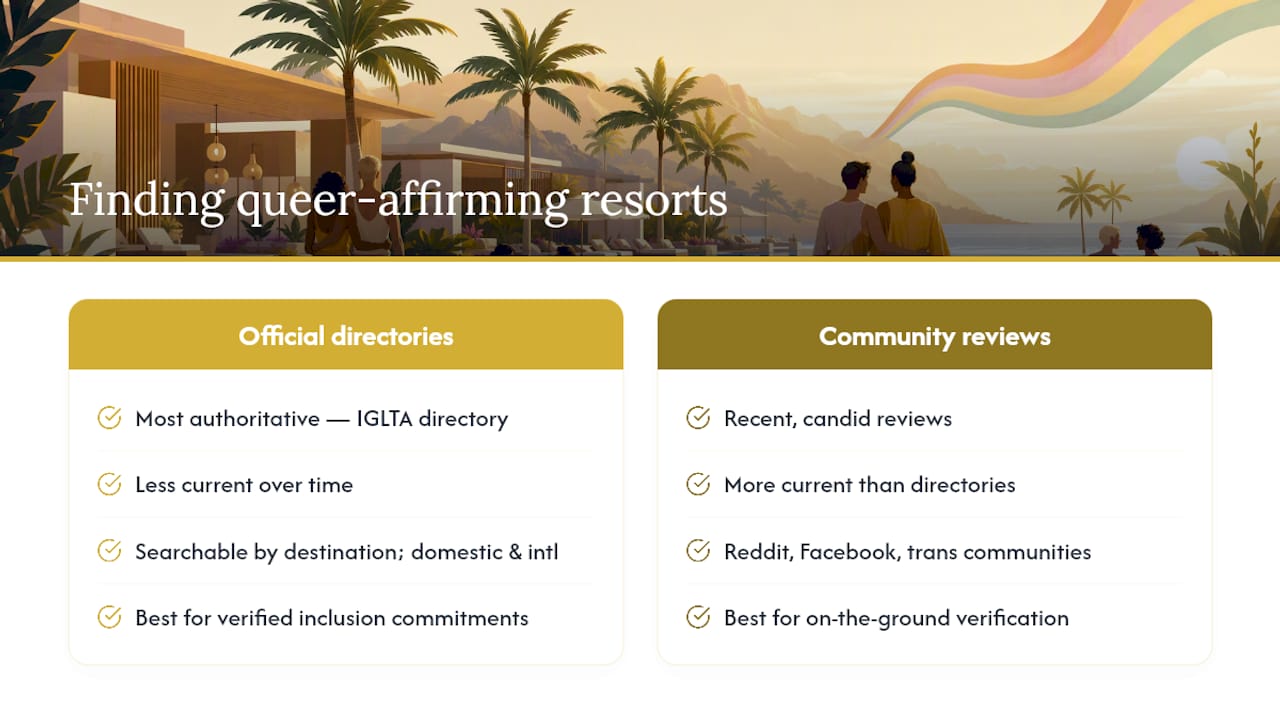
IGLTA’s member directory is the most authoritative starting point for verified affirming properties. Members have committed to active inclusion standards, and the directory is searchable by destination. For U.S. travelers, it covers both domestic and international options, which matters when the Gay Travel Index shows that legal protections vary significantly across destinations.
Destination-specific queer travel pages are valuable for understanding the community context of a place. Provincetown’s destination resources reflect decades of LGBTQ+ community shaping the local hospitality environment. Similar resources exist for Palm Springs, Key West, and Ogunquit.
Community travel forums on platforms like Reddit’s r/gaytravelers, Facebook groups for LGBTQ+ travelers, and dedicated queer travel communities offer recent, candid reviews that official directories cannot replicate. Trans-specific travel communities are particularly useful for verifying how properties handle documentation and facilities.
Travel publications including The Advocate and EDGE Media Network regularly profile affirming properties and emerging queer-friendly destinations, offering editorial context alongside property-level details.
When community reviews and official certifications point in the same direction, confidence is high. When they diverge, the community reviews tend to be more current. A property that earned an IGLTA listing three years ago but has recent negative reviews from trans travelers may have experienced staff turnover or policy drift.
A LGBTQIA+ travel planning guide can also help you structure your research process, particularly if you are planning a multi-destination trip where affirming accommodations need to be verified across several properties.
How a vetted luxury travel advisor evaluates queer-affirming resorts
A professional advisor’s vetting process goes beyond what most travelers can accomplish through a website search. Here is the framework Grandglobetrotting uses when evaluating a property for LGBTQ+ clients.
- Verify IGLTA membership or equivalent community partnership — Membership is cross-checked against the IGLTA directory to confirm it is current.
Travelers who want to apply this framework themselves can work through steps 1, 2, 3, 4, and 7 independently before booking. Steps 5, 6, and 10 are where a professional advisor adds the most value, since they require direct vendor relationships and the experience to interpret what a property’s answers actually mean.
Key Takeaways
A queer-affirming resort is defined by documented policies, trained staff, and sustained programming, not by marketing language alone.
| Point | Details |
|---|---|
| Policy is the baseline | A published nondiscrimination policy naming gender identity and sexual orientation is the minimum standard for a genuinely affirming property. |
| Training reaches every department | Pronoun practices, inclusive language, and incident response must extend from the front desk to housekeeping, spa, and dining. |
| Trans and nonbinary travelers need specific checks | Confirm preferred name on reservation, room assignment policy, and gender-neutral facility access before you arrive. |
| Pricing reflects the model | Boutique nightly rates align with local luxury markets; retreat and charter models range from around $1,100 to $30,000 per person depending on scale and programming. |
| Grandglobetrotting vets properties directly | Grandglobetrotting’s advisor framework verifies policies, training credentials, and programming depth before recommending any property to LGBTQ+ clients. |
Why the ‘affirming’ label deserves more scrutiny than it gets
The hospitality industry has become fluent in the language of inclusion without always doing the work behind it. A property can add a rainbow flag to its homepage, mention LGBTQ+ travelers in a press release, and still have no written policy, no trained staff, and no process for handling a trans guest’s documentation discreetly. The label “queer-affirming” is not regulated, which means it is only as meaningful as the practices behind it.
What actually matters is whether inclusion is an operational decision or a marketing one. Fogo Island Inn’s approach, embedding nondiscrimination commitments and staff training into the property’s hospitality ethos rather than treating it as a niche add-on, is the model worth emulating. The same logic applies to boutique properties like The Charles Napa Valley, where inclusivity is stated as a design principle, not an afterthought.
The travelers who benefit most from this distinction are not always the ones with the most visibility in queer marketing. Trans and nonbinary guests, BIPOC travelers, older queer travelers, and guests with disabilities are the ones most likely to encounter the gap between a property’s marketing and its actual practices. An advisor or a thorough pre-booking checklist closes that gap before it becomes a problem on arrival.
Queer travel, at its best, is about the freedom to be fully present in a place. That freedom is not a luxury. It is what every traveler deserves, and it is what a genuinely affirming property delivers consistently, not just during Pride month.
Grandglobetrotting’s approach to booking queer-affirming resorts
Finding a property that markets itself as affirming is straightforward. Finding one that actually delivers, for your specific identity, travel style, and privacy needs, takes a different level of work.
Grandglobetrotting’s concierge service handles that vetting directly. For LGBTQ+ clients, the process includes verifying written policies, confirming staff training credentials, reviewing programming calendars, and securing privacy-conscious booking arrangements before a single deposit is placed. Preferred names, pronoun preferences, and room assignment specifications are confirmed in writing with the property, not left to check-in. For trans and nonbinary travelers, the advisor also assesses local legal context and identifies affirming healthcare access near the destination.
The result is a bespoke travel itinerary built around your actual needs, not a generic list of “gay-friendly” properties. Whether you are planning a private retreat, a family vacation, a honeymoon, or a solo escape, Grandglobetrotting’s team brings direct vendor relationships and a thorough vetting framework to every booking. To start planning your affirming luxury stay, visit Grandglobetrotting’s travel planning service and request a consultation.
Trusted organizations and sources to consult
- How Fogo Island Inn became a quiet haven for LGBTQ+ travelers
- International LGBTQ+ Travel Association (IGLTA)
- There’s No Place Like This — Provincetown Business Guild
- Gay Travel Index and how it ranks destinations
- Up-and-coming LGBTQ+ destinations
- The Charles Napa Valley — LGBT-Friendly hotel in downtown Napa
- VACAYA offers LGBTQ+ travelers radically inclusive mission
Recommended
At Grand Globetrotting, we don't just plan vacations; we craft extraordinary adventures that leave you with cherished memories. Let us bring your dream vacation to life, perfectly tailored to your style, and immerse yourself in a world of luxury, exploration, and unforgettable moments. Your journey begins with us.
Itinerary planning services require a separate charge outside of cost to book travel accommodations. Depending upon the complexity of the itinerary and the level of effort required to acquire unique experiences, cost may vary. Speak with our team to learn more.
Book your consultation