

TL;DR:
- Multicultural corporate travel considers employees’ diverse cultural, religious, gender, disability, and neurodiversity needs. Support for minority travelers has declined, highlighting the urgent need for proactive, modular, and leadership-backed inclusive programs. Ongoing collaboration, continuous feedback, and cultural fluency are essential for effective, responsible global travel policy implementation.
Multicultural corporate travel is the intentional design of business travel programs that account for the cultural, religious, gender, disability, and neurodiversity needs of a workforce. The standard industry term for this practice is inclusive corporate travel, and the two phrases are used interchangeably across HR and travel management circles. Inclusive programs address gender, culture, religion, disability, neurodiversity, and age to improve employee confidence and reduce burnout. For corporate travel managers, this is no longer a peripheral concern. Data from the 2026 Business Travel Show Europe reveals that support for minority travelers has declined sharply, making proactive program design more urgent than ever.
What is multicultural corporate travel and why does it matter?
Multicultural corporate travel goes well beyond booking flights and hotels. It recognizes that a neurodivergent employee, a Muslim traveler observing prayer times, and an LGBTQ+ colleague traveling to a country with restrictive laws each face fundamentally different risks and needs on the same business trip.
The diversity dimensions that define this practice include:
- Cultural background — communication norms, social customs, and local etiquette that vary by region
- Religion — prayer schedules, dietary requirements, and religious observance dates that affect itinerary design
- Gender identity — safety considerations and legal protections that differ significantly by destination
- Disability and accessibility — physical accommodations, sensory-friendly environments, and assistive services
- Neurodiversity — reduced-stimulation hotel rooms, clear itinerary structures, and flexible scheduling
- Age — generational differences in technology comfort and physical stamina during long-haul travel
Each dimension requires a specific policy response, not a one-size-fits-all travel template. When a travel program ignores these factors, employees may opt out of business trips entirely, which directly damages their career growth and the organization’s ability to retain institutional knowledge.
Pro Tip: Design your travel program in modules rather than as a single policy document. A modular structure lets you activate specific accommodations for specific traveler profiles without rebuilding the entire program each time.

What are the biggest gaps in current programs?
The data from 2026 paints a concerning picture. A survey of 192 corporate travel professionals conducted at Business Travel Show Europe found that neurodivergent support dropped from 18% to 11% between 2024 and 2026. That is a significant regression at a time when workforce diversity is expanding, not shrinking.
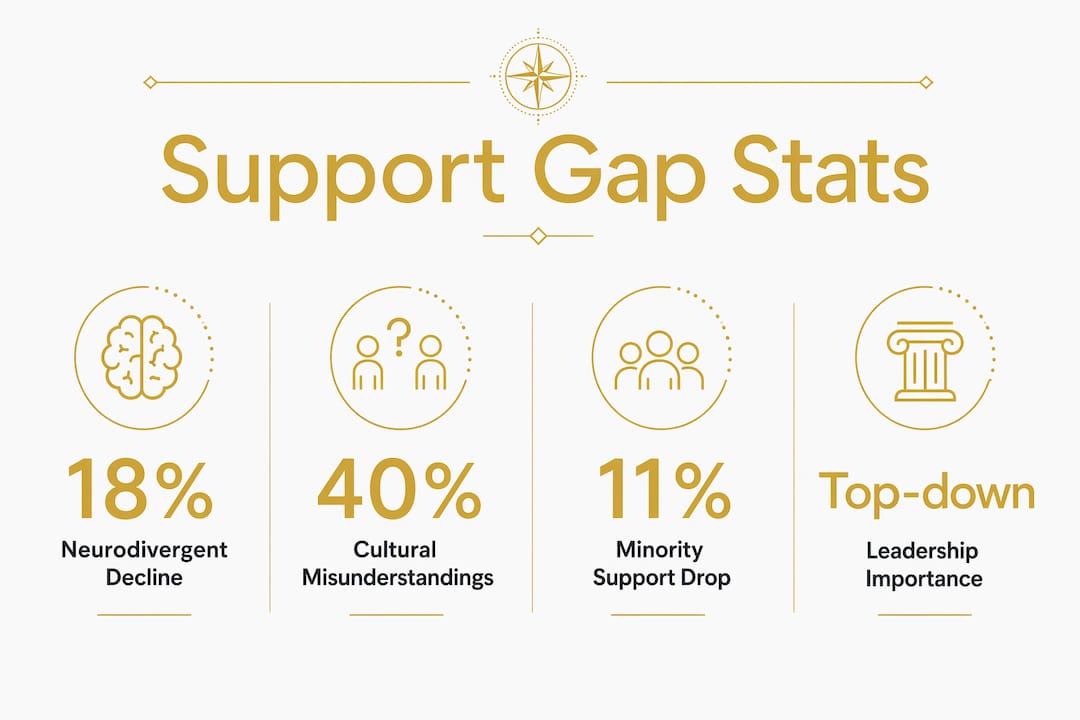
The table below shows where support levels stand across minority traveler groups based on that 2026 survey data.
| Traveler group | Support trend (2024–2026) |
|---|---|
| Neurodivergent travelers | Declined from 18% to 11% |
| Minority traveler groups overall | Declining across categories |
| LGBTQ+ travelers | Inconsistent policy coverage |
| Travelers with disabilities | Gaps in accessible accommodation sourcing |
The numbers reflect a deeper structural problem. Many organizations lack top-down leadership support, which leaves travel managers trying to implement inclusive policies without the authority or budget to do so. The result is a widening gap between stated DEI commitments and actual travel program design.
Cultural misunderstandings compound the problem. Over 40% of business travelers experienced cultural misunderstandings that harmed professional outcomes, even when they felt confident before the trip. That figure comes from a 2026 RW3 CultureWizard survey, and it signals that confidence alone does not equal cultural fluency.
Pro Tip: Partner with your company’s Employee Resource Groups (ERGs) to run post-trip surveys. ERGs surface specific friction points that anonymous feedback forms rarely capture, and they give underrepresented employees a direct channel to shape policy.
How do you implement an inclusive travel program?
Effective multicultural business travel programs are built through cross-functional collaboration, not solo effort from a travel manager. Successful implementation requires coordination across HR, legal, procurement, and travel management, with Employee Resource Groups providing ongoing feedback.
Building the program structure
Start by auditing your current travel policy against each diversity dimension listed above. Identify which traveler profiles have zero accommodation and prioritize those first. Then build modular policy blocks that can be activated per trip or per traveler profile.
Cultural fluency means embedding local expertise into your supplier choices and travel technology. For Asia Pacific travel, for example, this means selecting suppliers who understand regional safety norms, social customs, and local communication preferences. A global booking tool that ignores these nuances creates friction at every step.
Best practices for travel managers
- Audit existing travel policies against all six diversity dimensions before making changes
- Source accessible accommodations proactively, not as a reactive exception request
- Build destination guidance documents for high-risk countries, covering legal protections for LGBTQ+ travelers and religious minority travelers
- Integrate LGBTQ+ travel planning considerations into standard pre-trip briefings, not as a separate add-on
- Offer flexible booking windows that accommodate religious observances and cultural holidays
- Use post-trip surveys tied to specific traveler profiles to identify gaps in real time
- Ensure neurodivergent travelers can request sensory-friendly accommodations through a standard, non-stigmatizing booking process
- Staying connected across diverse destinations is also practical. Reliable global connectivity through tools like eSIM solutions for business helps travelers in unfamiliar regions access local information and maintain communication without roaming barriers
Inclusive travel is an ongoing process with iterative feedback loops rather than a one-time policy update. That distinction matters because travel environments, legal landscapes, and employee demographics all shift continuously.
How does inclusive travel connect to corporate strategy?
Multicultural travel programs are an extension of corporate duty of care, not a separate initiative. Inclusive travel should be viewed as an evolution of duty of care obligations, protecting both employee wellbeing and organizational reputation. That framing shifts the conversation from “nice to have” to “legally and ethically required.”
The business case is direct. When employees feel their needs are recognized in travel policy, they travel with greater confidence and perform better on the ground. When they do not, they opt out. Opting out means missed client meetings, lost deals, and the slow erosion of institutional knowledge as underrepresented employees disengage from global roles.
Retention is also at stake. Employees who experience repeated friction during business travel, whether from inaccessible hotels, culturally tone-deaf itineraries, or a lack of safety guidance, associate that friction with the company’s values. The corporate travel management framework that ignores diversity sends a clear message about whose experience the organization prioritizes.
“Inclusive travel efforts need executive sponsorship and cross-department collaboration to avoid leaving travel managers isolated. Without a leadership mandate, even the most well-designed inclusive travel policy will stall at the implementation stage.”
— Inclusive Travel Taskforce, ITM DEI Guide, 2026
Top-down leadership commitment is the single most critical factor in sustaining inclusive travel programs. Travel managers cannot carry this alone. Executives who treat multicultural travel as a travel department problem, rather than a company-wide priority, will see their DEI commitments stall in exactly the way the 2026 data shows.
Key Takeaways
Multicultural corporate travel requires executive sponsorship, modular policy design, and iterative feedback to protect diverse employees and sustain business performance globally.
| Point | Details |
|---|---|
| Define the scope clearly | Inclusive corporate travel covers culture, religion, gender identity, disability, neurodiversity, and age. |
| Act on the 2026 data | Neurodivergent support dropped from 18% to 11%, signaling a regression that demands immediate attention. |
| Build modular programs | Modular policy structures let you activate specific accommodations without rebuilding the entire program. |
| Require executive sponsorship | Without leadership mandates, travel managers cannot implement or sustain inclusive policies effectively. |
| Treat it as ongoing | Iterative feedback loops, including ERG partnerships and post-trip surveys, are the engine of continuous improvement. |
What I’ve learned about the gap between intention and execution
After years of working with corporate travelers across diverse markets, the pattern I see most often is not a lack of good intentions. It is a lack of accountability structures. Organizations announce DEI commitments, assign them to travel managers, and then provide neither budget nor executive cover to act on them. The 2026 Business Travel Show Europe data confirms this is not an isolated problem. It is systemic.
What actually works is treating inclusive travel the same way you treat travel risk management. You do not wait for an incident to build a risk framework. You build it proactively, test it, and update it continuously. The same discipline applies here. Cultural fluency, accessible accommodations, and destination safety guidance are not extras. They are the baseline for any organization sending a diverse workforce into the world.
The managers who get this right share one trait: they break silos early. They pull HR, legal, and procurement into the conversation before the policy is written, not after it fails. That cross-functional approach is the difference between a policy that looks good on paper and one that actually protects your travelers.
— Sandon
Grandglobetrotting’s approach to corporate travel diversity
Corporate travel managers who want to move from policy intent to real-world execution need a planning partner who understands the full spectrum of traveler needs. Grandglobetrotting specializes in bespoke business trip planning that accounts for the cultural, accessibility, and personal preferences of each traveler, from accessible hotel sourcing to destination-specific cultural guidance.
Every itinerary built through Grandglobetrotting reflects the specific profile of the traveler, not a generic corporate template. Whether you are planning cross-cultural business trips across Asia Pacific or coordinating travel for a team with varied religious and accessibility needs, the personalized planning process ensures no traveler is left without support. Reach out to Grandglobetrotting to build a travel program your entire workforce can rely on.
FAQ
What is the definition of multicultural corporate travel?
Multicultural corporate travel, also called inclusive corporate travel, is the design of business travel programs that explicitly address the cultural, religious, gender, disability, and neurodiversity needs of a diverse workforce. The goal is to ensure every employee can travel safely and effectively, regardless of their background.
Why is support for minority travelers declining in 2026?
A 2026 survey of 192 corporate travel professionals found that support levels for minority traveler groups have dropped across categories, with neurodivergent support falling from 18% to 11%. The primary cause is a lack of top-down leadership commitment, which leaves travel managers without the authority or resources to implement inclusive policies.
How does cultural misunderstanding affect business travel outcomes?
A 2026 RW3 CultureWizard study found that over 40% of business travelers experienced cultural misunderstandings that harmed their professional outcomes, even when they felt prepared. This shows that traveler confidence does not substitute for structured cultural fluency training and destination guidance.
What departments should be involved in building an inclusive travel program?
Effective inclusive travel programs require collaboration across HR, legal, procurement, and travel management teams. Employee Resource Groups should also be included to provide direct feedback from underrepresented travelers and identify gaps that standard surveys miss.
How often should inclusive travel policies be updated?
Inclusive travel is an ongoing process, not a one-time policy change. Post-trip surveys, ERG feedback sessions, and regular destination safety reviews should feed into continuous policy updates to keep pace with changing legal environments and workforce demographics.
Recommended
At Grand Globetrotting, we don't just plan vacations; we craft extraordinary adventures that leave you with cherished memories. Let us bring your dream vacation to life, perfectly tailored to your style, and immerse yourself in a world of luxury, exploration, and unforgettable moments. Your journey begins with us.
Itinerary planning services require a separate charge outside of cost to book travel accommodations. Depending upon the complexity of the itinerary and the level of effort required to acquire unique experiences, cost may vary. Speak with our team to learn more.
Book your consultation