

When you hire a luxury travel advisor, the brand you choose signals trust, saves measurable time, and determines the access you actually receive. Those three outcomes are precisely what executive-travel branding communicates before a single conversation takes place. A well-positioned advisor like Grandglobetrotting conveys consortium-level supplier relationships, clear service commitments, and the kind of confidentiality protocols that corporate clients require. Research on UHNWI decision-making confirms that expectation management, personal relationships with personnel, and time savings are the primary drivers of purchase and repurchase behavior among ultra-high-net-worth clients. The sections below give you precise brand signals to evaluate and a short checklist you can use in your first advisor meeting.
Key Takeaways
Executive-travel branding matters because it communicates trust, time savings, and supplier access before a single conversation, and those three signals predict the outcomes executives actually pay for.
| Point | Details |
|---|---|
| Brand signals predict outcomes | Consortium affiliation, named supplier access, and SLA clarity are the three most reliable predictors of executive outcomes. |
| UHNWI priorities are specific | Research identifies expectation management, personal relationships, and time savings as the top UHNWI purchase drivers. |
| Planning fees are often offset | Elite advisors charge —; consortium amenities typically exceed that fee in total value. |
| Vetting takes ten minutes | Request a sample itinerary, a written SLA, and one executive reference before committing to any engagement. |
| Hire on three checks | If access, response time, and confidentiality all pass verification, the advisor has earned the engagement. |
Table of Contents
- Why executive travel branding matters in your hiring decision
- What brand signals actually tell you about an advisor’s quality
- How brand signals translate into outcomes you can measure
- How to vet an executive travel advisor before you hire
- What engagement models and pricing look like for U.S. executive advisors
- How Grandglobetrotting’s brand is built for executive clients
- A short framework for deciding if a brand is the right fit
- What Grandglobetrotting’s design choices say about executive priorities
- Sources
Why executive travel branding matters in your hiring decision
Executives apply the same due diligence to a travel advisor as they do to a financial or legal partner. Credentials, digital footprint, consortium affiliations, and the clarity of a service offer all enter the evaluation before a proposal is ever reviewed. This is not incidental; it reflects how luxury brand perception actually works.
A 2022 study of 448 white-collar professionals found that self-identification with a luxury service brand and perceived brand status both increase the likelihood that a brand enters a consumer’s consideration set. In plain terms: if an advisor’s brand does not signal the right status and values, it never reaches your shortlist. A separate academic analysis confirms that perceived brand status mediates emotional anticipation, shaping which luxury service providers an executive even considers.
Executives are not buying a trip. They are buying confidence — the certainty that their schedule, investment, and reputation are protected by someone who has done this before at the highest level.
Industry analysis of high-value luxury bookings finds that the majority of clients are CEOs or founders, which means an advisor’s brand must convey corporate-level competence and complex logistics mastery, not just leisure planning. An advisor whose positioning reads as “vacation planning” rather than “executive travel management” is misaligned from the first impression.
What brand signals actually tell you about an advisor’s quality
Observable signals let you assess an advisor quickly, even before a formal conversation. They fall into three categories: status and affiliation, design and positioning, and operational trust.
Status and affiliation signals
- Consortium or host-agency membership (Virtuoso, Signature Travel Network, Ensemble Travel Group) with verifiable advisor credentials
- Preferred-partner status with specific luxury hotel brands, private aviation brokers, or destination management companies
- Published case studies or sample executive travel itineraries that show complexity, not just destination lists
- Named supplier relationships rather than vague “exclusive access” claims
Design and positioning signals
- A website that signals selectivity: a stated price floor, a deliberate inquiry form, and imagery that reflects the executive client rather than the leisure traveler
- Focused positioning on a specific client type or travel category, not a general “all travelers welcome” message
- Traveller Made’s industry commentary notes that many luxury operators fail to convert service quality into a compelling brand identity, and that specialization with narrative branding produces stronger pricing power and clearer referral messaging
Operational trust signals
- A written confidentiality or NDA framework for client data and itinerary details
- A published or stated response-time SLA (24/7 availability with a named escalation contact)
- A dedicated account lead, not a rotating team, for continuity across trips
- A clear crisis escalation protocol for flight disruptions, security events, or medical situations abroad
Pro Tip: If an advisor claims preferred-partner access to a specific hotel brand, ask them to name the on-property contact or the amenity package your booking would receive. A genuine preferred partner can answer that in under a minute. Evasion is a clear signal of a marketing claim without substance behind it.
How brand signals translate into outcomes you can measure
The connection between brand signals and executive outcomes is direct. Consortium affiliation, for example, is not a credential for its own sake. Booking through a preferred-consortium-affiliated advisor typically unlocks complimentary amenities and access that materially exceed common planning-fee amounts. That means the fee you pay is often offset before the trip begins.
Time savings are the most consistent benefit. An advisor with established supplier relationships and a documented workflow for business trip planning can compress a complex multi-city itinerary from days of research to a single briefing call. During a disruption — a canceled private charter, a hotel overbook at a flagship property — a well-branded advisor with real supplier contacts resolves the issue in minutes rather than hours, because the relationship already exists.
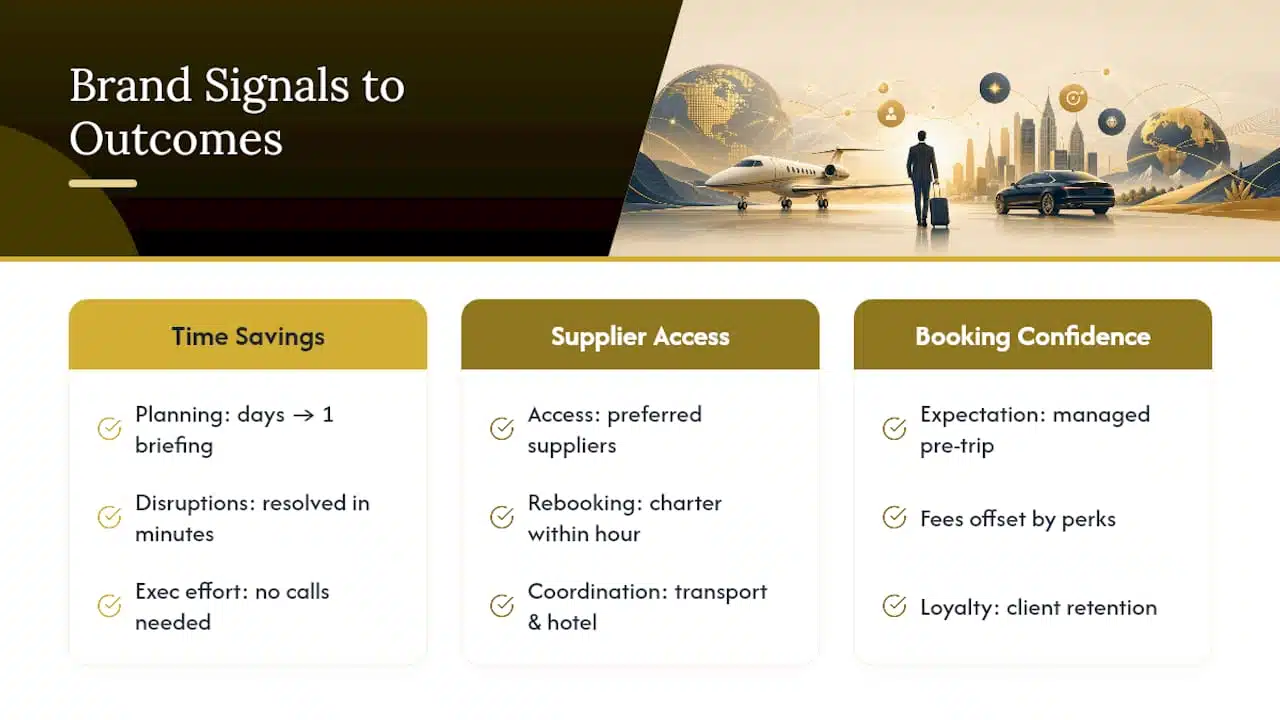
Consider a scenario where a CEO’s connecting flight is canceled the evening before a board meeting in a different city. An advisor with a direct relationship with a private aviation broker can rebook a charter within the hour, coordinate ground transport at both ends, and notify the hotel of the revised arrival time, all without the executive lifting a phone. That outcome depends entirely on the supplier network the advisor built before the trip, which is exactly what brand signals communicate in advance.

Research on UHNWI luxury experience places expectation management and personal relationships with personnel above almost every other purchase driver. An advisor whose brand clearly communicates who handles your account, what they will do, and how fast they will respond is already delivering on those priorities before the engagement begins. Booking confidence — the certainty that your time and investment are protected — is central to how luxury travelers choose and remain loyal to an advisor.
How to vet an executive travel advisor before you hire
Use this checklist in your first meeting or discovery call. It takes roughly ten minutes and surfaces the information that matters most.
Documents to request before or during the first meeting:
- Sample itinerary for a comparable executive trip (multi-city, mixed private and commercial aviation)
- Written confirmation of consortium or host-agency membership
- Reference contacts for at least two executive clients (not generic testimonials)
- Written SLA covering response times and escalation contacts
- Confidentiality or NDA framework for client data
Questions to ask in the first ten minutes:
- Which consortium or host agency are you affiliated with, and what does that membership give my bookings specifically?
- Who is my dedicated account lead, and what is their direct contact for a 2:00 AM disruption?
- How many executive or C-suite trips did you manage in the past twelve months?
- Walk me through your escalation workflow for a canceled private charter the night before a critical meeting.
- How do you handle supplier commissions relative to your planning fee, and where does my itinerary cost sit?
Red flags that should stop the conversation:
- Evasive or vague answers about which specific hotels or aviation brokers they have preferred-partner access with
- No dedicated point of contact — only a general inbox or team email
- Generic testimonials with no client detail, trip complexity, or verifiable reference
- No written fee structure or a reluctance to state how commissions work
- No confidentiality language or a dismissive response when you raise data privacy
What engagement models and pricing look like for U.S. executive advisors
Executive travel advisors in the U.S. typically operate under one of four models. Understanding them helps you evaluate whether a brand’s fee structure matches the service level it promises.
- Per-itinerary planning fee plus commissions: The most common entry point. Elite advisors typically charge a planning fee per itinerary within a moderate range in planning fees, with supplier commissions layered on top. Amenities secured via consortium partnerships often exceed the planning fee in total value.
- Retainer or concierge model: A fixed monthly or annual fee for priority access, unlimited itinerary revisions, and 24/7 availability. Suited to executives who travel frequently and want a single point of contact year-round.
- Subscription or membership model: Tiered access levels with defined service parameters at each tier. Useful for corporate travel programs with multiple travelers.
- Bespoke enterprise account: A negotiated arrangement for organizations with high travel volume, often including dedicated staffing, custom reporting, and integrated expense management.
For complex executive itineraries — multi-destination, mixed aviation, with event or meeting logistics — expect a planning lead time of three to six weeks for a first engagement. Advisors with mature supplier relationships and documented workflows can often compress that timeline on repeat engagements. Brand maturity shows up directly in turnaround speed: an advisor who has booked the same property forty times moves faster and gets better placement than one doing it for the first time.
The convenience factor in business travel is a measurable variable, not a soft benefit. Time recovered from logistics management is time returned to revenue-generating work.
How Grandglobetrotting’s brand is built for executive clients
Grandglobetrotting positions itself specifically for discerning clients who require more than a booking service. Founder Sandon built the advisory around a narrow, deliberate focus: bespoke itinerary planning that integrates luxury hotel partnerships, private and commercial flight coordination, ground logistics, and curated dining and excursion recommendations into a single managed experience.
That certainty shows up in specific, verifiable ways: a focused service offering rather than a general travel catalog, a named founder with a documented background in luxury travel, and a partner network built around preferred-access relationships with hotels, aviation brokers, and destination specialists. Executives who want to verify the access claims can request a sample itinerary or a reference call before committing to a planning fee.
A short framework for deciding if a brand is the right fit
Before you hire any executive travel advisor, run through this four-step check:
- Match your travel objectives to the advisor’s stated specialization. If your trips are primarily multi-city business with private aviation, confirm the advisor has documented experience in that category, not just leisure expertise.
- Verify supplier access with a specific question. Ask for the name of a preferred-partner contact at a hotel or aviation broker you actually use. A real relationship produces a real answer.
- Confirm response-time SLA and escalation contact. Get the name and direct number of the person who handles a 3:00 AM disruption. If that person is not named, the SLA is theoretical.
- Check references and confidentiality terms. Request one executive reference and a written confidentiality framework before signing anything.
Verdict rule: Hire if three core checks pass — access, response, and confidentiality. If any one of the three is evasive or absent, the brand has not earned the engagement.
Pro Tip: If you travel more than six times per year on complex itineraries, a retainer model almost always delivers better value than per-trip fees. The relationship depth that builds over a retainer engagement — the advisor knowing your preferences, your security requirements, your dietary needs — is itself a time-saving asset that compounds with each trip.
What Grandglobetrotting’s design choices say about executive priorities
When I designed Grandglobetrotting’s positioning, the guiding principle was selectivity over volume. Executives do not want an advisor who works with everyone; they want one who works with people like them and has built the supplier relationships that reflect that focus. Every element of the brand — the service scope, the partner network, the inquiry process — is designed to signal that this is a professional service built for clients who value precision and discretion above all else.
If you want to verify the access and service level before committing, the right first step is a brief discovery call or a request for a sample itinerary. That conversation will tell you more about an advisor’s real capabilities than any credential on a website.
Grandglobetrotting’s bespoke travel planning service is the natural starting point for executives who want to confirm fit before a full engagement. You can also explore the hotel partnerships and preferred-access amenities that make the planning fee a straightforward value proposition.
Sources
- Self-identification and consideration set formation for luxury services (International Journal of Consumer Studies, 2022)
- Unlocking consumer consideration set size formation for luxury services (Int. J. Consumer Studies, 2022)
- The seven habits of high-net-worth clients that agents need to know for 2025
- Traveller Made highlights branding as key to luxury DMC growth (TTG Asia, 2026)
Recommended
At Grand Globetrotting, we don't just plan vacations; we craft extraordinary adventures that leave you with cherished memories. Let us bring your dream vacation to life, perfectly tailored to your style, and immerse yourself in a world of luxury, exploration, and unforgettable moments. Your journey begins with us.
Itinerary planning services require a separate charge outside of cost to book travel accommodations. Depending upon the complexity of the itinerary and the level of effort required to acquire unique experiences, cost may vary. Speak with our team to learn more.
Book your consultation