

TL;DR:
- Integrating activities into executive travel enhances collaboration, innovation, and operational efficiency with measurable outcomes. A balanced approach recommends dedicating 60% of time to strategic work and 40% to relationship-building activities. Digital platforms streamline logistics, support duty of care, and help realize the strategic value of well-designed executive programs.
Integrating activities into executive travel is defined as the deliberate pairing of strategic work sessions with structured social and relationship-building experiences within a single trip program. Platforms like Navan and Booking.com for Business have made this approach far easier to manage at scale, giving travel planners consolidated tools to coordinate logistics, budgets, and itineraries in one place. The core argument for why integrate activities in executive travel comes down to measurable outcomes: executives who travel with integrated programs report stronger collaboration networks, higher trip satisfaction, and direct gains in innovation output. This guide covers the research, the practical frameworks, and the technology that makes it work.
What are the core benefits of integrating activities in executive travel?
Integrated executive travel produces results that isolated business trips simply cannot replicate. The benefits fall into four distinct categories, each supported by research.
-
Stronger collaboration networks. A Babson study on offsite events found that partners attending structured offsites formed 24% more new collaborations, with 17% of those relationships persisting for at least two years. This means a single well-designed executive retreat can produce professional connections that outlast the trip by years.
-
Direct innovation gains. Short-term business travel improves R&D investment impact by 4 to 5% through face-to-face knowledge sharing. Columbia and Stanford research further shows that face-to-face meetings produce 20% more creative ideas than remote collaboration. For organizations where innovation is a competitive priority, this alone justifies the investment.
-
Higher satisfaction and follow-through. According to Towerhouse Global’s executive retreat planning data, programs that allocate 60 to 70% of time to strategic work and 20 to 25% to relationship-building with structured follow-up produce measurably higher participant satisfaction and action-item completion rates. Executives leave with clarity, not just memories.
-
Operational cost efficiency. Navan’s platform data shows that integrated booking reduces average booking time from 45 minutes to 6 minutes per reservation, saving significant administrative hours across a multi-person executive program. That time savings compounds across every leg of a complex trip.
“Relationship-building during integrated activities catalyzes new collaboration and client work beyond superficial networking.” — Babson research on offsites
The importance of activities in business trips is not a soft benefit. It is a quantifiable return on the travel investment, visible in collaboration rates, innovation metrics, and operational efficiency.
How to strike the right balance between structured sessions and informal activities
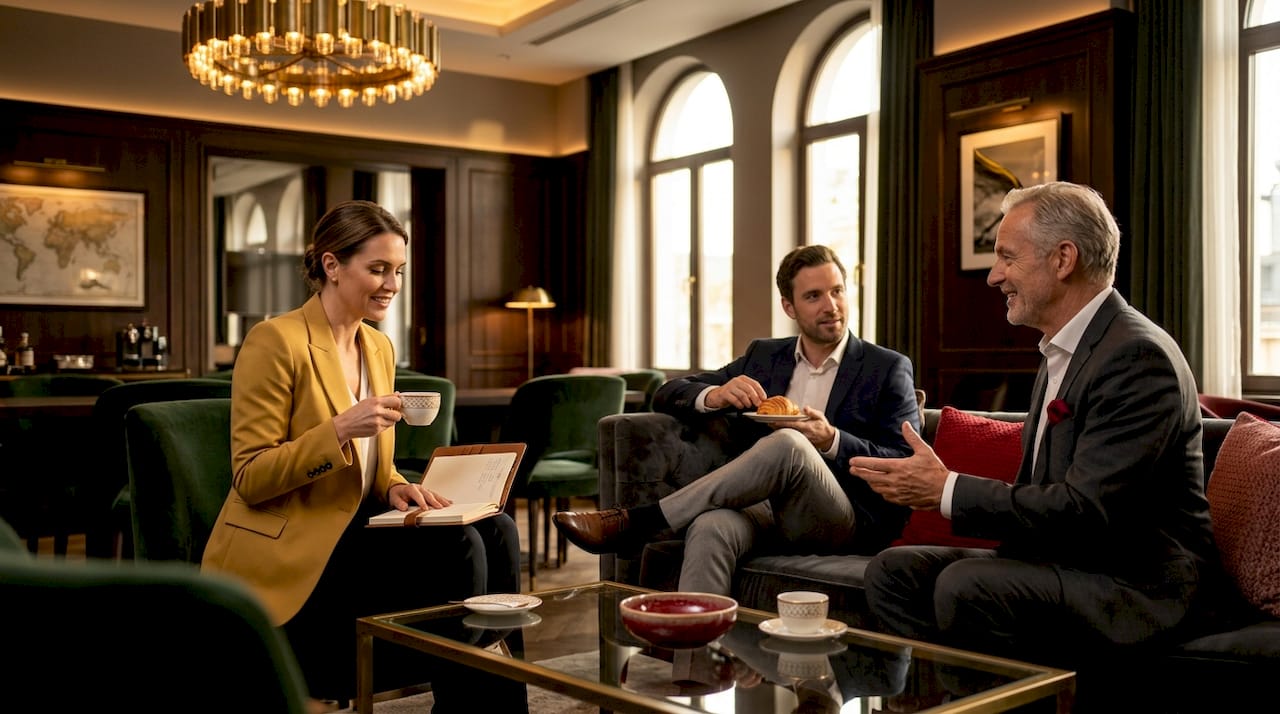
Agenda design is where most executive travel programs succeed or fail. The ratio matters more than the total number of activities.
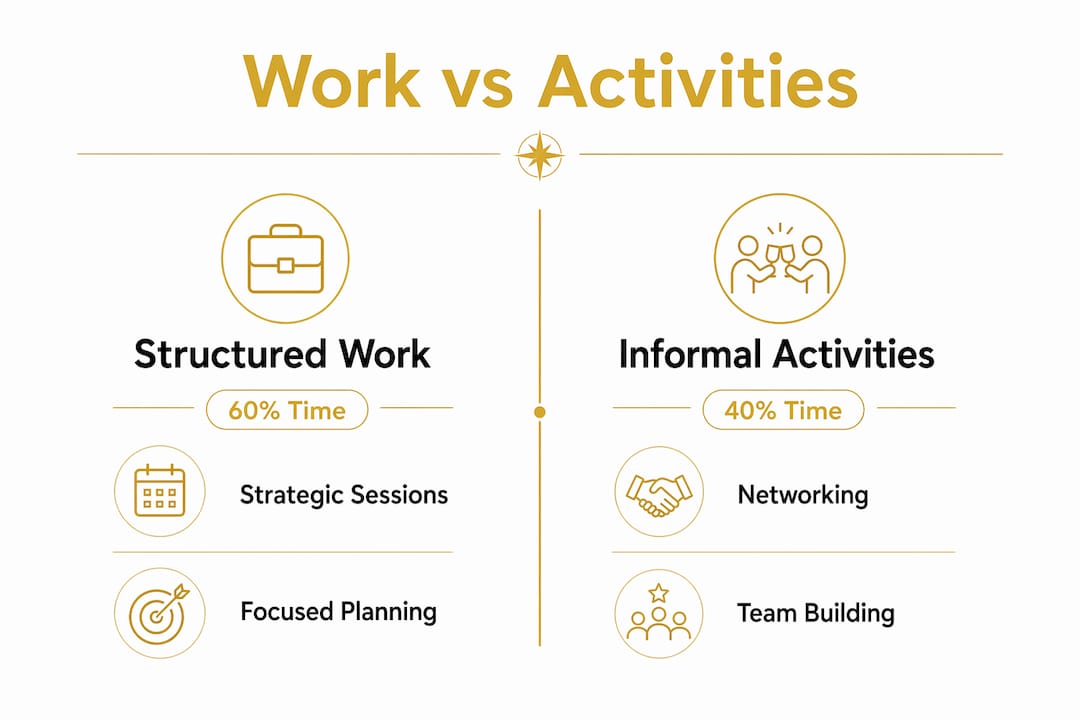
Navan recommends a 60/40 split as the most productive structure for executive teams: 60% of program time dedicated to structured strategic work, and 40% reserved for organic relationship-building. This balance gives executives enough focused time to accomplish objectives while creating the unstructured space where the most durable professional connections form.
Here is a practical framework for applying that balance across a three-day executive program:
- Schedule cognitive-heavy work in the mornings. Strategic planning sessions, keynotes, and decision-making workshops belong in the first half of each day. Executive energy and focus peak in the morning, and scheduling cognitive work early aligns with natural energy rhythms to maximize engagement.
- Reserve afternoons for collaborative activities. Group experiences like curated city tours, cooking classes, or golf outings work well in the afternoon. These activities lower social barriers and create shared reference points that carry back into the boardroom.
- Protect evening time for unstructured interaction. Dinners and informal gatherings are not filler. Research on conferences and offsites shows that unstructured coffee breaks and dinners are key drivers of new professional collaborations, outperforming formal sessions in generating lasting connections.
- Build in white space. Overprogramming is the most common mistake in executive travel design. A packed schedule signals distrust of executives’ ability to self-direct, and it eliminates the spontaneous conversations that produce the most valuable outcomes.
- Engage external facilitation for major sessions. Towerhouse Global notes that facilitated sessions yield higher action-item completion rates than self-moderated ones. A neutral facilitator keeps the agenda moving without any single executive dominating the room.
Pro Tip: When designing your executive travel itinerary, send a pre-trip survey asking executives to identify their top two relationship-building priorities. Use those responses to shape the informal activity selection, so the social program feels personally relevant rather than generic.
The goal is an agenda that feels spacious and purposeful at the same time. Executives should arrive at each session energized, not depleted from the one before it.
What operational and technology tools support effective integration?
The logistics behind integrated executive travel are complex. A multi-day program involving flights, hotels, ground transportation, group activities, and dining reservations across multiple time zones requires a system, not a spreadsheet.
| Tool Category | Example Platform | Key Function |
|---|---|---|
| Integrated travel and expense | Navan | Consolidated booking, real-time budget visibility, policy enforcement |
| Itinerary management | TripIt Pro | Real-time updates, disruption alerts, centralized schedule access |
| Event and retreat planning | Cvent | Group logistics, venue sourcing, attendee management |
| Duty of care tracking | International SOS | Traveler location monitoring, emergency response coordination |
Navan’s platform functions best as a workflow system for travel, not just a booking tool. When all reservations flow through one platform, travel managers gain real-time budget visibility that prevents out-of-policy bookings before they happen rather than catching them in expense reports afterward.
Centralized travel and event management reduces gaps and increases accountability across complex executive programs, according to Business Travel News. This is particularly relevant in 2026, as the shift toward integrated ecosystems managing travel under pressure has accelerated. A single point of coordination means fewer dropped handoffs when a flight changes or a venue cancels.
Duty of care is another area where integration pays dividends. When executive travel is managed through a centralized platform, travel managers know exactly where each executive is at any given moment. That visibility is not just a compliance requirement. It is a genuine operational advantage when disruptions occur.
Pro Tip: Before your next executive program, review your business travel checklist to confirm that every activity booking, ground transfer, and dining reservation is captured in your central itinerary system. Gaps in the system create gaps in the experience.
Traditional executive travel vs. integrated travel with activities
The difference between a standard business trip and a fully integrated executive travel program is not just experiential. It shows up in measurable outcomes.
| Outcome Metric | Traditional Executive Travel | Integrated Travel with Activities |
|---|---|---|
| New professional collaborations | Minimal, limited to formal meetings | Up to 24% more new connections formed |
| Collaboration durability | Rarely persists beyond the trip | 17% of new connections persist for 2+ years |
| Creative output | Baseline remote-equivalent | 20% more creative ideas from face-to-face work |
| R&D investment impact | No measurable travel contribution | 4 to 5% improvement from in-person knowledge sharing |
| Administrative efficiency | 45-minute average booking time | 6-minute average booking time with integrated platforms |
| Action-item completion | Lower without structured facilitation | Higher with external facilitation and structured follow-up |
The data tells a consistent story. Integrated programs outperform traditional trips across every metric that matters to a senior executive or a corporate travel manager. The shift to centralized management improving program success in 2026 reflects a broader recognition that executive travel is a strategic asset, not just a line item.
Adding leisure to business travel is not about indulgence. It is about creating the conditions where executives do their best relational and creative work. The value of integrated travel activities is ultimately the value of the relationships and ideas that come out of them.
Key takeaways
Integrated executive travel consistently outperforms traditional business trips by combining structured strategic sessions with deliberate social experiences, producing measurable gains in collaboration, innovation, and operational efficiency.
| Point | Details |
|---|---|
| Optimal time split | Allocate 60% to strategic work and 40% to relationship-building for the highest satisfaction and completion rates. |
| Networking durability | Integrated offsites produce 24% more new collaborations, with 17% persisting beyond two years. |
| Innovation impact | Face-to-face integrated programs generate 20% more creative ideas and improve R&D outcomes by 4 to 5%. |
| Technology backbone | Platforms like Navan reduce booking time from 45 minutes to 6, freeing planners for higher-value coordination. |
| Facilitation advantage | External facilitation in structured sessions yields higher action-item completion than self-moderated formats. |
Why I think most executive travel programs leave their best outcomes on the table
After years of planning and advising on high-end executive travel through Grandglobetrotting, the pattern I see most often is not overspending or poor logistics. It is undervaluing informal time. Travel planners fill every hour because empty space feels like waste. Executives push back on “team-building” because they associate it with forced fun. Both instincts are understandable, and both are wrong.
The research is unambiguous: informal settings at retreats generate the majority of collaboration formation. The dinner conversation, the walk between venues, the shared experience of a cooking class in a foreign city. These moments are not supplementary to the strategic agenda. They are the mechanism through which the strategic agenda actually takes hold.
What I advocate for with every client is treating unstructured time as a deliberate design element, not a gap to be filled. That means protecting it on the schedule, resisting the urge to add one more breakout session, and trusting that executives will use open time productively when the environment is right. The step-by-step approach to executive luxury travel I recommend always starts with defining the relationship outcomes the trip needs to produce, then building the activity program backward from those goals.
The future of executive travel integration will involve more digital tools, more real-time itinerary adaptation, and more data on what actually drives collaboration. But the core principle will not change. People do their best work together when they have had the chance to connect as people first.
— Sandon
Plan your next executive program with Grandglobetrotting
Grandglobetrotting specializes in designing executive travel programs that blend strategic productivity with curated, relationship-building experiences at the world’s finest destinations.
From selecting the right luxury property to coordinating group activities, private dining, and ground logistics, the Grandglobetrotting concierge team handles every detail. The result is a program where executives arrive focused, connect authentically, and leave with outcomes that extend well beyond the trip itself. Whether you are planning a C-suite retreat, a client incentive program, or a high-stakes leadership offsite, explore the personalized luxury travel guide to see how a tailored approach transforms executive travel from a cost center into a strategic investment. You can also build your luxury itinerary for 2026 with expert guidance at every step.
FAQ
Why integrate activities in executive travel at all?
Integrated activities produce measurable business outcomes, including up to 24% more new professional collaborations and a 4 to 5% improvement in R&D impact from face-to-face knowledge sharing. They transform a standard business trip into a program that advances both strategic and relational goals simultaneously.
What is the ideal ratio of work to activities on an executive trip?
Research from Navan and Towerhouse Global points to a 60/40 split as the most effective structure: 60% of program time for strategic sessions and 40% for relationship-building activities. This balance maximizes both productivity and the organic connections that sustain long-term collaboration.
How do informal activities compare to formal sessions for networking?
Informal settings like dinners, coffee breaks, and group outings are stronger drivers of new professional collaborations than formal sessions alone. Research on offsites confirms that unstructured social time accounts for the majority of new connections formed during executive programs.
What technology tools best support integrated executive travel?
Platforms like Navan for consolidated booking and budget management, TripIt Pro for real-time itinerary updates, and International SOS for duty of care tracking form a strong operational foundation. Centralizing all bookings and activities in one system prevents policy exceptions and reduces administrative time significantly.
Does adding leisure to business travel increase costs?
Integrated programs can reduce overall administrative costs through efficiency gains in booking and centralized management, even as activity budgets increase. The return on investment comes through stronger collaboration networks, higher innovation output, and improved executive satisfaction that reduces turnover and re-engagement costs.
Recommended
At Grand Globetrotting, we don't just plan vacations; we craft extraordinary adventures that leave you with cherished memories. Let us bring your dream vacation to life, perfectly tailored to your style, and immerse yourself in a world of luxury, exploration, and unforgettable moments. Your journey begins with us.
Itinerary planning services require a separate charge outside of cost to book travel accommodations. Depending upon the complexity of the itinerary and the level of effort required to acquire unique experiences, cost may vary. Speak with our team to learn more.
Book your consultation