

TL;DR:
- Traveler wellness programs support physical, mental, and recovery needs throughout the entire travel journey.
- Effective programs include pre-trip preparation, in-trip support, and post-trip recovery strategies to reduce fatigue and enhance performance.
Traveler wellness programs are defined as structured systems that support the physical comfort, mental well-being, and recovery of individuals throughout the entire travel journey. Understanding why prioritize traveler wellness programs matters has never been more relevant, as health-conscious travelers and wellness advocates increasingly demand more than logistics from their trips. Organizations like Corporate Travel Management (CTM), Booking.com, and Deloitte now treat wellness as a core pillar of travel planning, not an optional add-on. The evidence is clear: travelers who receive structured wellness support perform better, recover faster, and report significantly higher satisfaction with their experiences.
Why prioritize traveler wellness programs for stress and fatigue
Traveler wellness programs address the full travel lifecycle, shifting the focus from pure logistics to physical comfort and mental well-being. That shift matters because travel stress does not begin at the airport. It starts with pre-trip anxiety, peaks during disruptions, and lingers well into post-trip recovery.
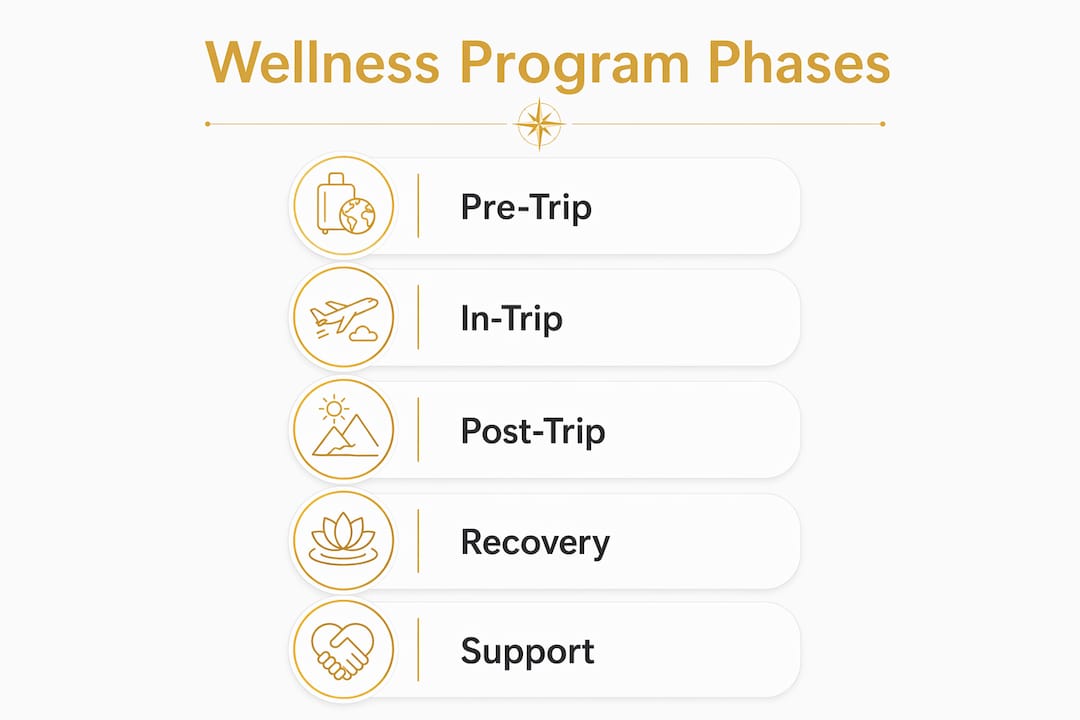
Effective programs break the journey into three phases: pre-trip preparation, in-trip support, and post-trip recovery. Each phase carries distinct risks. Pre-trip, travelers face scheduling pressure and health preparation gaps. In-trip, they deal with time zone changes, poor sleep environments, and disrupted routines. Post-trip, fatigue and cognitive fog can linger for days without deliberate recovery support.

One of the most practical tools in any wellness program is the landing buffer. Recovery scheduling builds a 24-hour reset period before critical engagements, a practice Deloitte’s 2025 Corporate Travel Study highlights as a direct response to fatigue impairing judgment and performance. That single scheduling adjustment costs nothing but time and pays dividends in decision quality.
Social and emotional well-being also play a significant role. Frequent travelers often experience what researchers call lost social capital, the erosion of personal and professional relationships caused by extended time away. A 2026 PLOS ONE review identifies rebuilding social connections as one of five primary self-care needs for international travelers. Programs that ignore this dimension address only half the problem.
- Schedule a minimum 24-hour buffer after long-haul or red-eye flights before any high-stakes meetings or decisions
- Book accommodations with sleep-quality features: blackout curtains, noise control, and temperature regulation
- Build check-in calls or social touchpoints into the itinerary to maintain personal connections during extended trips
- Use pre-trip health consultations to identify and address individual risk factors before departure
Pro Tip: When building a travel itinerary, treat recovery time as a non-negotiable appointment. Block it in the calendar the same way you would a board meeting.
How do wellness programs improve traveler productivity?
Poor sleep is the single largest productivity threat facing travelers today. Nine out of ten workers self-report productivity drops caused by poor sleep during or after travel. That figure means nearly every traveler you send on a trip is operating at reduced capacity unless a wellness program actively addresses sleep quality and recovery.
The productivity case for wellness programs extends beyond sleep. Fatigue reduces concentration, slows decision-making, and increases the likelihood of errors. For business travelers attending negotiations, client meetings, or conferences, those impairments carry real financial consequences. A traveler who arrives exhausted is not the same professional who left the office.
Wellness programs also serve as a competitive advantage for organizations managing frequent travelers. Companies that integrate mental health support, fitness access, and nutrition guidance into their travel policies report higher traveler retention and engagement. The McKinsey Health Institute frames well-being as a performance system requiring evidence-based design, not a collection of individual perks. That framing is important. It means wellness cannot be reduced to a gym membership or a meditation app.
Duty-of-care compliance adds another layer of urgency. Wellness checks and mental health support are now considered essential components of managing travel-related health, safety, and behavioral risks. Organizations that fail to address traveler well-being expose themselves to legal, reputational, and operational risk. Wellness programs, in this context, are as much a risk management tool as they are a health benefit.
For health-conscious travelers managing their own trips, the productivity argument is equally compelling. You are your own most valuable asset on the road. Protecting your cognitive performance through structured rest, nutrition, and recovery is not self-indulgence. It is smart travel practice. Reviewing business travel best practices before any major trip gives you a practical framework for integrating wellness into your personal travel routine.
What makes a traveler wellness program actually effective?
Program design is where most wellness initiatives succeed or fail. A 2026 AJMC systematic review reports mixed behavioral and health outcome results across worksite wellness programs, with poor design and self-selection bias cited as primary weaknesses. The implication is direct: a wellness program that only attracts already-healthy participants delivers minimal impact where it matters most.
Effective programs target higher-risk travelers first. Frequent flyers, travelers crossing multiple time zones, and those with pre-existing health conditions face compounding risks that generic wellness messaging does not address. Reducing access barriers, such as making wellness resources available during travel rather than only at headquarters, is the difference between a program that works and one that looks good on paper.
Cultural understanding is another underappreciated design element. The PLOS ONE self-care framework identifies cultural adaptation as a core self-care need for international travelers. A traveler navigating unfamiliar food systems, social norms, and healthcare environments needs culturally informed support, not a generic wellness checklist.
Pre-trip travel medicine consultations represent one of the highest-return investments in any wellness program. Pre-travel consultations covering vaccinations, destination-specific health risks, and post-travel evaluations, as outlined by AdventHealth Corporate Care, reduce health uncertainty and build traveler confidence before departure.
A 2026 Scientific Reports study adds a psychological dimension that most programs overlook. Mindfulness and tourist experience significantly influence fatigue levels, meaning program design must account for individual psychological variation, not just itinerary logistics. Two travelers on identical schedules can experience vastly different fatigue levels based on their psychological profiles.
| Common Approach | Proven Effective Element |
|---|---|
| Generic health messaging for all travelers | Targeted support for high-risk and frequent travelers |
| Gym access at home base only | On-the-road fitness and recovery resources |
| Post-trip health check only | Pre-trip consultation plus post-trip evaluation |
| Individual behavior focus | Cultural and structural support integrated into itinerary |
| Optional wellness add-ons | Recovery time built into the schedule as standard |
Pro Tip: Before finalizing any travel itinerary, run it through a wellness lens. Ask whether each leg of the trip allows adequate sleep, recovery, and social connection. Adjust before departure, not after arrival.
How can travelers and organizations put wellness first?
Putting wellness first requires deliberate choices at both the individual and organizational level. The good news is that many of the most effective wellness initiatives cost very little. They require planning, not budget.
For individual travelers, the foundation is pre-trip health preparation. Scheduling a travel medicine consultation, reviewing destination-specific health risks, and packing a personal wellness kit, including sleep aids, hydration support, and any required medications, sets a strong baseline. Reviewing an executive travel checklist before departure helps you avoid the common oversights that compound into larger health issues mid-trip.
For organizations, the priority is integrating wellness into travel policy rather than treating it as a separate HR initiative. Travel managers who collaborate with HR and risk management teams build programs that address the full spectrum of traveler needs. Technology plays a supporting role here. Apps that track sleep quality, flag fatigue risk, and provide mental health resources give travelers real-time support between formal program touchpoints.
Wellness-friendly accommodations are a practical lever that both travelers and organizations can use immediately. Hotels with spa facilities, fitness centers, healthy dining options, and quiet sleep environments directly support recovery. Grandglobetrotting’s curated hotel selection focuses on properties that deliver exactly these features for discerning travelers who take their well-being seriously.
Key wellness initiatives worth prioritizing:
- Mandate pre-trip travel medicine consultations for all international travel
- Build recovery buffers into every itinerary involving red-eye or long-haul flights
- Select accommodations based on sleep quality and wellness amenity criteria
- Provide access to mental health and fitness resources during travel, not just at home base
- Establish post-trip check-ins to monitor recovery and flag emerging health concerns
- Design productive executive itineraries that balance activity with deliberate rest periods
Key takeaways
Traveler wellness programs deliver their greatest value when recovery, cultural support, and targeted risk management are built into the itinerary from the start, not added as afterthoughts.
| Point | Details |
|---|---|
| Recovery scheduling is non-negotiable | Build 24-hour buffers after long-haul flights to protect judgment and performance. |
| Sleep quality drives productivity | Nine out of ten travelers report productivity drops from poor sleep, making accommodation choice critical. |
| Target high-risk travelers first | Programs that reach only healthy participants miss the travelers who need support most. |
| Wellness is a duty-of-care obligation | Mental health support and wellness checks reduce legal, safety, and operational risk for organizations. |
| Cultural and psychological factors matter | Effective programs address individual variation and cultural context, not just itinerary logistics. |
The shift i’ve watched happen in luxury travel
I have spent years planning trips for clients who measure success by what they accomplish on the road, not just where they go. The single most consistent mistake I see is treating wellness as a reward rather than a foundation. Travelers book the finest suites, fly business class, and then schedule back-to-back engagements from the moment they land. The luxury is real. The recovery is absent.
What I have found is that the most satisfied travelers are not the ones with the most packed itineraries. They are the ones who arrive at each experience rested, present, and genuinely engaged. That outcome does not happen by accident. It requires deliberate scheduling, thoughtful accommodation choices, and a willingness to treat rest as productive time.
The wellness travel movement, which the industry increasingly recognizes as a distinct category within luxury travel, is not about spa days and green juices. It is about designing trips that respect the human body’s need for recovery and the human mind’s need for connection. The travelers who understand this come home transformed rather than depleted.
My honest view is that wellness programs will become the standard expectation in premium travel within the next few years. The organizations and advisors who build these principles into their planning now will be the ones their clients trust most when that shift arrives.
— Sandon
Plan your next trip with wellness at the center
Grandglobetrotting specializes in building travel experiences where wellness is woven into every detail, from accommodation selection to itinerary pacing and recovery scheduling. Whether you are planning a solo retreat, a corporate trip, or a luxury vacation, the team brings the expertise to balance activity with genuine rest.
Every itinerary Grandglobetrotting creates reflects a deep understanding of what travelers need to arrive well, perform at their best, and return home restored. Explore the personalized luxury travel guide to see how bespoke planning integrates wellness at every stage. For travelers ready to experience the difference that expert itinerary design makes, the travel planning service is the place to start.
FAQ
What are traveler wellness programs?
Traveler wellness programs are structured systems that support physical comfort, mental well-being, and recovery across the full travel journey. They include pre-trip health preparation, in-trip support, and post-trip recovery planning.
How do wellness programs reduce travel fatigue?
Recovery scheduling, such as building 24-hour buffers after long-haul flights, directly reduces fatigue that impairs judgment and performance. Deloitte’s 2025 Corporate Travel Study identifies this practice as a core wellness strategy.
Why do organizations need traveler health programs?
Organizations have a duty-of-care obligation to manage health, safety, and behavioral risks for traveling employees. Wellness programs reduce legal and operational exposure while improving traveler retention and productivity.
Do wellness programs work for all travelers?
Programs designed without targeting higher-risk travelers tend to attract only already-healthy participants, limiting their impact. The AJMC 2026 systematic review recommends reducing access barriers and focusing on frequent and high-risk travelers for meaningful results.
What is the most overlooked element of wellness travel planning?
Social capital restoration is consistently underaddressed in wellness program design. The 2026 PLOS ONE review identifies rebuilding personal and professional connections during travel as one of the five primary self-care needs for international travelers.
Recommended
At Grand Globetrotting, we don't just plan vacations; we craft extraordinary adventures that leave you with cherished memories. Let us bring your dream vacation to life, perfectly tailored to your style, and immerse yourself in a world of luxury, exploration, and unforgettable moments. Your journey begins with us.
Itinerary planning services require a separate charge outside of cost to book travel accommodations. Depending upon the complexity of the itinerary and the level of effort required to acquire unique experiences, cost may vary. Speak with our team to learn more.
Book your consultation