

TL;DR:
- Prioritize defining your trip’s purpose, mood, budget, and logistics before researching destinations to ensure a personalized experience.
- Shortlist three to five exclusive locations based on expert curation, authenticity, and emotional resonance, then compare them logically.
- Optimal planning involves early bookings, private experiences, and working with professionals to create a tailored, memorable luxury journey aligned with your true preferences.
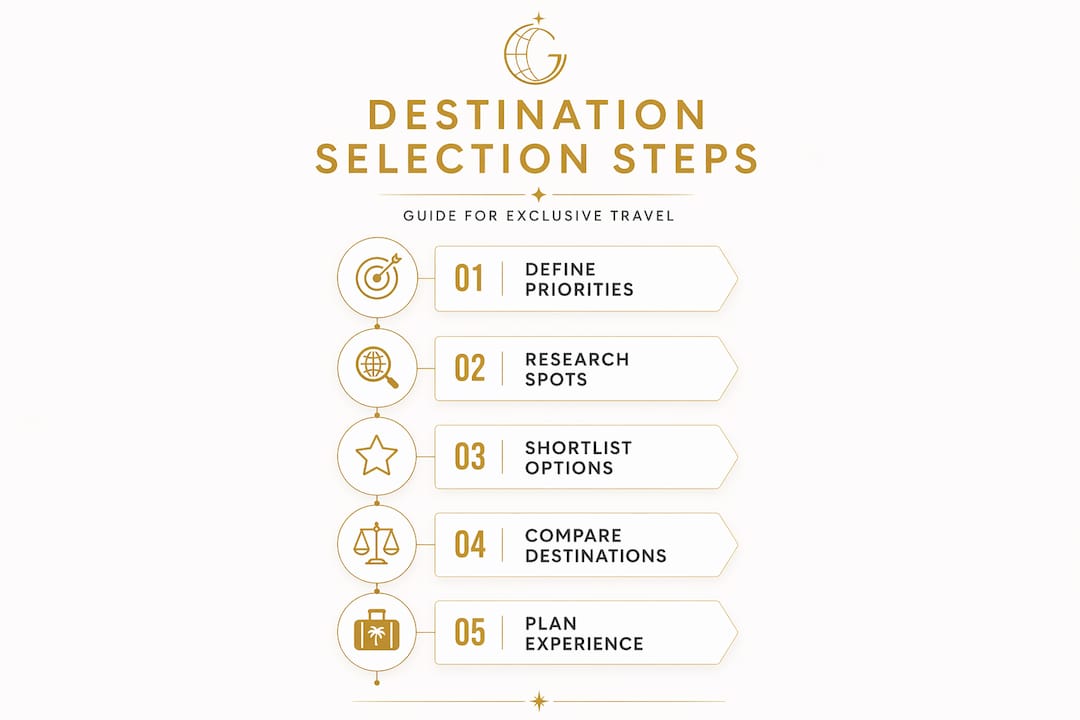
Choosing where to go should feel exciting. For most luxury travelers, though, it feels like sorting through noise. There are hundreds of lists, awards, and recommendations, each claiming to point you toward the world’s best experiences. The challenge is not finding options. The challenge is filtering them down to the one destination that genuinely fits your vision of an exclusive, memorable trip. This exclusive destination selection guide walks you through a deliberate, step-by-step process for identifying and choosing destinations that match your personal goals, travel temperament, and standards for true luxury.
Table of Contents
- Key takeaways
- Understanding your priorities before choosing a destination
- Researching and shortlisting exclusive travel spots
- Comparing shortlisted destinations effectively
- Planning your bespoke experience after choosing a destination
- My perspective on choosing destinations that truly deliver
- Plan your exclusive trip with Grandglobetrotting
- FAQ
Key takeaways
| Point | Details |
|---|---|
| Clarify your priorities first | Define trip purpose, mood, budget, and logistical needs before researching any destination. |
| Shortlist 3 to 5 contenders | Comparing a focused selection of destinations leads to smarter, more satisfying choices. |
| Seasonality drives exclusivity | Shoulder season travel often provides better access, fewer crowds, and stronger value at elite properties. |
| Emotional signature matters | The best destination for you resonates personally, not just by reputation or price. |
| Expert guidance saves time | A professional travel advisor provides personalized precision that no search engine can replicate. |
Understanding your priorities before choosing a destination
Before you open a single travel magazine or explore any luxury travel destination guide, you need to do some internal work. Skipping this step is exactly why so many travelers end up somewhere technically impressive but personally underwhelming. The destination is not the starting point. You are.
Start by defining the purpose and emotional tone of the trip. Are you seeking deep rest and private seclusion? Cultural immersion in a city with history and exceptional food? Adventure in a remote, dramatic landscape? These are not interchangeable moods, and chasing the wrong one in the right location still produces a disappointing trip. Vacations aligned with temperament and recreation goals produce measurably better outcomes than those chosen purely by reputation.
Budget is the next non-negotiable. Luxury travel does not mean unlimited spending, and geography is the single biggest budget lever in bespoke trip planning. A private villa in Bali or a boutique retreat in Morocco will deliver a genuinely exclusive feel at a fraction of what a comparable experience in peak-season Santorini or the Amalfi Coast would cost. Set your realistic daily spend before shortlisting destinations, and factor in the hidden costs: private transfers, tasting menus, guided excursions, and spa access all add up quickly.
Pro Tip: Write down three words that describe how you want to feel on this trip before you research a single location. These words become your filter. If a destination does not consistently evoke all three, it does not make your shortlist.
Here is a practical reference table for the key prerequisites to assess before destination research begins:
| Prerequisite | Questions to ask |
|---|---|
| Trip purpose | Rest, adventure, culture, romance, or celebration? |
| Travel mood | Energized and social, or private and restorative? |
| Budget ceiling | Daily spend limit including activities and dining? |
| Timing and duration | How many nights, and what season works logistically? |
| Logistical preferences | Direct flights available? Visa requirements manageable? |
| Group composition | Solo, couple, family, or small group? |
Timing connects to exclusivity more directly than most travelers realize. Shoulder seasons like May or late September offer fewer crowds and better access at top-tier resorts, often at reduced rates. Many elite properties close outside their preferred seasonal windows entirely, so understanding when a destination is at its best for your experience type is foundational before you commit.
Researching and shortlisting exclusive travel spots
Once your priorities are locked, you can research with intention rather than overwhelm. The difference is significant. Intentional research uses your prerequisite profile as a filter, which means you are not browsing, you are evaluating.

Start with trusted, expert curated sources. The Radiant Itinerary by Dandelion Chandelier is one of the most respected luxury travel destination guides available, selecting top destinations based on hotel openings, sustainability leadership, and cultural relevance. Publications like this reflect professional curation rather than ad spend, which makes them significantly more useful for building a genuine shortlist.
Rankings and awards offer another layer of validation. Entalula Beach in the Philippines, for example, ranked as the top remote exclusive beach destination in 2026, based on votes from over 1,000 travel industry professionals and influencers. That kind of data point signals authentic desirability among people who have seen a lot.
Do not overlook emerging destinations with strong sustainability credentials and cultural depth. These spots often deliver stronger exclusivity than their famous counterparts, simply because fewer travelers know about them yet.
When evaluating potential destinations for your shortlist, apply these criteria consistently:
- Exclusivity factor. Does the destination offer genuine privacy and limited-crowd experiences, or does “luxury” just mean expensive and crowded?
- Newness. Are there recent hotel openings, cultural programs, or experiential offerings that feel fresh rather than formulaic?
- Cultural authenticity. Does the destination have a distinct identity you can engage with meaningfully, or is it a generic resort environment?
- Emotional signature. When you picture yourself there, does the image align with those three words you wrote down in step one?
- Practical accessibility. Are direct flights available from your origin city? Is the visa process manageable within your timeline?
Pro Tip: Search specifically for boutique properties in lesser-known regions within countries you are already considering. Authentic luxury at better value often hides one province away from the famous name.
Aim to produce a shortlist of three to five destinations. More than five becomes unwieldy. Fewer than three limits your ability to compare objectively. Quality of contenders matters far more than quantity.
Comparing shortlisted destinations effectively
With your shortlist in hand, the next step is structured comparison. Gut feeling matters, but it works best when supported by side-by-side data. Build a simple comparison across the factors that affect your experience most.
| Factor | Option A | Option B | Option C |
|---|---|---|---|
| Best travel window | May to June | October to November | Year-round |
| Estimated daily cost | $300 to $500 | $150 to $250 | $400 to $700 |
| Direct flight availability | Yes | Connecting only | Yes |
| Crowd level in season | Moderate | Low | High |
| Cultural immersion depth | Strong | Moderate | Limited |
| Exclusivity of top properties | Very high | High | Moderate |
Cost comparisons sometimes surprise even experienced luxury travelers. Cities like Marrakech, Bangkok, Bali, and Istanbul deliver luxury-level experiences for $40 to $120 per day on many core expenses, which means a boutique riad in Marrakech or a private villa in Bali can feel more exclusive than a crowded five-star in peak-season Europe, while costing significantly less.
One underweighted factor in most destination comparisons is the emotional signature. According to the 2026 Radiant Itinerary, destination selection is increasingly driven by emotional resonance and mood rather than pure geography. This is not soft thinking. It is a recognition that a technically perfect destination that does not emotionally excite you will produce a forgettable trip regardless of the quality of its hotels.
A common pitfall worth naming directly: avoid destinations that carry the word “luxury” as a marketing label rather than a lived reality. Certain overexposed resort towns are expensive and well-branded, but their actual exclusivity has eroded significantly. If a destination is on every major publication’s list this year and flights are expensive, crowds are part of the deal. Exclusivity often lives one step off the beaten path, not at the center of it.
Pro Tip: For complex decisions involving multiple destinations, cultural considerations, or large groups, a professional travel advisor brings genuine value. Expert consultants outperform search engines when it comes to tailored, trusted recommendations that account for your specific circumstances.
For a deeper look at what separates a genuinely elite destination from one that simply markets itself as exclusive, Grandglobetrotting’s guide on defining exclusive destinations offers a clear framework.
Planning your bespoke experience after choosing a destination
Selecting the destination is only the first decision. The quality of your experience depends heavily on what comes after. This is where premier travel recommendations translate into lived reality.
Your accommodation sets the tone for everything. Beyond star ratings, look for properties that offer genuine privacy, exceptional staff ratios, and design that reflects the local culture rather than ignoring it. Consider how to select exclusive hotels based on criteria beyond brand recognition, including room count (smaller means more personal), property history, and access to experiences unavailable to the general public.
When building your excursion program, keep these principles in mind:
- Prioritize private over group. Private guides, private boat charters, and after-hours venue access are the clearest markers of a genuinely exclusive experience. Group tours at famous sites are the opposite of what you are planning for.
- Book the non-negotiables early. Elite properties and unique experiences, whether a private chef dinner in a Tuscan vineyard or a dawn hot air balloon over the Serengeti, have limited availability. Early booking is not just practical; it is how you secure access.
- Plan around the destination’s rhythm. Every location has specific days, times, or seasons when its best experiences are accessible. Working with a local expert to understand that rhythm is far more valuable than a generic itinerary.
- Leave margin in your schedule. Over-programming is one of the most common mistakes in luxury travel. The best experiences often happen when you have the freedom to extend a morning, linger over a meal, or accept an unexpected invitation.
- Blend the known with the undiscovered. The most rewarding curated travel experiences combine one or two signature experiences with genuinely local, off-grid moments that most visitors never find.
The logistics layer, covering transfers, dining reservations, and timing between activities, requires the same attention as the headline experiences. A flawless private dinner means little if the transfer was stressful or the timing was rushed.
My perspective on choosing destinations that truly deliver
I have helped travelers plan trips across dozens of countries, and the pattern I see most consistently is this: the trips people remember and talk about for years are rarely the most expensive ones. They are the ones with the strongest emotional alignment between traveler and place.
Exclusivity, in my experience, is more a mindset than a price point. I have seen travelers spend $30,000 on a week in a famous resort and feel vaguely bored by day three, and I have watched others spend half that on a boutique property in a lesser-known corner of Portugal or Sri Lanka and describe it as a life-changing week. The difference is almost always how well the destination matched who they actually are, not how well it matched a magazine’s ranking.
What I have learned to do for every client is treat destination selection as a world-building exercise. We are not just picking a place on a map. We are choosing a setting that will shape how you feel, what you notice, and what you take home with you. That framing changes the entire research process.
The other thing I will say plainly: do not underestimate the value of professional guidance for complex trips. I have seen how much time and money clients save by working with someone who knows the properties personally, understands the seasonal nuances, and has direct relationships with the people who can make unusual things happen. No search engine replicates that.
— Sandon
Plan your exclusive trip with Grandglobetrotting
Grandglobetrotting was built specifically for travelers who want exactly what this guide describes: a destination and experience that fits their vision, not a generic itinerary assembled from lists. The team at Grandglobetrotting combines industry relationships, destination expertise, and a genuinely personal approach to create personalized luxury travel plans that account for everything, from the right hotel to the right timing to the experiences you would never find through a standard booking platform. Whether you are planning a honeymoon, a solo adventure, or a multi-destination family trip, you can explore luxury hotel options and full bespoke travel planning services directly on the site. Start with a consultation and let the planning become as enjoyable as the trip itself.
FAQ
What makes a destination truly exclusive?
A truly exclusive destination offers genuine privacy, limited crowds, and experiences not widely available to the general public. Exclusivity is defined by access and alignment with your goals, not simply by price or brand recognition.
How do I start narrowing down luxury travel options?
Begin by clarifying your trip purpose, emotional goals, budget, and logistical preferences before researching any destination. Aligning destination to temperament consistently produces better outcomes than choosing based on popularity alone.
When is the best time to visit exclusive destinations?
Shoulder seasons like May or late September typically offer the best combination of favorable weather, reduced crowds, and access to elite properties. Peak season at famous destinations often means less exclusivity, not more.
Should I use a travel advisor for luxury trip planning?
Yes, particularly for complex or multi-destination trips. Professional travel consultants provide personalized recommendations and logistical handling that generic search tools simply cannot match.
How many destinations should I compare before deciding?
A shortlist of three to five destinations is ideal. This range gives you enough options for meaningful comparison without becoming overwhelming, allowing you to evaluate each contender across climate, cost, exclusivity, and personal fit.
Recommended
At Grand Globetrotting, we don't just plan vacations; we craft extraordinary adventures that leave you with cherished memories. Let us bring your dream vacation to life, perfectly tailored to your style, and immerse yourself in a world of luxury, exploration, and unforgettable moments. Your journey begins with us.
Itinerary planning services require a separate charge outside of cost to book travel accommodations. Depending upon the complexity of the itinerary and the level of effort required to acquire unique experiences, cost may vary. Speak with our team to learn more.
Book your consultation