

TL;DR:
- Residence clubs offer affluent travelers predictable luxury residences and concierge services through ownership or contracts. They suit frequent travelers seeking guaranteed quality and privacy but require significant upfront costs and long commitments. For flexible, trip-by-trip luxury experiences, personalized travel services like Grandglobetrotting present a valuable alternative.
Residence club travel is a members-only model that gives you private access to a curated portfolio of luxury residences and concierge services, typically through a fractional ownership stake or a right-to-use contract. For affluent, time-poor travelers, the core appeal is predictability: consistent quality, a dedicated service team, and no last-minute scramble for availability. The trade-offs are real, though.
- Pros: Predictable quality, hotel-grade concierge, privacy, and no property management burden
- Cons: Significant upfront membership cost, multi-year contract commitment, and limited resale liquidity
If you travel at least two to four weeks per year and value a frictionless, branded experience over the lowest nightly rate, a residence club is worth a serious look. If you travel infrequently or want full control of a second home, it probably is not.
Table of Contents
- What is residence club travel and how does it work day-to-day?
- How ownership models differ: deeded, right-to-use, and subscription
- Residence clubs vs. timeshares, vacation rentals, and fractional ownership
- Who gets the most value from a residence club membership?
- What does a residence club membership actually cost?
- Questions to ask before you commit to any club
- Red flags and legal considerations to verify before signing
- How U.S. residence and destination clubs position their models
- Key Takeaways
- When a residence club makes sense vs. hiring a luxury travel advisor
- Grandglobetrotting offers a flexible alternative to club membership
- Useful sources and next steps for verification
What is residence club travel and how does it work day-to-day?
Destination clubs are luxury, members-only programs built around a portfolio of high-end vacation properties and curated experiences. The model prioritizes concierge service and professional property management over the fixed-week structure of traditional timeshares.
Membership mechanics and booking flow:
- Members receive an annual allotment of usage days (called “plan days” in some clubs) or a fixed number of weeks tied to their share size
- Reservations typically open 6–12 months in advance, with priority windows for longer-tenured members
- “Floating” usage means you select dates within a season rather than the same week every year
- Blackout periods around peak holidays vary by club and should be confirmed in writing
Concierge services in practice:
- Pre-arrival provisioning (stocked refrigerator, preferred wines, dietary preferences on file)
- Private ground transportation and private jet coordination
- On-site activity planning, restaurant reservations, and childcare arrangements
Exchange partnerships expand the portfolio further. Reciprocal platforms such as THIRDHOME provide access to over 1,700 luxury residences worldwide, with an average property value of $2.3 million. Some clubs also affiliate with Interval International, opening thousands of additional resort options globally.
Exclusive Resorts intentionally limits new member intake and assigns dedicated Vacation Ambassadors to each household, preserving the service-to-member ratio that justifies premium pricing.

How ownership models differ: deeded, right-to-use, and subscription
The legal structure behind your membership determines what you actually own, what you can pass on, and what happens when you want to exit.
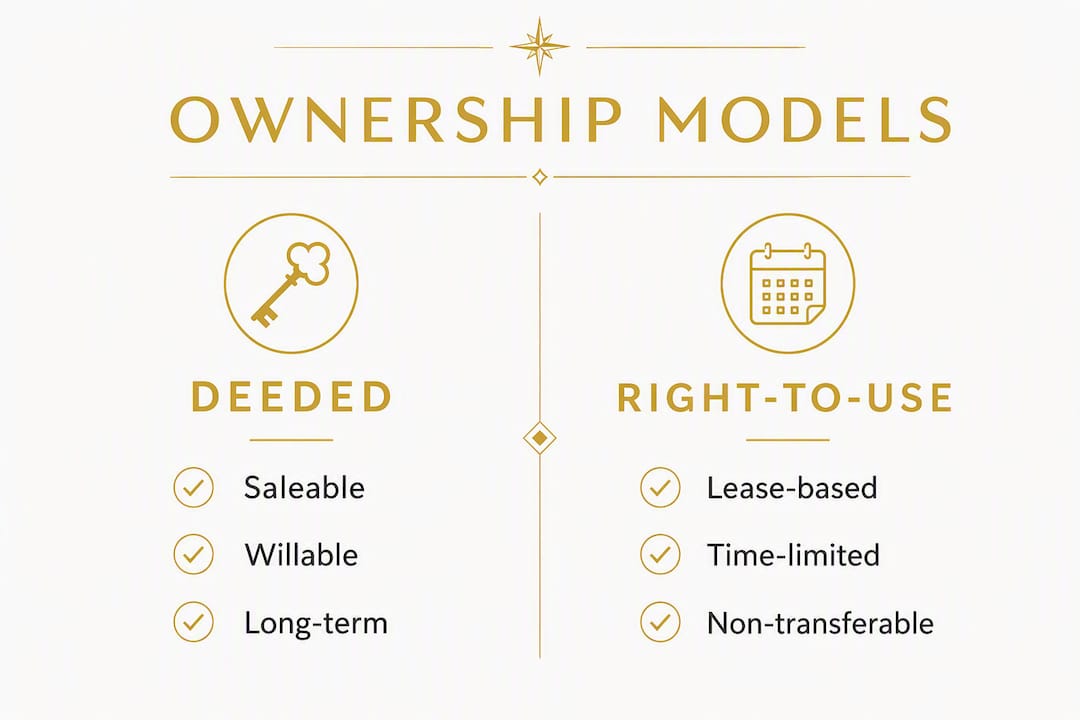
- Deeded fractional ownership: A legally recorded, transferable real-estate interest you can sell, will, or place in a trust. Fractional shares commonly run at 1/4, 1/6, 1/7, 1/8, and 1/10 interests, translating to roughly 13, 8–9, 7, 6, and 4–5 weeks of annual usage respectively. At The Residence Club at PGA WEST, fractional owners typically secure several weeks per year depending on share size.
- Right-to-use contracts: Contractual access for a defined term, generally 10–30 years, with no real-estate title. These contracts are not ownership interests, which limits resale options and complicates estate planning.
- Subscription or days-based clubs: Access without any real-estate interest. Exclusive Resorts markets ten- and thirty-year membership terms with plan-day pricing across hundreds of residences. Flexible and lower-commitment, but you hold no appreciating asset.
Pro Tip: Before signing, ask the club to specify in writing whether your interest is “deeded” or “right-to-use.” The marketing materials often blur this distinction, and the legal difference is significant for your estate.
Residence clubs vs. timeshares, vacation rentals, and fractional ownership
| Feature | Deeded Fractional | Right-to-Use Club | Subscription Club | Traditional Timeshare |
|---|---|---|---|---|
| Ownership model | Titled real-estate interest | Contractual access only | Access only, no asset | Deeded or right-to-use |
| Flexibility of use | Floating dates or points | Floating plan days | Plan days, broad portfolio | Fixed week, one property |
| Concierge & service | Hotel-grade, dedicated staff | Full concierge included | Full concierge included | Minimal to none |
| Entry cost | High (fractional price) | High initiation fee | Moderate initiation fee | Low to moderate |
| Annual dues | Yes, plus reserve fund | Yes, plus reserve fund | Annual membership fee | Annual maintenance fee |
| Resale / estate | Saleable, willable, trustable | Limited, contract-dependent | None | Difficult, low demand |
| Portfolio breadth | Single property or small set | Multi-property portfolio | Large curated portfolio | Single resort or chain |
AAA’s travel club explainers note that destination clubs offer home-style privacy with hotel-level services, a combination that neither vacation rentals nor standard timeshares reliably deliver.
Who gets the most value from a residence club membership?
SherpaReport’s analysis identifies quality assurance, maintenance outsourcing, concierge services, and travel commitment as the top reasons affluent travelers join destination clubs. The profile that fits best is specific.
Ideal members:
- Busy executives who want guaranteed, high-quality holiday windows without planning overhead
- Multigenerational families seeking a consistent “home base” that works for grandparents and grandchildren alike
- Privacy-focused couples who prefer a private residence over a hotel lobby
- Frequent international travelers who benefit from exchange network breadth
When a club is not the right fit:
- Travelers who vacation fewer than two weeks per year (the per-day cost rarely justifies the annual dues)
- Buyers who want full autonomy over a second home, including décor and rental income
- Value-focused travelers whose primary goal is cost savings rather than service consistency
The luxury-as-a-service framing is the right lens here. Members pay for convenience, standardization, and a high-touch model, not for a lower nightly rate.
What does a residence club membership actually cost?
Fee structures vary widely, but the components are consistent across most clubs.
| Fee Type | When Due | Notes |
|---|---|---|
| Initiation / entry fee | At signing | Covers your ownership or access interest |
| Annual dues | Each year | Covers management, staffing, and operations |
| Reserve fund contribution | Annually or at signing | Funds future capital improvements |
| Per-stay service fee | At each stay | Some clubs bundle this into dues |
| Transfer / exit fee | At resale or term end | Varies; deeded models may involve broker fees |
Key financial realities:
- Initiation fees for premium clubs can reach six figures; subscription clubs tend to start lower
- Annual dues on deeded fractional properties often include a reserve fund contribution that protects long-term property quality
- Right-to-use contracts typically have no resale market, so the initiation fee is effectively a sunk cost
- Deeded fractional interests can be sold, though the secondary market is thinner than for whole ownership
Contract lengths range from annual renewals (subscription clubs) to 10- or 30-year terms. Always request the full fee schedule, not just the headline initiation number.
Questions to ask before you commit to any club
A polished sales presentation is not due diligence. Bring this checklist to every membership meeting.
Documents to request:
- Full membership agreement (not a summary brochure)
- Audited reserve fund statements for the past two years
- Governance documents: who controls the homeowners’ or members’ association
- Sample reservation calendar showing actual availability in peak periods
- Third-party property appraisal for deeded fractional interests
Questions to ask the membership team:
- Can you show me three recent resale examples, including time on market and final price?
- What percentage of plan days go unused each year, and what happens to them?
- Which specific dates are blacked out, and how far in advance are blackouts published?
- What are the exchange partner agreements, and what fees apply to exchanges?
- What happens to my interest if the club operator defaults or is acquired?
Trust signals worth requesting include audited financials, a sample member ledger showing actual usage, and references from current members who joined more than five years ago.
Red flags and legal considerations to verify before signing
Consumer guides consistently flag aggressive sales tactics and opaque fine print as the most common traps in travel club contracts.
Watch for these warning signs:
- Reserve accounts that are not independently audited or disclosed
- Pressure to sign within 24–48 hours (“today-only” pricing)
- Vague or absent language on transferability and inheritance rights
- Unusually long minimum commitments with no exit clause
- Membership agreements that describe your interest as “access rights” without specifying whether any real-estate title is involved
Legal checklist before signing:
- Confirm in writing whether your interest is deeded or right-to-use
- Review transfer and inheritance language with a real-estate attorney
- Check whether the club is registered with the relevant state real-estate authority
- Verify that the reserve fund is held in a segregated, third-party account
This article is general information, not legal or financial advice. Consult a real-estate attorney experienced with fractional ownership before executing any membership agreement.
How U.S. residence and destination clubs position their models
Two operators illustrate the range of approaches in the U.S. market.
-
Exclusive Resorts positions itself as a subscription-style destination club with ten- and thirty-year membership terms and plan-day pricing. The portfolio spans hundreds of residences globally. The club intentionally limits membership size and assigns Vacation Ambassadors to maintain service quality, emphasizing a branded, consistent experience over exchange breadth.
-
Inspirato operates a subscription model where members pay a monthly fee for access to a curated portfolio of luxury homes, hotels, and experiences. The pricing structure is designed to eliminate per-trip booking fees, making costs more predictable for frequent travelers.
For deeded fractional ownership, The Residence Club at PGA WEST in Palm Springs offers 1/4 and 1/9 ownership interests in single-family homes within a premier golf community, with a minimum of 21 days of annual usage and full access to PGA WEST amenities. Members can also access luxury yacht charters and other premium experiences through reciprocal partner networks.
Key Takeaways
Residence club travel is most valuable as a luxury-as-a-service product: members pay for planning friction reduction and guaranteed quality, not simply for lower nightly rates.
| Point | Details |
|---|---|
| Ownership model matters most | Deeded fractional interests are saleable and willable; right-to-use contracts are not — verify in writing before signing. |
| Cost goes beyond the entry fee | Annual dues, reserve fund contributions, and per-stay fees add up; always request the full fee schedule. |
| Best fit is frequent, quality-focused travelers | Members who travel at least two to four weeks per year and prioritize service consistency extract the most value. |
| Due diligence is non-negotiable | Request audited financials, a sample reservation calendar, and resale examples before committing to any club. |
| Grandglobetrotting as an alternative | For travelers who want hotel-grade concierge and curated experiences without a long-term contract, Grandglobetrotting’s bespoke advisory model delivers comparable quality on a per-trip basis. |
When a residence club makes sense vs. hiring a luxury travel advisor
The case for a residence club is strongest when you want a committed travel framework: a guaranteed number of weeks, a known quality standard, and a service team that already knows your preferences. For executives who struggle to carve out vacation time, the financial commitment of a club membership can actually function as a forcing mechanism that protects family travel on the calendar.
That said, clubs are not the right answer for every affluent traveler. A 30-year right-to-use contract is a significant obligation, and the secondary market for most memberships is thin. If your travel patterns shift, or if you want the freedom to explore a different region each year, a fixed portfolio can feel limiting rather than liberating.
Pro Tip: If you are already a club member, use your Vacation Ambassador or concierge team for every logistical detail, including ground transport, dining reservations, and activity bookings. Members who engage the concierge fully extract far more value than those who treat the club purely as a booking platform.
The most honest rule of thumb: a residence club works best when you want to stop making travel decisions and start showing up. A luxury travel advisor works best when you want every trip tailored from scratch, with no long-term financial commitment attached.
Grandglobetrotting offers a flexible alternative to club membership
For affluent travelers who want the concierge experience and curated quality of a residence club without a six-figure initiation fee or a decade-long contract, Grandglobetrotting delivers exactly that, trip by trip.

Grandglobetrotting builds fully personalized luxury travel engagements that cover private flight coordination, hand-selected accommodations, ground logistics, dining, and on-trip support, with no annual dues and no minimum commitment. Every itinerary is built around your specific preferences, travel dates, and group dynamics, whether you are planning a multigenerational family trip, a corporate retreat, or a private getaway. The result is hotel-grade service and curated access, structured around your schedule rather than a club’s portfolio calendar. To start planning your next trip, visit Grandglobetrotting’s bespoke travel planning page and request a consultation.
Useful sources and next steps for verification
Before committing to any membership, gather these resources and consult the right professionals.
Documents to request from any club:
Professional advisors to consult:
Authoritative reference sources:
- Destination clubs overview — SherpaReport
- What is a travel club? — AAA Trip Canvas
- Are travel clubs worth it? — TravelAwaits
- How Does Four Seasons Residence Club Work? — Fidelity Real Estate
- Hype Luxury Boat Club — Qbic Travel (example of the club model applied to private boat experiences)
Recommended
At Grand Globetrotting, we don't just plan vacations; we craft extraordinary adventures that leave you with cherished memories. Let us bring your dream vacation to life, perfectly tailored to your style, and immerse yourself in a world of luxury, exploration, and unforgettable moments. Your journey begins with us.
Itinerary planning services require a separate charge outside of cost to book travel accommodations. Depending upon the complexity of the itinerary and the level of effort required to acquire unique experiences, cost may vary. Speak with our team to learn more.
Book your consultation