

TL;DR:
- High-end travel focuses on personalization, privacy, and authenticity rather than cost or size of amenities.
- Experiences are tailored, exclusive, and designed for genuine connection, not mass appeal or display.
- It involves significant investment in access, expert planning, and meaningful, memorable moments.
Most people assume high-end travel is simply about spending more. Bigger suites, more champagne, a higher thread count. But that assumption misses the point entirely. Ultra luxury travel planning is defined by precision and personalization rather than excess. The travelers who truly understand high-end experiences are not chasing price tags. They are seeking privacy, meaning, and moments that cannot be replicated. This guide breaks down what high-end travel actually means, how it differs from standard luxury, and how you can shape a journey that reflects exactly who you are and what you value.
Table of Contents
- Defining high-end travel: Beyond opulence
- What makes an experience truly high-end?
- The investment: Pricing, value, and benchmarks
- Personalization, privacy, and the new luxury frontier
- What most people get wrong about high-end travel
- Ready for your high-end journey?
- Frequently asked questions
Key Takeaways
| Point | Details |
|---|---|
| Personalization matters most | True high-end travel delivers individualized experiences centered on your interests and needs. |
| Privacy is the new luxury | Discretion, comfort, and exclusive access are more valuable than traditional luxury goods. |
| Value goes beyond price | High investment brings rare moments, seamless service, and authenticity you can’t get elsewhere. |
| Technology refines the experience | Smart use of data and advisors enhances but never replaces the human touch in luxury travel. |
Defining high-end travel: Beyond opulence
Now that we’ve confronted common myths, let’s clarify exactly what constitutes high-end travel today. The words luxury, premium, and high-end are often used interchangeably, but they carry distinct meanings for discerning travelers.
Premium travel typically refers to upgraded cabins, better hotel categories, and improved amenities. Standard luxury travel adds brand prestige, fine dining, and polished service. High-end travel, however, operates on a different level entirely. It is built around four core pillars:
- Hyper-personalization: Every detail is tailored to your preferences, history, and desires.
- Privacy: Exclusive access, private transfers, and spaces designed to keep you away from crowds.
- Service quality: Anticipatory service that responds before you even ask.
- Authenticity: Experiences rooted in genuine culture, place, and connection.
As customer luxury experience dimensions research confirms, the defining factors include service quality, authenticity, escapism, exclusivity, and status. Notice that none of those are simply about spending money.
“High-end travel is defined by precision, privacy, and hyper-personalization, not by the size of the bill.”
The profile of today’s high-end traveler has shifted. Ultra-high-net-worth individuals (UHNWIs) are not impressed by gold fixtures or recognizable logos alone. They want rarity. They want access that money can open but that most people never find. They want journeys that feel like they were designed specifically for them, because they were.
Exploring premium travel experiences gives a clearer picture of how the market has evolved. And for those ready to go further, a personalized luxury travel guide offers a structured path to building a trip that reflects your unique vision.
High-end travel is not about having everything. It is about having exactly what matters to you, delivered flawlessly.
What makes an experience truly high-end?
Understanding the core definition, let’s explore the real-world characteristics that set high-end experiences apart. The difference between a luxury resort stay and a genuinely high-end experience is often invisible on a brochure but unmistakable in person.
High-end experiences share several defining characteristics:
| Feature | Standard luxury | High-end experience |
|---|---|---|
| Accommodation | Five-star hotel | Private villa or island buyout |
| Dining | Award-winning restaurant | Private chef, custom menu |
| Activities | Curated hotel excursions | After-hours museum access, custom safari |
| Service | Attentive hotel staff | Dedicated personal concierge |
| Flexibility | Fixed itinerary options | Fully adaptable, real-time changes |
True hyper-personalization and escapism, not just cost, define what makes a trip genuinely high-end. A family that books a private island buyout in the Maldives is not paying for square footage. They are paying for the absence of strangers, the ability to set their own schedule, and a setting that feels like it belongs only to them.
Behind-the-scenes access is another hallmark. Think private tours of the Vatican after closing hours, a cooking session with a Michelin-starred chef in their home kitchen, or a guided wildlife experience led by a leading conservation scientist. These are not catalog items. They are crafted through relationships and expertise.

Pro Tip: When evaluating a high-end experience, ask whether it could be replicated by anyone with a credit card. If the answer is yes, it is luxury. If the answer is no, it is high-end.
Itinerary flexibility is equally critical. High-end travelers expect to change plans without friction. A sudden desire to extend a stay in Kyoto or pivot from a beach day to a private cooking class should be accommodated seamlessly. That level of control requires expert personalized travel planning and a deep understanding of the value of bespoke travel.
The investment: Pricing, value, and benchmarks
With a sense of what defines high-end travel, it’s essential to understand the investment and the value behind the numbers. Price in this segment is not arbitrary. It reflects the depth of service, the rarity of access, and the complexity of execution.
High-ticket trips often range from $5,000 to $50,000 or more per booking, with ultra-luxury experiences typically landing between $25,000 and $75,000 or higher. The average spend per high-end trip sits at approximately $28,400, a figure that reflects not just accommodation but the full architecture of a personalized journey.
What drives that number? Consider what is actually included:
- Private aviation: Charter flights eliminate airport friction and add hours back to your trip.
- VIP access and permits: Some experiences require advance relationships, not just payment.
- Dedicated advisors: Experts who manage logistics, anticipate needs, and resolve issues instantly.
- Exclusive accommodations: Properties that limit guest numbers to preserve the experience.
- Custom programming: Activities designed around your interests, not a generic activities menu.
Seasonality and destination also shape pricing significantly. The Amalfi Coast in peak summer commands a premium that the same itinerary in shoulder season would not. Remote destinations like Antarctica or Bhutan carry inherent costs tied to access, permits, and limited infrastructure.
Value, in this context, is not measured in cost per night. It is measured in the quality of what you experience, the time you save, and the memories that remain long after you return home. Personalizing luxury travel is where that value is truly realized, turning a high price point into a worthwhile investment.
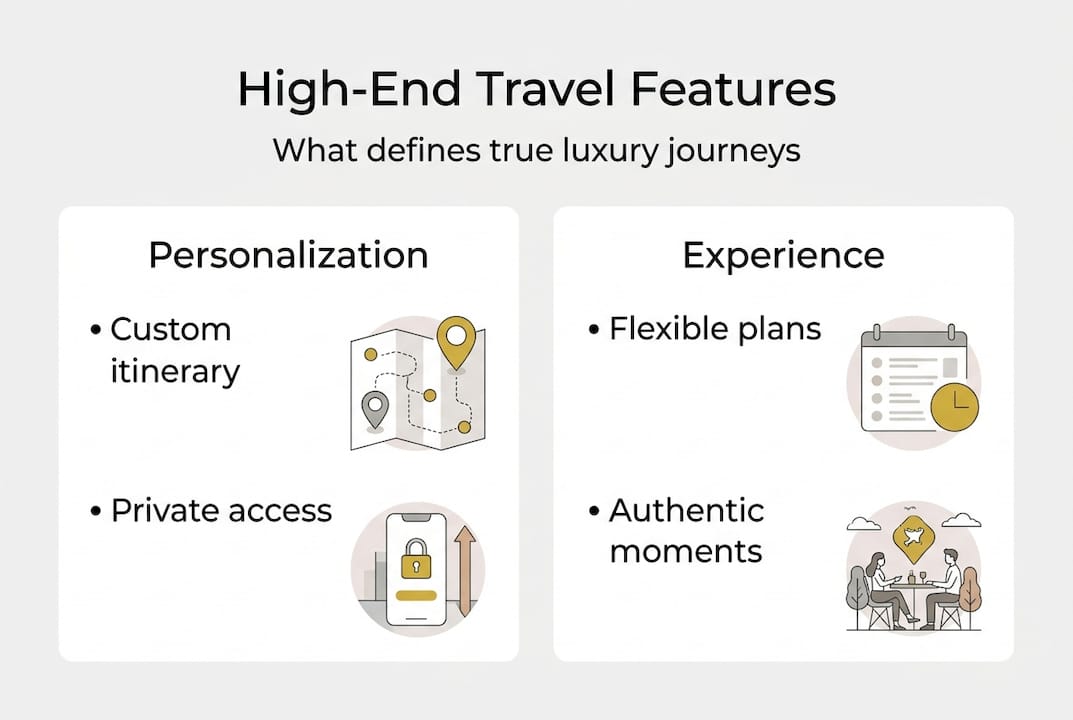
Key insight: The gap between a $10,000 trip and a $40,000 trip is rarely about more things. It is almost always about better access, deeper personalization, and fewer compromises.
Personalization, privacy, and the new luxury frontier
Beyond price and features, the heart of high-end travel is privacy and bespoke service. Let’s uncover how personalization is redefining luxury in 2026 and beyond.
Hyper-personalization means your travel advisor knows your dietary restrictions, your preferred pillow firmness, your interest in contemporary art, and your aversion to crowds before your trip begins. It means the welcome amenity in your suite is not a bottle of generic champagne but a local wine selected because your advisor noted your preference during a consultation six months earlier.
Here is how the best advisors approach this:
- Deep discovery: Detailed intake conversations that go far beyond destination preferences.
- Preference mapping: Building a profile that informs every vendor, hotel, and experience.
- Proactive communication: Sharing updates, weather considerations, and local insights before departure.
- Real-time support: On-call access during the trip for changes, emergencies, or spontaneous additions.
- Post-trip refinement: Gathering feedback to make the next journey even more precise.
Technology plays a growing role here. Hyper-personalization via data and AI is reshaping how advisors build and manage client profiles, though it also introduces a privacy paradox. The more data shared, the more tailored the experience. But affluent travelers are also among the most privacy-conscious clients in any industry.
At the same time, there is a growing pushback against what some industry observers call industrial luxury homogenization, where large hotel groups and tour operators deliver polished but predictable experiences. The response from discerning travelers is a demand for de-industrialized authenticity, experiences that feel genuinely rare rather than mass-produced for the wealthy.
Pro Tip: Before booking, ask your advisor how your experience will differ from the one offered to the next guest. If the answer is vague, keep looking.
Understanding why using a travel advisor matters and staying current with luxury travel trends are both essential steps for travelers who want to stay ahead of the curve.
What most people get wrong about high-end travel
After exploring the tangible elements, it’s time for an inside look at what really defines high-end travel for those who know.
The biggest misconception is that high-end travel is a display. That it is about being seen at the right property or posting from the right location. In reality, the most discerning travelers actively seek the opposite. They want privacy. They want experiences that cannot be photographed and captioned. They want to feel something, not just document it.
The greatest currency in this space is not money. It is access and authenticity. A private dinner hosted by a local family in a centuries-old farmhouse in Tuscany can be more meaningful than a suite at a recognizable brand hotel. A guided walk through a protected wildlife corridor with a conservation expert can outweigh any five-star amenity.
Ultra-luxury travel’s de-industrialized authenticity is what separates a genuinely transformative trip from one that simply costs more. The travelers who understand this shift their focus from features to meaning. They ask not “what is included?” but “what will I feel?”
If you want to get high-end travel right, explore the real value of bespoke travel and start planning with intention, not just budget.
Ready for your high-end journey?
This guide has shown that high-end travel is built on personalization, privacy, and purposeful design. Knowing that is one thing. Executing it is another.
At Grand Globetrotting, we specialize in turning your vision into a precisely crafted itinerary. Whether you are ready to plan your luxury trip from the ground up or want expert support for custom travel planning, our advisors bring the connections and insight to make it real. Celebrating a milestone? Our honeymoon planning tips are a great place to start. Reach out today and let’s design something worth remembering.
Frequently asked questions
How does high-end travel differ from standard luxury travel?
High-end travel goes beyond premium amenities by prioritizing exclusivity, privacy, and deep personalization, creating purpose-driven journeys that feel entirely unique. As precision and hyper-personalization define the category, standard luxury simply cannot match that level of intentional design.
Is high-end travel worth the price?
For travelers seeking rare, transformative experiences, the value is clear. With an average spend of $28,400 per trip, high-end travel reflects the depth of personalization, exclusive access, and expert service that standard options cannot replicate.
What role does technology play in high-end travel?
Technology enables more precise planning and seamless logistics, but the best advisors balance digital tools with discretion. The hyper-personalization and privacy paradox means data use must always be handled with care and consent.
Can families and groups benefit from high-end travel?
Absolutely. Specialized advisors design itineraries that serve every member of a group, from young children to grandparents, ensuring shared moments of exclusivity and comfort. Private and tailored journeys are just as powerful for families as for solo travelers.
Recommended
At Grand Globetrotting, we don't just plan vacations; we craft extraordinary adventures that leave you with cherished memories. Let us bring your dream vacation to life, perfectly tailored to your style, and immerse yourself in a world of luxury, exploration, and unforgettable moments. Your journey begins with us.
Itinerary planning services require a separate charge outside of cost to book travel accommodations. Depending upon the complexity of the itinerary and the level of effort required to acquire unique experiences, cost may vary. Speak with our team to learn more.
Book your consultation