

TL;DR:
- True curated travel is highly personalized, focusing on individual preferences and meaningful themes.
- Expert providers build long-term relationships and use local networks to deliver exclusive experiences.
- Genuine curation requires human judgment, creativity, and understanding, not just luxury amenities or technology.
Most people assume that booking a five-star hotel and a first-class seat qualifies as a curated travel experience. It does not. True curation goes far beyond premium amenities and upgraded rooms. It is a deliberate, deeply personal process that shapes every detail of a journey around who you are, what you value, and what you want to feel. This article breaks down exactly what curated travel means, how it differs from standard luxury, what genuine providers actually deliver, and how you can recognize the real thing before you commit to your next journey.
Table of Contents
- Defining a curated travel experience
- Key characteristics of curated luxury journeys
- How expert curation transforms the experience
- Curated travel in practice: Examples and what to look for
- Our perspective: Why authentic curation is the ultimate luxury
- Begin your curated travel journey
- Frequently asked questions
Key Takeaways
| Point | Details |
|---|---|
| Curated vs. luxury | Curated travel tailors every detail for you, going beyond standard luxury to offer unique, transformative experiences. |
| Hallmarks of curation | True curation brings hyper-personalization, privacy, exclusive access, and seamless service, not just upgrades. |
| Choose the right curator | Expert curators use human judgment and relationships to provide experiences technology alone can’t deliver. |
| Spotting authenticity | Look for providers who consult deeply, demonstrate insider access, and offer more than just buzzwords. |
Defining a curated travel experience
The word “curated” gets used loosely in travel marketing, but its true meaning is precise. A curated travel experience is one where every element, from the destination and accommodation to the dining and activities, is selected with intentional judgment based on a specific individual’s preferences, goals, and lifestyle. It is not about spending more. It is about choosing better, and choosing with purpose.
Standard luxury travel offers high-quality products at scale. Think premium hotel chains, business-class upgrades, and guided tours with small groups. These are excellent options, but they are built for a broad audience. Curated travel, by contrast, is built for one person or one group. The difference is not price. It is personalization at a level that requires genuine expertise and creative thinking.
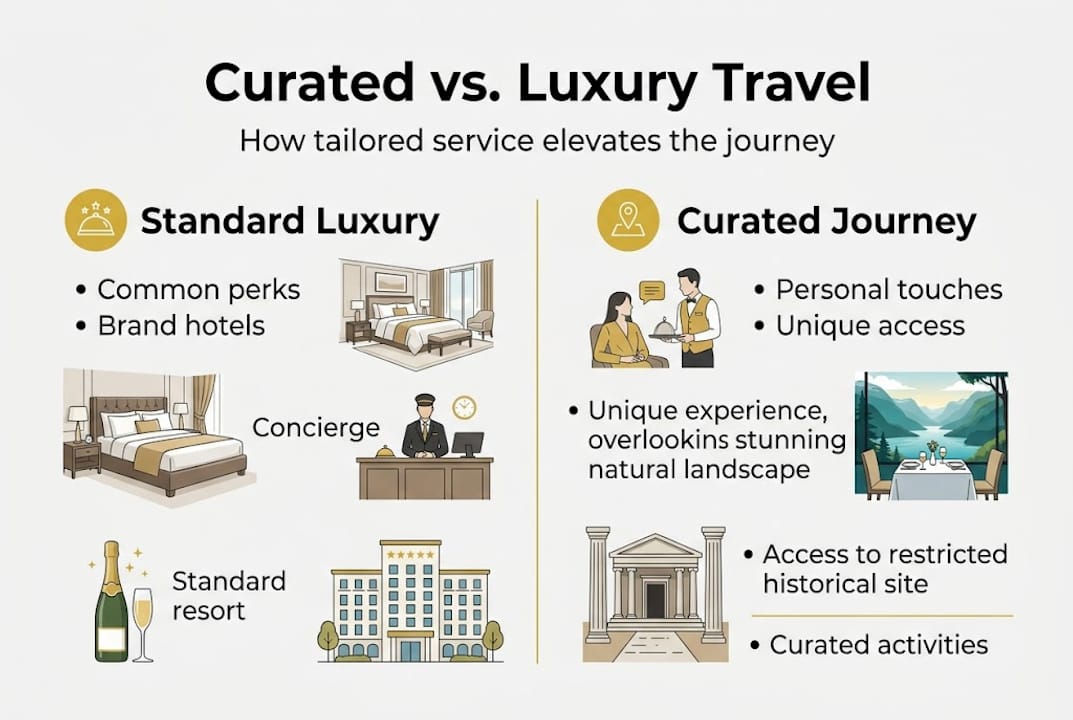
As ultra-luxury hospitality research shows, curation elevates travel from generic luxury, which is standardized, to ultra-luxury, which is individualized and transformative. Curation requires judgment, not just execution. That distinction matters enormously.
Here is what a genuinely curated journey includes:
- Personal discovery: A deep consultation process to understand your interests, travel history, and aspirations
- Thematic design: A unifying concept or story that ties the journey together meaningfully
- Selective access: Experiences that are not available through standard booking channels
- Seamless flow: Logistics handled invisibly so the traveler focuses entirely on the experience
- Ongoing refinement: Adjustments made in real time based on evolving preferences
“True curation is not about adding more. It is about choosing what belongs and removing everything that does not.”
Exploring luxury hotel curation reveals how this philosophy applies even to accommodation selection, where the right property is chosen not for its star rating but for how well it fits the traveler’s specific vision. You can also browse examples of curated journeys to see how these principles translate into real itineraries.
Key characteristics of curated luxury journeys
With the definition clear, it is time to see how these principles play out in the real world. Curated luxury journeys share a distinct set of characteristics that set them apart from even the most premium standard offerings.

According to luxury tourism research, high-net-worth travelers prioritize hyper-personalization, privacy, exclusivity, sustainability, and invisible luxury. Invisible luxury, in particular, is worth understanding. It refers to the seamless delivery of exceptional service without visible effort or intrusion. You never see the machinery. You only feel the result.
Here is a side-by-side comparison:
| Feature | Standard luxury travel | Curated luxury travel |
|---|---|---|
| Personalization | Preference-based upgrades | Identity-driven design |
| Access | Public premium experiences | Private, exclusive access |
| Planning | Template itineraries | Custom-built journeys |
| Service | Reactive | Anticipatory |
| Sustainability | Optional add-on | Integrated by design |
| Thematic concept | None | Central to the journey |
The contrast is stark. Standard luxury reacts to your requests. Curated luxury anticipates your desires before you voice them.
Some of the most valued features in curated travel include:
- Private access: Exclusive entry to cultural events, private estates, or closed collections
- Bespoke dining: Meals designed around dietary preferences, flavor profiles, and local ingredients
- Personalized themes: A journey built around a passion, such as architecture, culinary arts, or conservation
- Privacy by design: Accommodations and transport selected to minimize unwanted interaction
- Sustainability alignment: Experiences that reflect the traveler’s values around environmental responsibility
Pro Tip: When evaluating a travel offer, ask the provider to explain the theme of your proposed journey. If they cannot articulate one clearly, the experience is likely a premium package with a new label, not true curation.
For those ready to move forward, personalized itinerary planning offers a clear starting point, and understanding the itinerary customization process helps set the right expectations. Many travelers also find it useful to review the value of travel advisors before committing to a planning approach.
How expert curation transforms the experience
With the core attributes in mind, let us examine who delivers true curated travel and what their process looks like. The answer comes down to human expertise, long-standing relationships, and a genuine passion for the craft.
Top-tier providers such as Virtuoso, Abercrombie & Kent, and Black Tomato are often cited as benchmarks. What separates them from generic luxury travel companies is not their marketing. It is their network. As research on HNW travel companies confirms, expert providers use long-term relationships and local networks to deliver money-can’t-buy access that distinguishes true curation from generic bespoke claims.
What does that look like in practice? Consider these examples:
- A private dinner in a centuries-old palazzo arranged through a personal relationship with the owner, not a booking platform
- After-hours museum access secured through a curator’s professional connection, not a VIP ticket package
- A conservation expedition led by a scientist the travel advisor has worked with for years, not a packaged eco-tour
- A custom cultural immersion designed with input from local community leaders who trust the advisor personally
“The best travel curators do not search for experiences. They already know which ones are worth having.”
This is where technology in curated travel plays a supporting role rather than a leading one. AI tools can analyze preferences and surface options efficiently, but they cannot replicate the judgment that comes from years of trusted relationships. The human element remains irreplaceable.
Pro Tip: Before hiring a travel curator, ask them to describe a time they arranged something that was not available to the public. Their answer will tell you everything about the depth of their network and the authenticity of their curation.
Understanding trend forecasting for luxury travel also helps travelers recognize which providers are ahead of the curve, and exploring the itinerary management advantages reveals how expert-managed journeys reduce friction at every stage.
Curated travel in practice: Examples and what to look for
Equipped with an understanding of what curation should deliver, let us explore how this takes shape in practice and how you can identify genuine offers.
Consider two scenarios. First, a multi-generational family trip to Japan. A generic luxury version books five-star hotels in Tokyo and Kyoto, arranges a bullet train transfer, and includes a tea ceremony experience available to any tourist. A curated version designs the journey around the family’s shared love of architecture and food, secures a private session with a renowned ceramics artist, arranges a home-cooked kaiseki dinner with a local family, and builds in quiet time at a ryokan selected specifically for its accessibility for older family members.
Second, a couple seeking cultural immersion in Morocco. Standard luxury books a riad and a guided medina tour. Curated luxury arranges a private audience with a master weaver, a cooking lesson in a private home, and an overnight desert experience at a camp designed exclusively for two.
The difference is not the budget. It is the depth of understanding and the quality of the relationships behind the planning.
As industry analysis makes clear, the term “bespoke” is widely overused. Genuine curation requires client understanding, thematic concepts, and human expertise. Without those three elements, the label is just marketing.
Here is what to ask any provider before committing:
- What questions will you ask me before designing my itinerary?
- Can you describe the theme or concept behind the journey you have in mind?
- What experiences in this destination are only available through your relationships?
- How do you handle changes or unexpected situations during the trip?
- Can you share a specific example of something you arranged that could not be booked online?
Red flags to watch for include vague answers about personalization, a heavy reliance on pre-packaged itineraries, and the absence of a pre-trip consultation. You can explore bespoke itinerary planning examples to see what a thorough planning process looks like, and the curated travel experience list offers concrete inspiration across a range of destinations and travel styles.
Our perspective: Why authentic curation is the ultimate luxury
Here is an uncomfortable truth about the luxury travel industry: most of what is labeled “curated” is simply a premium package with a more expensive brochure. The word has been borrowed so frequently that it has lost much of its meaning in mainstream marketing.
True curation is rare. It requires a provider who genuinely understands you, not just your budget. It demands creative synthesis, not just logistics. And it depends on relationships built over years, not a database of vendor contacts.
At Grand Globetrotting, we believe the highest form of luxury is a journey that feels like it could only have been designed for you. That standard requires passion, not just professionalism. It requires curiosity about who you are, not just what you want to book.
Our advice: demand proof. Ask hard questions. If a provider cannot tell you the story of your journey before it begins, they are not curating. They are packaging. Staying informed about 2026 luxury experience trends also helps you recognize which providers are genuinely ahead of the curve and which are simply keeping up with the language.
Begin your curated travel journey
If authentic curation appeals to you, here is how to ensure your next journey is genuinely bespoke.
At Grand Globetrotting, we specialize in building travel experiences that reflect your individuality, not a template. Whether you are planning a honeymoon, a family adventure, or a solo cultural immersion, our advisory approach begins with understanding you deeply before a single booking is made. Our personalized luxury travel guide walks you through what to expect from a true curation process. You can also explore our step-by-step itinerary framework or discover what a bespoke travel experience truly looks like when designed with intention and expertise.
Frequently asked questions
How does curated travel differ from regular luxury travel?
Curated travel is built entirely around your individual identity, interests, and goals, while standard luxury delivers high-quality but broadly designed services. As ultra-luxury research shows, curation requires judgment and transformation, not just execution.
What are signs of a truly curated travel experience?
Look for thorough pre-trip consultations, a clear thematic concept for your journey, and access to private or exclusive experiences unavailable through standard booking. Expert HNW travel providers distinguish themselves through long-term local relationships that open genuinely rare doors.
Can technology replace the role of a human travel curator?
Technology supports the process efficiently, but it cannot replace the human judgment and relationship-driven access that define true curation. As industry analysis confirms, genuine curation requires thematic thinking and creative expertise that AI cannot replicate.
Why is curated travel popular with high-net-worth travelers?
High-net-worth travelers prioritize experiences that reflect their values and lifestyle rather than status symbols alone. Research on luxury tourism preferences highlights hyper-personalization, privacy, exclusivity, and invisible luxury as the defining draws for this audience.
Recommended
- Curated luxury experience list: bespoke journeys in 2026
- Hotels | Grand Globetrotting
- Personalized travel booking guide: luxury planning for bespoke journeys
- What is experiential travel? A luxury guide for 2026
- What is event curation? expert guide for luxury experiences 2026 – Winelands Function – For Every Occasion, Your Celebration
- Curated Yacht Experiences: Defining Luxury in Barcelona
At Grand Globetrotting, we don't just plan vacations; we craft extraordinary adventures that leave you with cherished memories. Let us bring your dream vacation to life, perfectly tailored to your style, and immerse yourself in a world of luxury, exploration, and unforgettable moments. Your journey begins with us.
Itinerary planning services require a separate charge outside of cost to book travel accommodations. Depending upon the complexity of the itinerary and the level of effort required to acquire unique experiences, cost may vary. Speak with our team to learn more.
Book your consultation