

TL;DR:
- Travel trend forecasting predicts traveler preferences well in advance using AI and behavioral data.
- Combining multiple data sources and advanced models achieves high accuracy, enabling proactive planning.
- Human expertise remains essential to navigate unpredictable events and personalize luxury experiences.
Travel trend forecasting is reshaping how the world’s most discerning travelers and their planners approach every journey. Rather than reacting to what’s already popular, sophisticated forecasting uses AI and behavioral data to predict future shifts in traveler preferences, behaviors, and market dynamics before they become mainstream. For high-net-worth individuals and the advisors who serve them, this intelligence is not a luxury—it’s a strategic necessity. This guide breaks down the core methods, data sources, and real-world applications that make travel trend forecasting an essential tool for designing truly bespoke, ahead-of-the-curve luxury experiences.
Table of Contents
- Defining travel trend forecasting: Beyond guesswork
- How travel trend forecasting works: Methodologies and metrics
- Big data sources fueling trend predictions
- Navigating volatility: The role of human expertise and anomaly detection
- Elevating luxury travel: Practical applications for forecasting insights
- Our take: Why high-touch intuition still matters alongside big data
- Design your next bespoke journey with future insights in mind
- Frequently asked questions
Key Takeaways
| Point | Details |
|---|---|
| Data-driven predictions | Luxury travel is shaped by AI-powered analysis of vast data, not guesswork. |
| Human–AI partnership | The best travel forecasting combines cutting-edge technology with expert judgment for resilient experiences. |
| Personalized designs | Accurate trend forecasts let you create truly bespoke journeys and seize emerging opportunities ahead of the curve. |
| Actionable for planners | Integrating forecasting into itinerary design delivers competitive advantages for both planners and luxury travelers. |
Defining travel trend forecasting: Beyond guesswork
Travel trend forecasting is not simply watching what went viral last season and booking more of the same. It is a disciplined, data-driven practice that blends data science, artificial intelligence, and deep human expertise to anticipate where traveler desire is heading—sometimes months or even years in advance. For luxury planners, this distinction is everything. Reacting to trends means competing for the same exclusive villas and overbooked experiences. Anticipating them means securing access before demand peaks.
Modern forecasting predicts far more than popular destinations. It maps evolving preferences—how guests want to feel, what experiences they crave, and what service expectations they carry. It tracks behavioral signals across millions of data points, from reservation patterns to social sharing, to build a living picture of traveler intent. Trend analysis in luxury travel has matured into a precise science, and the planners who embrace it gain a meaningful edge.
“Travel trend forecasting uses AI to analyze massive datasets such as reservations, online behavior, events, and more, turning raw signals into actionable predictions.”
The process typically follows four key steps:
- Data collection: Gathering inputs from bookings, searches, social sentiment, mobility data, and event calendars.
- Pattern analysis: Identifying recurring behaviors, seasonal shifts, and emerging preference clusters using AI models.
- Scenario planning: Building multiple forward-looking scenarios that account for market volatility, geopolitical shifts, and climate factors.
- Actionable recommendations: Translating forecast outputs into specific itinerary decisions, destination selections, and experience curation.
This structured approach transforms forecasting from abstract analysis into a practical tool that shapes every element of a luxury journey. It moves planning from intuition alone to intuition informed by precision, giving advisors the confidence to design experiences that feel ahead of their time.
How travel trend forecasting works: Methodologies and metrics
Now that you understand what forecasting is, let’s explore the innovative methods behind the predictions. The analytical engine powering modern travel forecasting is more sophisticated than most travelers realize. Core methodologies include time-series models such as SARIMA and Prophet for short-term demand prediction, machine learning approaches including gradient-boosted trees and transformer networks for medium- and long-range forecasting, and hybrid models that fuse multiple data signatures for maximum precision.
Time-series models excel at capturing seasonality and known cyclical patterns—ideal for predicting peak villa demand in Tuscany or high-season cruise routes in the Mediterranean. Machine learning models go further, integrating multi-source data in tourism forecasting to detect subtle behavioral shifts that traditional models miss entirely. Graph neural networks, for instance, can map how demand ripples across connected destinations when one market tightens.
| Method | Best use | Strength |
|---|---|---|
| SARIMA / Prophet | Short-term demand | Captures seasonality reliably |
| Gradient-boosted trees | Medium-term trends | Handles complex, non-linear signals |
| Transformer networks | Long-range forecasting | Learns from vast, diverse datasets |
| Hybrid models | All horizons | Combines precision and adaptability |
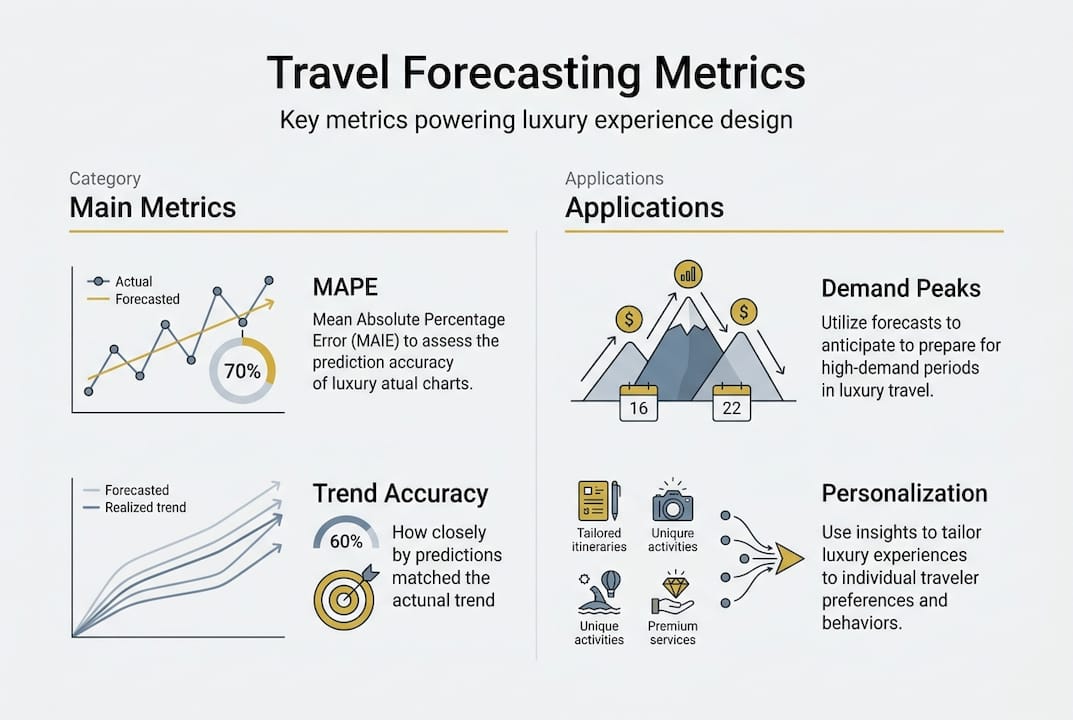
Stat to know: State-of-the-art machine learning models now achieve a MAPE as low as 6.3% and trend accuracy of 83.7% in urban tourism prediction—a level of reliability that makes these forecasts genuinely actionable for high-stakes itinerary decisions.
Accuracy is measured using metrics like Mean Absolute Percentage Error (MAPE), which quantifies how far predictions deviate from actual outcomes, and trend accuracy, which measures whether the model correctly identifies direction of change. Both matter for luxury planning, where a missed signal can mean losing access to a coveted property or arriving during an unexpectedly crowded season.
Understanding how technology in bespoke travel has evolved also reveals why these models now capture signals that earlier tools ignored—including the shifting tastes of younger ultra-high-net-worth travelers. The preferences of Gen Z and luxury travel audiences, for example, are already reshaping demand patterns that forecasting models are actively tracking.
Pro Tip: When evaluating a forecasting tool or advisory service, ask specifically about their MAPE scores and how often models are retrained with fresh data. Stale models produce stale predictions.
Big data sources fueling trend predictions
With methodology explained, let’s explore the rich data sources empowering accurate trend forecasts. The quality of any forecast is only as strong as the data feeding it. Modern travel forecasting draws from a remarkably wide range of sources, and the most powerful models integrate them all simultaneously to build holistic traveler profiles.
Data sources powering today’s best forecasts include:
- Transaction data: Booking volumes, cancellation rates, and reservation lead times across hotels, airlines, and cruise lines.
- Online behavior signals: Search query trends, destination page visits, and wish-list activity on travel platforms.
- Social sentiment: Hashtag momentum, influencer content patterns, and review sentiment across platforms like Instagram and TripAdvisor.
- Event calendars: Major cultural festivals, sporting events, art fairs, and fashion weeks that reliably drive luxury traveler movement.
- Weather and climate data: Seasonal patterns and anomaly alerts that shape optimal travel windows.
- Mobile signaling and OTA activity: Real-time mobility data and online travel agency click patterns that reveal intent before a booking is made.
| Data type | Signal it provides | Planning application |
|---|---|---|
| Booking transactions | Demand volume and timing | Secure reservations early |
| Social sentiment | Emerging destination buzz | Identify under-the-radar options |
| Event calendars | Predictable demand spikes | Design around or into events |
| Weather patterns | Optimal experience windows | Curate peak-condition itineraries |
Non-traditional data is where the real competitive advantage lives. Most planners track bookings. Fewer track real-time mobility signals that reveal where affluent travelers are actually moving before they formalize plans. Integrating weather pattern forecasts into itinerary curation, for example, allows a planner to position a Patagonian trekking experience during a statistically optimal weather window rather than a generic travel season.

Personalized travel planning at the highest level depends on this kind of layered data intelligence. It transforms planning from educated guesswork into anticipatory design.
Pro Tip: Social sentiment data often leads booking data by four to six weeks. Monitoring emerging destination conversations gives planners a meaningful head start on securing exclusive access before demand spikes.
Navigating volatility: The role of human expertise and anomaly detection
Underneath the surface, trend forecasting must handle unpredictability and rapid change. No model, however sophisticated, operates in a stable world. Geopolitical tensions, health events, climate disruptions, and sudden economic shifts can alter traveler flows dramatically and quickly. This is where human expertise becomes irreplaceable alongside the data.
Global tourism volatility remains a defining challenge for planners in 2026. Markets that appeared stable can shift within weeks. The Asia-Pacific resurgence in luxury travel, for instance, has created new demand corridors that models trained on pre-2020 data initially underestimated. Adaptive forecasting, updated continuously with fresh signals, is the only reliable response.
Hybrid approaches address this by combining machine precision with human judgment:
- Anomaly detection algorithms flag unusual demand spikes or drops for immediate human review.
- Scenario modeling prepares planners with contingency itineraries before disruptions materialize.
- Expert overlay allows seasoned advisors to adjust model outputs based on on-the-ground intelligence that data alone cannot capture.
- Continuous retraining keeps models current with the latest behavioral signals rather than relying on historical patterns alone.
“Edge cases with volatility require hybrid human-AI approaches and anomaly detection for interpretability—ensuring forecasts remain trustworthy even in turbulent conditions.”
For ultra-luxury itinerary design, this hybrid approach is not optional. A private expedition to a remote destination requires confidence that access, logistics, and safety conditions align. Executive travel itineraries built on volatile assumptions fail at the worst moments. A customized itinerary process that integrates both AI forecasts and expert human review creates the resilience that discerning travelers expect.
Elevating luxury travel: Practical applications for forecasting insights
With volatility accounted for, let’s turn to how these insights tangibly elevate luxury travel. Trend forecasting is not an abstract exercise—it produces specific, actionable intelligence that shapes every layer of a bespoke journey. Forecasting guides strategy for luxury planners to design personalized experiences that feel both timely and exclusive.
Here is how the best planners put forecasting to work:
- Identify peak demand windows: Forecasts reveal when a destination will be at its most sought-after, allowing planners to either position clients for the height of the experience or route them to equally stunning alternatives during quieter periods.
- Uncover under-the-radar destinations: Emerging destination signals appear in forecasting data before they reach mainstream travel media, giving ultra-high-net-worth travelers first access to genuinely undiscovered experiences.
- Secure exclusive reservations proactively: Knowing that demand for a specific property or experience is set to rise allows planners to lock in access months ahead, before availability tightens.
- Design around world events: Major cultural moments—art biennials, culinary festivals, private sporting events—can be woven into itineraries with precision when planners know their timing and traveler impact in advance.
- Monitor for real-time shifts: Forecasting is not a one-time exercise. Continuous monitoring allows itineraries to flex gracefully when conditions change, preserving the quality of the experience.
The result is travel that feels effortless to the guest but is the product of meticulous, intelligence-driven planning. Personalizing luxury travel at this level requires both the right data and the expertise to interpret it meaningfully. Strong itinerary management in luxury travel ensures that forecasting insights translate into seamless, on-the-ground execution.
Pro Tip: Build a 90-day rolling forecast review into your planning cycle. Trends that look stable at six months can shift meaningfully at 90 days, and early visibility protects both access and pricing.
Our take: Why high-touch intuition still matters alongside big data
Data and AI have genuinely transformed what’s possible in luxury travel planning. The forecasting tools available today would have seemed extraordinary a decade ago, and their accuracy continues to improve. But here is what the data cannot tell you: how a specific client feels the morning their itinerary begins, or why a particular destination will resonate with them on a level that no algorithm has yet modeled.
The most memorable journeys we have seen designed for discerning travelers share a common thread. They are informed by exceptional data intelligence, but shaped by a trusted advisor who knows the client well enough to interpret that data through a deeply personal lens. Cultural nuance, last-minute whims, and the subtle art of anticipating an unspoken preference—these remain human skills. The future of luxury travel planning is genuinely hybrid: technology sets the stage, and human connection delivers the magic.
Design your next bespoke journey with future insights in mind
Travel trend forecasting gives you a powerful lens for seeing where luxury travel is heading before the rest of the world catches on. Turning those insights into a flawlessly executed journey, however, requires more than data—it requires expertise, relationships, and a deeply personalized approach.
At Grand Globetrotting, bespoke travel planning integrates the latest trend intelligence with exclusive vendor connections and a high-touch concierge approach. Whether you are designing a private expedition, a multi-destination cultural journey, or an intimate retreat, our customized itinerary creation process ensures every detail reflects both emerging opportunity and your personal vision. Explore our luxury travel guide to see how forecasting-informed planning can elevate your next remarkable experience.
Frequently asked questions
What makes travel trend forecasting essential for luxury travel planners?
Travel trend forecasting enables luxury planners to anticipate guest preferences and design unique, timely experiences rather than simply react to demand. It shifts planning from reactive to anticipatory, which is where true exclusivity is created.
What types of data are used to forecast travel trends?
Forecasting draws on booking data, online searches, event calendars, social sentiment, weather trends, and mobility signals to build a complete picture of traveler intent. The most accurate models integrate all of these sources simultaneously.
How accurate are AI-powered travel trend forecasts?
State-of-the-art models can achieve a MAPE of 6.3% and trend accuracy above 80% in urban tourism predictions, making them reliable enough for high-stakes luxury planning decisions.
How do unpredictable events like geopolitics affect travel forecasting?
Expert human input and anomaly detection models help adjust forecasts rapidly for shocks like geopolitical shifts, pandemics, or climate events, keeping itineraries resilient and guest-ready.
How can high-net-worth travelers benefit from trend forecasting in their journeys?
By using forecasting insights, luxury travelers can access under-the-radar experiences, secure exclusive reservations ahead of demand peaks, and avoid overcrowded periods entirely.
Recommended
At Grand Globetrotting, we don't just plan vacations; we craft extraordinary adventures that leave you with cherished memories. Let us bring your dream vacation to life, perfectly tailored to your style, and immerse yourself in a world of luxury, exploration, and unforgettable moments. Your journey begins with us.
Itinerary planning services require a separate charge outside of cost to book travel accommodations. Depending upon the complexity of the itinerary and the level of effort required to acquire unique experiences, cost may vary. Speak with our team to learn more.
Book your consultation