

TL;DR:
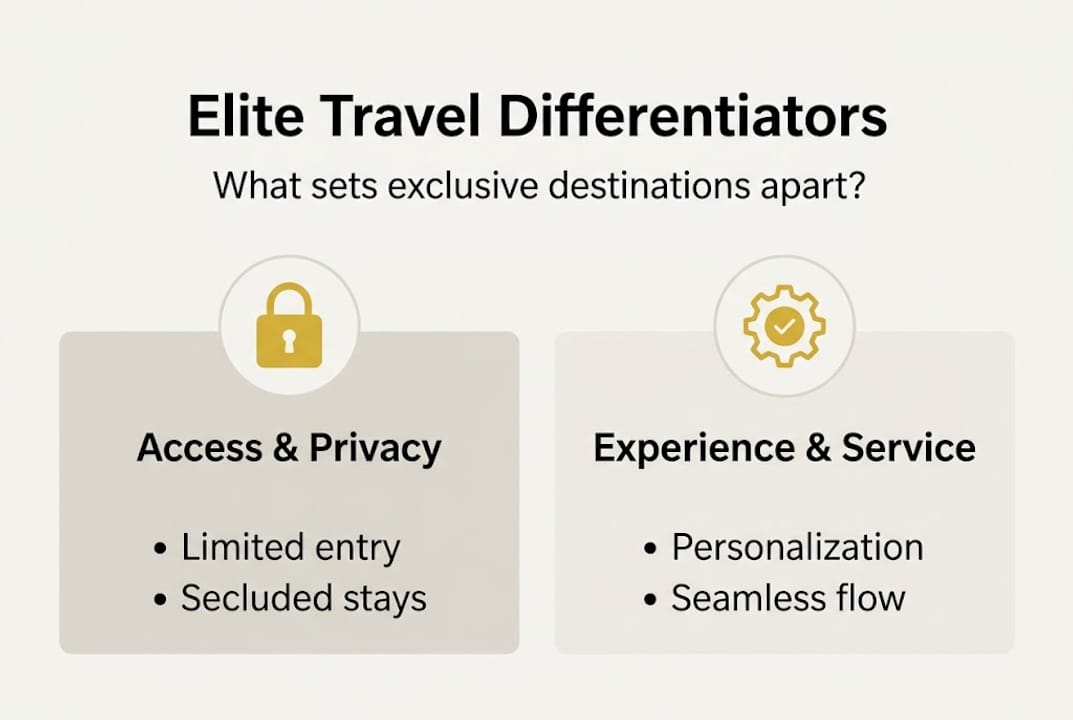
- True exclusivity relies on limited access, privacy, personalization, and authentic experience.
- Emotional connection and sense of place are more important than just cost or luxury amenities.
- Seamless, personalized service with genuine human interaction creates lasting elite travel impressions.
Most people assume that booking the most expensive suite automatically means the most exclusive experience. That assumption misses the point entirely. True exclusivity in travel is shaped by far more nuanced forces: limited access, genuine privacy, anticipatory service, and a deep sense of place. Privacy requests are up 45% among luxury travelers, signaling a clear shift away from conspicuous spending toward meaningful, personal experiences. This guide breaks down the real criteria that define elite destinations, so you can recognize and seek out the travel experiences that will genuinely set your journeys apart.
Table of Contents
- Limited access: The foundation of true exclusivity
- Privacy and seclusion: The essential luxury
- Personalization and anticipatory service: Crafting the guest experience
- Authenticity and sense of place: Beyond luxury’s surface
- All-inclusive seamlessness: The invisible thread of elite travel
- Why emotional exclusivity matters more than cost
- Experience the highest standard in exclusive travel planning
- Frequently asked questions
Key Takeaways
| Point | Details |
|---|---|
| Exclusivity starts with access | Restricted entry, remote locales, and buyouts make destinations truly elite beyond mere price. |
| Privacy is non-negotiable | Seclusion and control over your environment are the strongest draws for high-net-worth travelers. |
| Personalization defines the experience | Dedicated staff and custom itineraries transform a trip into a memorable, exclusive journey. |
| Authenticity matters most | Destinations that reflect local culture and sustainability trends elevate exclusivity beyond surface-level luxury. |
| Seamlessness seals the deal | Invisible, anticipatory service and all-inclusive offerings set the standard for elite travel. |
Limited access: The foundation of true exclusivity
When a destination is hard to reach, it immediately signals something worth protecting. Physical and logistical barriers are not inconveniences for the discerning traveler. They are part of the appeal. Exclusive access travel operates on a simple principle: scarcity creates desire, and controlled entry creates privilege.
Consider the benchmarks. North Island has just 11 villas, Soneva Secret offers helicopter-only remote access, and Bhutan enforces daily visitor fees to limit tourist volume. Each of these destinations uses access control as a deliberate design choice, not a side effect of geography. Antarctica takes this even further, with treaty-controlled visitor caps that restrict the number of travelers allowed on the continent at any given time.
Here is a quick comparison of how different access models shape the experience:
| Destination | Access model | Capacity control |
|---|---|---|
| North Island, Seychelles | Villa-only, private charter | 11 villas maximum |
| Soneva Secret, Maldives | Helicopter or seaplane only | Limited overwater villas |
| Bhutan | Government-regulated daily fee | High-value, low-volume policy |
| Antarctica | Treaty-governed expedition | Strict seasonal visitor caps |
Access restrictions do something powerful beyond limiting crowds. They build anticipation. Knowing that very few people will share your experience creates a psychological sense of privilege that no five-star hotel in a busy city can replicate. The journey itself becomes part of the story.
Key reasons why limited access defines exclusivity:
- Remote locations require effort, which filters out casual tourists naturally
- Villa buyouts ensure that your group is the only group, period
- Entry caps protect the environment and preserve the destination’s character
- Permit systems signal that the destination values quality of experience over revenue volume
Working with experienced travel advisors is often the only reliable way to secure access to these places, especially during peak windows.
Pro Tip: Quiet exclusivity often means sacrificing mainstream amenities for peace and scarcity. If a destination has a gift shop and a shuttle bus, it probably isn’t exclusive.
Privacy and seclusion: The essential luxury
Limited access sets the stage. Privacy is what plays out on it. For high-net-worth travelers, privacy is not a bonus feature. It is a non-negotiable baseline.

Privacy ranks as the number two ultraluxe experience sought by elite travelers, and 76% of them deliberately choose shoulder or off-peak seasons specifically for this reason. That statistic speaks volumes about what truly motivates luxury travel decisions at the highest level.
The most sought-after privacy benchmarks include:
- Private island resorts where no day-trippers or outside guests are permitted
- Full estate buyouts for families or groups who want complete control of their environment
- Secluded atolls accessible only by private transfer, with no shared beach or pool spaces
- Off-peak scheduling that ensures fewer guests, more attentive staff ratios, and a quieter atmosphere
“The real luxury of privacy is not just the absence of strangers. It is the presence of total comfort, where you can exist without performance or pretense.”
Privacy also carries an emotional dimension that goes beyond logistics. There is a distinct feeling that comes with staying somewhere that most people will never experience, or even know about. That sense of being in the know, of belonging to an informal inner circle of travelers who have discovered something rare, is deeply compelling. Ultra-luxury travel trends consistently show that this emotional layer drives repeat bookings and fierce loyalty.
Exploring privacy-focused hotel options is a practical first step toward identifying properties that genuinely prioritize seclusion as a design principle rather than a marketing claim. And for a broader framework, high-end travel insights can help you distinguish between destinations that perform exclusivity and those that actually deliver it.
Personalization and anticipatory service: Crafting the guest experience
Privacy creates the right environment. Personalization fills it with meaning. The difference between a very good hotel and a truly exclusive destination often comes down to one thing: whether the staff knows what you need before you ask.
Anticipatory service means that preferences, habits, and desires are tracked, remembered, and acted upon without prompting. It is the chef who already knows you prefer your eggs poached. It is the turndown service that places your preferred reading material on the nightstand. At Soneva, one chef is assigned per villa, and Forbes Five-Star ratings weight personalized service at 70 to 75% of their overall score. That weighting tells you everything about what separates elite from merely excellent.
Here is how human personalization compares to AI-enabled standardization:
| Approach | Strength | Limitation |
|---|---|---|
| Human anticipatory service | Emotionally intelligent, adaptive | Requires training and empowerment |
| AI-driven preference tracking | Consistent, scalable | Can feel clinical or impersonal |
| Hybrid model | Combines data with human warmth | Requires thoughtful implementation |
The most exclusive destinations use technology as a support tool, not a replacement for genuine human connection. Here is what real personalization looks like in practice:
- Staff-to-guest ratios that allow for individual attention rather than divided focus
- Pre-arrival preference questionnaires that go well beyond dietary restrictions
- Dedicated villa hosts or butlers who remain consistent throughout your stay
- Customized excursions designed around your specific interests, not a generic menu of activities
Pro Tip: The best exclusivity hinges on staff empowerment, not just algorithms. Ask any property how much autonomy their team has to make decisions on the spot. The answer reveals a great deal.
If you want to understand how to build this level of care into your own travel plans, the personalized travel booking guide and the customized itinerary process are excellent starting points. You can also explore practical approaches to personalizing luxury travel for your specific travel style.
Authenticity and sense of place: Beyond luxury’s surface
There is a version of luxury that feels the same everywhere. The same marble lobby, the same international menu, the same curated playlist in the spa. That kind of luxury is comfortable, but it is not exclusive. True exclusivity is rooted in place.
Forbes calls authenticity the new luxury standard, and Virtuoso identifies cultural immersion as one of the top trends shaping elite travel today. Destinations that integrate local heritage, regional cuisine, and active conservation efforts into the guest experience create memories that manufactured environments simply cannot.
What authentic exclusivity looks like in practice:
- Local artisan experiences that connect guests with the cultural fabric of the destination
- Conservation-led properties where your stay actively supports environmental protection
- Regional cuisine programs that go beyond sourcing local ingredients to telling the story behind them
- Community partnerships that allow guests to engage meaningfully with local populations
Antarctica is a compelling case study. Its exclusivity is inseparable from its fragility. The knowledge that climate change is altering this landscape creates a sense of urgency that adds emotional weight to every visit. You are not just traveling somewhere remote. You are witnessing something irreplaceable.
The opposite of authentic exclusivity is what industry insiders call the canned experience: a packaged interaction with local culture that has been sanitized for tourist consumption. Elite travelers recognize this immediately, and it erodes trust in a destination faster than almost anything else.
When selecting a luxury hotel, look for properties that can articulate a genuine connection to their environment. Ask about their conservation commitments, their local hiring practices, and how their programming reflects the region’s actual culture. A full luxury tourism overview reinforces why these elements now define the upper tier of travel.
All-inclusive seamlessness: The invisible thread of elite travel
The most exclusive travel experiences share one defining quality: nothing feels like effort. Every transfer is arranged, every preference anticipated, every detail handled before it becomes a concern. This seamlessness is the invisible thread that ties everything together.
All-inclusive is the number one ultraluxe experience according to Virtuoso research, and Forbes Five-Star criteria span more than 900 service and facility benchmarks. The majority of that score, roughly 70%, focuses on service quality rather than physical facilities. That balance reflects what elite travelers actually value.
Here is how seamless service compares to transactional travel:
| Experience type | Guest effort required | Emotional outcome |
|---|---|---|
| Seamless all-inclusive | Minimal, frictionless | Relaxed, present, immersed |
| Piece-meal planning | High, ongoing | Distracted, transactional |
| Partially managed trips | Moderate | Inconsistent satisfaction |
The hidden markers of true seamlessness include:
- Transfers that are waiting for you, never the other way around
- Guides who are genuine experts, not generalists reading from a script
- Dining reservations secured before you even think to ask
- A single point of contact who knows your entire trip inside and out
When travel is truly seamless, you stop thinking about logistics entirely. That mental freedom is, in many ways, the most valuable luxury of all. Exploring bespoke itinerary planning is one of the most effective ways to achieve this level of frictionless experience.
Why emotional exclusivity matters more than cost
Here is the uncomfortable truth that even seasoned luxury travelers sometimes miss: the most expensive trip is not always the most exclusive one. Emotional insider status matters more than visible price tags, and quiet luxury consistently outperforms flash in terms of lasting satisfaction.
What you remember years later is never the thread count or the champagne brand. It is the guide who knew your name on day one. The chef who adapted an entire menu around a conversation you had at breakfast. The moment you realized you were the only person standing on that particular stretch of coastline.
Standardized luxury, no matter how polished, loses meaning over time. The destinations and experiences that stay with you are the ones that felt singular, even imperfect in small, human ways. A rainstorm that forced an impromptu dinner on a covered terrace. A local market visit that was not on the itinerary but became the highlight of the trip.
Pro Tip: Seek destinations and planners who focus as much on emotional cues and storytelling as on amenities and price points. The feeling of defining exclusive access is ultimately what you are paying for.
Experience the highest standard in exclusive travel planning
Understanding what defines an exclusive destination is the first step. Translating that knowledge into a real journey is where Grand Globetrotting excels.
With deep industry connections, a personalized concierge approach, and a genuine passion for elite travel, Grand Globetrotting builds experiences that meet every criterion covered in this guide. Whether you are planning a private island escape or a conservation-led expedition, the personalized luxury travel planning guide is the ideal starting point. From there, the step-by-step luxury itinerary builder and personalized luxury journeys resources give you everything you need to move from inspiration to reservation with confidence.
Frequently asked questions
Is exclusivity in travel only about spending more?
No. True exclusivity is shaped by privacy, limited access, personalization, and emotional resonance. Price is a factor, but it is not the defining one.
Which destinations are considered most exclusive today?
Destinations like North Island, Soneva Secret, Bhutan, and Antarctica are considered truly exclusive for their strict access controls, limited capacity, and deeply private environments.
How does personalization impact the feeling of exclusivity?
Hyper-personalized service, with dedicated staff and anticipatory attention, creates a sense of insider status and belonging that no standard hotel experience can replicate.
Does authenticity matter at the highest luxury level?
Absolutely. Authenticity and sense of place are now top priorities for elite travelers, with destinations that offer genuine cultural immersion consistently rated as more valuable and memorable.
Recommended
- What is exclusive access travel: Your luxury guide
- Discover What High-End Travel Means for Luxury Seekers
- Personalized luxury travel: the ultimate planning guide
- Top luxury excursion ideas for discerning travelers 2026
- Exclusive Amenities in Limo Tours: Elevate Las Vegas Celebrations | MyVegasLimoTour
At Grand Globetrotting, we don't just plan vacations; we craft extraordinary adventures that leave you with cherished memories. Let us bring your dream vacation to life, perfectly tailored to your style, and immerse yourself in a world of luxury, exploration, and unforgettable moments. Your journey begins with us.
Itinerary planning services require a separate charge outside of cost to book travel accommodations. Depending upon the complexity of the itinerary and the level of effort required to acquire unique experiences, cost may vary. Speak with our team to learn more.
Book your consultation