

TL;DR:
- AI significantly reduces luxury trip planning time while enhancing personalization through integrated data.
- Hybrid models combining AI and human expertise provide the best balance of efficiency and emotional nuance.
- Limitations include AI’s bias toward popular destinations and the need for careful data privacy management.
Luxury travel has always been defined by two things: knowing exactly what you want and having the right people to deliver it. But the planning process itself has historically been slow, fragmented, and heavily dependent on who you knew. That is changing fast. AI-based tools now reduce trip planning time by 65 to 70 percent, challenging the long-held assumption that only seasoned human experts can curate a truly bespoke journey. This article walks through the technology powering next-gen travel planning, how the best hybrid models work, where the limitations lie, and how high-net-worth travelers can put all of it to use.
Table of Contents
- What is next-gen travel planning?
- The role of AI and emerging tech in luxury trip design
- Human expertise meets technology: The hybrid concierge model
- Limitations, challenges, and how to navigate them
- Why true luxury travel will always be hybrid-driven
- Transform your next journey with bespoke, next-gen planning
- Frequently asked questions
Key Takeaways
| Point | Details |
|---|---|
| AI redefines personalization | Generative and predictive AI deliver highly tailored luxury trip designs in less time. |
| Hybrid model is essential | The best results blend human expertise with technology for emotional and logistical excellence. |
| Awareness of limitations | Knowing privacy risks and AI bias helps travelers make informed decisions. |
| Application drives results | Using next-gen planning allows high-net-worth individuals to unlock unique, effortless journeys. |
What is next-gen travel planning?
Next-gen travel planning is not simply booking flights online or using a chatbot to find hotel suggestions. It represents a fundamental shift in how luxury itineraries are built, managed, and personalized at scale. At its core, it rests on four interconnected pillars that work together to deliver a seamless, tailored experience.
The mechanics of next-gen planning include generative AI that builds complete itineraries from a simple prompt, agentic AI that handles actual bookings and scheduling without manual input, predictive analytics that surface preferences before you even articulate them, and unified traveler profiles that pull data from across previously siloed sources. When these four elements work in concert, the result is a planning experience that feels almost effortlessly personal.
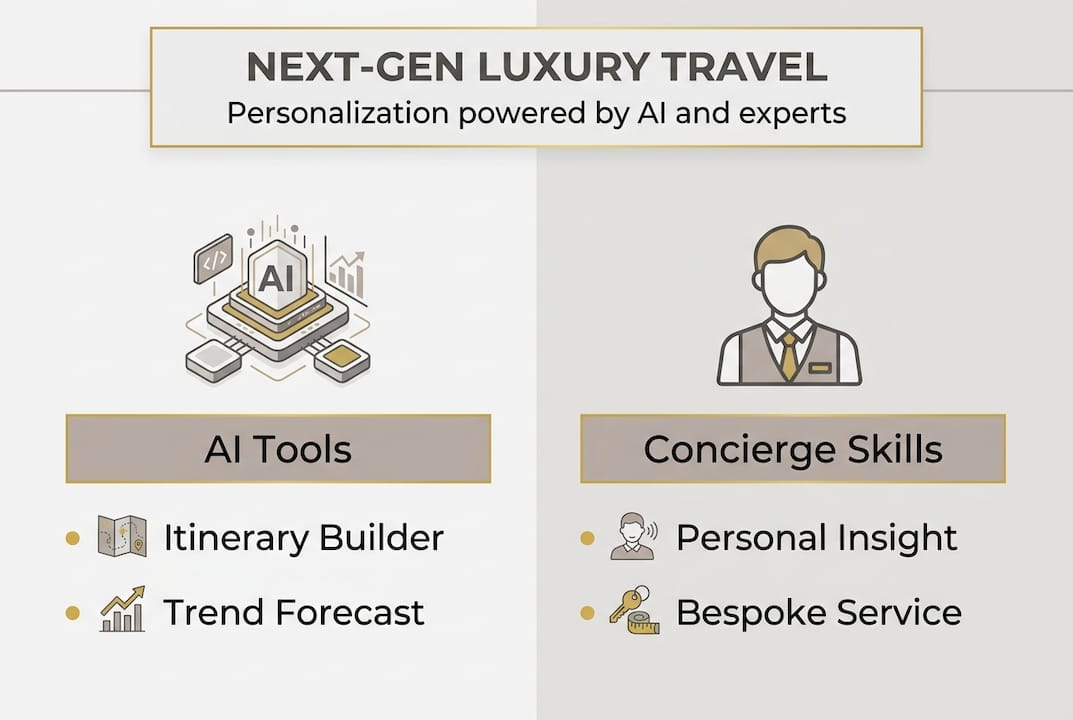
What separates next-gen planning from legacy approaches is seamless integration. Traditional planning required a traveler to communicate preferences repeatedly, often to multiple vendors. Next-gen systems remember everything, cross-reference it, and apply it forward. The way technology transforms luxury travel is not about replacing the human touch, but about making every touchpoint smarter and more informed.
Key capabilities of next-gen travel planning platforms include:
- Generative AI itinerary building from natural language prompts
- Agentic AI that executes bookings, reservations, and schedule changes autonomously
- Predictive analytics that anticipate preferences based on past behavior and profile data
- Unified traveler profiles that consolidate preferences, dietary needs, past destinations, and loyalty data into a single, continuously updated record
This is also where travel trend forecasting becomes a practical tool rather than a marketing buzzword. Platforms can identify emerging destinations and experiences before they become crowded, giving discerning travelers first-mover access.
Pro Tip: When evaluating any travel planning platform, ask directly how they use your personal data to refine recommendations. Platforms that build a richer profile over time will consistently outperform those that treat every interaction as a fresh start.
The role of AI and emerging tech in luxury trip design
The numbers behind AI adoption in luxury travel are striking. 62 percent of Millennials and Gen Z already use AI chatbots for travel research, and the luxury concierge market is projected to reach $1.2 billion by 2032. Perhaps most compelling for high-end operators: AI-assisted platforms drive a 20 percent increase in repeat bookings, a metric that speaks directly to client satisfaction.

To understand the practical shift, consider how the planning workflow has changed:
| Planning criteria | Traditional approach | Next-gen approach |
|---|---|---|
| Personalization | Relies on advisor memory and notes | AI builds and updates a live traveler profile |
| Time to itinerary | Days to weeks | Hours or less |
| Preference prediction | Reactive, based on stated requests | Proactive, based on behavioral data |
| Repeat business | Driven by relationship loyalty | Reinforced by data-informed recommendations |
| Complex multi-leg trips | Heavy manual coordination | Agentic AI handles logistics automatically |
An AI-optimized luxury trip workflow typically follows these steps:
- Profile intake: The traveler completes a detailed preference profile, including past destinations, suite preferences, dietary needs, and activity styles.
- Prompt-based itinerary generation: A generative AI system drafts an itinerary based on the profile and the traveler’s stated goals.
- Advisor review: A human expert reviews the draft for emotional coherence, cultural sensitivity, and exclusive access opportunities.
- Autonomous booking: Agentic AI executes confirmed reservations, from luxury hotel options to private transfers, in real time.
- Continuous refinement: Post-trip feedback updates the traveler profile, improving every future recommendation.
“The most powerful outcome of AI in luxury travel is not speed. It is the ability to learn what a traveler values and apply that understanding before they even ask.”
Effective itinerary management for luxury travel now depends on these systems working together rather than in isolation. The travelers who benefit most are those willing to share detailed preferences upfront, because richer data inputs lead to significantly better outputs.
Human expertise meets technology: The hybrid concierge model
33 percent of travelers now use generative AI for initial research, but among luxury clients, the preference is clear: AI structures logistics and discovery, while human advisors validate the emotional flow and authenticity of the experience. This is the hybrid concierge model, and it is widely regarded as the gold standard for high-end travel.
| Model | Strengths | Limitations |
|---|---|---|
| All-AI planning | Fast, scalable, data-rich | Lacks emotional nuance, misses cultural subtleties |
| All-human planning | Deep relationship, creative, emotionally attuned | Slower, dependent on individual expertise and availability |
| Hybrid model | Combines speed and personalization with human validation | Requires intentional integration between tools and advisors |
What human advisors bring to the equation cannot be replicated by any algorithm, at least not yet. Key contributions include:
- Emotional resonance: Understanding when a client needs privacy versus social immersion, or adventure versus pure relaxation
- Complexity handling: Managing last-minute changes, bespoke requests, and multi-party coordination across time zones
- Personal touch: Remembering the details that matter, such as a preferred wine region or a dislike of open-plan suites
- Vendor relationships: Securing access that is simply not available through any booking platform
For expert travel guidance to work at its best, the advisor needs to be supported by the right data. A well-designed hybrid system gives the human expert a complete picture of the client before the first conversation even begins.
Pro Tip: When choosing between planning services, ask whether your advisor has access to your full traveler profile in real time. If the data and the human are working separately, you are not getting the full benefit of the hybrid model. A travel concierge guide can help clarify exactly what to look for.
Limitations, challenges, and how to navigate them
Next-gen planning tools are powerful, but they are not without real constraints. Understanding where they fall short is essential for anyone making significant travel investments.
The most commonly cited limitation is that AI tends to bias toward popular destinations, lacking the nuance required for complex multi-country itineraries or yacht-based journeys. Algorithms are trained on existing data, and that data skews toward the well-documented and frequently booked. Truly off-grid or ultra-exclusive experiences are often underrepresented.
“For a multi-country trip requiring yacht positioning, bespoke shore excursions, and diplomatic-level privacy, no AI tool today can replicate the judgment of an experienced luxury advisor who has made that journey personally.”
Privacy is the other major concern. Unified traveler profiles are only valuable if the data feeding them is secure and handled responsibly. For high-net-worth individuals, the stakes are particularly high. Sensitive schedule information, travel companions, and financial preferences are part of a luxury traveler’s profile, and that data requires rigorous protection.
Practical strategies to navigate these limitations include:
- Vet your platforms carefully: Ask for clear documentation on data encryption, storage policies, and third-party data sharing before committing to any tool
- Integrate advisors explicitly: Do not rely on AI alone for trips involving multiple countries, charters, or highly sensitive logistics
- Audit your profile data regularly: Review what information is stored and remove anything that feels unnecessary or overly exposed
- Request transparency on recommendation logic: Understand whether your itinerary is AI-generated, advisor-curated, or a combination of both
- Separate planning from booking data: Where possible, use platforms that keep your preference profile distinct from your financial transaction data
A well-designed customized travel itinerary process will address these concerns proactively, giving you full visibility into how your information is used at every stage.
Why true luxury travel will always be hybrid-driven
There is a temptation in the industry to frame this as a contest between technology and human expertise. It is not. The most thoughtful observation here is that the travelers who try to go fully digital miss something critical, and those who dismiss technology entirely leave real efficiency and personalization on the table.
Adoption of AI tools is rising among younger high-net-worth individuals, but trust issues persist. That trust gap is not closed by better algorithms alone. It is closed by transparent, advisor-backed models where clients understand exactly how their profile is used and who is ultimately accountable for the experience.
Luxury travelers do not want to feel like they are being processed by a system. They want to feel known. Technology can build the architecture of that knowledge, but a skilled advisor gives it meaning. The future of luxury travel planning belongs to services that treat AI as a powerful tool in expert hands, not as a replacement for judgment, empathy, and genuine human connection. Elevating luxury travel with technology works best when the human element remains firmly at the center.
Transform your next journey with bespoke, next-gen planning
At Grand Globetrotting, we combine the precision of advanced technology with the warmth of genuine concierge expertise to plan journeys that feel exactly right, whether you are planning a honeymoon, a multi-generational family escape, or a solo adventure across continents.
Explore our ultimate luxury travel planning guide to see how a fully personalized approach comes together, or dive into our step-by-step luxury itinerary builder for your next destination. Families planning a high-end getaway will find everything they need in our dedicated luxury family trip planning resource. Reach out today to start a conversation about what your ideal journey looks like.
Frequently asked questions
How does next-gen travel planning differ from traditional travel agencies?
Next-gen travel planning blends AI-driven technology with human expertise to deliver faster, more tailored luxury experiences than traditional, manual methods. Traditional agencies rely on static notes and individual advisor memory, while next-gen platforms build living traveler profiles that improve with every interaction.
Is my data safe when using AI-powered travel planners?
Privacy is a genuine concern, and reputable platforms address it directly. Travelers should ask specifically how data is encrypted, who has access to it, and whether it is ever shared with third parties, since privacy and data concerns remain one of the primary barriers to wider adoption.
Can next-gen travel planning handle special requests and complex trips?
AI handles logistics and initial discovery exceptionally well, but human advisors are essential for nuanced, multi-country, or highly personalized journeys where emotional context and exclusive relationships matter most.
What types of luxury travelers benefit most from next-gen planning?
Honeymooners, families, and multi-destination travelers seeking deep personalization benefit most. The hybrid advisor model is particularly effective for clients who have complex preferences and high expectations for both logistics and emotional experience.
Recommended
At Grand Globetrotting, we don't just plan vacations; we craft extraordinary adventures that leave you with cherished memories. Let us bring your dream vacation to life, perfectly tailored to your style, and immerse yourself in a world of luxury, exploration, and unforgettable moments. Your journey begins with us.
Itinerary planning services require a separate charge outside of cost to book travel accommodations. Depending upon the complexity of the itinerary and the level of effort required to acquire unique experiences, cost may vary. Speak with our team to learn more.
Book your consultation