
TL;DR:
- High-end cruises emphasize exclusivity, personalized service, and intimate accommodations over size and opulence.
- They offer spacious suites, personalized butler service, gourmet dining, and curated shore excursions.
- All-inclusive packages typically cover dining, premium beverages, gratuities, and exclusive experiences, with some costs extra.
What Is a High-End Cruise? Ultimate Guide to Luxury Voyages
Many travelers still picture a high-end cruise as a larger, shinier version of a mainstream vacation at sea. That assumption sells these extraordinary experiences far short. High-end cruises are architecturally designed around exclusivity, intimacy, and personalization in ways that mass-market ships simply cannot replicate. From the moment you step aboard, the crew-to-guest ratio, the suite dimensions, and the caliber of every ingredient on your plate signals something different entirely. This guide walks you through what genuinely separates a luxury voyage from an ordinary one, covering accommodations, personalized service, destination access, and the true value of all-inclusive pricing.
Table of Contents
- Defining high-end cruises: More than just a voyage
- Signature accommodations and personalized service
- Curated itineraries and exclusive destination access
- All-inclusive value: What’s really included on a high-end cruise
- A fresh perspective: True luxury is personal, not just opulent
- Your next step: Curate the ultimate high-end cruise experience
- Frequently asked questions
Key Takeaways
| Point | Details |
|---|---|
| Top luxury lines | Regent, Seabourn, Silversea, and Viking lead the industry in service and unique itineraries. |
| Personalization is paramount | High-end cruises offer tailored experiences, private itineraries, and attentive service. |
| Value of all-inclusive | Luxury pricing includes most onboard amenities, curated excursions, and indulgent dining. |
| Beyond opulence | The true luxury lies in smaller crowds, exclusive access, and guest-driven customization. |
Defining high-end cruises: More than just a voyage
High-end cruises are not simply expensive versions of mainstream sailings. They operate on a fundamentally different philosophy, one built around fewer guests, more attentive staff, and experiences that feel curated for you specifically rather than engineered for the broadest possible audience.
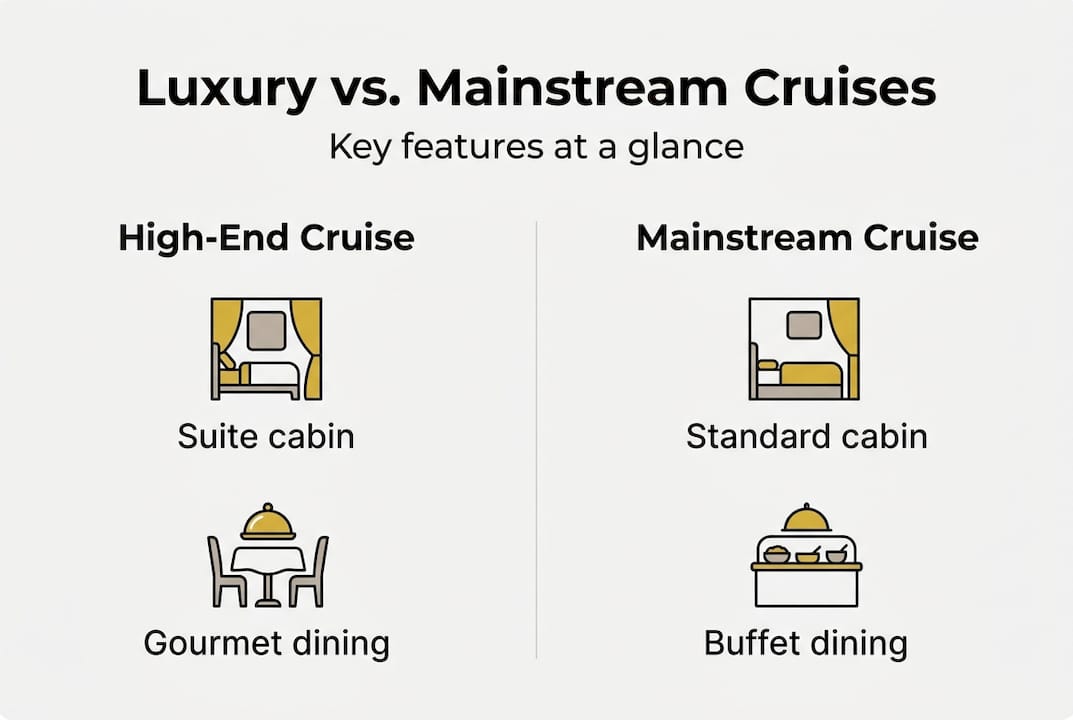
The most telling indicator is the guest-to-staff ratio. Mainstream ships might carry 4,000 or more passengers with a crew-to-guest ratio of roughly 1:3. Many luxury lines maintain ratios closer to 1:1, meaning there is nearly one crew member for every guest on board. That difference translates directly into the quality of attention you receive at dinner, at the spa, and in your suite.
Luxury cruise comparisons reveal clear distinctions between what top-tier lines offer and what you get from a standard voyage. Top-ranked lines according to U.S. News and Cruise Critic include Regent Seven Seas, Silversea, Seabourn, Crystal, Oceania, Viking, and Azamara, each earning recognition for service quality, inclusive amenities, and thoughtfully designed itineraries.
Mainstream vs. high-end cruises: A feature comparison
| Feature | Mainstream cruise | High-end cruise |
|---|---|---|
| Passenger capacity | 2,000 to 6,000+ guests | 100 to 900 guests |
| Crew-to-guest ratio | 1:3 or lower | Close to 1:1 |
| Dining options | Buffet-focused, timed seatings | Open-seating, gourmet restaurants |
| Shore excursions | Group bus tours | Private, curated experiences |
| Suite size | 150 to 250 sq ft average | 300 to 1,500+ sq ft |
| Gratuities | Usually added separately | Typically included |
| Beverages | Limited or extra cost | Premium spirits and wine included |
Beyond the numbers, luxury lines consistently deliver a set of distinguishing hallmarks that set them apart from the competition:
- Personal butler service assigned to each suite from embarkation to disembarkation
- Gourmet dining with menus developed by Michelin-level chefs and sourced with premium, often locally inspired ingredients
- Curated shore excursions designed around cultural immersion rather than a checklist of landmarks
- Spacious, well-appointed suites with private verandas, walk-in closets, and in some cases, private plunge pools
- Inclusive premium beverages, from fine wines to aged whiskeys and craft cocktails
- Onboard wellness facilities including hydrotherapy pools, medi-spa treatments, and private fitness consultations
- Enrichment programs featuring guest lecturers, culinary academies, and expedition briefings
Pro Tip: When evaluating luxury cruise lines, go beyond price. Study the guest-to-staff ratio and the depth of the itinerary. A ship that visits six ports in seven days tells a very different story than one that overnights in two and gives you time to truly explore.
Understanding what high-end travel means at a foundational level helps you ask smarter questions when comparing lines, rather than defaulting to price as the only measure of quality.
Signature accommodations and personalized service
If the guest-to-staff ratio defines the philosophy of a luxury cruise, the accommodations and service structure define its lived experience. Stepping into a high-end stateroom feels nothing like settling into a standard cabin on a large ship. Space, light, and thoughtful detail define every square foot.
Entry-level luxury suites on lines like Silversea or Seabourn typically begin at around 300 square feet with a private veranda, marble bathroom, and walk-in wardrobe. At the upper end, owner’s suites and penthouse-level accommodations run from 1,000 to well over 2,000 square feet. These top-tier spaces may include separate living and dining rooms, grand pianos, private hot tubs on the terrace, and butler pantries stocked to your preferences before you arrive.
Suite categories, pricing, and top amenities
| Suite category | Approx. price per person | Key amenities |
|---|---|---|
| Classic veranda suite | $4,000 to $8,000 | Private veranda, walk-in closet, premium linens |
| Deluxe or grand suite | $8,000 to $15,000 | Expanded living area, priority dining, butler access |
| Owner’s or penthouse suite | $15,000 to $27,000+ per night | Private hot tub, dedicated butler, bespoke menus |
| World cruise grand suite | $100,000 to $148,000+ total | Full-voyage personalization, exclusive events |
Pricing benchmarks show that 7 to 14-night sailings typically range from $4,000 to $15,000 per person, while ultra-luxury suites can reach $27,000 per night or $148,000 for a full world cruise.
The personalized service structure on a high-end cruise unfolds systematically, building a detailed picture of your preferences from the first moment of contact:
- Pre-voyage consultation: Your preferences for dining, activities, dietary needs, and suite setup are gathered weeks before departure.
- Embarkation greeting: A dedicated butler or concierge welcomes you by name and escorts you to your suite.
- Preference confirmation: Complimentary welcome amenities are tailored to your tastes, whether that means a specific champagne or a particular pillow configuration.
- Daily personalized attention: Your butler manages daily scheduling, restaurant reservations, and any special requests without you needing to ask twice.
- Surprise touches: Thoughtful gestures, from a handwritten note on your anniversary to your favorite dessert waiting after a shore excursion, reflect attentive observation rather than scripted hospitality.
Examples of world-class onboard service extend well beyond the butler. Several luxury lines offer in-suite spa treatments where therapists come directly to your veranda. Private event hosting, including intimate dinners on a private deck for two or a cocktail gathering in a signature lounge, is arranged with minimal notice. Guests on lines like Regent Seven Seas have reported receiving customized menus for onboard celebrations prepared in consultation with the executive chef.
You can explore current luxury cruise trends to see how personalization technology is reshaping these onboard experiences in 2026, from AI-powered preference tracking to pre-stocked mini-bars that reflect your actual tastes.
Curated itineraries and exclusive destination access
With exceptional accommodations comes the opportunity for equally remarkable journeys. Where mainstream ships follow well-worn routes designed to accommodate thousands of passengers efficiently, luxury lines build itineraries around destination depth, overnight stays, and access points that most travelers will never see.
Bespoke itineraries on lines like Azamara and Silversea commonly feature overnight dockings, meaning you stay in port long enough to experience a destination after the day-tripper crowds have disappeared. Imagine attending a private flamenco performance in Seville at 10 PM, or watching the sun rise over Dubrovnik’s old city walls before a single tourist coach has arrived. That kind of access is not incidental. It is the product of deliberate itinerary design and long-standing relationships with local authorities and cultural institutions.
Some of the most sought-after luxury excursion experiences include:
- Private island landings in the Adriatic or South Pacific, accessible only by tender boat with a small group
- Chef-led local market tours in cities like Istanbul, Marseille, or Osaka, followed by a cooking lesson using ingredients you selected
- After-hours museum access at venues like the Vatican Museums or the Acropolis Museum, arranged for a small group of guests only
- Cultural ambassador meetings with local artists, historians, or community leaders who share perspectives unavailable to mass tourism
- Expedition briefings and guided wildlife experiences in places like the Galápagos, Antarctica, or Norway’s Svalbard archipelago
- Private winery visits and vineyard dinners in Bordeaux or the Douro Valley, arranged through the cruise line’s culinary program
“Many of us who sail luxury lines are not just looking for a nicer ship. We want to feel like we actually visited a place, not just photographed it from a bus window. The smaller ships get you closer, stay longer, and let you go off-script.” This perspective resonates widely among experienced travelers who have weighed smaller ship benefits against the amenity-heavy appeal of mega-ships.
It is worth noting a meaningful contrast within the luxury category itself. Luxury-lite lines like Oceania and Viking offer refined experiences with strong culinary programs and thoughtful itineraries, but at a somewhat more accessible price point. Ultra-luxury lines like Seabourn and Silversea go further still, prioritizing extreme personalization, exclusive access, and the kind of spontaneous flexibility that lets a shore excursion be redesigned the morning you wake up in port.
For travelers focused on activities beyond the ship, our guides to top luxury excursions and exclusive excursion planning offer detailed frameworks for designing shore experiences that match your specific interests.
All-inclusive value: What’s really included on a high-end cruise
Exclusive destination access is only part of what defines a luxury cruise’s value proposition. The all-inclusive structure on high-end lines fundamentally changes the financial psychology of your vacation, removing the constant calculation that plagues mainstream sailings where every drink, every excursion, and every specialty restaurant carries a separate price tag.
In the luxury cruise world, “all-inclusive” means something genuinely substantial. It is not a marketing term layered over a basic package. On lines like Regent Seven Seas, which markets itself as the most inclusive luxury experience at sea, the package truly covers almost everything.
Typical inclusions across leading luxury lines encompass:
- Fine dining at every venue on board, including specialty restaurants, with no cover charges or reservation fees
- Premium spirits, wines, and champagne throughout the voyage, including during shore excursions in some cases
- Curated shore excursions in every port of call, often including private or small-group options
- Onboard gratuities for all crew members, eliminating the mental friction of end-of-voyage tipping
- Wellness amenities including fitness classes, select spa treatments, and thermal suite access
- Wi-Fi on most luxury lines, though speed and data limits can vary by vessel and destination
- Round-trip business or first-class airfare on select sailings and itineraries
Some experiences, however, may still carry an additional cost even on the most premium lines:
- Private helicopter or seaplane transfers to remote destinations
- Rare and collector-grade wines or aged spirits beyond the standard selection
- Bespoke private excursions arranged outside the ship’s program
- High-end boutique shopping or onboard spa upgrades beyond included services
Pricing tiers break down roughly as follows: entry luxury sailings run $4,000 to $6,000 per person, true all-inclusive experiences from $6,000 to $15,000 per person, and top suites on premier voyages from $15,000 to over $100,000 per person depending on the sailing length and ship.
For travelers considering upgrades to elevate an already strong experience, our breakdown of luxury cruise upgrades outlines what genuinely enhances a voyage versus what amounts to a premium price for a marginal improvement.
Pro Tip: Even among the most reputable luxury lines, inclusions are not always identical. Read the fine print on every line’s definition of “all-inclusive” before booking. Check whether shore excursions are truly included or merely discounted, and confirm whether gratuities and airfare are part of the quoted fare or added later.
A fresh perspective: True luxury is personal, not just opulent
Conventional wisdom in travel marketing frames luxury as a function of price and opulence. The larger the suite, the more elaborate the ship, the higher the cost, the more luxurious the experience. That framing misses something important.
Seasoned travelers consistently report that the most memorable moments on a high-end cruise have little to do with the thread count of the sheets or the square footage of the owner’s suite. They involve a spontaneous private dinner arranged by the chef using ingredients purchased that morning at a port-side market. They involve a cultural connection, a conversation facilitated by the ship’s expedition team, or a morning hike through terrain most tourists never reach.
What we at Grand Globetrotting have observed working with discerning clients is that a beautiful ship can disappoint if it does not resonate personally. A traveler passionate about culinary arts will find deeper satisfaction on a line with a serious cooking program than on one with a grand atrium and a generic spa. A traveler driven by wildlife and conservation will connect more powerfully with an expedition-style luxury line than with a white-glove ocean liner.
Prioritizing personalized cruise preferences before selecting a line is the most practical advice we can offer. Ask yourself what genuinely excites you about being at sea and on shore, and let that answer guide the selection. The right high-end cruise is one that fits your particular idea of an extraordinary experience, not someone else’s definition of opulence.
Your next step: Curate the ultimate high-end cruise experience
Now that you understand what separates a true luxury cruise from a premium-branded mainstream sailing, the next move is to translate that understanding into an itinerary designed specifically for you.
At Grand Globetrotting, we specialize in personalized travel curation that goes far beyond selecting a ship and a departure date. Our approach begins with understanding what matters most to you, whether that is culinary immersion, private shore access, wellness, cultural depth, or simply the pleasure of being impeccably looked after at sea. From itinerary design to private event arrangements and exclusive excursion planning, our luxury travel planning guide walks you through every step. Explore our curated top luxury excursions for inspiration, and reach out to begin building your ideal voyage.
Frequently asked questions
Which cruise lines are truly considered high-end or luxury?
Top luxury lines include Regent Seven Seas, Seabourn, Silversea, and Viking, all recognized by U.S. News and Cruise Critic for outstanding service, inclusive amenities, and distinctive itineraries that set them clearly apart from mainstream options.
What is the typical price range for a luxury cruise?
High-end cruises generally range from $4,000 to $15,000 per person for a 7 to 14-night voyage, with ultra-luxury suite experiences and world cruise packages reaching $27,000 per night or well over $100,000 total.
Do high-end cruises always include all food, drinks, and excursions?
Most luxury lines offer genuinely all-inclusive packages covering dining, premium beverages, excursions, and gratuities, but rare wines, private helicopter transfers, and bespoke excursions outside the standard program may carry additional costs.
Why do some affluent travelers prefer smaller ships over mega-ship luxury?
Smaller luxury ships provide greater destination immersion and more personalized attention with far fewer fellow passengers, allowing for overnight port stays, exclusive access, and a pace of travel that genuinely connects guests to each destination rather than simply passing through it.
Recommended
At Grand Globetrotting, we don't just plan vacations; we craft extraordinary adventures that leave you with cherished memories. Let us bring your dream vacation to life, perfectly tailored to your style, and immerse yourself in a world of luxury, exploration, and unforgettable moments. Your journey begins with us.
Itinerary planning services require a separate charge outside of cost to book travel accommodations. Depending upon the complexity of the itinerary and the level of effort required to acquire unique experiences, cost may vary. Speak with our team to learn more.
Book your consultation