

A luxury travel advisor’s most underrated skill is not finding the perfect villa or securing a sold-out restaurant reservation. It is acting as a neutral mediator and logistics advocate when companions disagree, vendors fall short, or plans unravel. Conflict resolution in travel planning protects the financial investment, preserves relationships, and keeps a bespoke experience on track when the unexpected happens.
For affluent travelers and groups, the stakes are simply higher. A single unresolved dispute can forfeit a five-figure deposit, fracture a friendship, or collapse a multi-generational itinerary that took months to build. A skilled advisor steps in before any of that happens.
Three outcomes a concierge-led approach delivers:
- Preserved relationships: Companions leave the trip closer, not resentful, because a neutral third party absorbed the friction.
- Protected trip value: Deposits, bookings, and non-refundable experiences are defended through documentation and supplier advocacy.
- Faster vendor resolution: Advisor relationships with preferred suppliers produce outcomes that consumer channels rarely match.
Request a pre-trip agreement template from your advisor before final payments are due. That single document prevents most disputes before they begin.
Key Takeaways
A luxury travel advisor who owns conflict resolution from the pre-trip phase protects both the financial investment and the relationships that make group travel worth taking.
| Point | Details |
|---|---|
| Advisor as neutral mediator | A single advisor managing decisions and communications prevents planning from becoming political. |
| Pre-trip agreement is non-negotiable | Signed agreements covering payments, rooming, and decision frameworks prevent most disputes before departure. |
| Escalate vendor issues within 24–72 hours | Acting quickly while options remain open is the most effective travel planning strategy for supplier disputes. |
| CFAR and group insurance protect deposits | Requiring travel protection at booking preserves financial value when cancellations occur. |
| Grandglobetrotting’s planning process | Mediation, supplier advocacy, and documented protections are built into every Grandglobetrotting engagement. |
Table of Contents
- Why conflict resolution matters more in luxury and group travel
- What causes most companion and planning conflicts?
- How a concierge advisor resolves conflicts at every stage
- Prevention tools that stop conflicts before they start
- How to handle vendor and booking disputes in the U.S.
- When should you escalate, and what does concierge intervention cost?
- Real conflict resolution in action: three Grandglobetrotting examples
- What advisors get wrong about owning conflict resolution
- Grandglobetrotting’s approach to conflict-protected luxury travel
- Sources
Why conflict resolution matters more in luxury and group travel
The role of conflict resolution in travel planning scales directly with the cost and complexity of the trip. A typical weekend getaway has little at stake. A high-value group safari or a private-villa week in Tuscany involves significantly greater investment and complexity.
Bespoke bookings are, by definition, inflexible. Private-villa contracts, yacht charters, and exclusive-use restaurant buyouts carry strict cancellation windows and non-refundable deposits. When a companion drops out or a vendor fails to deliver, the financial exposure falls on the group. Group contracts with attrition dates and locked pricing can limit that exposure, but only when an advisor negotiated them in advance.
Group dynamics add another layer. Without a single, neutral authority managing communication, deadlines, and payments, planning becomes political. Side conversations multiply, information fragments, and missed deadlines and last-minute document problems become almost inevitable. The larger the group, the faster this fragmentation accelerates.
The practical consequences are concrete:
- Lost deposits from late cancellations or headcount changes
- Schedule disruptions when one companion’s needs are not surfaced early
- Damaged relationships when money collection falls to the trip organizer
- Supplier disputes that go unresolved because no one has the right contacts
What causes most companion and planning conflicts?
Most disputes trace back to one of six sources, and nearly all of them are preventable with early intervention.
- Preference misalignment: One traveler wants adventure activities; another wants spa days. Without a priority-ranking exercise at intake, the itinerary satisfies no one fully.
- Budget mismatch: Companions have different spending thresholds for upgrades, dining, and excursions. Unspoken assumptions about who pays for what create resentment fast.
- Scheduling and availability: Arrival times, departure flexibility, and mid-trip free days rarely align perfectly across a group. Conflicts surface when the itinerary treats everyone as identical.
- Health and accessibility needs: Mobility limitations, dietary restrictions, and medical requirements that are not disclosed upfront force last-minute substitutions that feel like afterthoughts.
- Rooming and privacy: Who shares a room, who gets the primary suite, and who has quiet hours are conversations most groups avoid until they are standing at the front desk.
- Role confusion: When no one is designated as the decision-maker, every choice becomes a negotiation. Payment collection falls to the organizer by default, which is the fastest way to damage a friendship.
Pro Tip: At the first group intake call, ask each traveler to rank their top three priorities and their one non-negotiable. This five-minute exercise surfaces conflicts before deposits are paid and gives the advisor a documented basis for every major itinerary decision.
How a concierge advisor resolves conflicts at every stage
The most effective conflict resolution techniques in travel follow a three-phase structure: prevent before departure, manage in real time, and finalize after the incident.
Pre-trip: build the agreement before money moves
- Intake and priority mapping. Collect individual preferences, health needs, budget ceilings, and rooming preferences from every traveler separately, not in a group call where social pressure shapes answers.
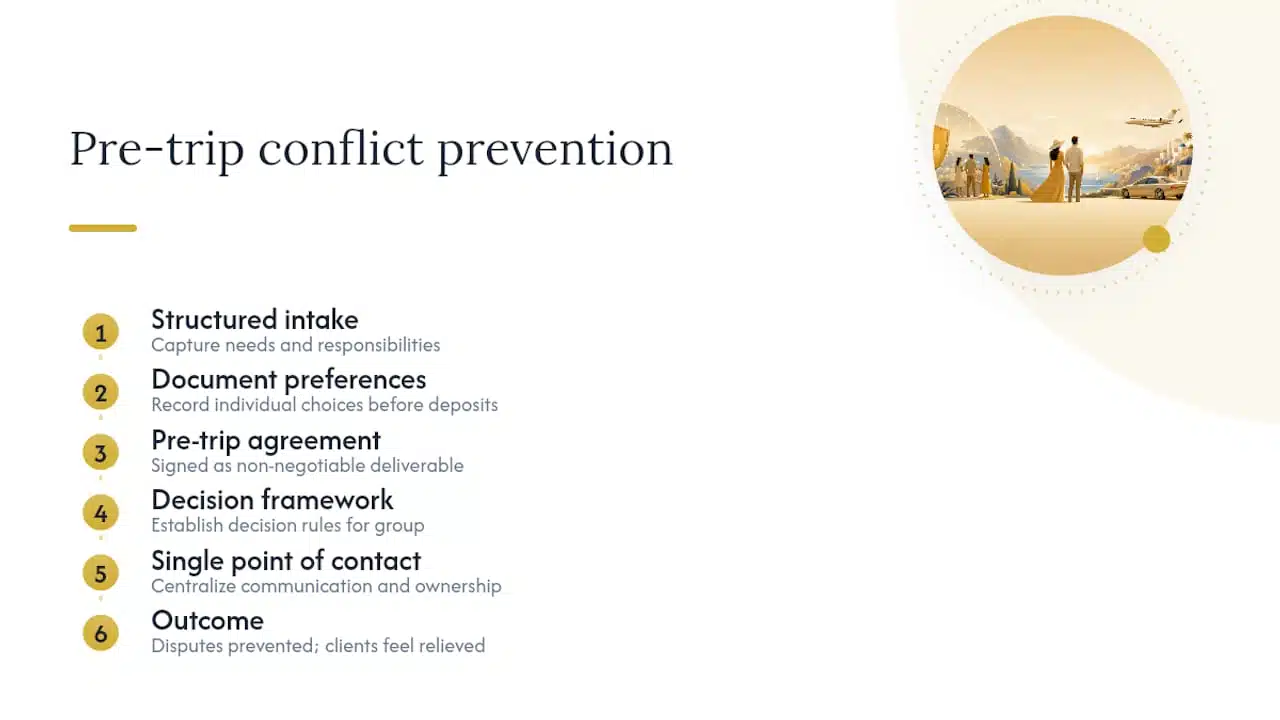
- Pre-trip agreement. Document roles, payment schedules, cancellation rules, dietary and mobility needs, and privacy requests. Every participant signs before deposits are paid.
- Decision framework. Establish in writing how tie-breaking decisions are made: majority rule, payer priority, or advisor recommendation. This removes the politics from in-trip choices.
- Travel protection. Require group travel insurance or Cancel For Any Reason (CFAR) coverage. Advisors should obtain signed waivers from any traveler who declines.
- Single communication channel. Designate one channel (a shared itinerary app, a dedicated email thread) as the official source of truth. Fragmented group chats produce outdated information and missed deadlines.
In-trip: monitor, mediate, and substitute
- Monitor flight status and supplier confirmations continuously. Advisors often detect delays before clients see app alerts and can begin remediation sooner.
- Follow an escalation tree: advisor contacts supplier directly, then regional manager, then preferred-supplier account representative.
- For companion disputes, use neutral framing: “Based on what everyone shared at intake, here is the option that honors the most priorities.” This positions the advisor as the enforcer of the group’s own stated preferences, not an outside authority.
- When a service cannot be delivered, activate pre-approved substitutions rather than improvising. A documented substitution protocol prevents the perception of a downgrade.
Post-incident: document, claim, and update
- Collect all receipts, written confirmations, and incident timestamps within 24 hours.
- Submit insurance claims and credit-card dispute documentation promptly. Most travel insurers require notice within a defined window.
- Request written resolution from suppliers, not verbal assurances.
- Update the trip file with lessons learned to inform future planning.
Pro Tip: Frame every enforcement conversation around the group’s own pre-trip agreement, not the advisor’s judgment. “You all agreed to X in the pre-trip document” is far more effective than “I think you should do X.” It keeps the advisor neutral and the decision grounded in the travelers’ own words.
Prevention tools that stop conflicts before they start
Prevention hinges on documented expectations and a fair financial structure. The pre-trip agreement is the single most powerful tool, but it works best alongside a decision framework and a payment system that removes the organizer-as-debt-collector dynamic.
Pre-trip agreement essentials:
- Named decision-maker and tie-breaking method
- Individual payment amounts, due dates, and accepted methods
- Cancellation and refund policy per traveler
- Dietary, mobility, and medical disclosures
- Rooming assignments and privacy preferences
- Agreed communication channel and response expectations
Decision frameworks and when to use them:
- Majority rule: Best for activity choices where preferences are roughly equal.
- Payer priority: The traveler covering the largest share of a specific cost has final say on that line item.
- Anchor-moment scheduling: Fix two or three non-negotiable shared experiences; build independent itinerary tracks around them. This “together but separate” model reduces forced proximity and prevents exhaustion-driven arguments in multi-generational groups.
For payment logistics, advisors can use invoicing platforms that bill each traveler directly, removing the organizer from the collection process entirely. This one structural change eliminates the most common source of group friction.
Pre-payment checklist:
- Pre-trip agreement signed by all travelers
- Individual invoices issued and confirmed
- Travel protection purchased or waiver signed
- Substitution options identified for high-risk bookings
- Single communication channel established and shared
How to handle vendor and booking disputes in the U.S.
Follow this sequence: documentation first, then supplier escalation, then insurance or payment remedies in parallel.
- Preserve all records immediately. Save booking confirmations, contracts, receipts, and any written supplier communications. Note timestamps for every interaction.
- Escalate to the supplier directly. Contact the account manager or regional director, not the general customer line. Advisors with preferred-supplier relationships can often negotiate relocations, rescheduling, or credits that consumer channels cannot access.
- Request written resolution within 48–72 hours. A documented, polite escalation through an advisor consistently outperforms public social media pressure and produces a paper trail for insurance.
- Invoke travel insurance or CFAR. File promptly. Most policies require written notice within a specified period after the triggering event.
- Dispute the charge with your credit card issuer if the supplier fails to deliver a paid service and refuses to refund. U.S. cardholders have chargeback rights under the Fair Credit Billing Act for services not rendered.
- For U.S. flight cancellations, the Department of Transportation requires airlines to provide prompt refunds when a flight is canceled and the passenger does not accept rebooking.
| Document | Purpose | Where to store |
|---|---|---|
| Booking confirmation | Proof of service contracted | Cloud folder, shared with advisor |
| Supplier contract | Cancellation and refund terms | Cloud folder, advisor file |
| Receipts and invoices | Financial evidence for claims | Cloud folder, insurance portal |
| Incident log with timestamps | Chronological record for disputes | Shared document with advisor |
| Written supplier communications | Evidence of non-delivery or agreement | Email thread, advisor file |
Pro Tip: A documented escalation through your advisor’s preferred-supplier channel almost always produces a better outcome than a public complaint. Suppliers protect relationships with high-volume advisors. That relationship is leverage a solo traveler simply does not have.
When should you escalate, and what does concierge intervention cost?
Escalate immediately for any safety or health issue. For supplier problems affecting the itinerary, escalate within 24–72 hours while options remain open. For refunds or rebooking leverage, act before final payment deadlines pass.
Escalation triggers:
- Safety or medical emergency involving any traveler
- Non-delivery of a paid, confirmed service
- Supplier non-response within 24 hours of a documented issue
- Imminent travel deadline (departure within 48 hours)
- Companion dispute that is affecting group cohesion or health
Concierge conflict-handling typically takes one of three pricing shapes: a flat mediation fee for a single incident, an hourly triage rate for ongoing supplier advocacy, or a full-trip management add-on that covers all conflict handling from pre-trip through post-incident. These are example structures; actual rates vary by advisor and scope.
Pro Tip: A modest mediation fee, often a fraction of a single night’s accommodation cost, can protect tens of thousands of dollars in non-refundable deposits. The math is straightforward. The decision to engage an advisor before a crisis is almost always less expensive than engaging one after.
Advisors who build resilience into the itinerary before departure reduce the frequency and severity of in-trip crises. Pre-departure risk planning is not a luxury add-on. It is the foundation of effective travel planning strategies for high-value trips.
Real conflict resolution in action: three Grandglobetrotting examples
Companion rooming dispute on a private villa booking
Outcome: Rooming conflict identified pre-trip, resolved before arrival, relationships intact.
A group of six booked a private villa in the Caribbean. Two companions assumed they would share the primary suite; neither had disclosed this expectation. During the pre-trip intake, Grandglobetrotting’s advisor surfaced the conflict through individual preference forms. The advisor proposed a room assignment based on the pre-trip agreement’s payer-priority framework, communicated the decision in writing to all parties, and documented acceptance before final payment. No dispute reached the villa.
Multi-generational family cancellation and insurance coordination
Outcome: Partial deposits preserved, trip restructured, insurance claim filed successfully.
A family of fourteen planned a European river cruise. Three weeks before departure, four members canceled due to a medical situation. Without group travel insurance, the family would have forfeited deposits across multiple suppliers. Grandglobetrotting had required CFAR coverage at booking and had negotiated attrition provisions in the group contract. The advisor filed the insurance claim, coordinated with the cruise line on headcount adjustments, and restructured the remaining itinerary within 72 hours. The family traveled as planned; the canceled members received partial refunds through the CFAR policy.
Last-minute vendor no-show resolved with a pre-approved substitution
Outcome: Private transfer no-show replaced within 90 minutes, no itinerary disruption.
A couple arriving in Tokyo for a bespoke cultural itinerary found their private transfer had not appeared. The advisor, monitoring arrival confirmations in real time, identified the no-show before the clients left the arrivals hall. Using a pre-approved substitution protocol, the advisor arranged a comparable private vehicle through a preferred local supplier, communicated the update directly to the clients, and initiated a written complaint and refund request to the original vendor. The clients reached their first appointment on time.
What advisors get wrong about owning conflict resolution
Most advisors treat conflict resolution as a reactive skill, something to deploy when things go wrong. That framing misses the point entirely.
The advisor’s role is to make conflict resolution invisible. When a pre-trip agreement is signed, a decision framework is in place, and individual preferences are documented before deposits are paid, most disputes never materialize. The clients experience a smooth trip. They attribute it to good planning, which is exactly right. The mediation happened in the pre-trip phase, not at the villa.
What advisors underestimate is the emotional weight clients carry into group travel. High-net-worth travelers are often the person in their social circle who organizes everything. They feel responsible for everyone’s experience. When something goes wrong, that responsibility becomes guilt. An advisor who takes ownership of conflict resolution removes that burden. That is not a soft benefit. It is the core of what a premium planning service delivers.
Grandglobetrotting trains every advisor to treat the pre-trip agreement as a non-negotiable deliverable, not an optional add-on. The VIP planning process includes a structured intake, a documented decision framework, and a single point of contact for every communication. Clients who want to request a consultation or a pre-trip agreement template can do so directly through Grandglobetrotting’s planning team.
Grandglobetrotting’s approach to conflict-protected luxury travel
Grandglobetrotting builds mediation, supplier advocacy, and documented trip protections into every bespoke planning engagement, not as an add-on but as a standard part of the service. For group and companion travel, that means a pre-trip agreement drafted before deposits are paid, individual invoicing that removes the organizer from payment collection, and a single advisor as the neutral point of contact for every decision.

Specific services that support conflict resolution include pre-trip agreement creation, centralized itinerary communications, preferred-supplier escalation, and on-call crisis management during the trip. For travelers who want additional coverage, optional mediation add-ons are available for complex multi-party or multi-destination itineraries.
To request a pre-trip agreement template or book a planning consultation, visit the personalized luxury travel planning guide or contact Grandglobetrotting’s team directly. The consultation is the first step toward a trip where the only surprises are the good ones.
Sources
- When Travel Disruptions Happen, Here’s the Difference Between Having an Advisor and Doing It Alone – PTN Travel
- The Multi-Gen Luxury Trip Strategy Everyone Wants To Know, Become a Travel Agent | Travel Agent Pro
- Group Size Matters: Why 8+ People Need a Custom Vacation Planning Pro – The One Nine Group Inc.
Recommended
At Grand Globetrotting, we don't just plan vacations; we craft extraordinary adventures that leave you with cherished memories. Let us bring your dream vacation to life, perfectly tailored to your style, and immerse yourself in a world of luxury, exploration, and unforgettable moments. Your journey begins with us.
Itinerary planning services require a separate charge outside of cost to book travel accommodations. Depending upon the complexity of the itinerary and the level of effort required to acquire unique experiences, cost may vary. Speak with our team to learn more.
Book your consultation