

TL;DR:
- Nearly 74% of luxury travelers now see contactless and AI-personalized experiences as essential. Technology now defines luxury travel by enabling real-time personalization, seamless digital touchpoints, and predictive services. A hybrid model combining AI with human expertise is key to creating emotionally resonant and highly tailored journeys.
Nearly 74% of luxury travelers now consider contactless and AI-personalized experiences essential, not optional. That single figure reshapes everything we assumed about what defines a premium journey. For years, luxury travel meant white-glove human service and nothing else. Today, the most discerning travelers expect both: the warmth of expert guidance and the precision of intelligent technology working seamlessly together. This guide walks you through how that shift is happening, what it means for your next bespoke vacation, and how to leverage these tools to craft journeys that feel genuinely, unmistakably yours.
Table of Contents
- Redefining luxury travel: Technology as the new standard
- How AI and data transform personalized planning
- The human touch: Where technology stops and experts shine
- Future trends: What’s next for luxury travel technology?
- Perspective: Why the best luxury journeys will always blend tech and talent
- Plan your ultimate personalized luxury getaway
- Frequently asked questions
Key Takeaways
| Point | Details |
|---|---|
| Tech-driven personalization | AI and data analysis now enable tailored journeys that reflect each traveler’s unique style and needs. |
| Hybrid expertise required | The best luxury experiences combine advanced technology with hands-on human curation and support. |
| Growth and innovation | Luxury travel is rapidly growing and is a space where adopting emerging technologies delivers exceptional value. |
| Future readiness | Staying current on AI, trend forecasting, and personalized planning tools helps affluent travelers access unique and seamless journeys. |
Redefining luxury travel: Technology as the new standard
The definition of luxury travel has quietly but decisively changed. Where exclusivity once meant a private butler and a penthouse suite, today’s high-net-worth travelers also expect their preferences to be known before they arrive, their itineraries to adapt in real time, and their entire experience to feel curated around them specifically. Technology is the engine making that possible.
The numbers tell a compelling story. The luxury travel market is predicted to surpass $1 trillion by 2027, driven in large part by demand for personalized, tech-enhanced experiences. Meanwhile, 68% of luxury advisers report that their clients are willing to spend more when personalization is built into the service. These are not small shifts. They signal a structural change in what affluent travelers value.
Understanding the current luxury travel trends helps clarify why technology has moved from a nice-to-have to a baseline expectation. Here is what today’s discerning traveler typically expects:
- Real-time personalization across hotels, flights, and dining based on past preferences
- Seamless digital touchpoints from booking through checkout, with minimal friction
- Predictive service that anticipates needs before they are expressed
- Privacy-first data handling that protects sensitive personal information
- Consistent experience quality whether traveling solo, as a couple, or with a multi-generational family
Different trip types benefit from technology in distinct ways. Honeymoon couples gain from AI-curated romantic experiences tailored to shared interests. Multi-generational families benefit from logistics coordination across varied age groups and preferences. Milestone celebrators, whether marking a significant birthday or anniversary, receive itineraries that reflect the emotional weight of the occasion.
“Luxury is no longer defined by what money can buy. It is defined by what technology and human expertise can create together, specifically for you.”
This is the new standard. And for travelers who expect nothing less than exceptional, understanding this evolution is the first step toward experiencing it fully.
How AI and data transform personalized planning
Artificial intelligence has become the backbone of truly bespoke travel planning. Its power lies in aggregating and analyzing data from multiple sources simultaneously: property management systems (PMS), customer relationship management (CRM) platforms, past booking records, and real-time inputs like weather and local events. The result is a planning process that feels less like a transaction and more like a conversation with someone who genuinely knows you.
Data-driven personalization in travel works through several distinct technologies. Attribute-based filtering matches travelers to properties and experiences based on granular preferences rather than broad categories. AI itinerary generators build multi-stop journeys that account for travel time, personal interests, and budget parameters simultaneously. Predictive analytics anticipate what a guest will want next based on behavioral patterns.
Here is how these technologies translate into real travel moments:
- Weather-adjusted itineraries that automatically reschedule outdoor activities when conditions change
- Dietary preference tracking that ensures every restaurant recommendation meets specific requirements
- Multi-stop logistics optimization that sequences destinations for minimum travel time and maximum experience
- Proactive upgrade suggestions based on a traveler’s historical preferences and current availability
- Real-time local event integration that adds culturally relevant experiences to existing plans
The investment behind this capability is substantial. AI investments average $320,000 per hotel in 2026 for revenue intelligence and demand forecasting alone. That figure reflects how seriously the industry is taking intelligent personalization.
| AI technology | Primary function | Traveler benefit |
|---|---|---|
| Attribute-based filtering | Preference matching | Hyper-relevant recommendations |
| Predictive analytics | Behavioral forecasting | Anticipatory service |
| Natural language processing | Preference capture | Effortless communication |
| Real-time data integration | Dynamic itinerary updates | Seamless adaptability |
Exploring bespoke travel tech reveals just how far customized itinerary planning has advanced beyond simple booking tools. These systems learn, adapt, and improve with every interaction.
Pro Tip: Before your next luxury trip, prepare a detailed preference profile covering dietary needs, activity interests, accommodation style, and past experiences you loved or disliked. The more specific your input, the more precisely AI-powered systems can tailor every element of your journey.
The human touch: Where technology stops and experts shine
For all its capability, AI has clear limits. Technology can analyze patterns, but it cannot read the room. It can optimize logistics, but it cannot sense when a traveler needs something unexpected, something that no algorithm would predict. This is precisely where expert advisors become irreplaceable.

The hybrid human-AI model is now considered optimal for bespoke high-net-worth travel. Advisors use AI to handle data-heavy tasks like availability checks, pricing comparisons, and preference matching. This frees them to focus entirely on what they do best: listening deeply, crafting creative solutions, and managing sensitive situations with discretion.
There are specific moments where only a trusted human expert will do:
- Privacy-sensitive requests that require confidential handling beyond what automated systems can guarantee
- Creative vision for once-in-a-lifetime experiences that have no template or precedent
- Crisis management when something goes wrong and a calm, resourceful person is needed immediately
- Relationship-based access to exclusive properties, events, or experiences that are not publicly bookable
- Emotional attunement during milestone trips where the stakes are personal and meaningful
The risk of relying too heavily on technology alone is what industry experts call the “uncanny valley” of service: experiences that feel technically precise but emotionally hollow. Tech enhances scale and personalization, but the balance between automation and human warmth is what separates a good trip from an unforgettable one.
| Planning approach | Strengths | Limitations |
|---|---|---|
| AI-only planning | Speed, data processing, 24/7 availability | Lacks empathy, creative vision, discretion |
| Human-only planning | Trust, creativity, relationship access | Time-intensive, limited data processing |
| Human plus AI | Full personalization, efficiency, emotional depth | Requires skilled advisors to integrate both |
Understanding the itinerary management benefits of a combined approach makes clear why the world’s most discerning travelers choose advisors who use both tools expertly.
Pro Tip: When briefing your travel advisor, go beyond destinations and dates. Share the emotional tone you want, the memories you hope to create, and any past travel disappointments. This context allows your advisor to direct AI tools more precisely and add their own creative layer on top.
Future trends: What’s next for luxury travel technology?
The pace of innovation in luxury travel is accelerating. What feels cutting-edge today will be standard within a few years, and the travelers who understand what is coming will be best positioned to take advantage of it.
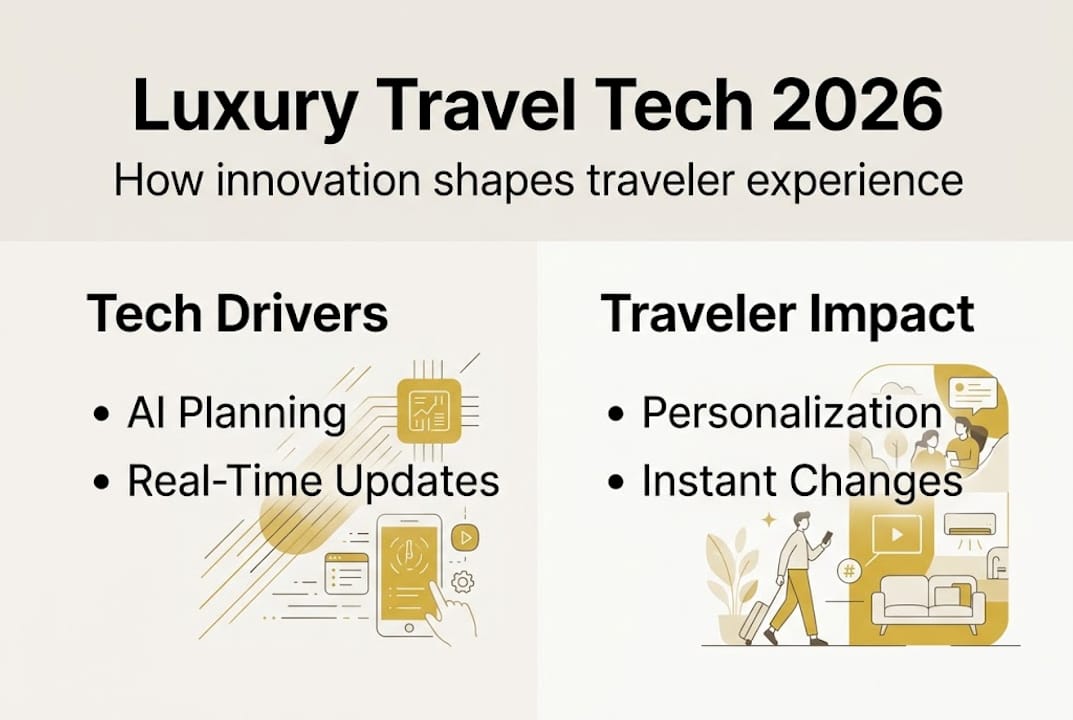
The growth signals are clear. Personalization in travel is predicted to grow 18% per year, and 41.2% of travel companies are already implementing generative AI into their planning and service workflows. These are not experimental pilots. They are industry-wide commitments.
| Trend | Current adoption | Expected impact by 2030 |
|---|---|---|
| Generative AI trip design | 41.2% of companies | Fully conversational itinerary creation |
| Biometric check-in | Growing at luxury properties | Frictionless, identity-verified arrivals |
| Immersive pre-trip experiences | Early adoption phase | Virtual destination previews before booking |
| Predictive hospitality | Widely deployed at top hotels | Needs met before they are expressed |
Here are five high-impact trends every affluent traveler should watch:
- Generative AI trip design that creates fully personalized itineraries through natural conversation rather than form-filling
- Biometric check-in at luxury hotels and private terminals, eliminating friction at every arrival point
- Immersive digital previews allowing travelers to virtually experience a villa, yacht, or destination before committing
- Predictive hospitality where AI anticipates preferences and prepares personalized welcomes without any guest input required
- Sustainability intelligence that builds carbon-conscious choices into itineraries without sacrificing experience quality
“The future of luxury travel is not about choosing between technology and human expertise. It is about designing journeys where both work so well together that the traveler never has to think about either.”
Staying ahead of forecasting travel trends and personalizing luxury journeys with these innovations in mind positions you to access experiences that most travelers will not even know are possible.
Perspective: Why the best luxury journeys will always blend tech and talent
There is a temptation in the industry to treat AI as the final answer to personalization. It is not. Technology is a powerful amplifier, but it amplifies what is already there. If the underlying understanding of a traveler is shallow, AI will simply deliver shallow recommendations faster.
The planners who create truly seamless luxury experiences understand something important: five-star service has always been about anticipation and empathy. AI can now handle the data side of anticipation brilliantly. But empathy, the ability to sense what a traveler truly needs versus what they asked for, still requires a human being with experience and genuine care.
The most memorable journeys we have seen crafted are ones where technology handled the complexity and a skilled advisor handled the soul. Neither could have done it alone. That balance is not a compromise. It is the standard worth demanding.
Plan your ultimate personalized luxury getaway
Are you ready to experience the future of travel planning with personalized, technology-driven luxury at your fingertips?
Grand Globetrotting combines intelligent technology with expert concierge guidance to design journeys that reflect exactly who you are and what you value. Whether you are planning a honeymoon, a multi-generational family escape, or a milestone celebration, our team uses the latest tools alongside deep industry relationships to build something truly extraordinary. Start with our luxury travel planning guide, create your luxury itinerary with expert support, or explore how we plan family luxury vacations that work for every generation.
Frequently asked questions
How does technology enhance the privacy and security of luxury travel itineraries?
AI unifies data securely from multiple systems using encrypted communications and secure storage, enabling highly personalized planning that keeps your sensitive preferences completely confidential.
Can technology adapt last-minute for sudden trip changes?
Yes. Modern AI-driven planning tools leverage real-time inputs to update itineraries instantly in response to weather shifts, travel disruptions, or changed preferences, keeping your experience seamless throughout.
Is human advice still important when using travel planning technology?
Absolutely. The hybrid human-AI model consistently delivers the most exclusive results, with advisors contributing creative insight, discretion, and relationship-based access that no algorithm can replicate.
What’s the next big innovation in luxury travel planning?
Generative AI for conversational trip design, immersive digital destination previews, and predictive hospitality are leading the next phase, with 41.2% of companies already deploying generative AI across their planning and service operations.
Recommended
- How technology elevates bespoke luxury travel experiences
- Personalized travel planning for luxury journeys in 2026
- How to personalize luxury travel in 2026: 7 steps
- Why use itinerary management for luxury travel in 2026
- Top luxury event trends for 2025: innovation meets exclusivity – Winelands Function – For Every Occasion, Your Celebration
At Grand Globetrotting, we don't just plan vacations; we craft extraordinary adventures that leave you with cherished memories. Let us bring your dream vacation to life, perfectly tailored to your style, and immerse yourself in a world of luxury, exploration, and unforgettable moments. Your journey begins with us.
Itinerary planning services require a separate charge outside of cost to book travel accommodations. Depending upon the complexity of the itinerary and the level of effort required to acquire unique experiences, cost may vary. Speak with our team to learn more.
Book your consultation