

What defines a signature travel experience?
A signature travel experience is a uniquely curated, high-touch journey built around exclusive access, deep local immersion, and a personalized narrative arc designed to create emotional impact and lasting memories. It is not simply a longer trip or a pricier hotel. The distinction lies in intentional design: every element serves a clear emotional promise, and the traveler leaves with a story rather than a checklist.
These experiences stand apart from standard tourism in the most fundamental way. Where a typical vacation is organized around sights and schedules, a signature journey is organized around transformation. Think of a private dawn access to a UNESCO heritage site before the crowds arrive, or a multi-day expedition living alongside an Indigenous community in a remote rainforest.
Core defining elements of a signature travel experience:
- A clear emotional promise or transformation at the center of the itinerary
- Small-group settings that allow genuine connection with people and place
- Rare, behind-the-scenes access unavailable through standard booking channels
- Intentional “story moments” planted throughout the trip
- Personalized details tied to the specific traveler’s passions or occasion
- Storytelling as the primary currency, not a list of inclusions
Table of Contents
- What characteristics make a travel experience truly signature?
- How tourism businesses can design signature travel experiences
- Benefits of signature experiences for travelers and tourism businesses
- What luxury travel experts say about crafting these experiences
- How a signature experience differs from a standard travel definition
- How signature experiences differ from generic travel
- Grandglobetrotting brings signature travel within reach
- Key Takeaways
What characteristics make a travel experience truly signature?
The hallmarks of a memorable, high-end experience go well beyond luxury amenities. Exclusivity, personalization, and emotional engagement work together to create something a traveler genuinely cannot replicate on their own.
Key characteristics include:
- Exclusivity: Limited group sizes and rare access points create intimacy. True exclusivity means more than a premium price tag; it involves authentic local access that fosters genuine connection with host communities.
- Personalization: Itineraries are tailored to the traveler’s specific interests, whether culinary, cultural, adventure-driven, or family-focused.
- Thematic coherence: Every activity, meal, and transfer reinforces a central story or theme rather than filling time.
- Authentic local engagement: Frontline guides act as cultural intermediaries, setting the tone and facilitating the moments that become lasting memories.
- Sensory and emotional immersion: Experiences engage travelers on emotional, physical, and intellectual levels, going far beyond passive sightseeing.
- Deliberate white space: Protected time for reflection and spontaneity is built into the schedule, not treated as wasted time.
Without white space, travelers feel like passengers moving through a program rather than participants in a living experience. The pause is as intentional as the activity.
Pro Tip: When reviewing an itinerary, count the unscheduled hours. If there are none, the experience is likely over-packaged. The most memorable trips leave room for the unexpected.

How tourism businesses can design signature travel experiences
The starting point for any tourism professional is defining a clear emotional promise, not a destination or a duration. That promise becomes the spine of the entire itinerary and the anchor of all marketing copy.
From that promise, the design process follows a deliberate sequence:
- Define the emotional core: Frame the trip around a transformation (“Reconnect with your family before the kids leave home”) rather than a geography (“Seven nights in Tuscany”).
- Plant 3–5 marquee moments: These are the standout story moments that define the entire trip. A private dinner in a candlelit courtyard, a behind-the-scenes winery access, a surprise ceremony tied to a milestone.
- Build in exclusive access: Private tours, after-hours entry, and community-led expeditions give travelers something they genuinely could not arrange themselves.
- Design the physical environment: The architecture and interior design of tourism spaces set expectations before a word is spoken. Branded, story-driven spaces reinforce the experience at every touchpoint.
- Name and own the experience: Give the trip a branded identity and package it as a flagship offering on your website and marketing channels.
Pro Tip: Describe your marquee moments in sensory and emotional language, not logistics. “Walking into a candlelit courtyard for a family celebration” sells the experience far more effectively than “Welcome dinner included.”
For operators looking at exclusive excursion design, the same principle applies: the activity is the vehicle, and the emotional outcome is the destination.
Benefits of signature experiences for travelers and tourism businesses
For travelers, the value of a well-designed signature experience extends well beyond the trip itself. Research from Tripadvisor found that many surveyed travelers rank in-destination activities as a top contributor to a memorable trip, and two in three now place more value on experiences over material possessions.
Benefits for travelers:
- Deeper satisfaction and emotional resonance that outlasts the trip
- Personal growth and identity-shaping moments
- Stories worth telling, not just photos worth posting
- A sense of genuine connection to place, culture, and community
Benefits for tourism businesses:
- Loyalty and referrals: Clients who experience a marquee trip become advocates. They don’t list inclusions; they tell stories to friends.
- Brand differentiation: A named, flagship experience sets a business apart from commodity booking services.
- Sustainable growth: Experiences are not about discounts; they layer on value that travelers are genuinely willing to pay for.
- Repeat business: When a trip is framed as the beginning of a long-term travel story, clients return for the next chapter.
What luxury travel experts say about crafting these experiences
The most authoritative voices in experiential travel consistently point to the same priorities: narrative, guides, and restraint.
McKinsey and Skift research identifies well-trained guides as one of the most critical components of a great experience. Because creating a magical guided experience depends so heavily on the person leading it, operators who invest in frontline talent consistently outperform those who focus only on logistics. Expert guides act as cultural intermediaries, managing both entertainment and safety while facilitating the moments that travelers remember for years.
Statistic callout: Nearly nine in ten travelers report experiencing their most memorable moments while participating in a destination activity on their most recent trip.
Storytelling functions as the emotional backbone of the entire experience. Experts emphasize that narrative-driven travel turns visits into encounters that resonate long after the traveler returns home. The Mentawai Tribal Immersion expedition led by Jungle Guides International is a compelling example: participants travel by longboat into Sumatra’s primary rainforest, live in traditional longhouses, and learn directly from Indigenous hosts. The experience is defined as much by what it excludes as what it includes.
Pro Tip: The best local guides don’t just narrate a destination. They create the conditions for a traveler’s own discovery. Hire for emotional intelligence, not just subject knowledge.
How a signature experience differs from a standard travel definition
In tourism, the broader term “travel experience” covers everything a traveler encounters from pre-trip research through post-trip memories, including lodging, dining, and in-destination activities. A signature experience is a specific, elevated subset of that spectrum. It is intentionally designed, programmed, and delivered for travelers who want more than sightseeing.
The Canadian Signature Experiences framework, developed by Destination Canada, defines these offerings as experiences that “dive deeper into natural environments and authentic local culture, connecting travelers with places and people that enrich their lives.” They engage visitors in memorable activities that are “inherently personal, engage the senses, and make connections on an emotional, physical, spiritual, intellectual, or social level.” That framework has influenced how tourism boards and operators worldwide think about experience design.
How signature experiences differ from generic travel
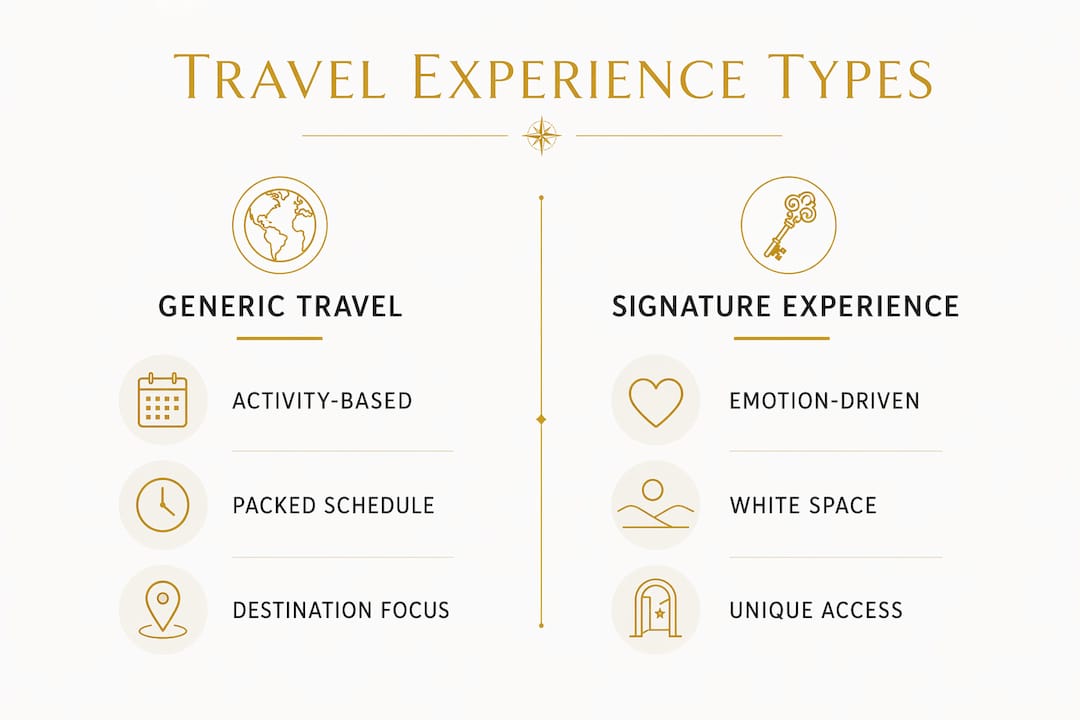
The gap between a signature experience and a standard vacation is not a matter of budget. It is a matter of design intent.
| Dimension | Generic travel | Signature experience |
|---|---|---|
| Structure | Activity-based schedule | Emotional promise as the spine |
| Group size | Large or open | Small, curated groups |
| Access | Public or standard | Rare, behind-the-scenes, or community-led |
| Storytelling | Incidental | Deliberately designed |
| White space | Unplanned | Intentionally protected |
| Outcome | Sights visited | Transformation experienced |
Generic travel fills time. A signature experience shapes it. Travelers on a standard tour describe where they went; travelers on a bespoke luxury journey describe who they became or what they felt. That distinction drives every referral, every repeat booking, and every five-star review a tourism business earns.
Private Grand Canyon tours from operators like Grand Canyon Journeys illustrate the contrast well: a small-group, expert-guided experience of the canyon’s rim bears little resemblance to a crowded bus tour of the same viewpoint.
Grandglobetrotting brings signature travel within reach
Planning a genuinely signature trip takes more than a good itinerary template. It requires deep vendor relationships, insider access, and the kind of concierge attention that turns a well-organized vacation into an experience worth telling people about for years.
Grandglobetrotting specializes in exactly that. Rather than offering a catalog of pre-packaged tours, the team builds bespoke itineraries around each client’s specific emotional goals, whether that means a multi-generational family reunion in the Italian countryside, a honeymoon with private access to remote natural wonders, or a solo adventure designed around a lifelong passion. Every detail, from private flights and exclusive hotel access to curated excursions and dining reservations, is handled with a high-touch concierge approach that removes the research burden entirely. Start planning your signature trip by visiting Grandglobetrotting’s travel planning service and booking a consultation today.
Key Takeaways
A signature travel experience is defined by its emotional promise, intentional design, and rare access, not by price or destination alone.
| Point | Details |
|---|---|
| Emotional promise first | Every signature trip is built around a clear transformation, not a geography or duration. |
| 3–5 marquee moments | Deliberately planting standout story moments drives satisfaction and referrals. |
| White space is essential | Protected, unscheduled time allows travelers to internalize and connect with the experience. |
| Guides shape the outcome | Well-trained frontline guides are the single most critical factor in delivering a memorable experience. |
| Grandglobetrotting | Builds fully bespoke, high-touch itineraries around each client’s emotional goals, from exclusive excursions to private flights. |
Recommended
At Grand Globetrotting, we don't just plan vacations; we craft extraordinary adventures that leave you with cherished memories. Let us bring your dream vacation to life, perfectly tailored to your style, and immerse yourself in a world of luxury, exploration, and unforgettable moments. Your journey begins with us.
Itinerary planning services require a separate charge outside of cost to book travel accommodations. Depending upon the complexity of the itinerary and the level of effort required to acquire unique experiences, cost may vary. Speak with our team to learn more.
Book your consultation