

TL;DR:
- Effective luxury business trip planning requires clear objectives, detailed preferences, and compliance considerations.
- Building a personalized, flexible itinerary with technology enhances efficiency and minimizes disruptions.
- Securing vetted accommodations, transport, and safety protocols ensures a productive and professional trip.
A poorly planned executive trip does not just cost time. It costs deals, relationships, and credibility. When a confirmation goes missing, a hotel falls short of expectations, or a schedule collapses under the pressure of back-to-back meetings, the ripple effects reach far beyond the trip itself. For corporate executives, business travel is a strategic tool, not a logistical formality. This guide walks you through a structured, step-by-step approach to luxury business trip planning, from defining objectives and building bespoke itineraries to securing top-tier accommodations and verifying every last detail before departure.
Table of Contents
- Assessing requirements and setting objectives
- Building the personalized luxury itinerary
- Securing accommodations and travel logistics
- Final verification and communication protocols
- Beyond checklists: What executives overlook in luxury trip planning
- Upgrade your next executive business trip
- Frequently asked questions
Key Takeaways
| Point | Details |
|---|---|
| Define trip objectives | Begin every luxury business trip by clarifying primary goals, traveler priorities, and compliance requirements. |
| Build a detailed itinerary | Develop a mobile-friendly, comprehensive itinerary including local times, contacts, confirmations, and route approvals. |
| Prioritize safety and personalization | Book luxury accommodations and transport with clear duty of care, verified safety protocols, and tailor experiences to all stakeholders. |
| Verify and communicate | Double-check all documentation, establish contingency protocols, and maintain open lines with clients and team members. |
Assessing requirements and setting objectives
Every successful executive trip begins well before any booking is made. The foundation is a clear picture of what the trip needs to accomplish and what standards of comfort and efficiency you expect along the way.
Start by defining your business objectives. Are you closing a deal, nurturing a key client relationship, attending a high-profile conference, or scouting a new market? The purpose shapes everything, from destination selection to the pace of your schedule. Without this clarity, even the most luxurious itinerary can feel misaligned.
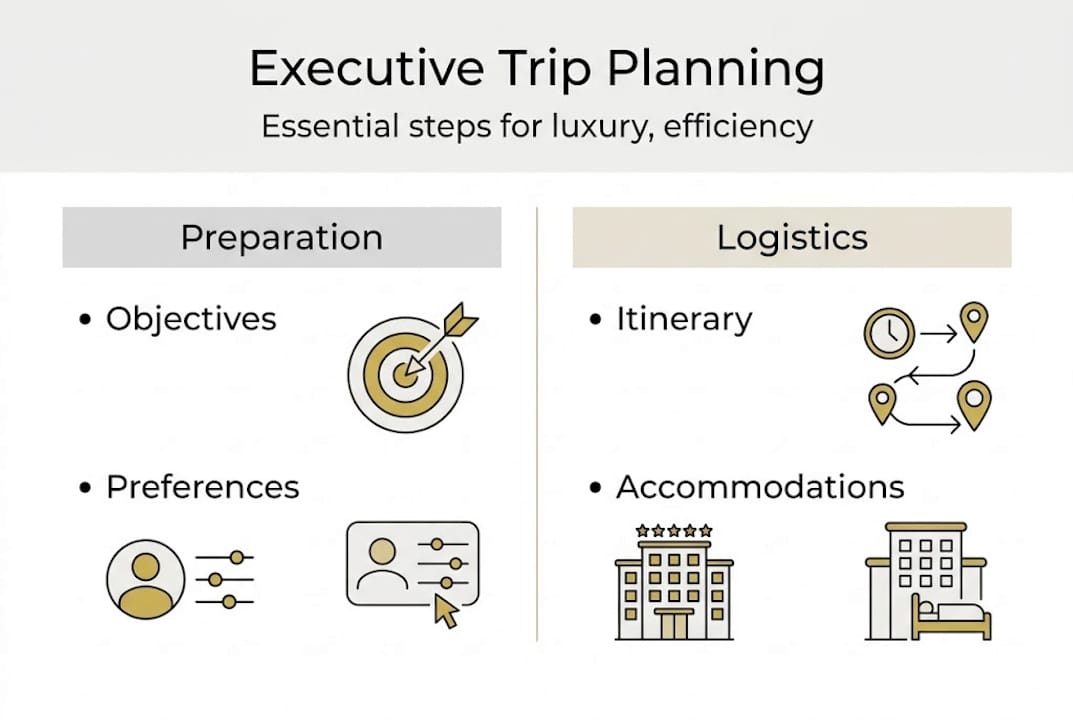
Once objectives are set, document your traveler preferences with precision. This means more than just noting a preference for business class. It includes suite configurations, dietary requirements, preferred airline alliances, ground transport standards, and even ambient preferences like quiet floors or city-view rooms. These details are the difference between a functional trip and a truly productive one.
You will also want to capture all compliance requirements upfront. Most organizations require route approvals, spend thresholds, and vendor agreements to be respected. The challenge is that rigid travel policies frustrate travelers, with non-compliance averaging 42% across organizations. The smarter approach is to balance policy structure with flexibility, using technology to enforce guardrails without sacrificing executive autonomy or productivity.
Here is a quick snapshot of the key requirements to document before planning begins:
| Requirement | Details to capture |
|---|---|
| Business objectives | Meetings, client goals, deliverables |
| Traveler preferences | Airline, hotel tier, transport, dining |
| Compliance needs | Route approvals, spend limits, vendor rules |
| Risk considerations | Contingency contacts, travel insurance |
| Schedule constraints | Time zones, buffer periods, return deadlines |
With these elements documented, you can build a step-by-step luxury itinerary that actually serves your goals. Consider using real-time itinerary management platforms that sync across devices and allow live updates, so your team and travel advisor are always working from the same information.
Key items to assess before any booking:
- Primary business goals and client touchpoints
- Personal comfort preferences and non-negotiables
- Internal policy requirements and approval chains
- Risk profile of the destination
- Communication needs for stakeholders at home
Pro Tip: Share your documented requirements with your travel advisor before any planning begins. Advisors who specialize in executive travel itineraries can match your preferences to exclusive inventory that never appears on standard booking platforms.
Building the personalized luxury itinerary
With requirements clearly defined, the next step is constructing an itinerary that delivers both luxury and efficiency in equal measure. This is where planning becomes an art form.
A well-built executive itinerary is not just a schedule. It is a living document that accounts for time zones, buffer periods, client preferences, contingency options, and the subtle details that make a trip feel effortless. The goal is to anticipate every variable before it becomes a problem.
Follow these steps to build a bespoke, mobile-friendly itinerary:
- Map your core commitments first. Block meetings, client dinners, and conference sessions before anything else.
- Layer in travel segments. Add flights, transfers, and check-in times with realistic buffers between each.
- Integrate local context. Note local time zones, public holidays, and cultural considerations that may affect scheduling.
- Add all confirmations and contacts. Include hotel reservation numbers, airline booking references, driver contacts, and venue addresses.
- Build in contingency options. Identify backup flights, alternative dining venues, and emergency contacts for each destination.
- Review for compliance. Confirm route approvals are in place and spend allocations are within policy.
A comprehensive business travel documentation approach means your itinerary includes local times, all contacts, and full confirmations, with a separate risk contingency pack attached.
Choosing the right tools matters. Here is how traditional and digital itinerary methods compare:
| Feature | Traditional (paper/email) | Digital platform |
|---|---|---|
| Real-time updates | No | Yes |
| Mobile access | Limited | Full |
| Geo-tagging | No | Yes |
| Team sharing | Manual | Instant |
| Contingency alerts | No | Automated |
Digital platforms win on every dimension that matters for executive travel. They allow geo-tagged sharing, which is especially useful when coordinating with clients or local teams across multiple cities. Explore the customized itinerary process to see how a professional advisor structures these documents for maximum impact.
For a broader view of how personalization elevates the entire planning experience, the ultimate luxury travel planning guide offers a strong reference point. And if you are evaluating platforms, reviewing itinerary management benefits will help you choose the right fit.
Pro Tip: Use geo-tagged itinerary sharing to keep clients and colleagues informed of your location and schedule in real time. It reduces coordination friction and signals a level of professionalism that clients notice.
Securing accommodations and travel logistics
With your itinerary finalized, attention turns to the crucial next step: arranging top-tier accommodations and logistics that support both comfort and safety.
Choosing the right hotel is not simply about star ratings. For executive travel, the right property aligns with your work style, proximity to key meetings, and the impression it creates when hosting clients. A suite with a dedicated workspace, reliable high-speed connectivity, and discreet concierge access can meaningfully improve your output during the trip.
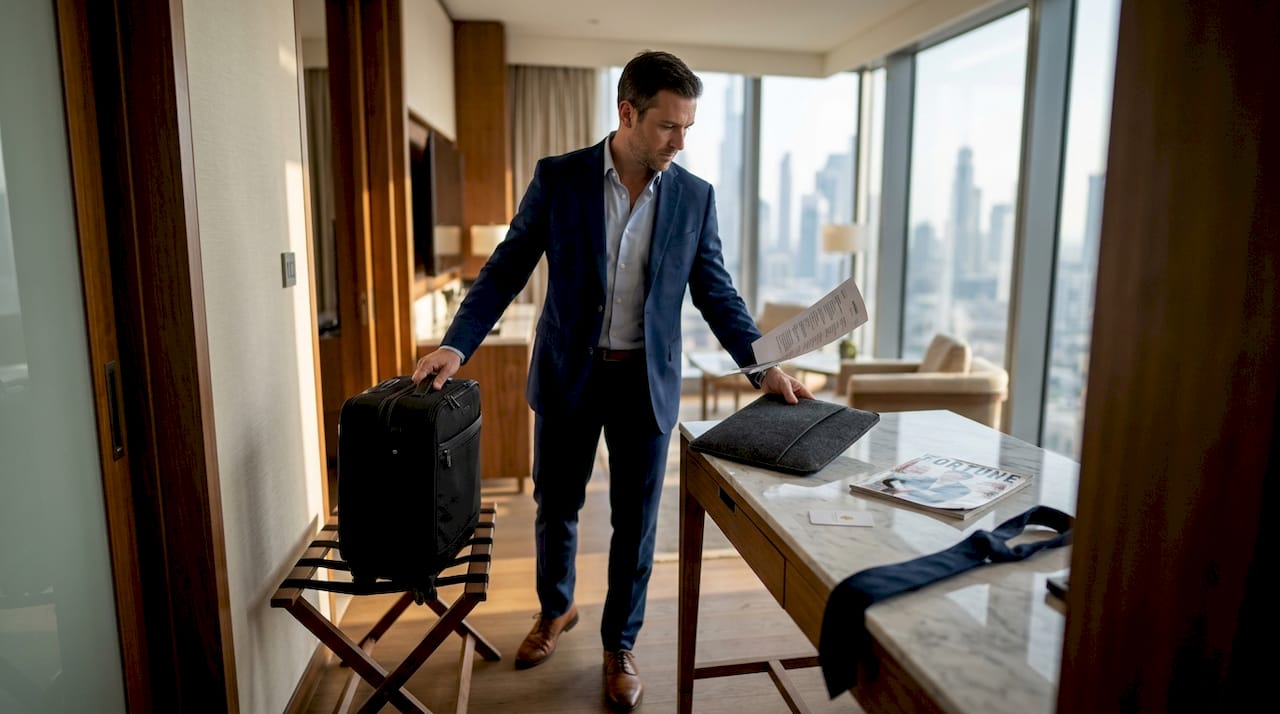
When booking flights, first and business class are standard for executive travel, but the details matter beyond the seat. Consider airline lounges at layover airports, direct routing to minimize transit fatigue, and preferred departure times that protect your energy for high-stakes meetings.
Ground transport deserves equal attention. Private car services with professional drivers, pre-arranged airport transfers, and vetted local transport options eliminate the unpredictability that erodes executive productivity.
Safety and duty of care are non-negotiable. 89% of organizations have a formal travel safety policy, and 44% of executives prioritize safety over price when making travel decisions. This is especially relevant in unfamiliar destinations or regions with elevated risk profiles.
Safety note: Always confirm that your accommodations and transport providers are vetted against your organization’s duty of care standards. Carry emergency contact information, travel insurance documentation, and destination-specific risk advisories in your travel pack.
Key considerations when securing luxury travel logistics:
- Verify hotel proximity to all meeting venues
- Confirm suite amenities: workspace, connectivity, and privacy
- Book preferred airline with direct or minimal-connection routing
- Pre-arrange all ground transport with licensed, vetted providers
- Confirm travel insurance coverage for the full trip duration
- Review destination safety advisories and risk ratings
For guidance on selecting properties that match executive standards, explore these luxury hotel selection tips or browse curated options directly through book luxury hotels. For a broader understanding of what sets high-end travel apart, the luxury travel guide is a useful reference.
Luxury accommodations are not an indulgence. They are a productivity tool. When you sleep well, work comfortably, and move efficiently between engagements, the quality of every client interaction improves.
Final verification and communication protocols
After securing logistics, it is essential to finalize and verify every detail to ensure a flawless business trip. This stage is where many executives lose ground, assuming everything is in order without confirming it.
Follow this verification sequence before departure:
- Confirm all bookings. Cross-check hotel, flight, and transport confirmations against your itinerary.
- Verify route approvals. Ensure all travel segments have been approved per internal policy.
- Distribute the itinerary. Share the final document with your executive assistant, travel advisor, and relevant stakeholders.
- Test all contact details. Call or message driver contacts, hotel concierge, and local coordinators to confirm readiness.
- Review the risk pack. Confirm emergency contacts, travel insurance details, and contingency options are current and accessible.
A well-documented travel pack includes mobile-friendly itinerary access, all confirmations, local contacts, and a separate contingency section for route disruptions or emergencies.
Contingency protocol: Establish a rapid-response communication chain before departure. Identify who handles rebooking, who contacts clients in case of delay, and what the fallback options are for each leg of the trip. Speed of response during disruptions protects both your schedule and your professional reputation.
Best practices for executive travel communication:
- Brief your executive assistant on all trip details and approval contacts
- Set up automated travel alerts for flight status and hotel check-in
- Share a simplified version of the itinerary with clients you will be meeting
- Establish check-in protocols with your home office for multi-day trips
- Keep a digital and printed copy of all critical documents
For executives who want a fully managed approach, bespoke travel planning services handle verification and communication protocols as part of a white-glove concierge experience. Working with a luxury travel advisor ensures that nothing is left to chance, even when your schedule leaves no room for error.
Beyond checklists: What executives overlook in luxury trip planning
Most executives approach business travel with a checklist mindset. Book the flight. Reserve the hotel. Confirm the meetings. Check, check, check. But the trips that genuinely move the needle on client relationships and business outcomes are built on something checklists cannot capture: intentional personalization.
The data is clear. Rigid travel policies lead to non-compliance at an average rate of 42%, which means the cost-cutting logic behind strict rules often backfires. The executives who get the most from their travel invest in flexibility, not just structure. They think about the experience their client has when they walk into a carefully chosen restaurant. They consider how a well-rested, unhurried arrival shapes the tone of a negotiation.
Technology-enabled policies outperform rigid rules because they adapt to context. But technology alone is not enough. The real differentiator is the relationship between an executive and a skilled travel advisor who understands both the business goals and the personal preferences at play. That collaboration is where personalized luxury planning becomes genuinely strategic, and where high-end luxury travel insights translate into measurable results.
Pro Tip: Brief your travel advisor on the client you are meeting, not just the destination. The right advisor will use that context to recommend experiences and venues that strengthen the relationship before a single word of business is spoken.
Upgrade your next executive business trip
The strategies outlined here represent a proven framework for turning executive travel into a competitive advantage. But knowing the steps and executing them flawlessly are two very different things. That is where Grand Globetrotting comes in.
Grand Globetrotting specializes in personalized luxury travel planning for corporate executives who expect more from every trip. From curating bespoke itineraries and securing preferred luxury hotel selection to managing every verification detail and contingency protocol, the team handles it all with precision and discretion. Explore how personalizing luxury travel can transform your next business trip into an experience that delivers results well beyond the boardroom.
Frequently asked questions
What are the most common mistakes in luxury business trip planning?
Executives often skip thorough itinerary verification and fail to build flexibility into their travel policies, which drives non-compliance averaging 42% and reduces overall trip efficiency.
How can executives ensure duty of care and safety during business travel?
With 89% of organizations holding formal safety policies, executives should prioritize vetted accommodations, approved routes, and a prepared risk contingency pack for every trip.
What technology streamlines luxury business trip planning?
Mobile-friendly itinerary platforms with geo-tagging and real-time alerts allow executives and their teams to stay aligned, as comprehensive digital documentation significantly reduces coordination errors.
How can executives personalize business trips to optimize client relationships?
Bespoke itineraries that incorporate client preferences, curated dining, and exclusive experiences create high-value touchpoints that strengthen relationships far more effectively than standard corporate travel arrangements.
Recommended
- Designing executive travel itineraries for productive trips
- Personalized luxury travel: the ultimate planning guide
- Create your step-by-step luxury itinerary for 2026
- Why use itinerary management for luxury travel in 2026
- Master the Personalized Event Planning Process for Luxury Occasions – Winelands Function – For Every Occasion, Your Celebration
At Grand Globetrotting, we don't just plan vacations; we craft extraordinary adventures that leave you with cherished memories. Let us bring your dream vacation to life, perfectly tailored to your style, and immerse yourself in a world of luxury, exploration, and unforgettable moments. Your journey begins with us.
Itinerary planning services require a separate charge outside of cost to book travel accommodations. Depending upon the complexity of the itinerary and the level of effort required to acquire unique experiences, cost may vary. Speak with our team to learn more.
Book your consultation